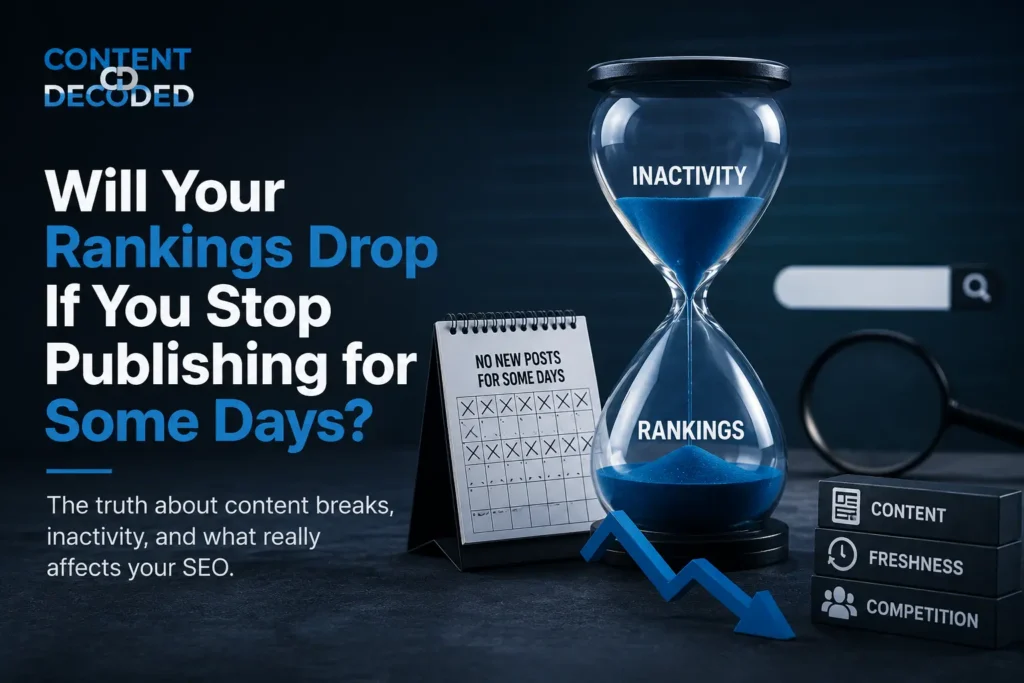
Will Your Rankings Drop If You Stop Publishing for Some Days?
No, rankings will not drop if you stop publishing the blog for some days.
Many bloggers and website owners worry that their rankings will drop the moment they stop publishing for a few days. This fear usually comes from seeing large websites post new content constantly, which makes it seem like daily activity is necessary to stay visible on Google.
But SEO does not work like that.
Google does not rank websites just because they publish every day. It mainly ranks pages based on how useful, relevant, and valuable they are for users. If your existing content still answers the search properly, a short break from publishing usually changes very little, especially for evergreen websites.
At the same time, some niches depend heavily on fresh content, and long periods of inactivity can slowly affect rankings. So the real answer depends on what type of content you publish and how competitive your niche is.
Why Rankings Usually Don’t Drop for Evergreen Websites
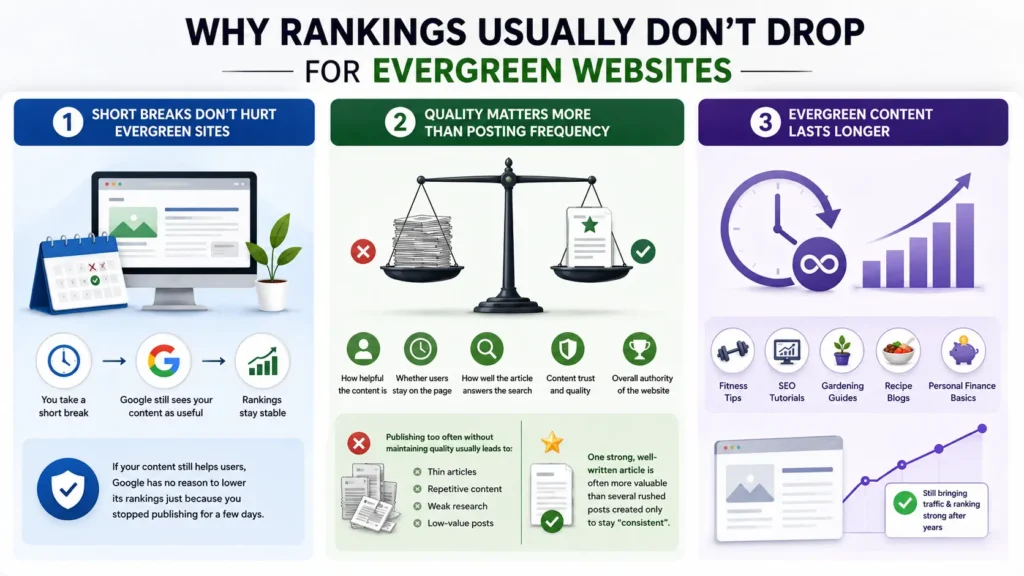
For evergreen websites, short breaks usually do not affect rankings because evergreen content stays useful for a long time. Topics like SEO tips, fitness guides, recipes, blogging tutorials, or personal finance basics continue getting searches for months or even years.
If an article still helps users, Google has no reason to suddenly lower its rankings just because you stopped publishing for a few days.
Quality Matters More Than Posting Frequency
Google cares far more about content quality than how often you publish. A website does not rank higher simply because it posts every day.
Google mainly looks at:
- How helpful the content is
- Whether users stay on the page
- How well the article answers the search
- Content trust and quality
- Overall authority of the website
Publishing too often without maintaining quality usually leads to:
- Thin articles
- Repetitive content
- Weak research
- Low-value posts
That is why one strong, well-written article is often more valuable than several rushed posts created only to stay “consistent”.
Evergreen Content Lasts Longer
Unlike news content, evergreen content does not become outdated quickly.
Topics like:
- Weight loss tips
- Home workouts
- SEO tutorials
- Gardening guides
- Recipe blogs
can continue bringing traffic for years because people keep searching for them regularly.
That is why many older articles still rank strongly even without constant updates.
When Breaks Can Affect Rankings
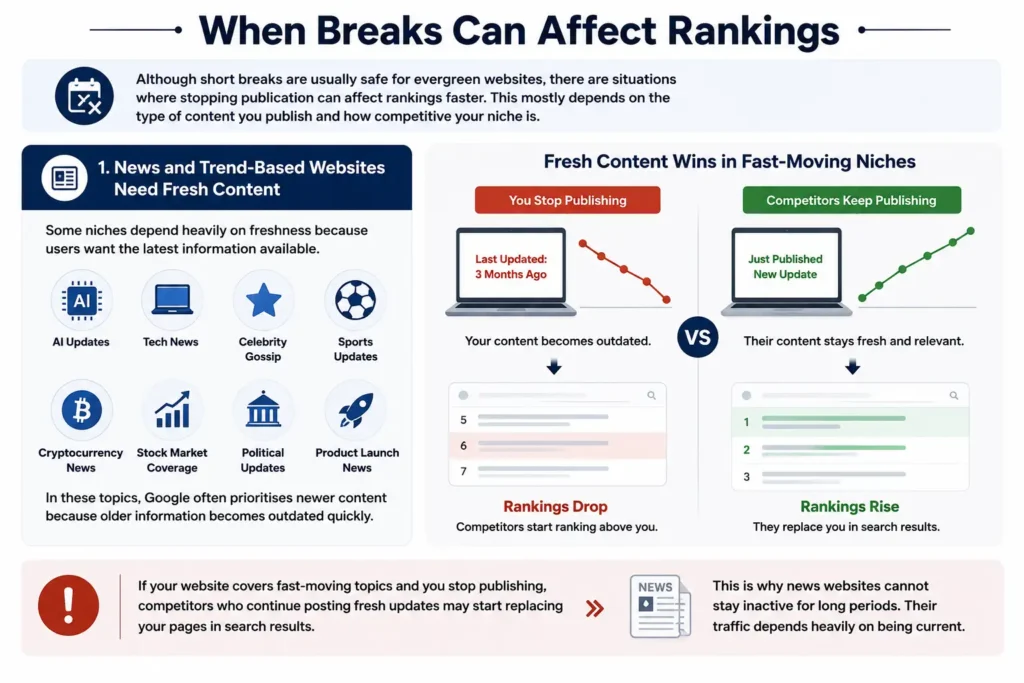
Although short breaks are usually safe for evergreen websites, there are situations where stopping publication can affect rankings faster.
This mostly depends on the type of content you publish and how competitive your niche is.
News and Trend-Based Websites Need Fresh Content
Some niches depend heavily on freshness because users want the latest information available.
For example:
- AI updates
- Tech news
- Celebrity gossip
- Sports updates
- Cryptocurrency news
- Stock market coverage
- Political updates
- Product launch news
In these topics, Google often prioritises newer content because older information becomes outdated quickly.
If your website covers fast-moving topics and you stop publishing, competitors who continue posting fresh updates may start replacing your pages in search results.
This is why news websites cannot stay inactive for long periods. Their traffic depends heavily on being current.
Competitors Continue Improving Their Content
One of the biggest reasons rankings drop over time is not because Google punishes silence but because competitors continue improving while your content stays unchanged.
While you are inactive, competitors may:
| What Competitors Improve | How It Affects Rankings |
| Add updated statistics | Makes their content look fresher |
| Improve article design | Better user experience |
| Add videos or images | Keeps users engaged longer |
| Update titles with new year. | Increases click rate |
| Expand content depth | Covers more user questions |
| Improve internal linking | Strengthens page authority |
Over time, Google may start seeing those pages as more useful than yours.
That is why long-term inactivity becomes risky, especially in competitive niches.
Content Naturally Gets Older
Even evergreen content needs occasional maintenance.
Over time:
- Facts become outdated
- Links stop working
- Screenshots no longer match tools
- Statistics lose relevance
- Older titles attract fewer clicks
This process is often called content decay, but the idea is simple: older content slowly loses strength if it is never refreshed.
That does not mean rankings collapse immediately. Usually the decline happens slowly over months, not days.
Beyond Google: How Breaks Affect AI Citations
As AI search tools and chat-based platforms become more common, freshness and expertise are starting to matter beyond traditional Google rankings.
AI systems usually prefer sources that show strong Experience, Expertise, Authority, and Trustworthiness (EEAT). Websites that regularly update content, maintain accurate information, and continue showing real expertise are more likely to be referenced as reliable sources.
This does not mean you need to publish every day, but long periods of inactivity combined with outdated content can reduce how often your website gets cited in AI-generated answers over time.
What Actually Happens When You Stop Publishing?
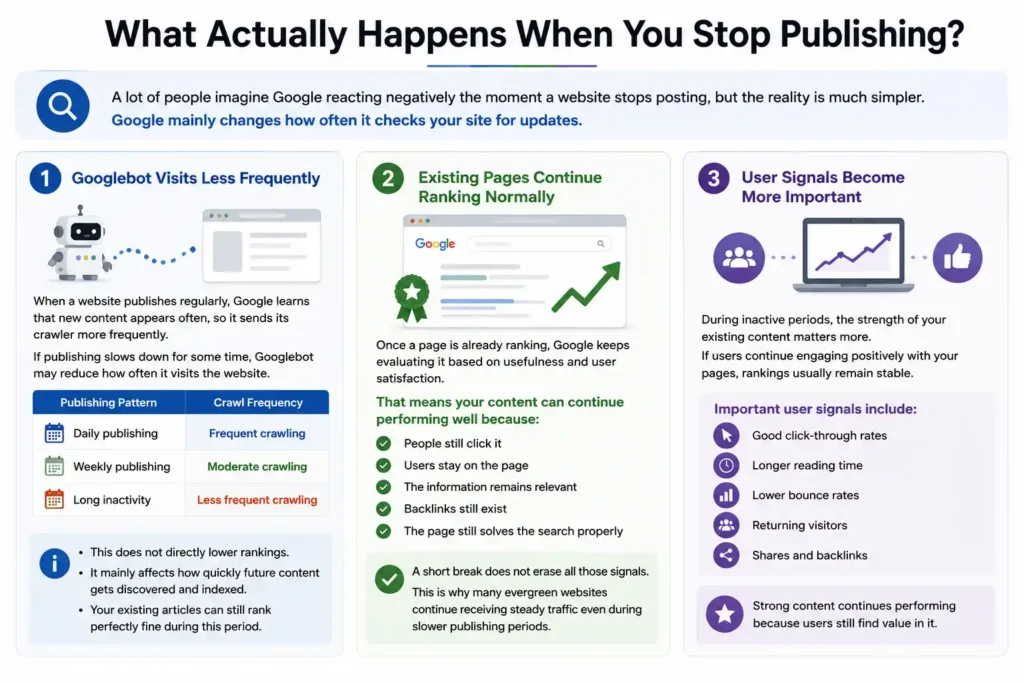
A lot of people imagine Google reacting negatively the moment a website stops posting, but the reality is much simpler.
Google mainly changes how often it checks your site for updates.
Googlebot Visits Less Frequently
When a website publishes regularly, Google learns that new content appears often, so it sends its crawler more frequently.
If publishing slows down for some time, Googlebot may reduce how often it visits the website, which may cause problems like the page showing the ‘discovered but currently not indexed‘ status and indexing becoming slow.
For example:
| Publishing Pattern | Crawl Frequency |
| Daily publishing | Frequent crawling |
| Weekly publishing | Moderate crawling |
| Long inactivity | Less frequent crawling |
This does not directly lower rankings.
It mainly affects how quickly future content gets discovered and indexed.
Your existing articles can still rank perfectly fine during this period.
Existing Pages Continue Ranking Normally
Once a page is already ranking, Google keeps evaluating it based on usefulness and user satisfaction.
That means your content can continue performing well because:
- People still click it
- Users stay on the page
- The information remains relevant
- Backlinks still exist
- The page still solves the search properly
A short break does not erase all those signals.
This is why many evergreen websites continue receiving steady traffic even during slower publishing periods.
User Signals Become More Important
During inactive periods, the strength of your existing content matters more.
If users continue engaging positively with your pages, rankings usually remain stable.
Important user signals include:
- Good click-through rates
- Longer reading time
- Lower bounce rates
- Returning visitors
- Shares and backlinks
Strong content continues performing because users still find value in it.
Note – Crawl frequency takes a few days to return to normal once you start posting again.
Publishing Daily Does Not “Boost” Rankings
One common SEO myth is that constantly “pinging” Google with new content automatically improves rankings. That is not true.
Publishing a new post, updating a sitemap, or requesting indexing simply tells Google something changed on your website. It is basically an invitation for Googlebot to check the page. The rankings still depend on content quality, usefulness, and relevance.
Consistency mainly affects how often Google crawls your website, not how highly it ranks your pages.
For example:
| Action | Effect on Rankings | Effect on Googlebot |
| Publishing daily | No direct ranking boost | Faster crawling and indexing |
| Taking a short break | Usually no ranking impact | Slower crawl frequency |
| Updating old content | Positive impact possible | Re-evaluates the page |
| Publishing low-quality posts daily | Can hurt SEO | Creates content bloat |
Consistency is more useful for building audience habits than improving rankings directly. Readers may return regularly if they know you publish on specific days, but Google still cares far more about the quality of the content than the publishing frequency.
That is why one strong article is usually more valuable than several rushed posts created only to “stay active”.
A Smarter SEO Strategy During Breaks
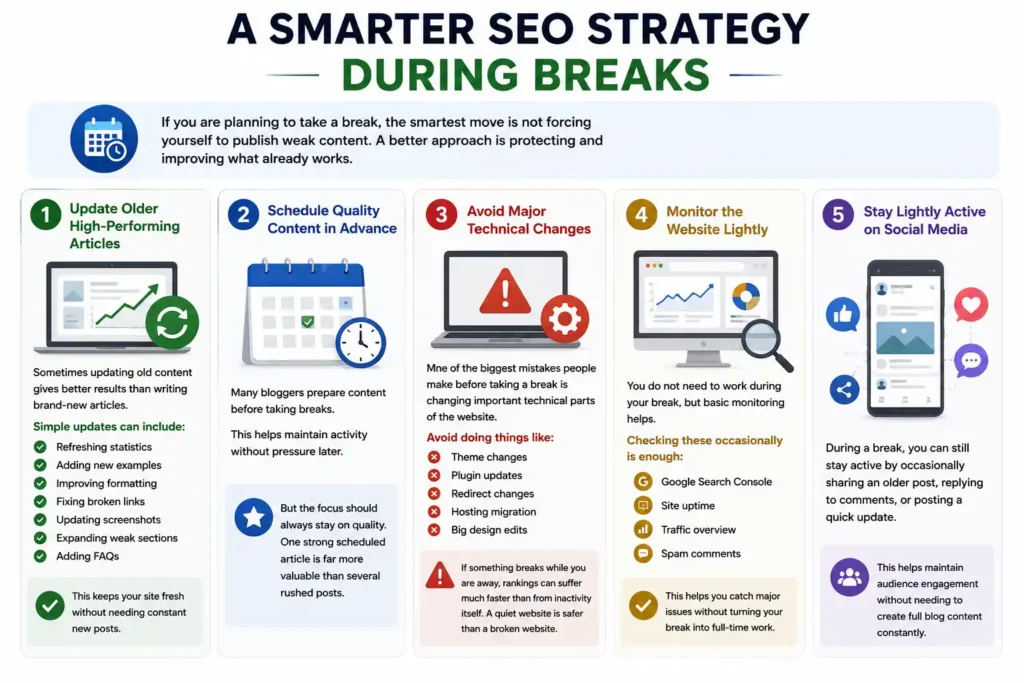
If you are planning to take a break, the smartest move is not forcing yourself to publish weak content. A better approach is protecting and improving what already works.
Update Older High-Performing Articles
Sometimes updating old content gives better results than writing brand-new articles.
Simple updates can include:
- Refreshing statistics
- Adding new examples
- Improving formatting
- Fixing broken links
- Updating screenshots
- Expanding weak sections
- Adding FAQs
This keeps your site fresh without needing constant new posts.
Schedule Quality Content in Advance
Many bloggers prepare content before taking breaks.
This helps maintain activity without pressure later.
But the focus should always stay on quality. One strong scheduled article is far more valuable than several rushed posts.
Avoid Major Technical Changes
One of the biggest mistakes people make before taking a break is changing important technical parts of the website.
Avoid doing things like:
- Theme changes
- Plugin updates
- Redirect changes
- Hosting migration
- Big design edits
If something breaks while you are away, rankings can suffer much faster than from inactivity itself.
A quiet website is safer than a broken website.
Monitor the Website Lightly
You do not need to work during your break, but basic monitoring helps.
Checking these occasionally is enough:
- Google Search Console for keyword research, traffic checking and many more.
- Site uptime
- Traffic overview
- Spam comments
This helps you catch major issues without turning your break into full-time work.
Stay Lightly Active on Social Media
During a break, you can still stay active by occasionally sharing an older post, replying to comments, or posting a quick update. This helps maintain audience engagement without needing to create full blog content constantly.
The “Break Timeline” Most Evergreen Sites Experience
Here is a realistic idea of how breaks usually affect evergreen websites.
| Time Without Publishing | Typical Impact |
| 1–7 Days | Usually no impact at all |
| 8–14 Days | Slight reduction in crawl frequency |
| 15–30 Days | Minor freshness disadvantage possible |
| 1–3 Months | Competitors may begin overtaking some pages |
| 3–6 Months | Older content may start weakening |
| 6+ Months | Stronger ranking decline becomes possible |
This timeline changes depending on your niche, content quality, and competition level, but for most evergreen websites, short breaks are very safe.
The Real Danger Is Burnout, Not Taking a Break
Many creators become so obsessed with consistency that they eventually damage their own content quality.
Writing while exhausted usually creates:
- Repetitive articles
- Weak research
- Generic advice
- Poor structure
- Low-energy writing
Readers notice this very quickly.
And once users stop enjoying the content, rankings often begin falling naturally.
A rested creator usually writes better content, researches more deeply, and brings stronger ideas to the table.
Sometimes stepping away from work for a few days actually improves long-term SEO because the quality becomes better after returning.
Focus on Building a Library, Not a Newspaper
This is one of the healthiest ways to think about SEO.
There are two types of websites:
| Website Type | How It Works |
| Newspaper Style | It depends on constant fresh updates |
| Library Style | Builds long-term evergreen value |
If your website focuses on evergreen content, your goal should be building a library full of useful resources that continue helping people for years.
That type of content keeps working even when you take short breaks.
Final Thoughts
If you run an evergreen website, taking a short break from publishing is usually not a problem. What matters far more is whether your existing content continues helping users better than competing pages.
Instead of stressing about posting constantly, focus on building strong articles that stay useful for a long time. A well-written guide with regular updates will almost always perform better than rushed content published only to stay “active”.
A smarter long-term strategy is simple:
- Publish when you have real value to add
- Update important older content regularly
- Avoid low-quality filler posts
- Take breaks before burnout affects your work quality
In SEO, consistency matters, but sustainable quality matters even more.
 Add Content Decoded as a preferred source