How Google Selects AI Overview Sources: The Logic Behind the Summary
Google selects AI Overview sources by retrieving top-ranking pages, extracting the most relevant and self-contained passages, verifying facts across multiple sources, and prioritising content that is clear, structured, trustworthy, and adds unique value beyond what already exists.
If you strip everything down to its core, Google’s AI Overview works like a fast, multi-source research system powered by Retrieval-Augmented Generation (RAG)—a process Google calls grounding, which anchors AI answers in live web index results.
- It pulls content from top-ranking pages (76.1% of cited URLs come from the Top 10)
- It extracts only the most useful, answer-ready sections
- It cross-checks facts across multiple sources to ensure accuracy
- It prioritizes information gain, not repetition
- It cites sources that are easy to read, verify, and trust
The real goal is simple but demanding: deliver the most complete, direct, and verified answer in the least amount of time.
Step-by-Step: How Google Builds an AI Overview
Step 1: Query Understanding & Trigger

Everything begins with intent classification, and this step is far more nuanced than it appears.
Google’s system evaluates whether the query actually needs synthesis. For example, a simple query like “weather today” does not require multiple sources, but a query like “best diet for fat loss and muscle gain” clearly does.
At this stage, the system determines:
- Whether the query is multi-intent or layered
- Whether a single source can answer it sufficiently
- Whether combining multiple perspectives would improve accuracy
Only when the system detects complexity does it trigger the AI Overview layer.
Step 2: Candidate Pool Retrieval
Once triggered, Google performs a traditional search in the background and builds what can be called a candidate pool.
This pool typically includes:
- Top 10–20 ranking pages
- Pages with strong topical relevance
- Recently updated or fresh content
It’s important to understand that this stage still relies heavily on traditional SEO signals. In fact, industry data shows that 76.1% of AI Overview citations come from pages already ranking in the Top 10, which confirms that ranking is still a prerequisite, just not the final deciding factor.
Step 3: Passage Extraction
Here’s where the process starts to diverge sharply from traditional search.
The AI does not evaluate entire pages. Instead, it extracts specific passages that can function independently.
These include:
- Direct answer paragraphs
- Structured lists
- Tables with clear comparisons
- Concise explanatory sections
This is why “information islands” matter. A single well-written paragraph that fully answers a question can outperform an entire 2,000-word article filled with scattered insights.
Step 4: Semantic Re-Ranking


After extraction, the system evaluates each passage based on how effectively it contributes to the final answer.
This is where information gain becomes a dominant factor.
Instead of asking, “Which is best overall?”, the system asks:
- Which passage adds something new?
- Which one improves clarity?
- Which one fills a missing gap in the answer?
Content that simply repeats existing information starts losing value rapidly at this stage.
Step 5: Cross-Verification (Consensus Check)


Before anything is included in the final answer, Google performs a consensus-based validation.
The system compares claims across multiple sources:
- If several sources agree → the information is considered reliable
- If a claim appears in only one source → it is treated cautiously
- If sources conflict → the system may exclude or soften the claim
This step is fundamental because the core objective of AI Overviews is not just speed but verified accuracy.
Step 6: Synthesis (Answer Creation)


Once validated, the AI generates the final response.
This is not a simple aggregation. It is a structured synthesis that:
- Combines overlapping facts into a single statement
- Integrates unique insights where relevant
- Maintains logical flow and readability
The output is designed to feel like a complete answer, not a stitched-together summary.
Step 7: Attribution & Display


Finally, the system maps each part of the answer back to its source.
- Citations are attached to specific claims or sections
- These appear as clickable references in the interface
At this point, something subtle but powerful happens:
a citation becomes a trust signal, not just a link.
Users can also mark helpful sites as preferred sources, which can make those sites appear higher for them in future searches—including in AI Overviews—when the content is relevant.
Ranking Factors for AI Overview (Not the Same as SEO)

The weighting of factors in AI overviews is noticeably different from traditional ranking systems.
High Priority Factors
These directly influence whether your content is selected and cited.
- Information Gain
Content that introduces new insights, data, or perspectives has a disproportionate advantage because it reduces redundancy in the final answer. - Semantic Completeness
Passages must be able to stand alone and fully answer a question without relying on surrounding context. - E-E-A-T (Experience, Expertise, Authority, Trust)
This becomes especially strict for YMYL topics such as health and finance. In these cases, Google often requires a clear, verifiable author entity and credentials linked to real expertise before citing content. - Clarity and Structure
Well-organised content with clean formatting significantly improves extractability.
Medium Priority Factors
These influence eligibility and consistency rather than direct selection.
- Page Speed and Crawlability
Slow or poorly optimised sites may not be crawled frequently enough to surface fresh insights. - Mobile Usability
Since most interactions are mobile-first, poor responsiveness reduces trust in cited sources. - Content Hierarchy (Headings and Semantic HTML)
Helps the system understand relationships between sections and ideas. - Meta Tags
Meta tags like meta descriptions, URLs, slugs, and meta titles help signal relevance and context, but they are not direct ranking factors for AI overviews.
Low Priority Factors
These still matter but have minimal direct impact on citation.
- Visual Design and Aesthetics
The AI does not interpret visual appeal the way users do. - Traditional Engagement Metrics
Metrics like bounce rate are less relevant compared to content clarity and usefulness.
Ignored or Deprioritised Factors
These have significantly reduced importance in AI selection.
| De-Prioritized Factor | What Replaces It |
| Domain Authority (DA/PA) | Topical authority and expertise in a niche |
| Backlink Quantity | Relevance and credibility of mentions |
| Exact Keyword Matching | Semantic understanding and intent alignment |
| High Word Count | Information density and clarity |
| Organic Rank #1 | Information gain and extractability |
llms.txt Files / Markdown Mirrors | Standard crawlable HTML; Google treats these files normally, giving them no special algorithmic weight |
| Special AI Schema Markup | Standard Schema.org markup; there is no unique schema required for generative AI features |
What AI Overview Actually “Sees”
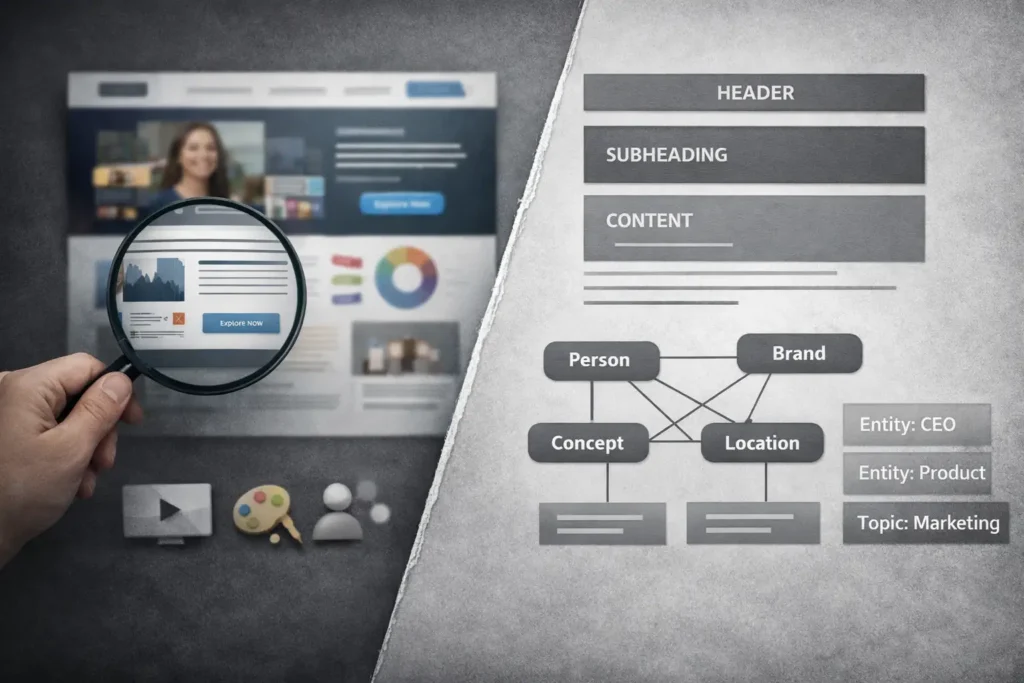
One of the biggest misconceptions is assuming the AI reads content the way humans do.
It doesn’t.
Instead, it processes content in a structured, almost mechanical way, focusing on:
- Clearly defined text blocks
- Logical section hierarchy
- Explicit entity mentions (people, brands, concepts)
- Relationships between ideas
It largely ignores:
- Visual design elements
- Animations and interactive components
- Complex layouts and scripts
In effect, the AI interprets your page more like a structured dataset than a visual experience.
Role of Query Fan-Out
For complex queries, Google often performs multiple sub-searches simultaneously, a process known as query fan-out.
Instead of relying on a single result set, the system breaks the query into smaller components, such as:
- Definitions
- Comparisons
- Subtopics
- Edge cases
This allows the AI to assemble a more complete answer by pulling the best source for each component.
The implication is significant:
You do not need to dominate a broad keyword. You only need to be the best source for a specific part of the query.
Content Format That AI Overview Prefers
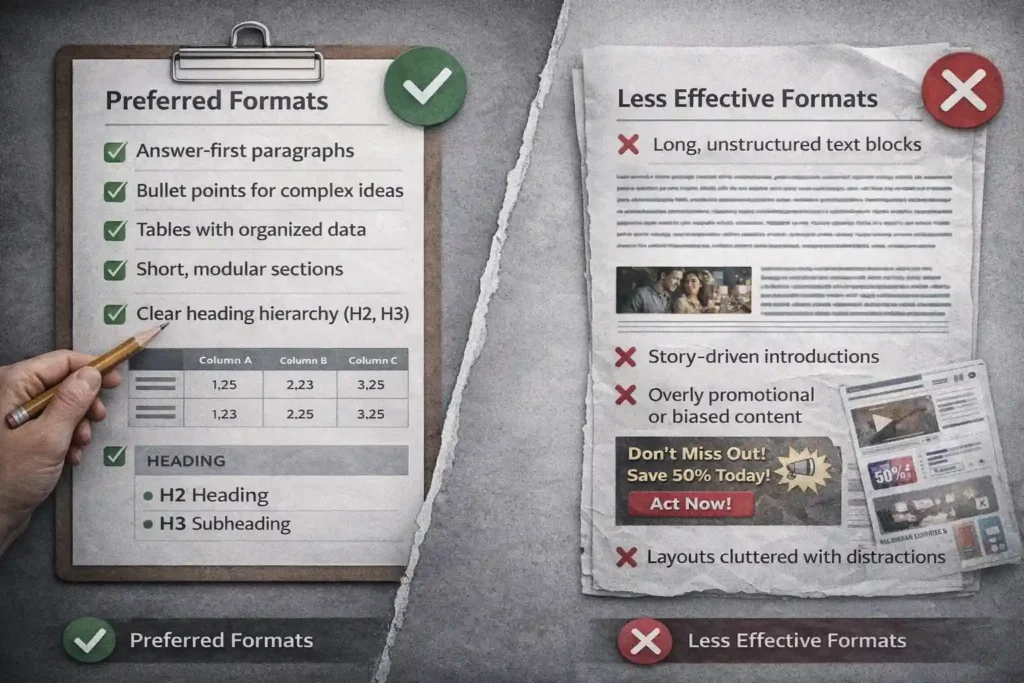
Structure plays a decisive role in whether your content is usable.
Preferred Formats
- Answer-first paragraphs that immediately address the query
- Bullet points that break down complex ideas
- Tables that organize comparisons and data
- Short, modular sections that function independently
- Clear heading hierarchy (H2, H3) that guides interpretation
Less Effective Formats
- Long, unstructured text blocks
- Story-driven introductions that delay the answer
- Overly promotional or biased content
- Layouts cluttered with distractions
That’s why writing content naturally automatically gives you ranking power in AI Overview.
Additional Real-World Dynamics You Should Know
The “Conversion Premium” Effect
There is a growing misconception that AI overviews simply reduce traffic due to zero-click behaviour. While total clicks may decline (with some reports indicating up to a 61% drop in CTR), the nature of traffic is changing.
Here are fixes for decline in clicks due to AI Overview.
Recent industry data from late 2025 and early 2026 (including insights from Ahrefs and Seer Interactive) highlights a different pattern:
- Users who click from an AI Overview are significantly more qualified
- These users are already convinced of your credibility because the AI has effectively “endorsed” your content
In fact, some datasets suggest that such users are up to 23 times more likely to convert compared to traditional organic visitors.
This turns a citation into something more powerful than visibility:
It becomes a trust badge, where the user arrives with pre-built confidence in your expertise.
This real-world dynamic underscores Google’s core advice to focus entirely on people-first, non-commodity content. When you design pages that leave a human visitor feeling genuinely satisfied and informed, you naturally optimize for the precise, high-intent criteria that triggers the AI Overview citation—and ultimately captures that high-converting traffic.
The “Citation Stability” Factor
Unlike traditional rankings, AI Overview citations are highly dynamic.
In fast-moving sectors such as finance or technology, citation positions can change within hours rather than weeks.
This happens because the following:
- New content with higher information gain can emerge quickly
- Fresh data can override older consensus
- The system continuously re-evaluates relevance and accuracy
This introduces a new challenge:
Maintaining a citation requires ongoing freshness, not just initial optimisation.
The Role of Brand Mentions (Even Without Links)
A 2026 study by Position Digital found a 0.664 correlation between branded mentions and AI Overview citations.
This suggests that:
- Being referenced across the web, even without backlinks, strengthens credibility
- The AI interprets repeated mentions as a signal of authority within a topic
This shifts part of the strategy from link-building to entity building.
The Rise of Agentic Experiences
Beyond simply synthesizing text for a user to read, modern search algorithms are preparing for AI agents—autonomous systems capable of executing multi-step tasks on behalf of a user, such as booking a reservation or comparing and helping to decide on live product specs through the ‘Ask’ button on a search result page.
Browser agents interact with your site mechanically rather than visually, analyzing your underlying DOM structure and your accessibility tree to map out actions. To ensure your site is built for this agentic shift:
- Prioritize Layout Stability: Avoid erratic layout shifts that could confuse vision-based AI models taking screenshots of your page.
- Maintain Clean Interactivity: Ensure interactive elements use true semantic HTML tags (like
<button>or<a>) instead of styled<div>elements so agents can easily navigate your funnels. - Watch Emerging Protocols: Keep an eye on open standards like the Universal Commerce Protocol (UCP), which aim to streamline how search agents interact with e-commerce checkouts.
Final Thought
AI Overviews are not designed to reward the most optimised page or the most powerful domain.
They are designed to deliver the most complete, direct, and verified answer possible, using multiple sources to reduce error and increase confidence.
That changes the goal entirely.
You are no longer competing to be the top result.
You are competing to be the most useful piece of the answer.
And in this system, usefulness is defined by clarity, originality, and trust—nothing else.
 Add Content Decoded as a preferred source