Exact Match Keywords In Your Content Do Not Guarantee Ranking
You followed what most SEO advice used to say. You placed the exact keyword in the title, added it in headings, and made sure it appeared again and again inside the content. On paper, everything looked optimised.
But rankings didn’t stay. Or worse, they never came at all.
This is where many website owners get stuck. They think they are missing some hidden trick when the real issue is much simpler and more fundamental.
Exact match keywords are no longer a reliable way to rank, and when you force them into your writing, they often reduce the overall quality of your content and your website.
Let’s go step by step and clear every confusion around this.
Why Exact Match Keywords Feel Important (But Aren’t Enough)
There was a time when search engines relied heavily on matching words exactly. If someone searched for a phrase, pages using that exact phrase had a clear advantage.
That is no longer how search works.
Search engines now understand meaning, context, and intent. They don’t just scan for repeated phrases; they try to understand what the page is actually about and whether it helps the user.
So when you repeat the same keyword again and again, you are trying to solve a problem that no longer exists.
What Actually Happens When You Force Keywords
Let’s not talk in theory. Let’s look at what really happens inside your content when you try to “optimise” too much.
When you force exact match keywords:
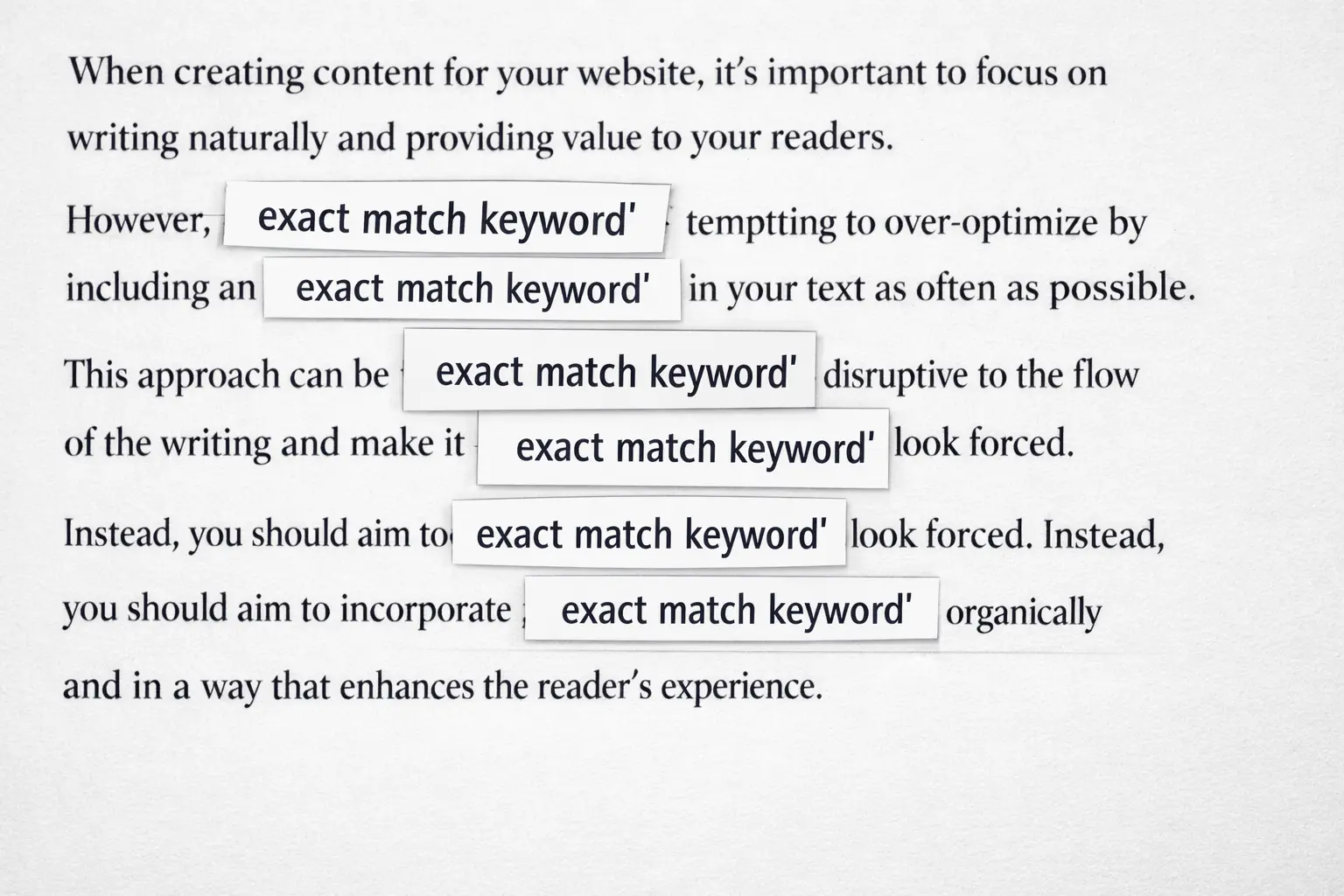
- Your sentences lose their natural flow because you are trying to fit a phrase instead of explaining an idea.
- You start repeating the same wording, which makes the content feel robotic and predictable.
- You avoid using better or clearer words just because they don’t match the keyword exactly.
- You end up writing for a system instead of writing for a person.
Now think from the reader’s side. They don’t care about your keyword. They care about whether your content helps them.
If the content feels unnatural, they don’t stay.
Below is an example of Blog filled with exact match keyword and tell if it is readable or not-
Why Google No Longer Depends on Exact Matching
This is the part many people skip, but it explains everything.
Search engines now rely on understanding intent rather than exact wording. A person might search using different phrases, but still expect the same answer.
For example, these searches all mean almost the same thing:
- How to fix a flat tire
- Bicycle puncture repair
- Cycle tube fix guide
Even though the wording is different, the intent is identical.
So instead of looking for exact matches, search engines check whether your content covers the topic properly and satisfies the user’s need.
If your page explains the solution clearly, it can rank for multiple variations without repeating a single phrase over and over.
The Real Problem With Keyword Stuffing
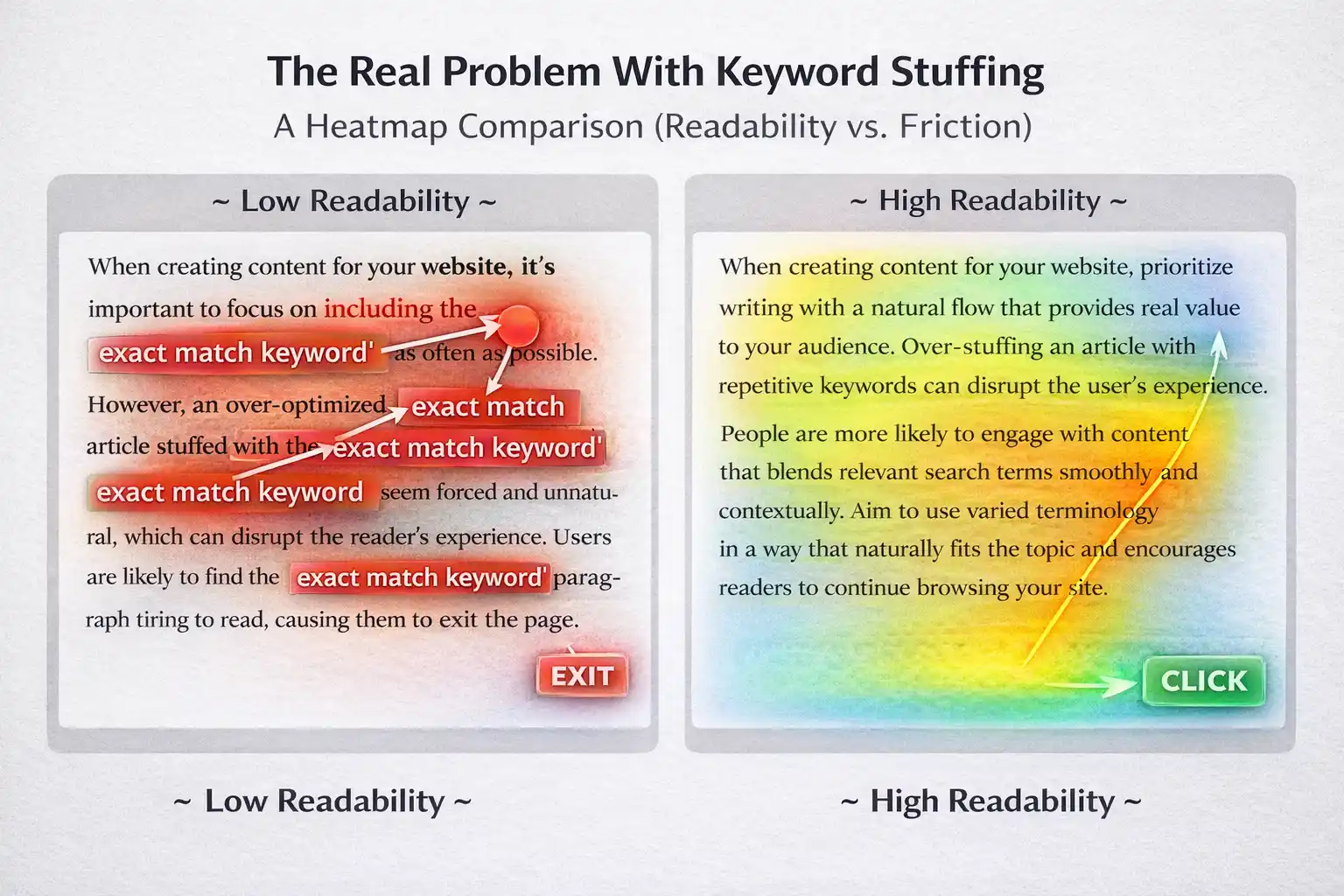
Keyword stuffing is not just an outdated technique. It actively harms your content.
Let’s understand why in a practical way.
It breaks readability
When the same phrase appears again and again, the content becomes tiring to read. It feels repetitive, and readers lose interest quickly.
It reduces trust
People can sense when content is written for manipulation rather than clarity. Even if they don’t know SEO, they feel that something is off.
It sends negative engagement signals
When readers leave quickly or don’t interact with your page, search engines take that as a sign that your content did not meet expectations.
This creates a chain reaction: Low engagement → Reduced trust → Drop in rankings.
Why Some Pages Rank First and Then Drop
Many website owners notice this pattern but don’t understand it.
A page goes live, ranks for a short time, and then disappears.
This happens because initial ranking can be influenced by relevance signals, including keywords. But after that, real user behavior takes over.
Search engines test your page with actual users. If the page fails to satisfy them, rankings decline.
This is why exact match keywords can give a temporary push, but they cannot sustain rankings.
Impact on Your Overall Website Quality
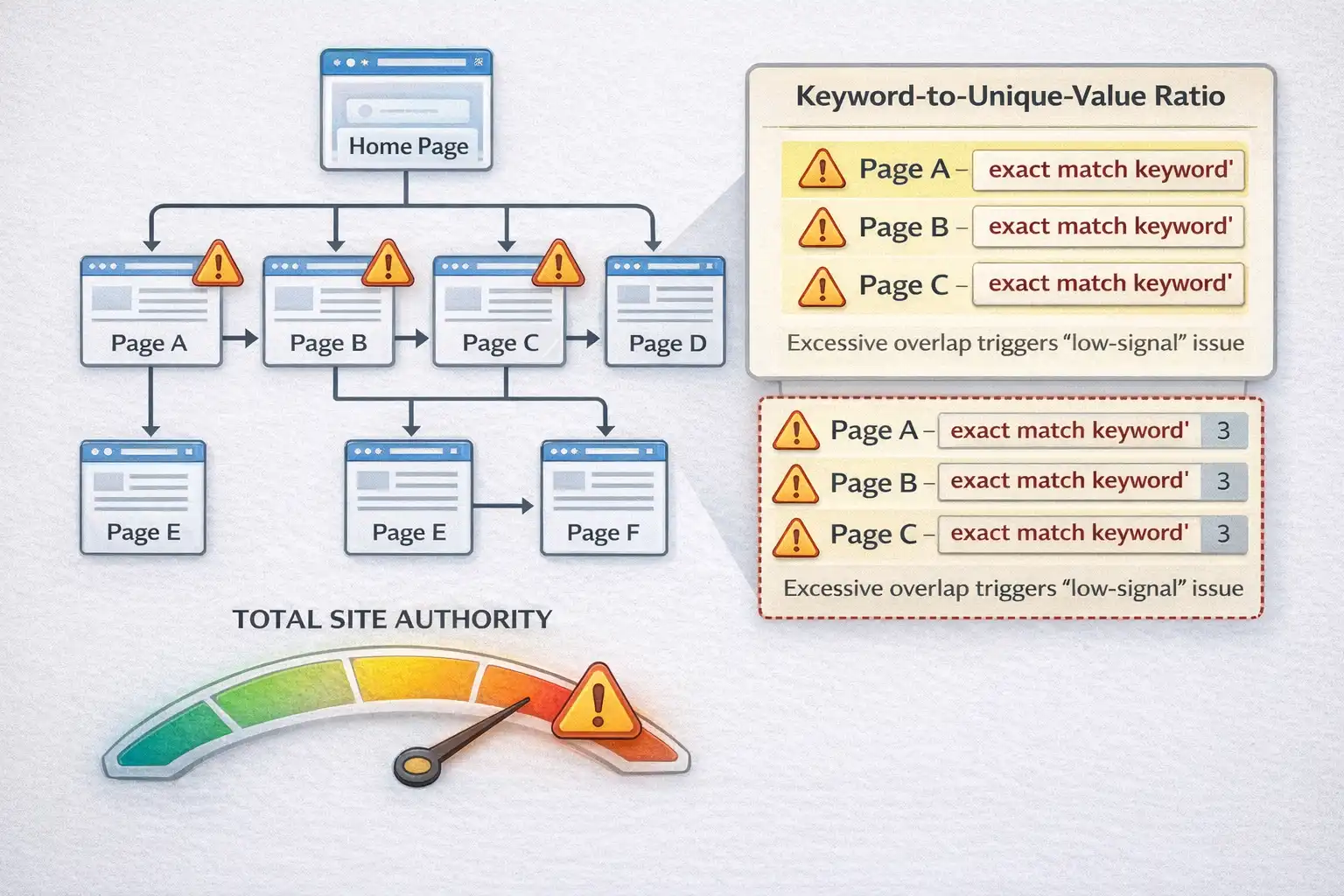
Most people think this problem is limited to one blog post. It is not.
When multiple pages on your site follow the same pattern of forced keywords, the impact becomes much bigger.
Over time, your website starts to look like this:
- Pages feel similar and repetitive
- Content lacks depth and originality
- Information does not go beyond basic explanations
Search engines start seeing your site as low value. Even your better pages may struggle because the overall trust and quality of the site has dropped.
Rewrite one “stuffed” paragraph — live audit
Take a real paragraph from your site that feels repetitive. Apply the “human filter”:
- Remove every forced keyword that doesn’t add value.
- Replace with a clear explanation or a short example.
- Read it out loud — if it sounds unnatural, rephrase until it flows.
Example:
❌ “We offer best SEO services for local SEO. Our SEO services help your SEO ranking.”
✅ “We help local businesses appear in relevant searches by focusing on what actually brings customers.”
This small shift makes content trustworthy. Try it now on your draft.
What Actually Works Instead of Exact Match Obsession
Now the important question. If exact match keywords are not the solution, what should you focus on?
Let’s go through this carefully.
1. Start with the user’s problem, not the keyword
Before writing anything, understand what the user is trying to achieve.
Ask yourself:
- What question are they asking?
- What result do they want?
- What would make them stop searching?
When you answer these clearly, your content automatically becomes more useful.
2. Write naturally, then refine
Don’t start by forcing keywords into sentences. Write your explanation in a clear and natural way first. Once the content is ready, check where the main keyword fits naturally. If it fits, keep it. If it doesn’t, don’t force it. This approach keeps your writing human and readable.
That’s why Natural SEO and content writing play such an important role in building long-term visibility and trust online.
3. Cover the topic in depth
Instead of repeating one phrase, expand your coverage. We touched on secondary keywords, but the 2026 algorithm is heavily focused on Entities. For example, if your topic is about SEO content, you should naturally talk about: user intent, content quality, search behavior, and engagement signals. This creates a strong and complete page that search engines trust.
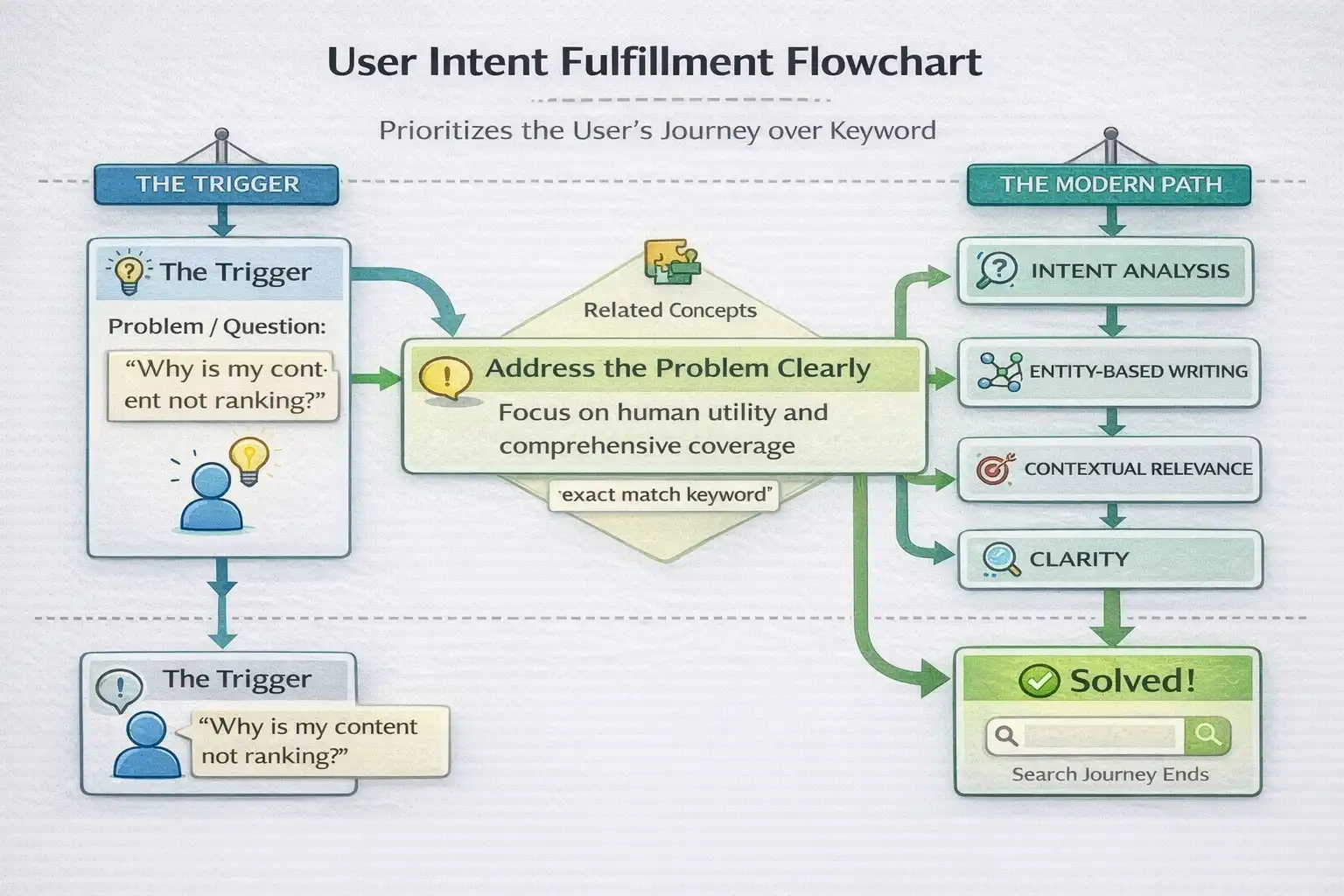
4. Use variations without overthinking
You don’t need to manually insert keyword variations. If you understand the topic properly, you will naturally use different ways to describe the same idea. This is how real conversations work, and search engines are built to understand that.
5. Focus on clarity and usefulness
At the end of the day, good content does one thing well. It makes things easy to understand. You can improve this by:
- Explaining concepts step by step
- Avoiding unnecessary repetition
- Using simple and clear language
- Structuring content so it is easy to follow
When readers understand your content without effort, they stay longer. That is what improves rankings.
Want to go deeper? Learn more about how Google evaluates usefulness beyond word count and what actually drives rankings.
6. Close the Loop
Natural writing is not just about flow; it’s about finishing the user’s search. If someone reads your page and still goes back to Google for the same query, your content didn’t fully help. Make sure you answer the main question clearly and remove follow-up doubts so the user doesn’t need to search again.
The Zero-Click Reality You Can’t Ignore
Search is changing. Many users now get their answers directly on the results page without clicking any website.
This is where natural writing gives you an advantage. Content that explains things clearly, in a structured and human way, is more likely to be picked up by AI overviews and featured snippets. Keyword-heavy writing usually gets ignored because it lacks clarity.
If your content answers questions directly and logically, it has a better chance of being selected, even without relying on exact-match phrases.
When You Can Still Use Exact Match Keywords
Exact match keywords are not wrong. The problem is how they are used.
You can use them when they fit naturally and help explain the topic clearly. For example: in the title if it describes the topic well, in a heading if it matches the section, and in the content where it flows naturally.
You should avoid them when you feel the need to adjust your sentence just to include the keyword. That is the point where optimization starts hurting your content.
Old Approach vs Modern Approach
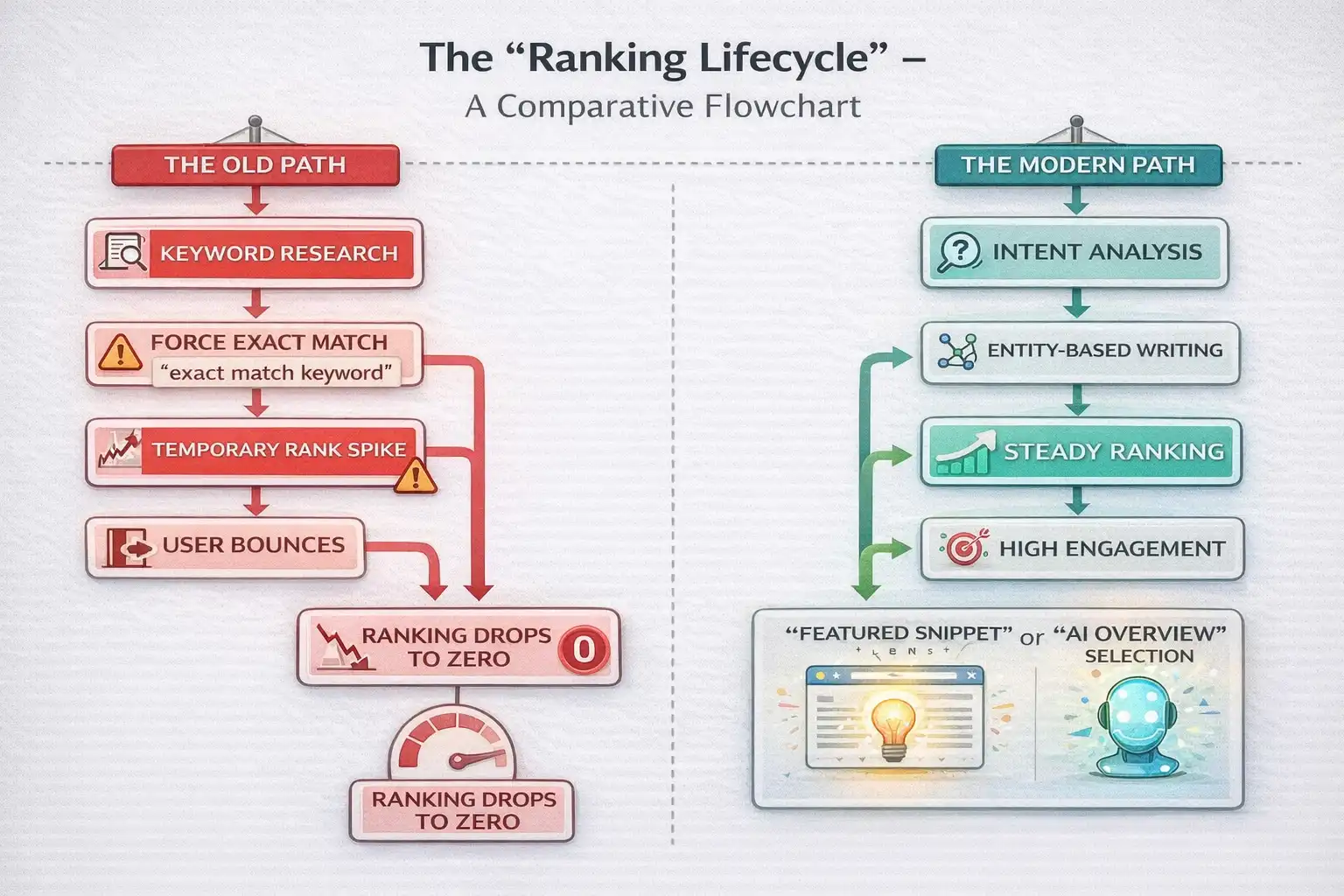
This difference becomes much clearer when you compare both approaches side by side.
| Old Approach | Modern Approach |
|---|---|
| Focus on exact keywords | Focus on user intent |
| Repeat keywords frequently | Explain the topic clearly |
| Write for search engines | Write for real people |
| Measure density | Measure usefulness |
| Force placement | Natural integration |
| Chasing High Volume Keywords (broad/noisy) | Chasing High Intent or real time query (specific/valuable) |
A Simple Self-Check Before Publishing
Before you publish your content, take a few minutes to review it honestly.
Read it like a normal reader, not like someone checking SEO.
Ask yourself:
- If I were paying for this content, would I feel like I’m reading a unique insight or just a repeated script?
- Did I repeat any phrase just to “optimize” instead of to explain?
- Is every part of this content actually useful, or did I add sections just to fill space?
- If I landed on this page from search, would I continue reading or go back and click another result?
If something feels forced, it probably is. Fix it before publishing.
Final Thought
Exact match keywords are not a magic solution, and they were never meant to carry your entire content strategy.
When you focus too much on them, you lose sight of what actually matters, which is helping the reader understand something clearly and completely.
Once you shift your focus from “placing keywords” to “solving problems,” everything starts to align naturally. Your writing improves, your content becomes more useful, and your chances of ranking increase without forcing anything.
That shift is what separates content that disappears from content that lasts.
— In 2026, the best way to rank for a keyword is to stop writing for the keyword and start writing for the person behind it. —