
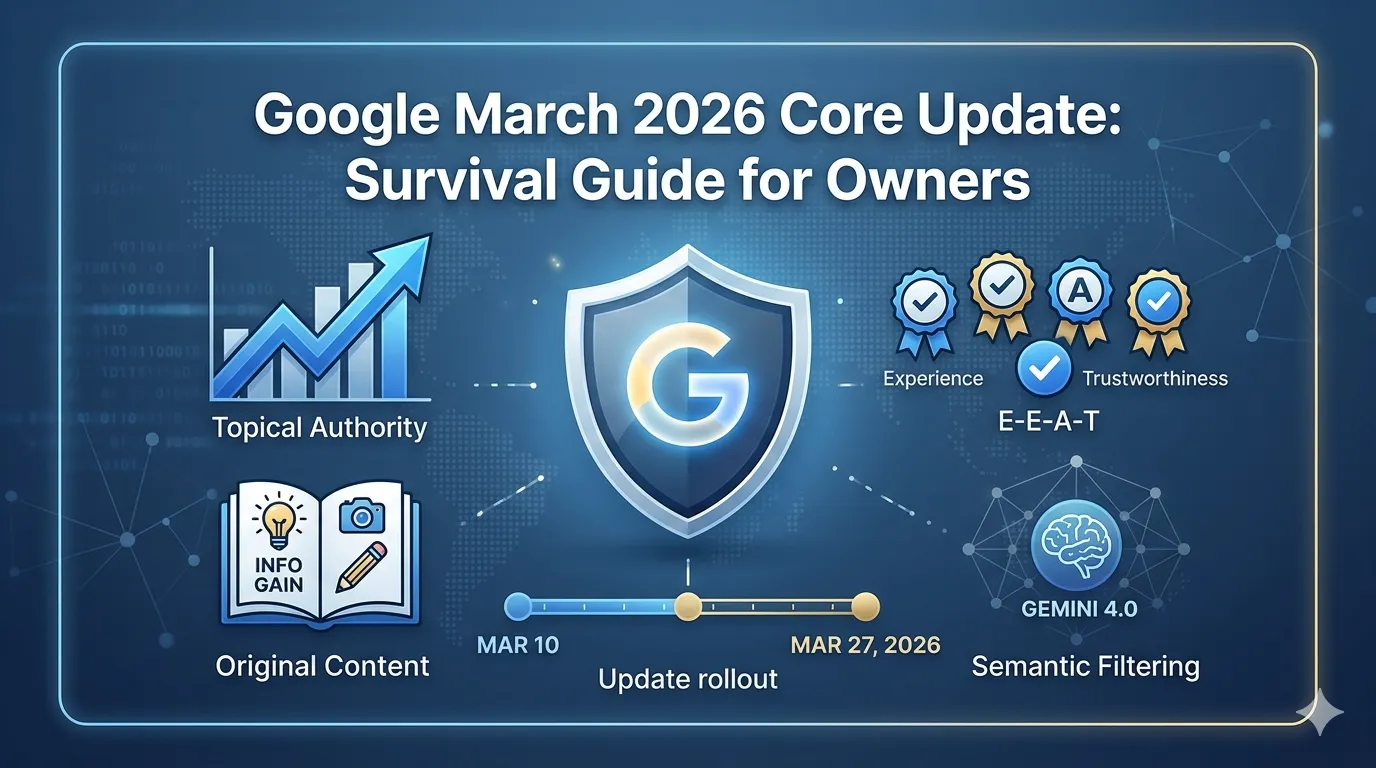
Google March 2026 Core Update: What Website Owners Need to Know
Google has officially started rolling out the March 2026 Core Update, a major change to its search ranking system aimed at improving the quality of results shown to users.
According to the official announcement from Google, the update began rolling out on March 27, 2026 at 2:00 AM PT and may take up to two weeks to fully complete. During this period, website owners may notice ranking fluctuations, traffic changes, and shifts in search visibility.
This update focuses primarily on improving content quality, originality, and expertise.
What Is the March 2026 Core Update?
The Google March 2026 Core Update is a broad core algorithm update designed to improve how Google evaluates and ranks web pages.
Unlike spam updates that target rule-breaking websites, a core update re-evaluates overall content quality across the entire web.
That means:
- Some websites may gain rankings
- Others may lose visibility
- Most sites will experience temporary volatility during the rollout
Google usually rolls out these updates several times a year to refine how search results are ranked.
Key Focus Areas of the March 2026 Core Update
Early signals from SEO tools and industry experts suggest that Google is emphasizing three main factors in this update.
1. Information Gain and Original Content
One of the biggest priorities in this update is “Information Gain.”
Google is prioritizing content that adds new value, such as:
- Original research
- Personal experience
- Unique insights
- First-hand product testing
- Real case studies
Content that simply rewrites or summarizes existing search results may lose rankings.
Example:
Instead of writing a generic article like “Best SEO Tools in 2026”, Google prefers content that includes:
- Personal usage experience
- Data comparisons
- Real screenshots
- Expert insights
2. Stronger AI Content Quality Filtering
Google has significantly improved how it detects mass-produced AI content with little human oversight.
With advanced semantic understanding powered by AI systems like Google Gemini, Google can better identify:
- Low-value AI articles
- Automated content farms
- Scaled pages created only for search traffic
This does not mean AI content is banned.
Instead, Google is rewarding human-reviewed, expert-driven content rather than purely automated articles.
3. Higher Importance of E-E-A-T
Google continues to strengthen its E-E-A-T framework:
- Experience
- Expertise
- Authoritativeness
- Trustworthiness
Websites that clearly demonstrate real expertise and credibility are more likely to perform well.
Important signals include:
- Detailed author bios
- Trusted references and citations
- Transparent business information
- Real expertise in a specific niche
What Website Owners Should Do Now
If you notice traffic changes during the rollout, don’t panic.
Core updates usually take up to two weeks to stabilize, and rankings may fluctuate several times during this period.
Here are some recommended steps.
1. Monitor Google Search Console
Check your performance in Google Search Console to see:
- Which pages lost traffic
- Which keywords dropped
- Whether the impact is site-wide or page-specific
Compare data before and after the update to identify patterns.
2. Improve Content Quality
Focus on improving pages that:
- Provide generic information
- Repeat what other websites already say
- Lack original insight
Add:
- Personal experience
- Unique examples
- Updated statistics
- Practical tips
3. Build Topical Authority
Google increasingly favors websites that demonstrate deep expertise in one topic.
Instead of publishing random content across multiple niches, focus on building authority around a specific subject area.
For example:
A website about digital marketing should publish content related to:
- SEO
- content marketing
- analytics
- search algorithms
Rather than unrelated topics.
4. Focus on User Experience
Technical factors still matter.
Make sure your website has:
- Fast loading speed
- Mobile optimization
- Clear navigation
- Helpful content structure
These signals contribute to better search performance.
Final Thoughts
The Google March 2026 Core Update highlights Google’s continued push toward helpful, experience-driven content.
Websites that offer original insights, genuine expertise, and real value for users are more likely to succeed in the long run.
Instead of chasing algorithms, the best strategy remains the same:
Create high-quality content that genuinely helps your audience.