

How do Trust Signals Work Across Multiple Pages?
Imagine publishing one excellent article. It’s detailed, well-structured, and genuinely helpful. Then you publish five more that are thin, vague, or loosely related. Now ask yourself: which pattern stands out?
Here’s the thing. Search systems don’t look at pages in isolation. They observe behaviour over time. They compare structure, topic consistency, depth, internal linking, and user interaction signals across the entire site. What this really means is that one strong URL doesn’t automatically elevate the whole domain.
This idea aligns with how the Google Helpful Content system works. It evaluates patterns site-wide, not just page-by-page. A single weak article won’t destroy authority overnight. But repeated misalignment between topics, inconsistent depth, or scattered intent sends a clear signal.
Authority is not a moment. It’s a pattern. Repetition builds expectation. Alignment reinforces expertise. And consistency compounds credibility across URLs.
Trust is the result of repeated, aligned signals across multiple pages, not the performance of a single page.
📌 TL;DR — No Time? Read This.
Search systems don’t judge pages one by one. They study patterns across your entire site.
One great article won’t build lasting authority if the surrounding content is thin, scattered, or inconsistent. Trust forms when multiple pages reinforce the same topic, depth level, terminology, structure, and philosophy over time.
Here’s what actually matters:
Consistent topical focus instead of random publishing
Stable quality and depth across related pages
Clear structural patterns in headings and formatting
Internal links that connect ideas, not just URLs
Alignment in tone, advice, and positioning across the archive
Updates like the Google Helpful Content system reward sustained usefulness, not isolated optimisation wins. Authority isn’t a moment. It’s a repeated behaviour.
When pages support each other, signals compound. When they contradict or dilute focus, trust weakens quietly.
Stop asking, “How do I optimise this page?”
Start asking, “How does this page strengthen my site’s overall pattern?”
Trust grows in systems, not silos.
Step 1: Trust Is Not Page-Based — It’s Pattern-Based
Google doesn’t “score” a page in isolation. It watches how pages relate to each other.
What this really means is trust forms from consistency across your entire content ecosystem.
The Single-Page Illusion
Most people obsess over perfecting one page. They polish headings, add keywords, tweak structure, and expect authority to follow. But Google doesn’t view that page in a vacuum. It compares it against other pages on the same domain. If the surrounding content lacks depth or clarity, that strong page looks like an outlier.
Wait, why? Because credibility isn’t built on a single performance. A professor isn’t defined by one academic paper; their body of work proves expertise. Search systems work the same way.
One strong page can rank. A consistent pattern builds trust—which is exactly why perfectly optimised exact-match pages often fail to rank at all when that pattern is missing.
This is why polishing a single URL rarely works long‑term. Many site owners redesign their homepage instead of strengthening the entire domain. But as explained in this detailed guide on why a hero page can’t fix a weak website, structural weakness eventually affects rankings.
Site-Wide Evaluation Systems
Google’s Helpful Content philosophy evaluates sites through recurring signals across URLs, not isolated wins.
- Depth consistency across related topics
- Structural consistency in formatting and explanation
- Topic coherence without random, disconnected pivots
Repetition across pages reinforces perceived quality.
How Patterns Form Trust Signals
Search systems detect repetition: similar topical language, reinforced terminology, recurring subject matter. Over time, these repetitions create pattern accumulation.
Trust forms gradually. Signals compound as themes, structure, and intent align across the domain.
Step 2: Topic Consistency Builds Perceived Expertise

When your pages stay focused on one main topic, they support each other. It’s like they’re connected instead of standing alone. Over time, this makes both readers and search engines see you as someone who really knows the subject. Posting random content feels messy. Sticking to a clear theme feels planned. And that clear focus builds authority.
Thematic Glue Between Articles
When related subtopics connect logically, each page makes the others stronger.
For example, if a site focuses on technical SEO, its articles should build on each other: crawl budget, log file analysis, indexing control, and schema implementation. This creates clear topic depth because the same key terms and ideas keep showing up in a structured way.
Subtopics should layer naturally. One main guide explains the basics. Other articles dive deeper into specific parts. That’s how you build depth instead of noise.
Even great content can feel weak if it’s random. Without clear connections, it doesn’t show real specialisation.
Aligned cluster example:
Technical SEO Basics → Crawl Budget Optimisation → Log File Analysis Guide → Advanced Indexation Control
Site Architecture Guide → Internal Linking Strategy → Orphan Page Audits → Faceted Navigation SEO
Scattered site example:
Technical SEO Guide → Best WordPress Themes → Keto Diet Tips → Instagram Growth Hacks
Clusters vs Content Scatter
| Aligned Pages | Scattered Pages |
|---|---|
| Depth | Surface |
| Reinforcement | Dilution |
Ten tightly aligned articles compound authority. Fifty unrelated ones fragment it. Alignment strengthens expertise signals because each page adds context to the others. Scatter resets credibility every time.
Semantic Reinforcement Over Time
When terminology repeats consistently across posts, clarity increases. Definitions remain stable. Arguments build on prior explanations. This creates stronger entity recognition and domain association.
Consistent framing also builds reader trust. If your explanation of crawl efficiency matches across multiple guides, it signals reliability rather than improvisation.
Repetition with structure creates recognition, and recognition builds authority.
Step 3: Quality Consistency Separates Amateurs From Systems
Quality isn’t about one great article. It’s about maintaining a stable depth level across dozens.
Depth Stability Across Pages
If one article breaks down concepts with layered reasoning and another barely scratches the surface, that gap becomes a pattern. Search systems don’t judge pages in isolation. They compare them. When argument depth, evidence, and structure fluctuate wildly, it signals instability. Consistency, on the other hand, suggests process. It shows there’s an editorial standard behind the content, not random bursts of effort.
- One post cites data and explains implications; another makes broad claims without support.
- One article answers primary and secondary intent; another stops at surface definitions.
- One uses clear frameworks; another rambles without hierarchy.
- One anticipates objections; another ignores nuance completely.
Consistency builds cumulative trust. Inconsistency quietly erodes it.
Structural Patterns Google Observes
Across multiple pages, structural clarity becomes measurable. Logical headings, predictable formatting, and complete intent coverage create a repeatable pattern. Clean layouts reduce friction, which improves engagement signals. When users find similar clarity across different posts, perception shifts from “random blog” to “reliable source.”
What this really means is structure itself becomes a trust signal.
- Clear heading hierarchy that mirrors search intent
- Scannable formatting without clutter or distraction
- Sections that fully resolve the query before moving on
Tone and Philosophical Alignment
Tone is rarely discussed, yet it shapes authority. If one article sounds measured and analytical while another leans on hype or exaggerated claims, credibility fractures. Readers feel the shift immediately. Algorithms detect engagement changes that follow.
Philosophical alignment matters too. A site that claims to value evidence but occasionally publishes opinion-driven fluff sends mixed signals. Trust grows when voice, reasoning style, and underlying principles stay aligned across the site.
Consistency is not repetition. It is identity.
Step 4: Internal Linking as Reinforcement, Not Navigation

Internal links create relationships between ideas. Relationships create trust reinforcement. When one page thoughtfully connects to another, it signals that the content wasn’t written in isolation. It belongs to a larger, structured body of knowledge.
Contextual Linking Builds Conceptual Bridges
Internal links work best when they function like evidence chains. One idea leads naturally to the next, and the connection feels earned. That’s how topic clusters form. A primary guide introduces the core idea, supporting pages expand on subtopics, and links between them reinforce the hierarchy. The structure itself communicates clarity.
When a page about technical SEO links to a deeper guide on crawl budget optimisation, the connection does more than help navigation. It shows conceptual alignment. The reader sees how the pieces fit together. Search engines see it too. Concept reinforcement happens because each page strengthens the others within the same thematic cluster.
Isolated Pages vs Interconnected Systems
An isolated page may perform well on its own, but it accumulates little reinforcement from the rest of the site.
An interconnected cluster of compound signals. Relevance flows between related URLs. Authority builds across the structure. Even strong pages gain more stability when surrounded by aligned, supportive content.
Trust grows in systems, not silos.
Step 5: Contradictions and Signal Dilution
Alignment across pages is philosophical, not just structural. When your content disagrees with itself, trust erodes quietly. Search systems don’t just read individual pages; they interpret patterns across your domain. If your advice shifts without context, the overall signal weakens.
Thematic Conflict Detection
When two posts promote opposing strategies without explanation, it creates uncertainty. For example:
Page A: Long-form content is unnecessary and often bloated.
Page B: Every serious article must exceed 3,000 words to rank.
Another clash might look like this:
Page A: Expertise matters more than formatting.
Page B: Formatting alone can secure top positions.
Search systems analyse semantic relationships across documents. If your core claims contradict each other, the algorithm detects inconsistency in intent and authority. What this really means is simple: internal disagreement looks like instability, and instability reduces perceived reliability.
Editorial Integrity as a Signal
Strong sites evolve, but they evolve openly. When your philosophy changes, update older posts to reflect that shift. Add context. Explain why your position matured. That transparency reinforces credibility instead of damaging it.
Running a cross-page audit helps maintain coherence. Review themes, claims, and tone across your archive.
Quick internal audit:
Identify posts with opposing conclusions.
Update outdated claims with clear editor notes.
Align terminology and strategic stance across related articles.
Note- In 2026, AI-driven search filters are specifically designed to flag ‘hallucinations’ or conflicting advice within a single domain. This adds a layer of urgency.
Step 6: Trust Compounds Through Repetition
Trust behaves like compound growth. Each aligned page strengthens the pattern. Over time, repetition stops looking accidental and starts looking reliable. Search systems reward that stability because consistency reduces uncertainty.
Signal Strength Over Volume
5 pages → light signal
20 pages → reinforced
100 pages → durable
Five aligned pages suggest intent, but the pattern is still fragile. It could be a coincidence or early experimentation. At twenty aligned pages, the structure becomes clearer. Internal links support the theme, terminology stabilises, and topical focus sharpens. The signal is reinforced.
At one hundred aligned pages, the pattern becomes durable. Topic depth is layered. Supporting subtopics connect naturally. User expectations are consistently met. What this really means is that trust stops being page-specific and becomes domain-level. It is not about publishing more content. It is about repeating the same quality signals until the pattern becomes undeniable.
Why Consistency Accelerates Future Rankings
When a domain establishes a stable topical pattern, new pages enter an environment of existing credibility. Search systems rely on accumulated behavioural and structural signals. That history acts like a reputation memory.
Because the system has already mapped your domain’s reliability in a specific topic cluster, it needs less evidence to evaluate new content. Crawling is more efficient. Indexing confidence is higher. Alignment is easier to verify.
Consistency today shortens the trust cycle tomorrow.
This is exactly how Google assigns trust at the domain level – through repeated, reliable patterns.
How I Built a Cross-Page Trust Intentionally?
Turning Scattered Posts Into a Reinforced System
When I audited my blog, the pattern was obvious. Some posts were deeply analytical. Others skimmed the surface. A few drifted into loosely related topics that didn’t strengthen the core theme. It wasn’t a strategy. It was an accumulation.
So I fixed it deliberately:
- Defined one clear niche focus and committed to it fully.
- Archived or merged posts that didn’t reinforce that direction.
- Rewrote thinner articles to match the depth and reasoning of my strongest pieces.
- Standardised terminology so concepts stayed consistent across pages.
- Built intentional internal links between tightly aligned guides.
After publishing 15 closely aligned articles within the same niche, something shifted. New posts are indexed faster. Rankings required less push.
Trust didn’t spike overnight. It stabilised first — then it compounded.
Step 7: What This Means for Content Strategy
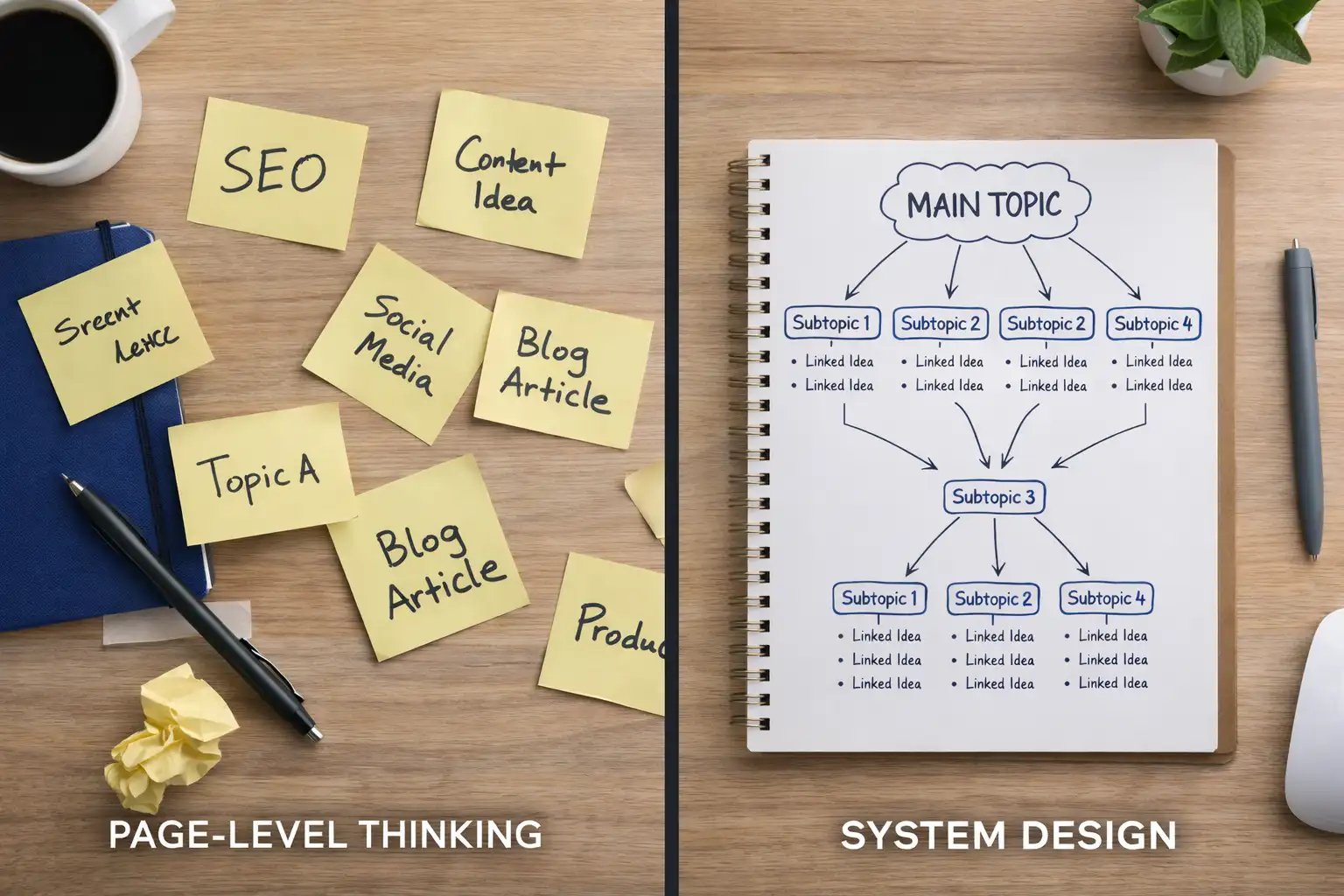
Shift mindset from page optimisation to system design.
From Page-Level Thinking to System Design
Most creators ask, “How do I optimise this page?” That question is too narrow. A better one is, “How does this page reinforce my site’s trust pattern?”
Here’s the thing. Search engines don’t evaluate pages in isolation for long. They observe how pages relate to each other. Do they share terminology? Do they follow similar reasoning? Do they reflect the same depth and standards?
Strategic publishing replaces random posting. Instead of chasing keywords one by one, you build interconnected assets that support the same core position. Each article strengthens the others. Each update aligns with a larger structure. Over time, your site begins to behave like a coherent body of work rather than a collection of attempts.
Designing a Cross-Page Trust Audit
To apply this, run a simple audit:
- Pick 5 top pages that represent your core topics
- Check terminology alignment across them.
- Check structural consistency in formatting and argument depth.
- Check philosophical alignment in advice and positioning.
If one page contradicts tone, standards, or intent, it weakens the pattern. Even a single outlier can dilute perceived authority.
The Systems Mindset Advantage
Trust is an observed behaviour. Not claims. Not badges. Behavior. When your content repeatedly demonstrates clarity, consistency, and aligned intent, that pattern compounds.
Consistency becomes strategic, not accidental. Authority becomes cumulative, not temporary.
When your site behaves like a system, trust stops being requested and starts being inferred.
Build a Trust Scorecard for Your Own Site
Create a lightweight scoring system:
Rate each article from 1–5 on:
Topical alignment
Depth consistency
Structural clarity
Terminology stability
Internal reinforcement
Anything below 3 → revise.
Anything below 2 → merge or remove.
What this does is simple: it forces pattern awareness.
Pattern-Level Questions Most People Get Wrong
Can One High-Quality Page Build Domain Trust?
One exceptional page can rank, but it cannot anchor domain-level trust on its own. Search systems evaluate it against the surrounding content. If adjacent pages lack depth or alignment, the strong page stands alone rather than reinforcing a pattern. Trust compounds when multiple pages reflect consistent intent, structure, and topical direction. Isolated excellence signals effort. Pattern density signals reliability.
Does Deleting Weak Content Improve Cross-Page Trust?
Removal can help when certain pages cause signal dilution by weakening topical alignment or quality consistency. Pruning works only if it sharpens thematic focus. Cutting pages without reinforcing the core narrative simply reduces volume, not confusion.
How Many Related Pages Are Needed to Form a Strong Pattern?
There is no fixed number. A few aligned pages suggest intent. A moderate cluster suggests commitment. A durable pattern forms when repetition crosses a signal threshold and reinforces the same topic from multiple angles.
Do Internal Links Alone Create Trust Signals?
Internal links clarify relationships, but they cannot replace substance. Mechanical linking connects URLs. Conceptual reinforcement connects ideas. Structure amplifies trust only when depth already exists.
How Long Does It Take for Cross-Page Trust to Stabilise?
Trust accumulates gradually as aligned pages are published, crawled, and reinforced. Consistent velocity matters more than bursts. Patterns stabilise through repetition, not urgency.
— trust grows in systems, not silos —