
Domain Authority Is Not a Google Ranking Factor?
Domain authority is not a Google ranking factor. Despite its popularity in the SEO industry, Google does not use this metric—or any single “website authority” score—to determine where your site ranks. John Mueller a prominent Google Search Advocate and Senior Search Analyst also confirms that Google don’t use it.
Domain Authority (DA) is a third-party estimate created by Moz to predict a site’s ranking potential based on link profiles, but it is not a signal used by Google’s actual algorithms.
The real problem isn’t the metric itself; it’s the misguided strategy of chasing a higher DA score while ignoring the signals Google actually prioritises: topical authority, information gain, and entity relationships.
Only chasing a higher DA score can hold back your SEO.
Where The Confusion Actually Starts
Domain Authority feels real because it behaves like a score, and humans naturally trust numbers when evaluating performance.
A higher number suggests a stronger site, while a lower number suggests weakness, which creates a simple mental model that is easy to follow but fundamentally flawed.
The problem is that Google does not operate on a single numerical authority score assigned to an entire domain.
Instead:
- Google evaluates individual pages, not just entire websites as a single unit
- It considers context, intent, and relevance in a much more granular way
- It uses multiple layered signals rather than a single “authority metric”
What this means in practice is that two websites with identical DA scores can perform completely differently in search results depending on how well their content aligns with user intent and topic relevance.
This is why relying on DA as a predictive metric often leads to confusion, especially when outcomes do not match expectations.
Why Domain Authority Became So Popular
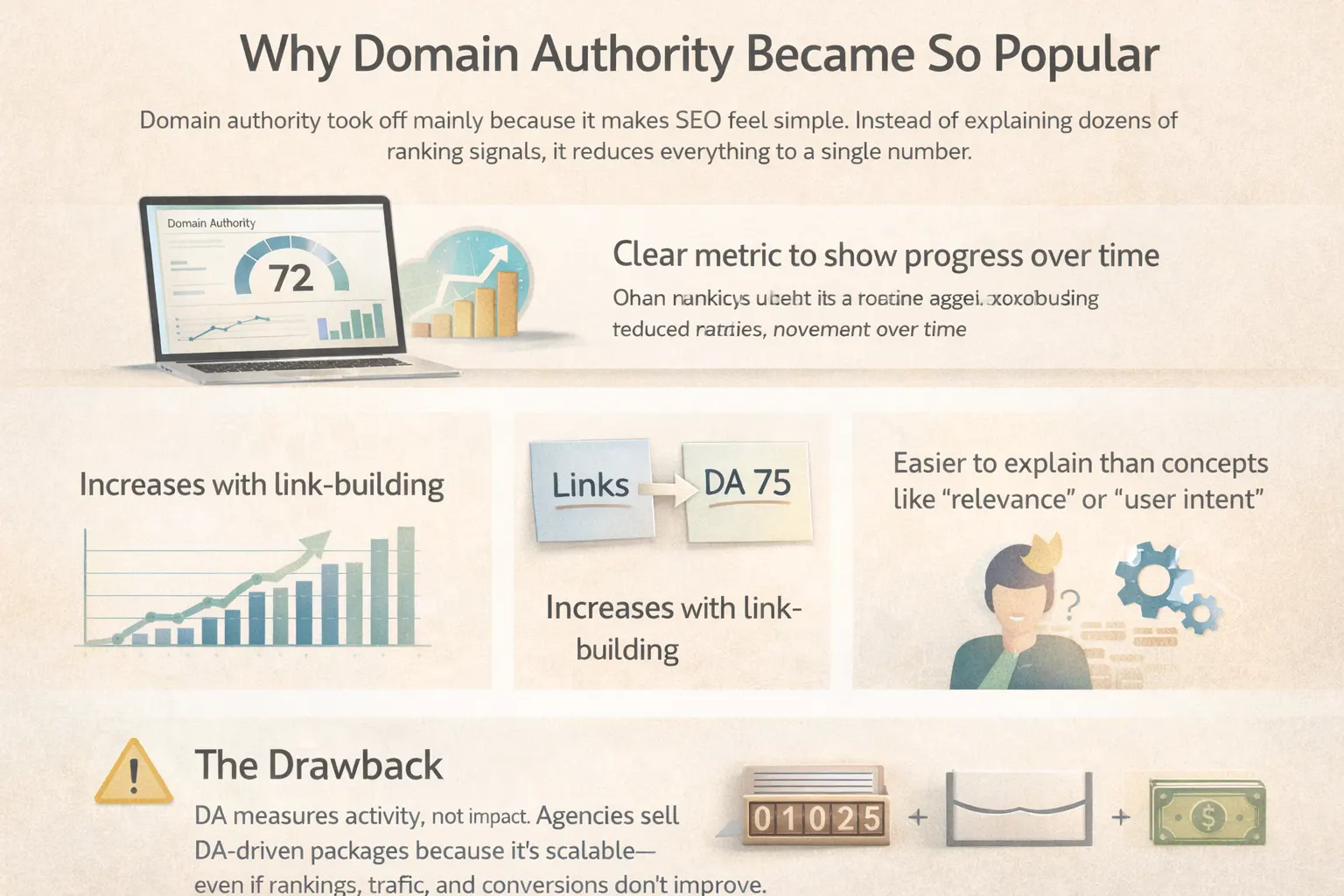
Domain authority took off mainly because it makes SEO feel simple. Instead of explaining a complex system with dozens of ranking signals, it reduces everything to a single number that’s easy to track and report.
Teams rely on it because:
- It gives a clear metric to show progress over time
- It increases with link-building efforts, creating visible movement
- It’s easier to explain than concepts like ‘relevance’ or ‘user intent’.
However, this simplicity has its drawbacks. DA measures activity, not actual impact. So it’s entirely possible to see your score rise while rankings, traffic, and conversions stay exactly the same—and that’s where strategies start going in the wrong direction.
This is exactly why many agencies continue to sell DA-driven packages; it’s a scalable reporting tool, even if it doesn’t move the needle on revenue.
The Mechanical Flaw: DA Measures The Wrong Things
At a structural level, domain authority is heavily influenced by link-based signals, particularly the following:
- The number of domains linking to your website
- The perceived strength of those domains based on Moz’s own index
- The overall link graph patterns detected across the web
While these inputs are not entirely useless, they are incomplete.
What DA does not reliably measure includes the following:
- Contextual relevance of links
- Whether those links exist within meaningful content
- User engagement signals
- Depth and comprehensiveness of content
- Actual expertise demonstrated on the topic
Such knowledge leads to situations that seem counterintuitive at first glance but are actually very common in real-world SEO.
For example:
- A website with DA 60 struggles to rank for mid-competition keywords
- A website with DA 15 consistently outranks it in the same niche
This is not an exception or an anomaly. It is a direct result of modern search algorithms prioritising relevance and usefulness over abstract authority ratings.
What Google Actually Pays Attention To
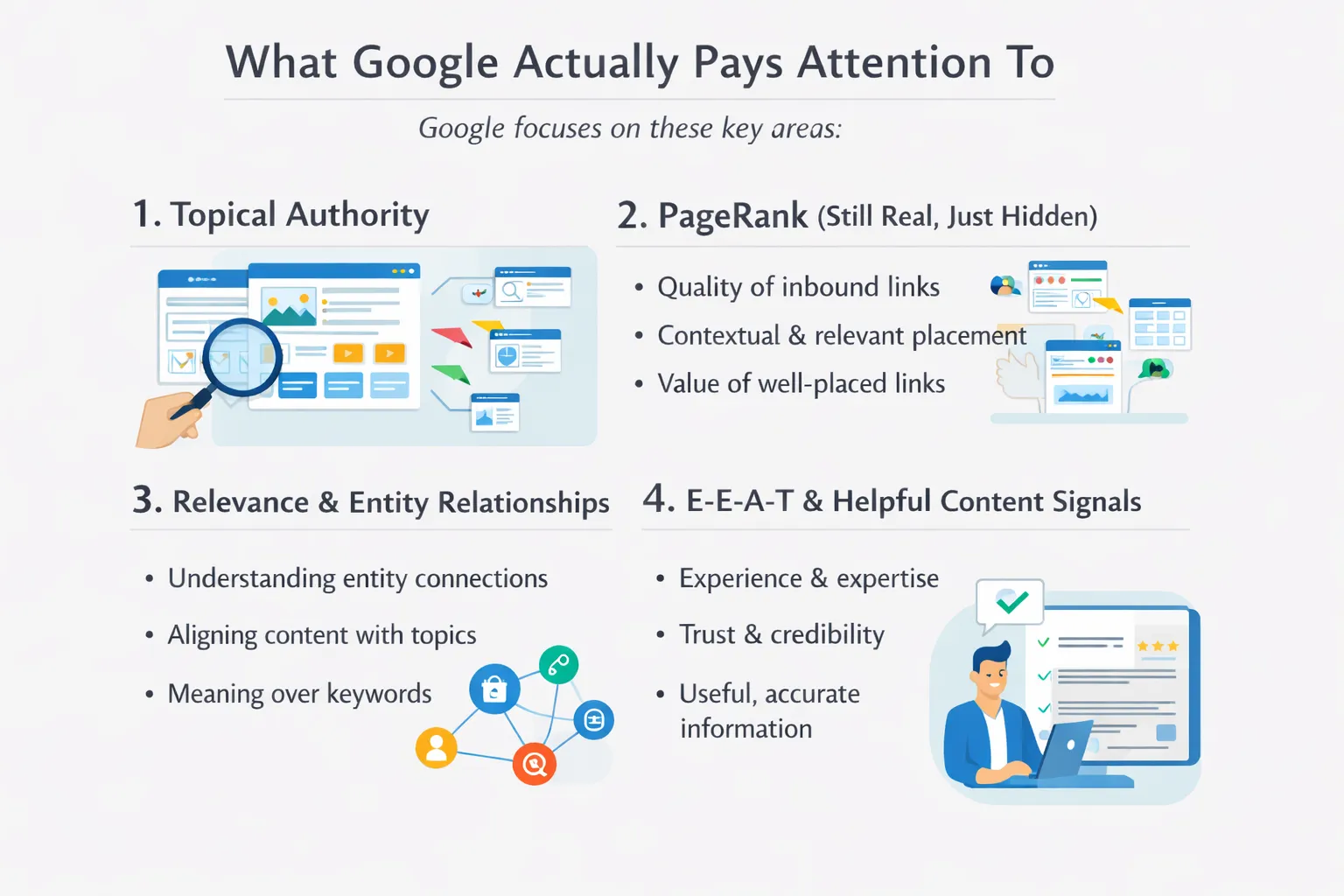
Google replaces abstract domain authority scores with a combination of granular, interdependent signals.
1. Topical Authority
This is one of the most important shifts in modern SEO, and it fundamentally changes how websites should approach content creation.
Google is no longer asking whether a site is generally authoritative. Instead, it is evaluating whether a site is authoritative within a specific topic or subject area.
This means:
- A website that deeply covers a niche topic can outperform a larger, more generalized site
- Consistency in covering related subtopics strengthens perceived expertise
- Breadth across unrelated topics often weakens clarity of authority
For example:
A focused SEO blog publishing dozens of detailed articles on internal linking, entity SEO, and content structure will often outperform a large general news site that publishes one broad, surface-level article on SEO.
The difference lies in depth, consistency, and contextual relevance.
2. PageRank (still very real, just hidden)
Although Google removed the public PageRank toolbar years ago, the underlying concept still exists within its ranking systems.
PageRank evaluates:
- The quality of incoming links
- The distribution of those links across pages
- The likelihood that users would actually click those links
Modern PageRank is far more refined than its original version.
It considers:
- Contextual placement of links within content
- Relevance between the linking page and the destination page
- The dilution of link value when a page links to many destinations
This means a single well-placed, contextually relevant link can pass significantly more value than dozens of low-quality, irrelevant links.
3. Relevance and entity relationships
Search has evolved from simple keyword matching to understanding meaning.
Google now interprets content through entities, which are identifiable concepts such as people, topics, brands, or ideas, and it maps how these entities relate to one another.
As a result:
- Content that clearly aligns with a specific topic cluster performs better
- Pages that establish strong relationships between related concepts gain more visibility
- Relevance outweighs raw link strength in many scenarios
This is why a smaller, highly focused website can outperform a larger one when the topic alignment is stronger.
4. E-E-A-T and helpful content signals
Experience, expertise, authoritativeness, and trustworthiness form a framework that helps Google evaluate content quality.
While these are not direct ranking factors in isolation, they influence how algorithms are trained and refined.
In practical terms, this means:
- Content should demonstrate real understanding, not surface-level summaries
- Writers should show familiarity with the subject, whether through examples, insights, or experience
- Pages should provide clarity, accuracy, and usefulness to the reader
This information connects directly to one of the most important concepts shaping modern rankings.
Information Gain: The Quiet Ranking Driver
One of the biggest reasons content fails to rank, even when it is technically optimised, is that it does not add anything new.
If your article repeats what already exists on the first page of search results, it offers no additional value.
Google has no incentive to rank it higher.
‘Information gain’ refers to the unique value your content provides beyond what is already available.
Such content can take several forms:
- Introducing a new perspective or interpretation
- Providing original data or analysis
- Explaining a concept more clearly or deeply than existing content
- Challenging commonly accepted ideas with evidence
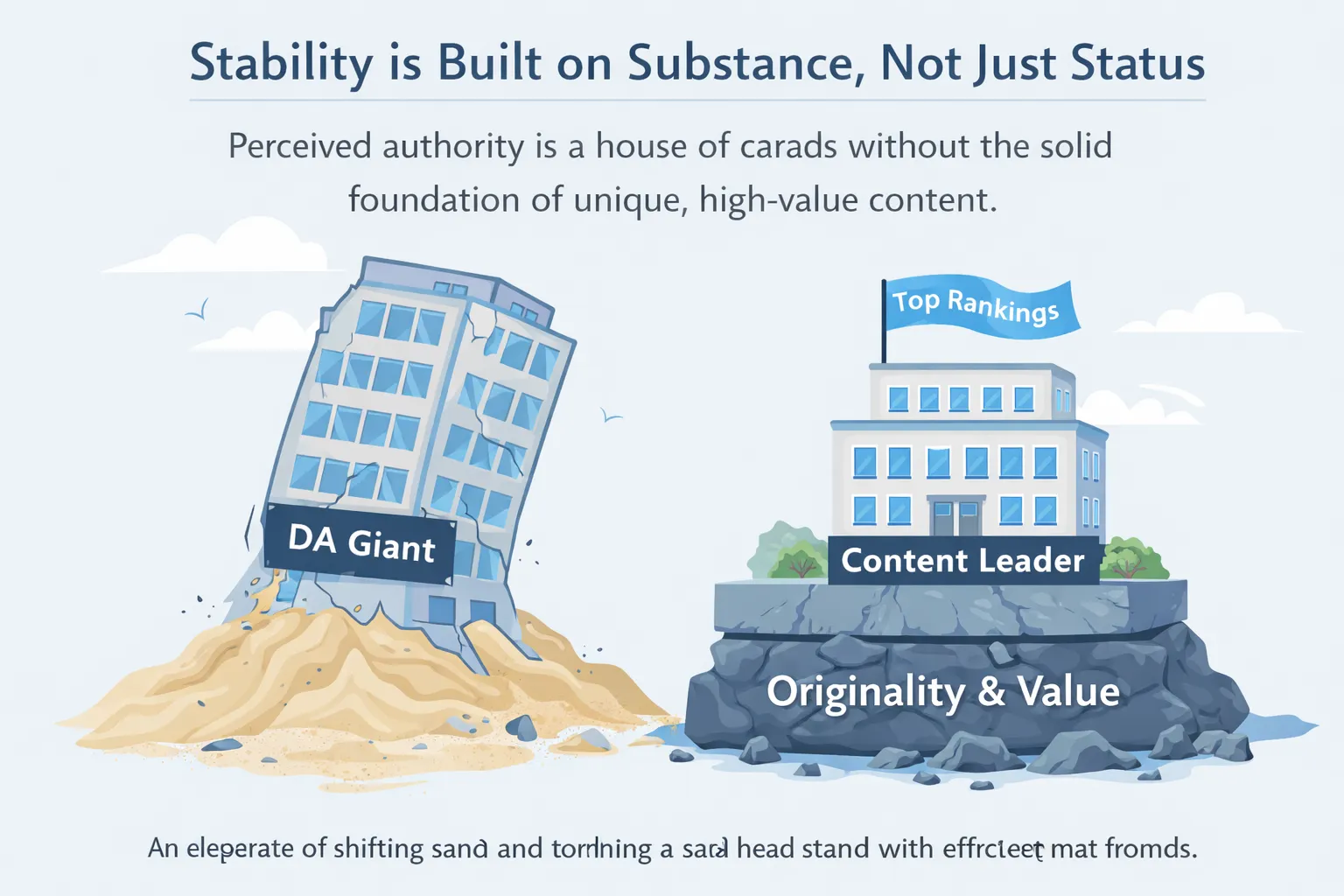
This area is where many high-DA sites struggle.
They rely on their perceived authority but produce content that lacks originality, which leads to unstable rankings over time.
🧪 Practical Lab: Audit Your Own DA Trap
Stop chasing scores — here’s a 15-minute exercise to refocus on real signals.
📌 Outcome: Real authority grows from what you add, not what you buy.
The Backlink Quality Gap (This Is Where DA Falls Apart)
Not all backlinks carry the same weight, even though DA often treats them similarly.
This creates a significant gap between perceived authority and actual authority.
Here is how that difference typically looks:
| Feature | Inflated DA Profile | Real Authority Profile |
|---|---|---|
| Link Sources | Directories, profiles, generic platforms | Niche blogs, industry publications |
| Source | Often Manually Created | Natural and Earned Links generally |
| Relevance | Often unrelated to the topic | Closely aligned with subject matter |
| Traffic | Minimal or no referral visitors | Consistent, relevant referral traffic |
| Stability | Short-term gains, long-term volatility | Long-term stability and growth |
When links are:
- Easy to create
- Available to anyone
- Not embedded in meaningful content
Google tends to discount their value significantly.
Internal Links: The Underrated Lever
Internal linking is often overlooked, yet it plays a critical role in shaping how authority flows within a website.
While external backlinks bring authority into your site, internal links determine how that authority is distributed.
Effective internal linking helps:
- Guide search engines toward your most important pages
- Strengthen relationships between related topics
- Build structured content clusters that reinforce topical authority
For example:
A well-linked pillar page supported by multiple related articles sends strong signals about importance and expertise.
Strategic linking from high-authority pages within your site can accelerate the visibility of newer content.
Internal links do not create new authority, but they maximise the impact of what you already have.
The “Temporary Boost” Effect
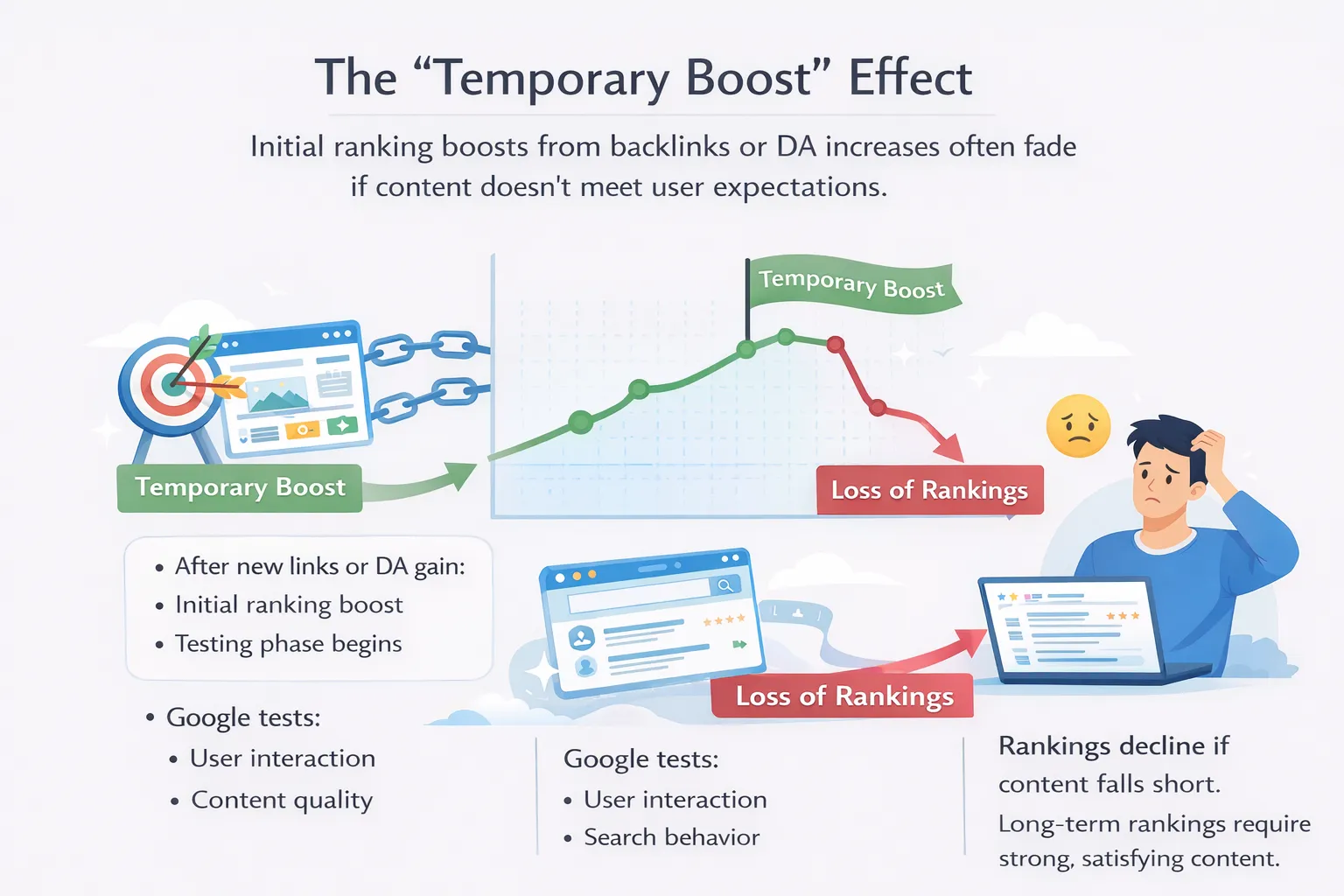
It is common to see a page gain rankings quickly after acquiring backlinks or increasing DA, only to lose those positions later.
This happens because Google often tests new or updated content.
During this testing phase, it evaluates:
- How users interact with the page
- Whether the content satisfies their intent
- If users return to search results to find alternatives
If the content does not meet expectations, rankings decline.
Backlinks can create initial visibility, but they cannot compensate for weak or unoriginal content in the long term.
A Better Way To Think About Authority
Instead of chasing a metric, it is more effective to focus on building genuine authority within a specific domain of knowledge.
This involves:
- Covering topics comprehensively rather than superficially
- Creating content that adds new insights or perspectives
- Earning links naturally from relevant sources
- Structuring internal links to reinforce topic clusters
- Maintaining consistency in publishing and subject focus
The Shift From Metrics To Ecosystems
The most important change in SEO is not technical but conceptual.
Websites are no longer evaluated as isolated pages or based on singular metrics.
They are understood as ecosystems of information.
A strong SEO ecosystem:
- Covers a topic from multiple angles
- Connects related ideas through internal linking
- Builds depth and context over time
- Continuously evolves with new insights and updates
This approach aligns with how Google processes information and delivers results.
Final Thought
Domain authority is not inherently useless, but it is often misunderstood and overvalued.
It works best as:
- A rough comparative tool
- A directional benchmark when analyzing competitors
But it should not be treated as the following:
- A definitive ranking factor
- A measure of actual authority
- A primary goal in SEO strategy
The websites that succeed today are not those chasing higher scores.
They are the ones investing in depth, relevance, consistency, and originality.
Real authority cannot be calculated by a single number; it must be built over time.
— trust grows in systems, not silos —