
How to Rank for Exact Match Keywords Without Using Them Through Semantic Entity Mapping?
Here’s the direct answer: You can rank for a keyword without ever writing it if your content proves that it fully understands the topic behind that keyword.
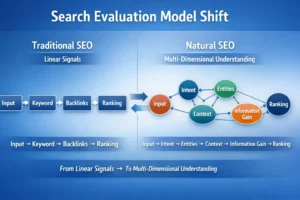
Search engines in 2026 don’t rely on matching words. They map meaning. They evaluate how deeply your page and your entire website understand a subject, how concepts connect, and whether your content fills real gaps.
What this assessment really means is simple:
Stop chasing phrases. Start building complete topic understanding.
Why This Works: Search Has Moved From Words to Meaning
Earlier, search engines looked for exact phrases. If someone searched for “best accounting app for shopkeepers”, pages repeating that phrase had an advantage.
Now, search systems analyse entities and relationships:
A “shopkeeper accounting app” is not just a phrase. It is a combination of entities like the following:
- inventory management
- billing software
- GST calculation
- offline data storage
- small business finance tools
If your content explains these clearly and connects them properly, search engines understand, “This page solves the problem behind the query.” Even if the exact keyword is missing or comes only a single time.
If you still think keyword usage alone guarantees rankings, you should read this breakdown on why exact match keywords don’t guarantee rankings .
What is Semantic Entity Mapping (in simple terms)
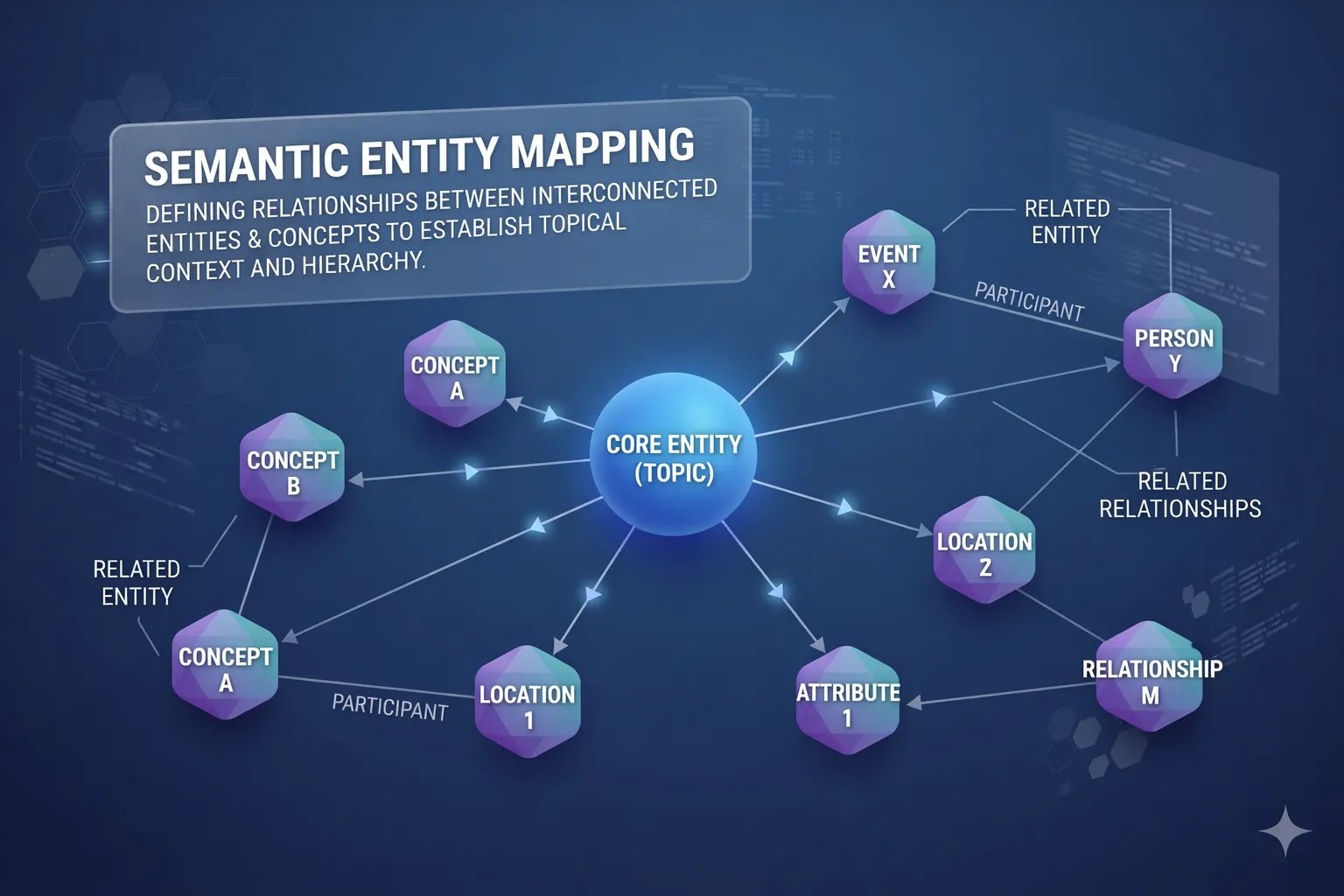
Think of your topic like a map, not a keyword.
Instead of writing around one phrase, you identify all the important pieces of that topic and connect them naturally.
🧠 The Core Idea You Need to Understand
Ranking without keywords depends on three things working together:
- Entity coverage — Did you cover all important concepts?
- Relationships – Did you explain how they connect?
- Depth – Did you go beyond surface-level explanations?
If these are strong, keywords become optional.
So now, let’s understand step by step how to rank without using exact match keywords.
Step 1: Identify the Real Topic Behind the Keyword
Most people start with keywords. That’s where they go wrong.
Instead, ask: “What problem is the user trying to solve?”
Example
Keyword: “how to speed up website”
Real topic includes:
- server response time
- caching
- image optimization
- CDN usage
- code minification
- hosting performance
If your article explains all of this clearly, you don’t need to repeat the keyword.
Step 2: Build Your Entity List
Before writing, list all related concepts.
How to find them
- Look at top-ranking pages
- Check “People also ask” questions
- Think like a user: what would they ask next?
Example structure:
| Main Topic | Related Entities |
|---|---|
| Website Speed | caching, CDN, server latency |
| Performance Optimization | image compression, lazy loading |
| Hosting | shared hosting, VPS, cloud hosting |
| Technical SEO | Core Web Vitals, page load time |
This list becomes your content blueprint.
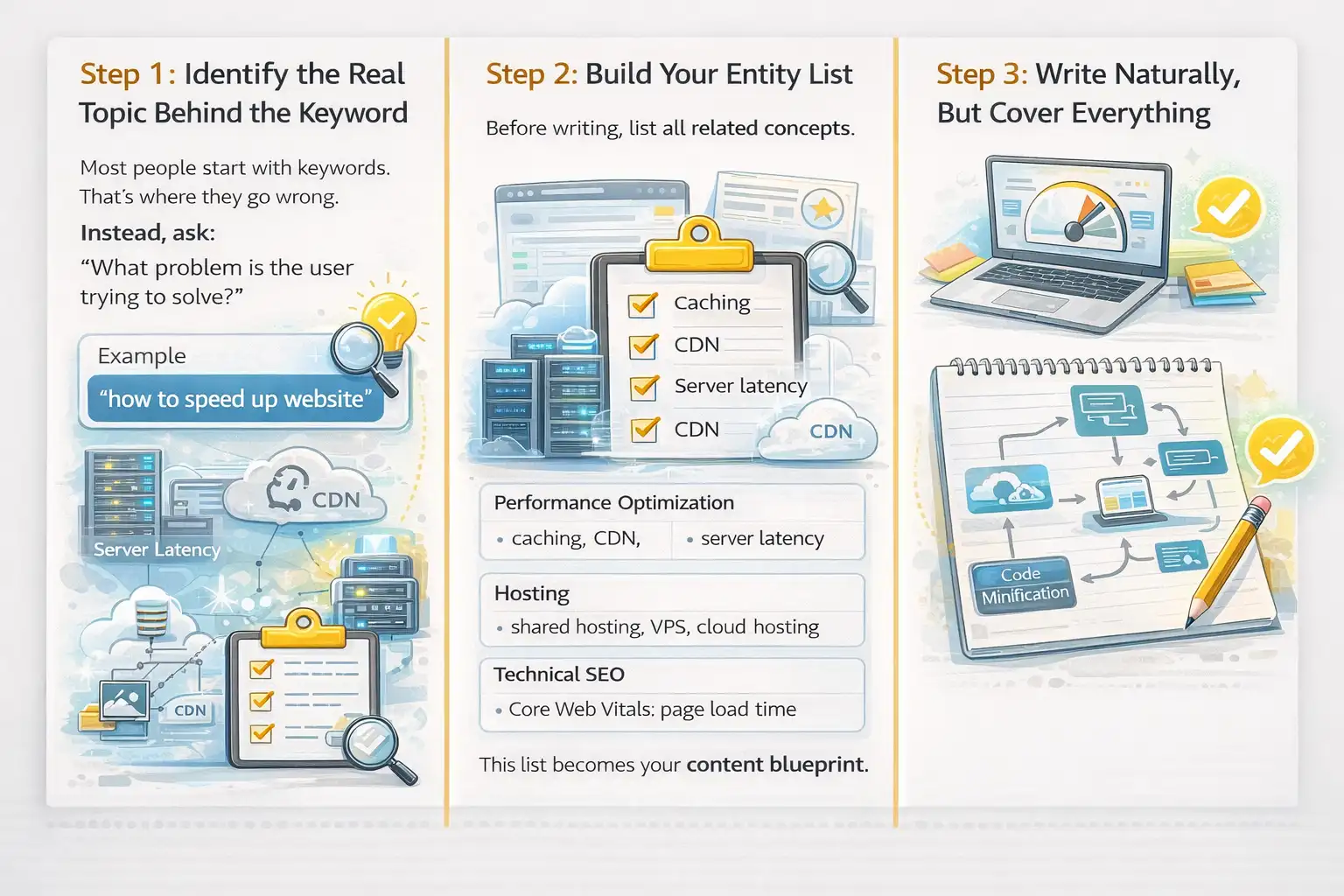
Step 3: Write Naturally, But Cover Everything
Now comes the important part.
Do not force keywords. Do not repeat phrases. Instead:
- Explain each concept clearly
- Connect ideas logically
- Answer the next question before the reader asks
What good content looks like
Instead of writing: “This is the best way to speed up your website.”
You write: “Reducing server response time improves how quickly your page starts loading, especially when users visit for the first time.”
No keyword. Still perfectly relevant.
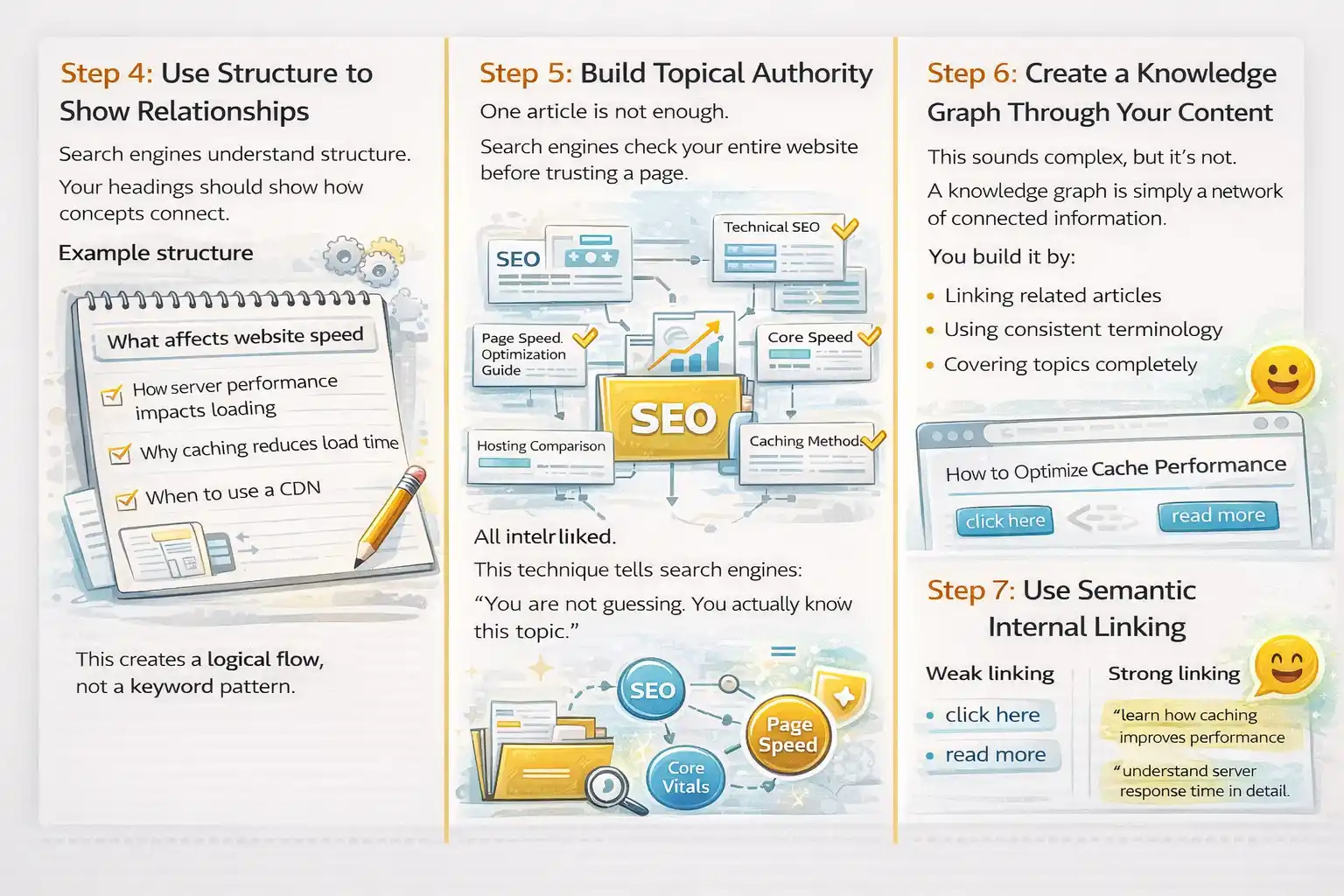
Step 4: Use Structure to Show Relationships
Search engines understand structure.
Your headings should show how concepts connect.
Example structure:
- What affects website speed
- How server performance impacts loading
- Why caching reduces load time
- When to use a CDN
This creates a logical flow, not a keyword pattern.
Step 5: Build Topical Authority
One article is not enough. Search engines check your entire website before trusting a page.
If you write one post about SEO but your site is about random topics, it won’t rank well.
You need multiple supporting articles. For example, an authoritative SEO hub requires:
- Technical SEO basics
- Page speed optimization guide
- Core Web Vitals explained
- Hosting comparison
- Caching methods
All interlinked. This technique tells search engines: “You are not guessing. You actually know this topic.”
Step 6: Create a Knowledge Graph Through Your Content
This sounds complex, but it’s not. A knowledge graph is simply a network of connected information.
You build it by:
- Linking related articles
- Using consistent terminology
- Covering topics completely
Example: Your site connects SEO → Technical SEO → Page Speed → Core Web Vitals → User Experience. Now your site becomes a structured knowledge source. That’s what search engines trust.
Step 7: Use Semantic Internal Linking
Internal links are not just navigation. They explain relationships.
Weak linking: “click here” / “read more”
Strong linking:
- “learn how caching improves performance”
- “understand server response time in detail”
This helps search engines understand how your pages connect.
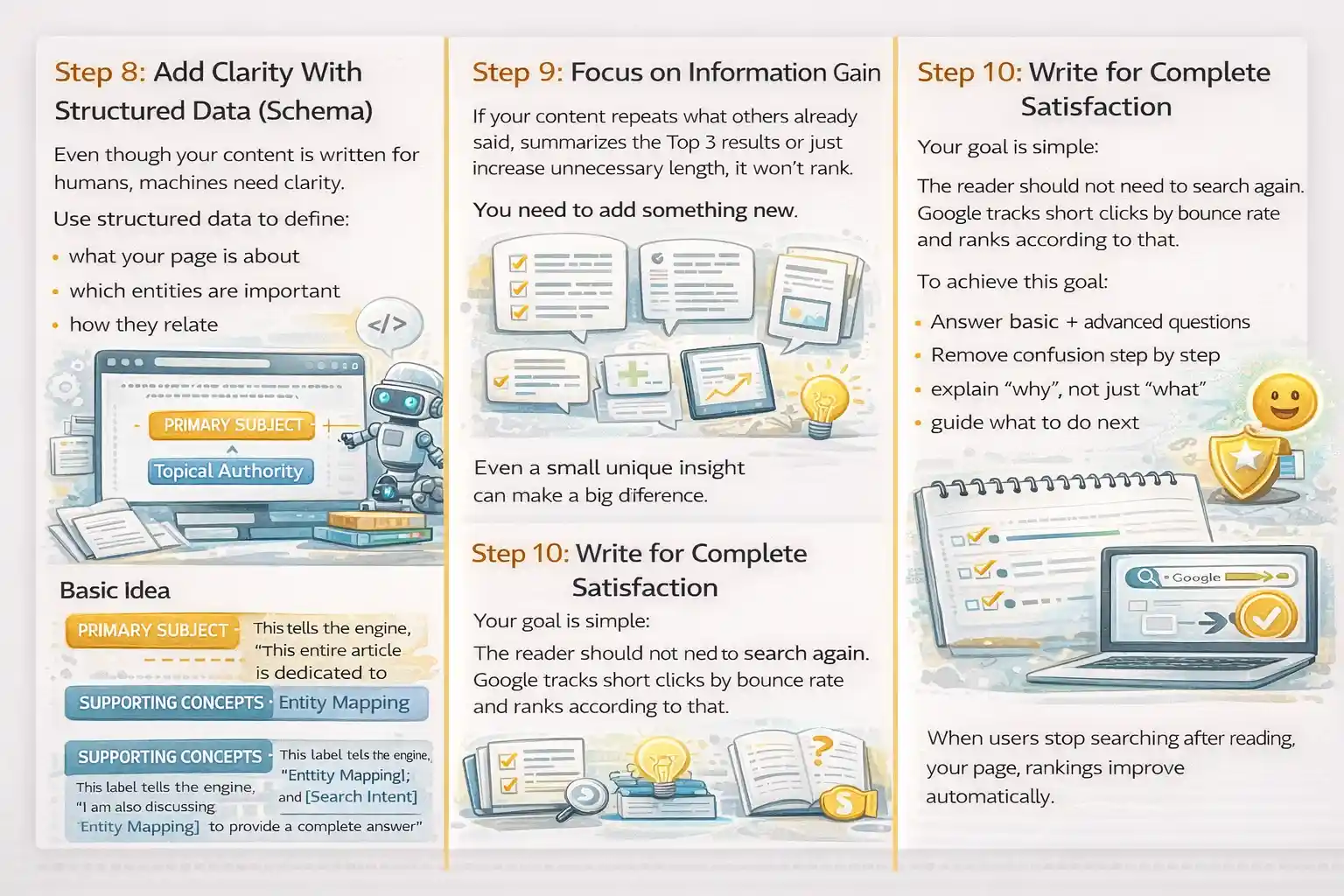
Step 8: Add Clarity With Structured Data (Schema)
Even though your content is written for humans, machines need clarity.
Use structured data to define:
- what your page is about
- which entities are important
- how they relate
Basic idea: The “Primary Subject” Label tells the engine, “This entire article is dedicated to Topical Authority.” The Supporting Concepts Label tells the engine, “I am also discussing Entity Mapping and Search Intent to provide a complete answer.”
Step 9: Focus on Information Gain
If your content repeats what others already said, summarises the Top 3 results or just increases unnecessary length, it won’t rank. You need to add something new.
Ways to do that
- Share real examples
- Explain mistakes people make
- Go deeper into one part others ignore
- Answer questions others skipped
Even a small unique insight can make a big difference.
Step 10: Write for Complete Satisfaction
Your goal is simple: The reader should not need to search again. Google tracks short clicks by bounce rate and ranks according to that.
To achieve this goal:
- Answer basic + advanced questions
- Remove confusion step by step
- Explain “why”, not just “what”
- Guide what to do next
When users stop searching after reading your page, rankings improve automatically.
Step 11: Maintain Living Authority
Topical authority isn’t a one-time win; it’s a status you maintain. In 2026, Google will prioritise content velocity—the speed at which you update your “knowledge nodes” to reflect the real world.
- Updating Beats Publishing: Refreshing an existing high-authority post with 2026 data or new case studies is significantly more powerful than publishing ten new, average articles. Google rewards the “freshness” of established trust.
- Entities are Not Static: The relationships between topics evolve. A new tax law becomes a new entity if you have a guide for shopkeepers. If your map doesn’t include it, your authority expires.
- The Maintenance Workflow: To stay unshakeable, treat your blog as a living knowledge base:
- Audit for Gaps: Every quarter, check if new technologies or terms have entered your niche.
- Strengthen Connections: Link new supporting articles back to your main “Pillar” post to deepen your knowledge graph.
- Signal Depth: Don’t just change the date. Add a paragraph that explains a new insight or corrects an old assumption.
Common Mistakes to Avoid
Many people try this approach but fail for the following reasons:
- Writing vague content without depth
- Ignoring related concepts
- Not building supporting articles
- Using unnatural language to avoid keywords
- Focusing on tricks instead of clarity
The goal is not to avoid keywords. The goal is to make them unnecessary.
Old SEO vs Modern Semantic SEO
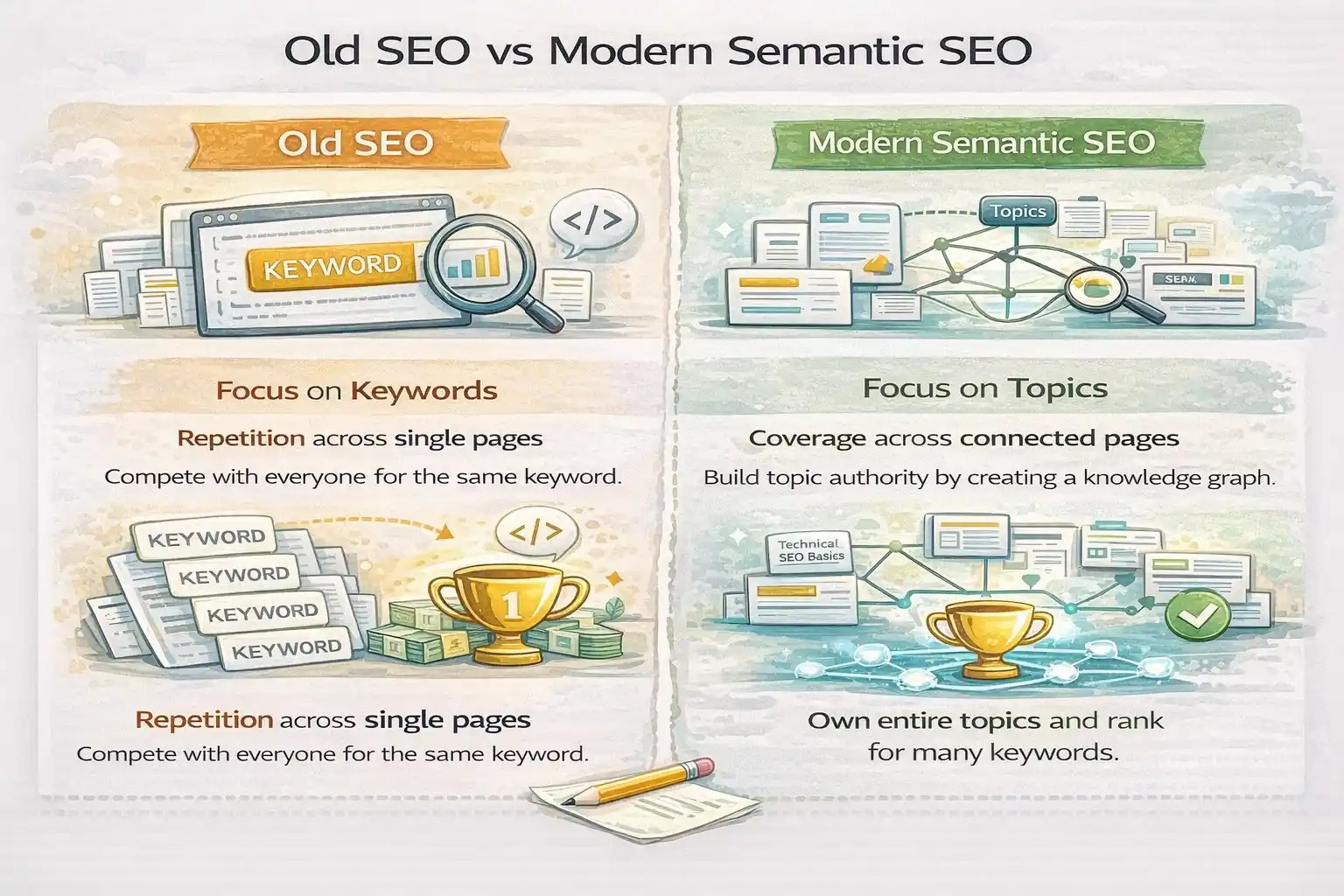
| Factor | Old Approach | New Approach |
|---|---|---|
| Focus | Keywords | Topics |
| Strategy | Repetition | Coverage |
| Structure | Single page | Connected pages |
| Ranking Signal | Keyword match | Topic understanding |
| Goal | Rank one keyword | Own the topic |
What This Means for You
- You rank for multiple keywords without targeting them
- Your content becomes more natural and readable
- Your website builds long-term authority
- You depend less on constant keyword research
- And most importantly, your content actually helps people.
📘 Real-World Case Study: How I Built “Content Decoded” as a Knowledge Node
I don’t just write about semantic mapping; I use it as the foundation for my own website, Content Decoded. My mission is to bridge the gap between what Google’s algorithms want and how creators build their sites. I don’t follow a generic checklist; I build a system designed for everyone from beginners to elite SEO professionals.
The “Invisible” Strategy: Instead of chasing high-volume keywords, I focused on creating a network of interconnected topics that address the core of modern search: Helpful Content & User Intent, Domain-Level Trust, Algorithm Myth-Busting providing “Information Gain” by correcting common SEO misinformation.
The Result: A Living Knowledge Graph By consistently covering these related entities, I have turned my website into a structured knowledge source. Google has already begun to recognise Content Decoded as a credible authority for SEO concepts—not because I used specific keywords but because I mapped the entire semantic relationship of the industry. My goal is not to rank for one day but to strengthen this topical footprint every day. When your site behaves like a primary source of truth, the rankings follow naturally.
The Final Shift You Need to Make
Stop asking, “What keyword should I use?”
Start asking: “What does the user require to fully comprehend this topic?”
Once your content answers that completely, search engines will do the rest.
That’s how you rank without using the keyword even once.
— Follow Entities, Not Keywords —