Why Thin Content Is Different from Short Content?
Short does not mean thin. That confusion ruins a lot of good writing. Think espresso versus a bag of chips. One is small but concentrated. The other is big but mostly air.
Thin content lacks value density, intent satisfaction, and clarity. Short content can deliver all three.
Here’s the real lens: did the page solve the reader’s problem fully, without wasting their time? Thin content dodges depth, repeats obvious points, and leaves gaps. Short content respects attention, answers precisely, and stops when the job is done.
What follows are practical tests you can use to tell the difference. No theory. Just clear signals.
Quick Answer:
| Feature | Short Content (The Espresso) | Thin Content (The Bag of Chips) |
|---|---|---|
| Purpose | To solve a specific problem fast. | To occupy space on a keyword. |
| Experience | High-density, precise, punchy. | Fluffy, repetitive, generic. |
| User Reaction | “Exactly what I needed.” | “I’ve read this three times already.” |
| Success Metric | High satisfaction, low bounce. | High frustration, “pogo-sticking.” |
Short Content: Small, Precise, and Complete
Short content is not compressed content. It’s intent-focused content. It exists to solve one narrow problem fully, without wandering into side topics. When someone searches for a definition, a setting, a number, or a quick fix, they’re not asking for depth. They’re asking for clarity.
That’s what short content does well. It respects the scope of the question and stops when the job is done.
The “Espresso Shot” Model of Content
Think of it like an espresso shot. Small cup. Strong impact. No dilution.
Short content works best when the query is tight and specific. You’re not building an essay. You’re delivering a precise outcome.
Ideal use cases:
- Definition queries
- Specific tool or app settings
- Quick troubleshooting fixes
- Dates, numbers, formulas, measurements
Complete does not mean long. It means the question is fully resolved.
The 3 Signals That Short Content Is High-Quality
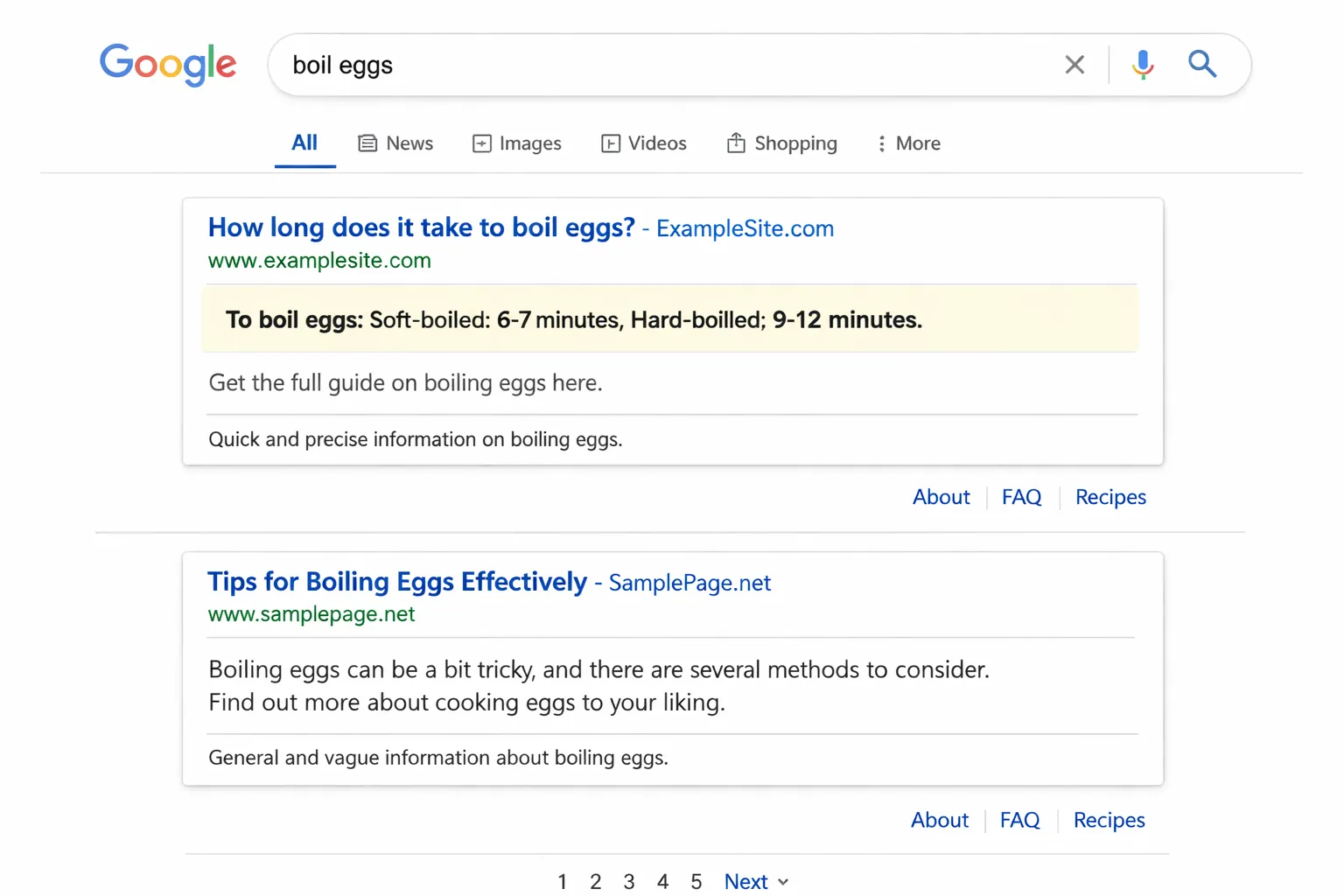
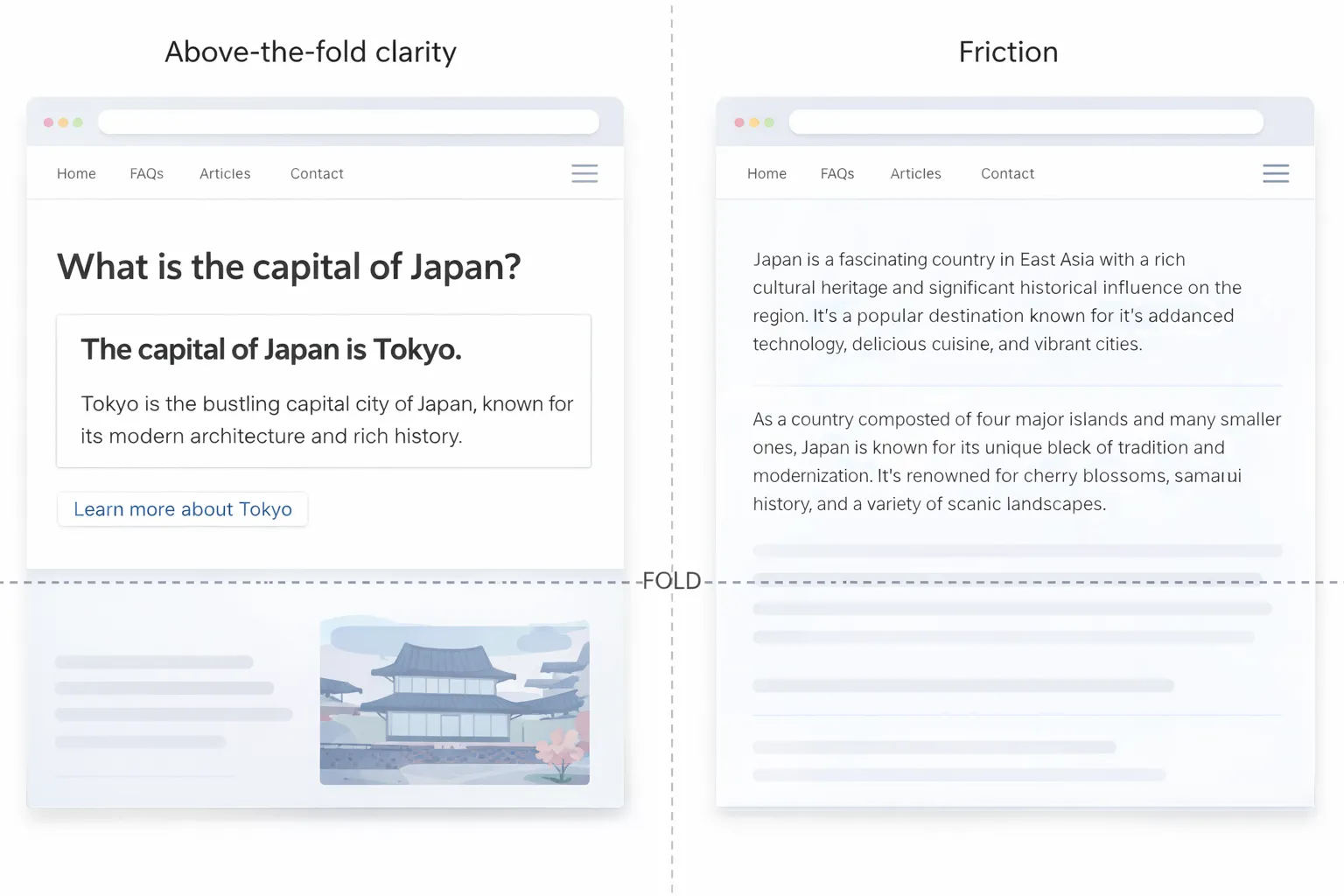
- The direct answer appears immediately, often in the first line. No scrolling required.
- There is no generic introduction or throat-clearing. It gets straight to the point.
- There is no repetition or padding. Every sentence adds new value.
Mini example:
Question: What temperature to bake a cake?
Answer: Bake at 180°C (350°F) in a preheated oven.
When Short Content Actually Performs Better
Short content wins when speed matters more than exploration. In these cases, clarity builds trust faster than length.
It performs especially well in:
- FAQ sections
- Support documentation
- Glossary pages
- Product feature explanations
When users find answers quickly, they feel confident in the source.
When Short Content Is Actually Thin
Short becomes thin when it fails to close the loop. The answer feels incomplete, forcing the reader to keep searching.
Warning signs:
- Vague definitions without real clarity
- Missing critical steps in a process
- Surface statements without explanation
Short respects time. Thin wastes it.
Thin Content: Looks Big, Feels Empty
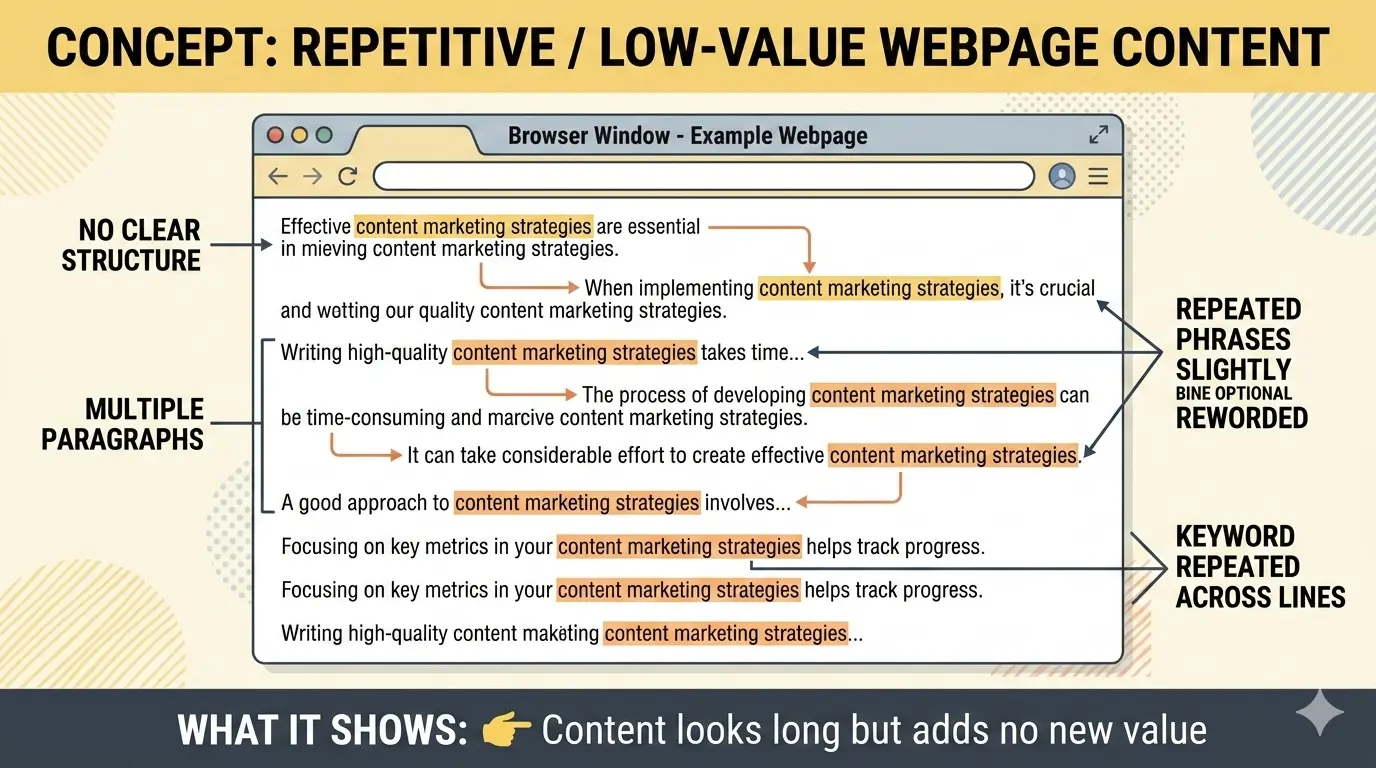
Thin content isn’t about length. It’s about information gain. A page can run 2,000 words and still leave the reader with nothing new, nothing clearer, nothing more useful than what they already knew. That’s thin.
Here’s the thing: thin content consumes attention without delivering insight. It answers surface questions but avoids specifics. It fills space instead of solving problems. And readers feel that immediately.
The “Bag of Chips” Effect
You open the page. Big headline. Strong promise. Scroll down, and it’s paragraph after paragraph of setup, definitions you’ve heard a hundred times, obvious statements dressed up as insight, and exact keywords repeating just slightly reworded.
It’s like opening a large bag of chips that’s mostly air. The packaging suggests abundance. The reality is light and forgettable. You read 1,500 words and walk away with one vague takeaway you could’ve gotten from a short paragraph.
Thin content looks full but delivers no new value.
5 Real Signs Your Content Is Thin
Before you publish, run this quick check:
- You could delete 30% and lose nothing important.
- It mirrors top-ranking pages without adding fresh insight.
- There are no concrete examples or real scenarios.
- It avoids specifics like numbers, steps, or comparisons.
- The advice sounds helpful, but it stays generic.
If any of these hit, tighten it. Add proof. Add clarity. Add something only you can say.
The Ctrl+F Test (5-Second Audit)
Here’s a simple self-check: the Ctrl+F Test. Imagine a reader lands on your page and immediately searches for a keyword to skip ahead. If they jump past 80% of your content just to reach the useful part, you’ve padded it.
Good content doesn’t need to be hunted. It guides. It respects time. Before you publish, ask yourself: would someone actually read this straight through?
Why Thin Content Hurts More Than You Think
Thin content doesn’t just underperform. It erodes trust. When readers feel misled by inflated writing, they hesitate to return. That quiet frustration sticks.
Over time, that perception shapes authority. If your content feels shallow, your expertise does too.
People don’t remember word count. They remember how your page made them feel.
The Word Count Trap: Where Most People Get It Wrong
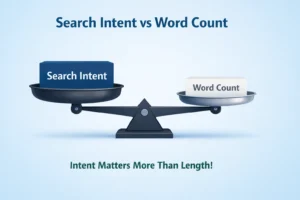
People love numbers because they feel solid. Word count is easy to measure, so it becomes a proxy for quality. But length is visible. Depth isn’t. That’s where the confusion starts.
Why “Longer = Better” Became a Lazy Rule
Longer pages often rank well, so people assumed length caused rankings. In reality, many of those pages simply answered more angles of the same query. They satisfied the broader intent. The word count was the result, not the reason.
When writers copy the length without understanding the intent, they chase surface metrics instead of substance. What actually matters is value per word. Every sentence should either clarify, solve, or move the reader forward.
Word count is an outcome of solving the problem fully, not a strategy to begin with.
If you want a practical way to determine the right length before you start writing, read how to decide blog post length based on search intent. It shows how intent signals shape ideal depth.
The Dangerous Shortcut: Writing to Hit 1,500 Words
Here’s where things go wrong. Writers start stretching.
They add long introductions, textbook definitions, obvious examples, and repeat the same point three different ways.
Compare this:
- 200 words: Direct answer, clear steps, immediate solution.
- 1,800 words: History, filler context, recycled advice, buried solution.
Both look different on paper. Only one respects the reader’s time.
Padding doesn’t create depth. It creates invisible thinness.
For a deeper take, read why long‑form content doesn’t always rank — it explains when length backfires.
What This Really Means for Rankings
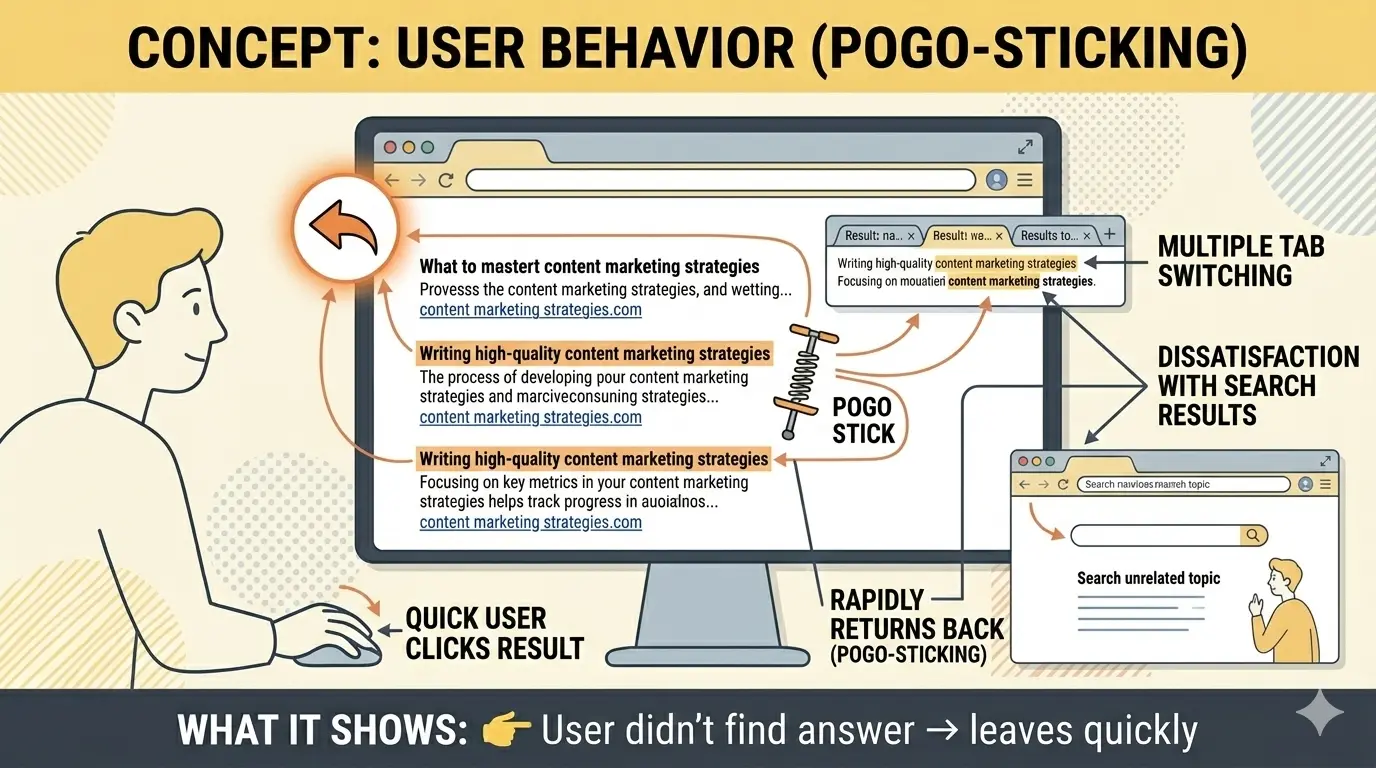
Search engines observe behaviour. If people click your page and return to results because they didn’t find what they needed, length won’t protect you. Clear answers keep readers. Confusion sends them away.
Satisfaction beats size.
So ask yourself: are you adding words, or adding resolution?
The Encyclopedia vs. The Sticky Note Framework
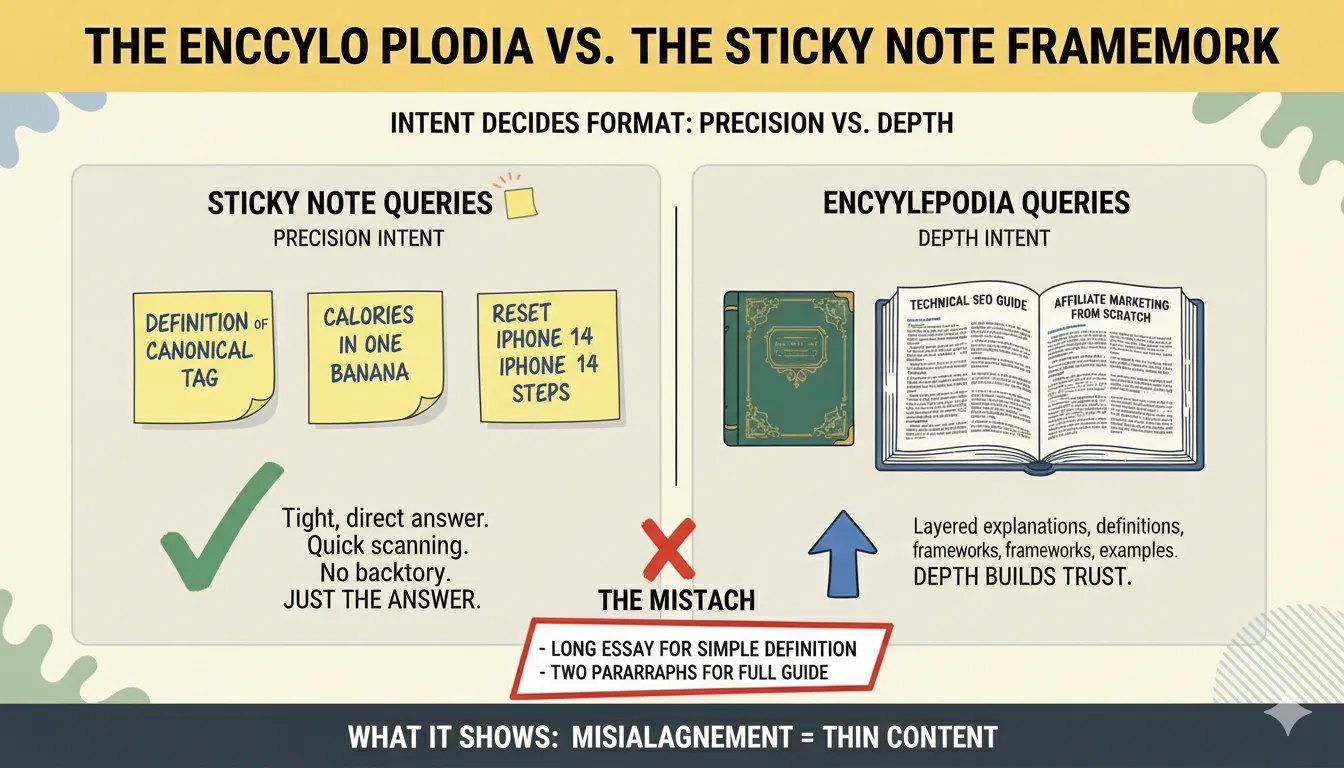
Intent decides format. Some searches want a single clear answer. Others want context, process, nuance. If you ignore that difference, you either over-explain something simple or under-deliver on something complex.
Sticky Note Queries (Precision Intent)
Examples:
- Definition of canonical tag
- Calories in one banana
- Reset iPhone 14 steps
These searches want precision. The reader is not browsing. They’re solving one small problem. The right response is tight, direct, and structured for quick scanning. No long backstory. No extended theory. Just the answer, clearly stated, possibly with short steps or a one-line explanation.
Encyclopedia Queries (Depth Intent)
Examples:
- Complete guide to technical SEO
- How to start affiliate marketing from scratch
These searches signal commitment. The reader expects layered explanations, definitions, frameworks, examples, and common mistakes. A surface-level answer feels incomplete. Here, depth builds trust because the intent demands it.
The Mistake That Creates Thin Content
The real issue is a mismatch.
Long essay for a simple definition. Two paragraphs for a full beginner guide.
That’s intentional misalignment.
If you’re unsure which path fits, check how long a blog post should be for SEO — it clarifies length by intent.
A Real-World Comparison: When 300 Words Beat 1,800
Here’s a quick field observation. Two pages targeted the same narrow query. Same keyword. Different philosophy.
Example keyword: What is keyword cannibalisation?
Page A (1,800 words): Opens with a long SEO history lesson, defines basic terms, adds strategy tips, tools, and case studies. The actual definition appears halfway down. It looks authoritative, but the user has to dig for the answer.
Page B (300 words): Defines keyword cannibalisation in the first 50 words. Adds a short explanation and one clean example. Stops.
Page B feels lighter but finishes the job faster. Users get clarity without scrolling fatigue.
When intent is narrow, efficiency wins.
🧪 Practical lab: the 2‑minute satisfaction audit
Open your draft in one tab and a clean notepad in another. Read only the subheadings. If you can’t predict what value sits under each heading, your structure is thin. Now read just the first sentence of every paragraph. If you’ve grasped the core message without reading the rest, your writing is tight.
Try it now: highlight every sentence that could be removed without losing meaning. If you remove more than 20% and the post still makes sense, you’ve found thin padding.
The Satisfaction Test: Before You Hit Publish
Theory is useful. But before you click publish, you need a simple way to check whether the page actually delivers. This is where most content fails. It sounds complete. It looks long enough. But it doesn’t feel satisfying.
Here’s the thing. Satisfaction isn’t about word count. It’s about closure. When someone lands on your page, they’re carrying a question. Your job is to remove friction and give them clarity without wasting their time.
Before publishing, run your draft through a quick test. Not a grammar check. Not a keyword scan. A satisfaction check. If the content passes, it’s ready. If it doesn’t, you know exactly what to fix.
Ask These 5 Questions
- Did I answer the main question immediately?
- Did I remove repeated explanations that say the same thing twice?
- Did I add at least one unique insight that isn’t obvious?
- Would I genuinely bookmark this if I found it elsewhere?
- If this page disappeared, would anything valuable disappear with it?
The “So What?” Filter
Fluff survives when nobody challenges it. After every paragraph, pause and ask what it changes for the reader. If it doesn’t deepen understanding, clarify a point, or move the idea forward, it’s filler.
After every paragraph, ask “So what?” If the answer is weak, cut it.
The Bottom Line: Respect Attention, Not Word Count
Here’s what it comes down to. Readers don’t care how long your article is. They care whether it solves their problem.
Short content that answers the question earns trust. Thin content that dances around it loses trust. Time is the real currency, and people feel when you waste it.
Length is not a strategy. It’s a side effect. When you solve a problem thoroughly, the right number of words appears on its own.
Stop chasing word counts. Start chasing clarity.
The Mic Drop
Short content respects time.
Thin content steals it.
Length simply reflects how much explanation the problem truly needs.
Don’t write to look comprehensive. Write to finish the job.
Frequently Asked Questions
Can a 2,000-word article still be considered thin content?
Yes. Length doesn’t protect you. If the piece repeats obvious points, skims the surface, or says nothing new, it’s thin no matter how long it is. Substance beats size every time.
Is short content risky for competitive keywords?
Not automatically. Competition depends on intent, not word count. Study what’s ranking and ask: do readers want depth or speed? Match the format to the expectation before you write.
How do I know if I’ve added enough depth?
Run a quick check. Did you include specifics, real examples, clear explanations, and at least one original angle? If you’ve answered both why and how where needed, you’re likely there.
Does updating old thin content require rewriting everything?
No. Sometimes tightening works better than expanding. Cut fluff, sharpen structure, add concrete examples, and clarify weak spots. Quality often improves without adding a single extra paragraph.
Can AI-generated content become thin even if it sounds polished?
Absolutely. Smooth writing can still be generic. When insights feel recycled, or experience is missing, thinness hides beneath polish. Add real examples or a distinct perspective to strengthen it.
— trust grows in systems, not silos —