
Why Matching Competitor Word Count Is a Mistake And What To Do Instead?
Most creators open top-ranking pages, scroll straight to the bottom, note the word count, and treat it like a ranking formula. If the leader has 2,800 words, they decide they also need 2,800. It feels logical. It’s also misleading.
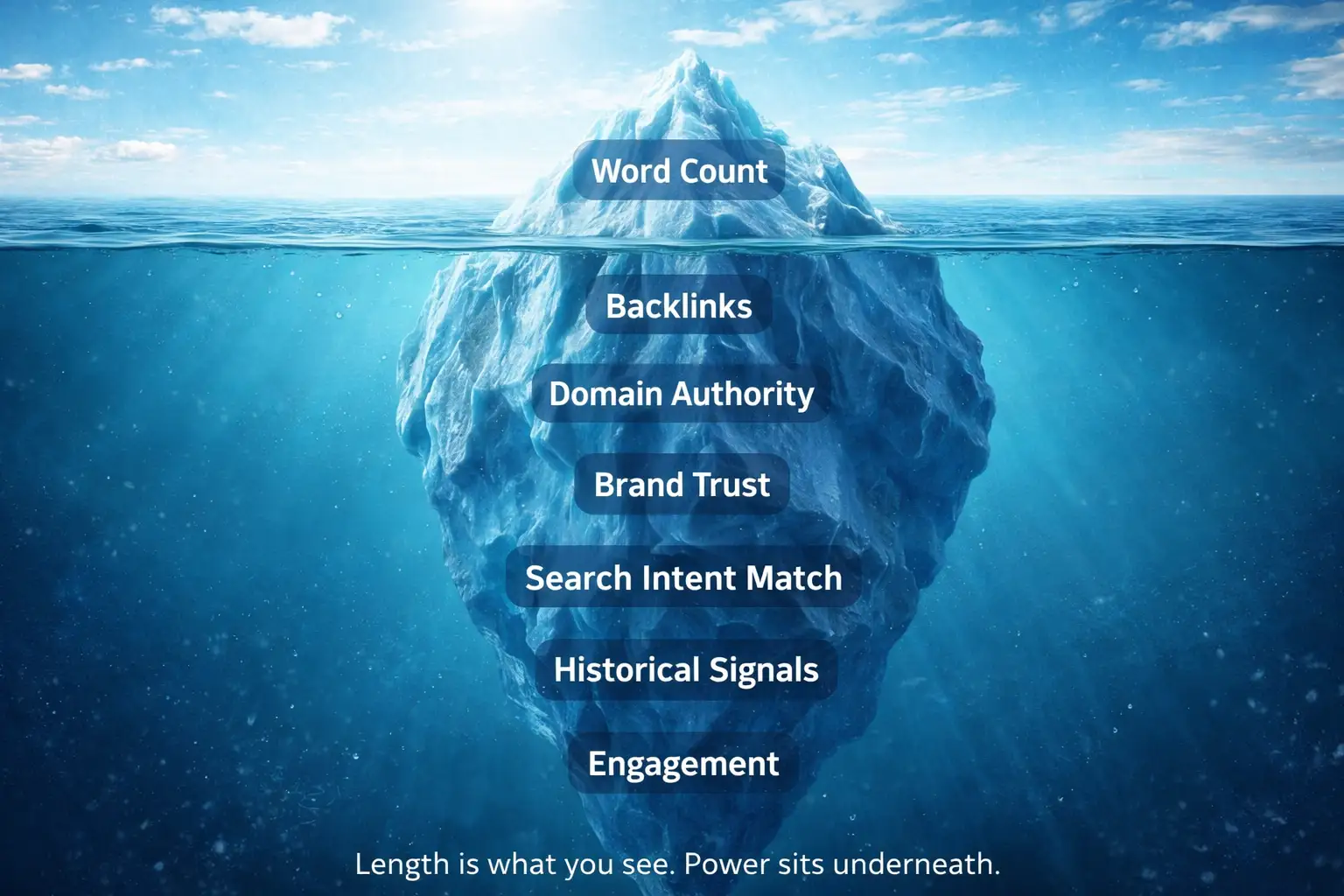
That 2,800-word page might rank because of backlinks, brand trust, and intent alignment, not because of length. When you copy the number without understanding the context, you copy the surface, not the substance. What this really means is you’re reacting to correlation, not causation.
Length is a visible metric, not a ranking signal.
Here’s the thing: matching word count ignores authority, content gaps, and what the reader actually needs. In this article, you’ll see why copying length backfires and what to focus on instead.
Quick Answer— Matching competitor word count is a mistake because rankings come from fully solving search intent with clarity and authority—not from copying someone else’s length.
📌 TL;DR — No Time? Read This.
Copying a competitor’s word count feels strategic, but it’s reactive. Rankings are built on authority, backlinks, intent alignment, and information gain — not hitting a number.
Here’s what actually matters:
Search intent depth > competitor length
Information gain > imitating structure
Clarity first, padding never
If you only match the surface, you’ll miss the engine underneath.
The “Visible Metric” Illusion That Tricks Smart Writers
Here’s what happens. You open the top three ranking pages, scroll straight to the bottom, check the word count, and quietly note the number. It feels productive. It feels analytical. But really, it’s just copying what’s easiest to see.
We gravitate toward visible metrics because they give us certainty. Length is measurable. You can count it, compare it, and match it. Authority, backlinks, engagement signals, and intent alignment? Those are harder to see, so they get ignored.
Word Count Is Easy to Measure — That’s the Problem
Most writers start with a simple habit: check how long the ranking articles are. If they’re around 2,500 words, that becomes the target. It feels logical.
But this is surface-level data. Word count is visible. Backlinks, brand strength, and user behaviour signals are not. What you’re seeing is the exterior of a system, not the engine underneath. For deeper context, read how long should a blog post be for SEO?
It’s like judging a restaurant by the size of its menu without knowing how good the food is.
Length is easy to copy. Ranking power isn’t.
You’re Copying the Outcome, Not the Cause
Think about someone with a great physique. You see the body. You don’t see the years of training, diet discipline, and recovery strategy behind it.
Ranking works the same way. A competitor ranks and happens to have 3,000 words. It’s tempting to assume the length caused the result. In reality, authority, links, brand trust, and historical performance may be doing the heavy lifting.
You’re imitating what’s visible instead of understanding what’s responsible.
Without that distinction, you’re guessing.
Why This Thinking Leads to Mediocre Content
When length becomes the goal, strategy disappears. Instead of asking what the reader actually needs, you ask how many words you need to match.
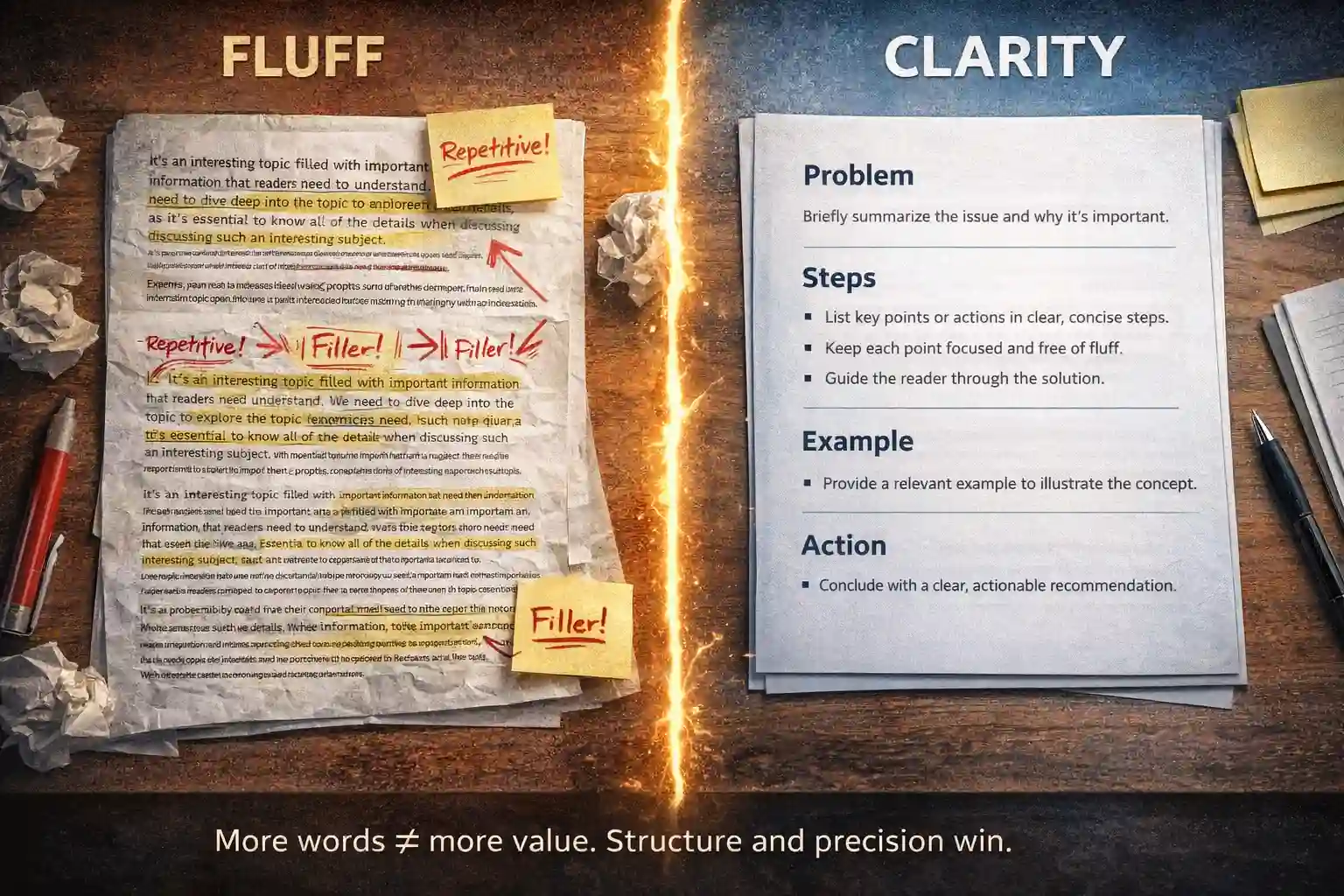
That mindset encourages padding. Extra sections. Rephrased ideas. Content that looks full but says very little.
Over time, originality fades. You’re no longer building something distinctive. You’re recreating what already exists.
And that’s how smart writers slowly become average competitors.
The Hidden Risks of Matching a Longer Competitor
Now let’s shift from mindset to outcome. The real damage of copying a longer competitor isn’t just wasted words. It quietly weakens clarity, focus, and publishing momentum.
The Fluff Expansion Effect
When a topic genuinely needs 1,100 words, but you stretch it to 2,200, padding sneaks in fast:
- Repeating the same definitions in different wording
- Over-explaining basics your reader already understands
- Adding side sections that don’t directly answer the query
Here’s what happens. The article becomes heavier without becoming smarter. Readers start scanning harder, skipping more, and trusting less. What should feel tight and useful begins to feel slow.
Clarity drops because the signal-to-noise ratio worsens. Important insights get buried under filler. The reader works more to extract value, and most won’t bother.
Clarity beats quantity.
Diluted Topical Focus
Someone searches for “fix crawling error.” They want a solution.
Instead, the article expands into a full SEO audit guide.
Now the scope has widened. The original problem gets lost inside broader explanations about site architecture, keyword mapping, and technical checklists. What started as a precise intent becomes a general discussion.
When the scope expands unnecessarily, relevance weakens. Search engines measure satisfaction, and readers measure usefulness. If the answer feels indirect, both lose confidence.
Precision wins. Expansion often backfires.
Higher Effort, Lower ROI
Stretching length increases cost:
- Writing time doubles
- Editing complexity increases
- Publishing frequency drops
What this really means is slower momentum. Instead of publishing two focused articles, you publish one bloated piece. Opportunity cost grows quietly.
Longer doesn’t always mean better. Sometimes it just means slower.
This is why long‑form content doesn’t always rank — depth only works when the topic demands it.
The Hidden Risks of Matching a Shorter Competitor
Short content ranking well can look like a shortcut. Here’s the thing: short isn’t automatically safe. Copying a smaller word count can quietly limit your ability to compete, especially when you don’t share the same authority signals as the page you’re copying.
The Under-Explanation Trap
A competitor ranks with 700 words. You publish 700 words. On the surface, it feels aligned.
But what you don’t see is their domain strength, backlinks, and existing trust. If they’ve earned links over the years, their 700 words carry more weight than yours. Equal length does not mean equal depth in Google’s eyes.
Imagine a finance blog with strong backlinks ranking for “how to start investing” in 700 words. If your newer site publishes the same length, you’re offering equal surface coverage without the credibility cushion. You likely need more context, examples, and clarity to compete.
Matching depth works only when the authority is equal. Most of the time, it isn’t.
Missing the “Information Gain” Opportunity
If the top results average 900 words and you also write 900, you’ve added nothing new. Ranking often improves when you identify what those pages skip. Maybe they explain what something is, but not common mistakes, or benefits, but not trade-offs. Expanding strategically means filling those gaps, not padding paragraphs. That added perspective is what creates separation.
Short Doesn’t Mean Sufficient
| Query | Real Need |
|---|---|
| Definition query | Short answer |
| Decision query | Detailed comparison |
Some searches truly require brevity. A definition can be solved in a few lines. But decision-based queries usually involve comparisons, risks, alternatives, and examples. When you match a short competitor without asking what the searcher is really trying to decide, you risk leaving key sub-questions unanswered. And that’s where stronger pages win.
Practical: Intent Map Exercise
Before your next post, draw a simple two‑column table: “What they ask” vs “What they actually need to do”.
Example — “fix crawling error”
❌ They ask: “what is a crawl error?”
✅ They need: step‑by‑step fix for each error type + tools to check.
Now scan top 3 results. If they only cover “what”, you’ve found your gap. Expand there, not in word count. This is how you build information gain without bloating.
What I Do Instead of Matching Competitor Word Count?
I stopped treating word count as a target. During research, I don’t even look at how long competing articles are. Once, I matched a competitor’s 2,500-word article. It took twice the time. Engagement dropped. The article felt bloated. That’s when I realised length wasn’t leverage. Now, I focus on the query itself and ask one simple question: what is the minimum information required to solve this completely? Not impressively. Completely.
From there, I think in terms of reader completion. At what exact point does someone finish the article and feel no need to open another tab? That’s the standard. Everything in the outline must move the reader toward that moment.
- Ignore total word count during research.
- Map the minimum information needed to fully solve the query.
- Define the reader’s completion point.
- Stop writing once the problem is fully resolved.
Sometimes that’s 900 words. Sometimes 1,800. Publishing gets faster, editing gets cleaner, bounce rate drops, and every paragraph earns its place. I control the depth. Competitors don’t.
What You Should Analyse Instead of Word Count?
Rankings are shaped by intent, coverage, and authority context, not by hitting 2,000 words because a competitor did. Let’s shift from copying length to understanding leverage. Here’s what actually deserves your attention.
Search Intent Depth, Not Length
Search intent defines depth. A quick definition query needs clarity and speed. A product comparison demands a structured evaluation. A troubleshooting query requires step-by-step fixes. The more complex the intent, the deeper the explanation must go. Length is a byproduct of solving the problem fully, not the starting goal.
Before writing, pressure-test intent with this checklist:
- What does the user want done, not just understood?
- What would success look like after reading this page?
- What questions would remain unanswered?
If your page resolves those clearly, you’ve matched depth. Extra paragraphs beyond that are noise.
For a deeper look at how Google evaluates usefulness beyond raw length, read Google usefulness beyond word count.
Content Gaps Across Top Results
Instead of copying structure, scan strategically.
- Identify repeating subtopics. If every top result explains the same three points, those are baseline expectations.
- Spot what’s missing. Look for unanswered angles, overlooked examples, or weak explanations.
- Check what’s outdated. Statistics, tools, or tactics may no longer reflect reality.
Your edge comes from filling gaps, not mirroring headings.
Authority Context
Sometimes a page ranks because the brand is strong, not because the content is longer. Established domains, niche relevance, and backlink strength often outweigh marginal word differences.
If you’re not operating with that authority cushion, you must win on precision, clarity, and usefulness.
Ask yourself: are you competing on length, or on leverage?
The Smarter Alternative: Intent-Led Content Planning
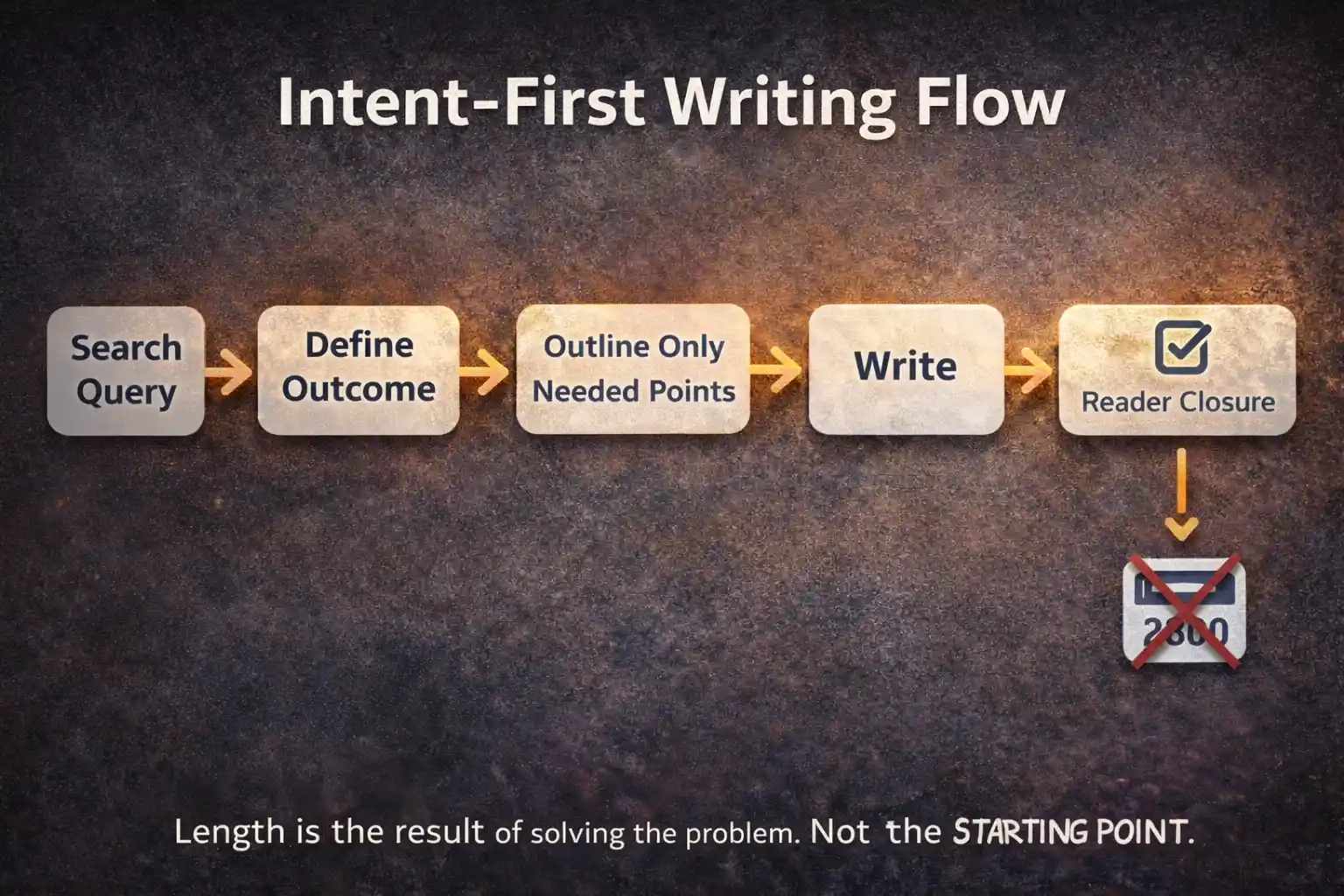
Here’s the better approach: plan around intent, not inches of scroll. Strong pages aren’t long because they rank. They rank because they solve something completely. When you anchor your structure to the reader’s desired outcome, length becomes a byproduct of clarity. That’s the shift.
Start With the Outcome, Not the Word Counter
- Define the reader’s exact end goal before outlining.
- List only the points that directly help them reach that goal.
- Stop writing once the goal is fully satisfied.
If it moves the reader forward, it stays. If it doesn’t, it goes.
Use the “So What?” Filter While Editing
After every section, pause and ask: Does this actually help the reader take the next step? If the answer feels vague, that section probably exists for you, not for them.
Cut explanations that repeat obvious ideas or stretch simple points into essays. Clarity beats volume every time.
If it doesn’t change the reader’s outcome, delete it.
Let Length Be the Result, Not the Target
Some topics genuinely need depth. Others need precision. The difference depends on complexity, not competition.
What this really means is simple: length should emerge from usefulness. When clarity drives structure, the right word count takes care of itself.
Final Thought: Stop Measuring Pages Like Rulers
Here’s the trap: copying a competitor’s word count feels strategic, but it’s reactive. You’re measuring surface numbers instead of the real value. Length is a byproduct, not a plan.
Strategy begins where imitation ends. Strong pages win because they answer intent better, not because they stretch to match someone else’s total. Readers reward clarity, relevance, and sharp thinking.
Before your next article, turn off the word counter.
Frequently Asked Questions
If word count isn’t a ranking factor, why do longer pages often rank higher?
Longer pages often rank because they cover broader intent, attract more backlinks, or sit on stronger domains. The length is usually a side effect of depth, not the reason for visibility. When a topic requires layered explanation, examples, and related subtopics, the page naturally expands. What this really means is simple: depth can create length, but length alone doesn’t create rankings.
Should I ever check competitor word count during research?
Yes, but only for context. It helps you understand how extensively others are covering the topic. The mistake begins when observation turns into imitation. Use it to interpret expectations, not to set a numeric target.
What if all top-ranking pages have similar word counts?
That similarity may signal how much depth the query demands. But your edge won’t come from matching the number. It comes from clearer structure, tighter explanations, and covering gaps others ignored.
Can writing shorter content hurt my chances in competitive niches?
Shorter content fails only when it leaves intent partially answered. Precision often beats bulk. If you solve the problem faster and more clearly, readers stay. That engagement is what matters.
How do I know when to stop writing?
Stop when the reader has closure. If no logical next question remains and new paragraphs only repeat earlier points, you’re done. Clarity is the finish line, not word count.
— trust grows in systems, not silos —