Why “Write for Humans” Is Not a Helpful Content Guarantee?
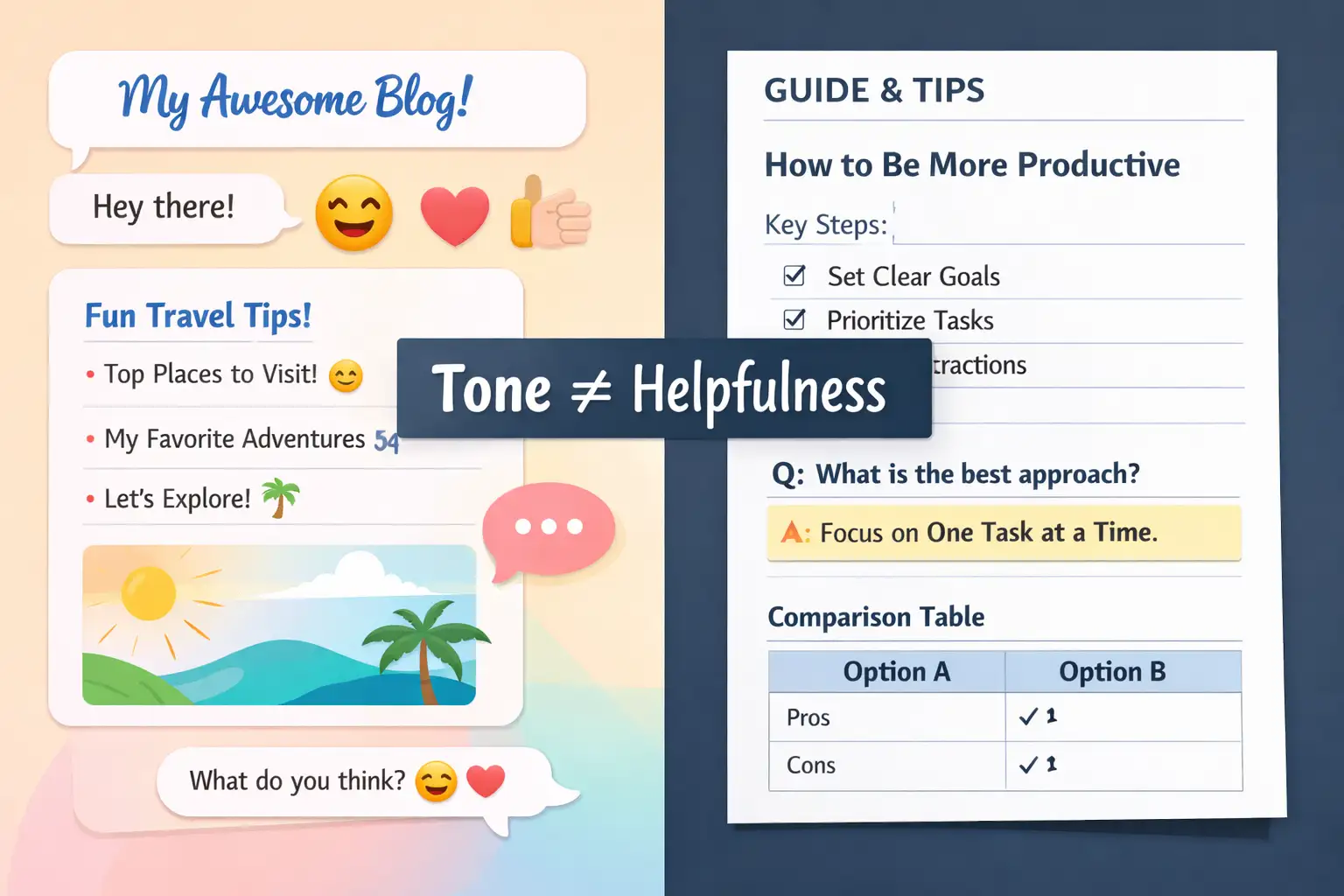
Writing for humans is necessary, but it is not a measurable framework for helpfulness. Tone alone cannot prove usefulness, depth, or intent alignment.
Here’s the thing. Many creators assume that sounding natural automatically satisfies Google’s people-first guidance. It doesn’t. Helpful content systems don’t evaluate warmth or personality. They assess whether the page genuinely solves a problem, demonstrates understanding, and matches search intent.
This article isn’t a criticism of Google’s guidance. It’s a clarification of how it’s often misunderstood. “Write for humans” is directionally correct, but incomplete as a strategy.
What this really means is that helpfulness is structural and evidential, not stylistic.
What This Article Will Clarify
- Why people-first does not equal conversational tone
- How is it evaluated beyond readability?
- The difference between intent alignment and engagement
- Why structure and substance outweigh writing style
📌 TL;DR
Writing for humans improves clarity and engagement, but it does not prove usefulness on its own. Search systems evaluate whether your page fully satisfies intent, delivers real depth, and adds information beyond what already ranks.
Tone supports trust and readability. Structure, task completion, and information gain determine competitive strength.
If your content does not solve the searcher’s problem clearly, completely, and efficiently, sounding natural will not make it rank.
What Google Actually Says About Helpful Content (Not What SEO Twitter Says)
Google’s guidance is clearer and more nuanced than social media summaries suggest.
“People-First Content” in Official Documentation
In public guidance from Google, Google Search Central, and the Google Search Quality Rater Guidelines, the language is consistent:
- Create helpful, reliable, and people-first content designed to satisfy real user needs.
- Demonstrate experience, expertise, authoritativeness, and trust in meaningful ways.
- Avoid producing content primarily to manipulate rankings or capture traffic.
This reads less like a checklist and more like directional guidance about intent and quality.
The Gap Between Direction and Evaluation
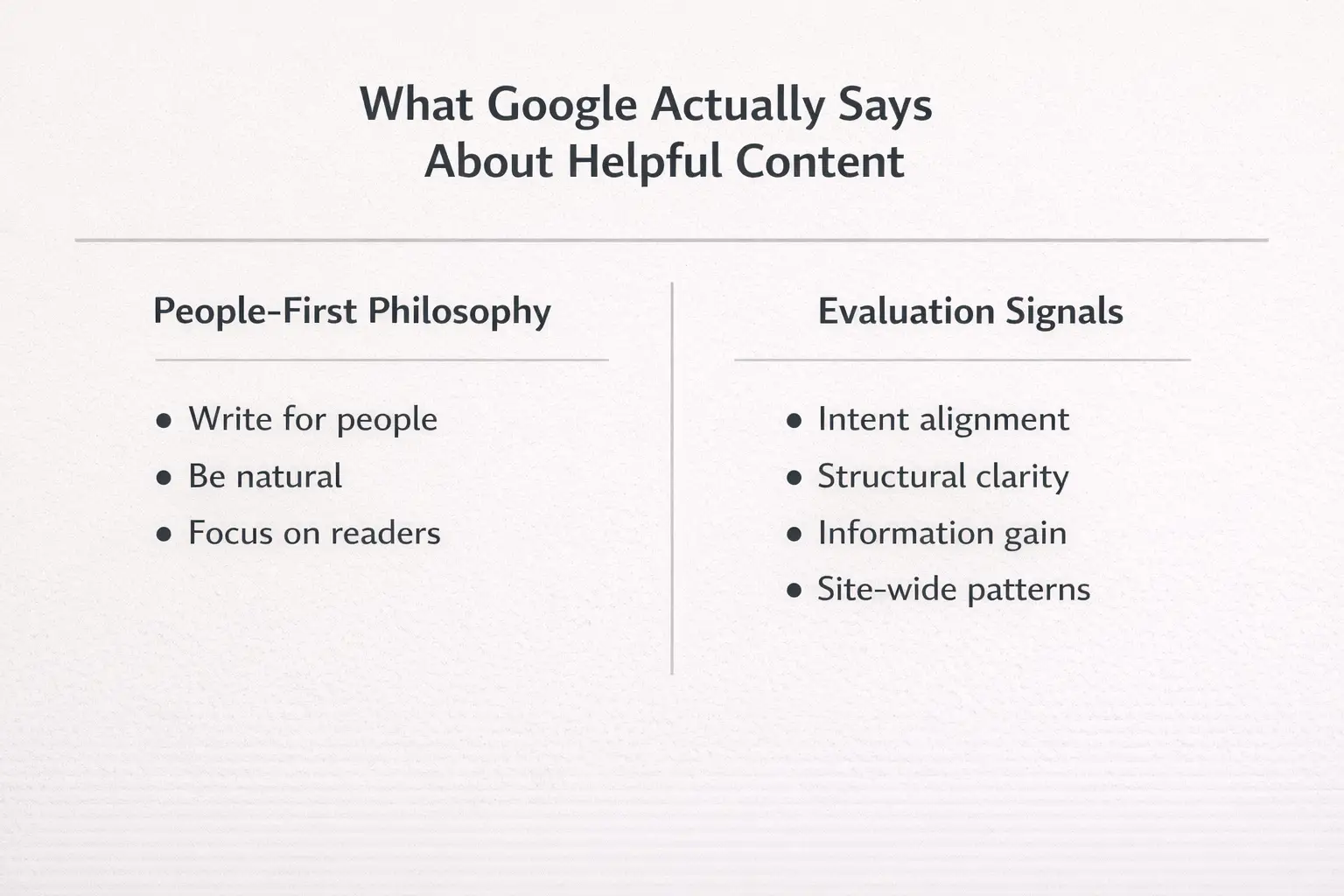
Here’s the thing: “write for people” is a philosophy, while ranking systems evaluate measurable signals such as intent alignment, structure, clarity, and site-wide patterns. Tone alone is not a ranking factor; usefulness is inferred from how well a page solves the searcher’s problem.
Philosophy → Write for people
Evaluation → Intent match, structure, site signals
Why “Write for Humans” Became Oversimplified Advice
SEO communities often compress complex documentation into short slogans. It makes guidance easier to repeat, but harder to apply correctly.
It’s similar to motivational advice: inspiring in theory, vague in execution. Without operational detail, “write for humans” becomes interpretation, not strategy.
Why Human-Friendly Writing Can Still Fail to Rank?
You can write clearly, sound natural, and still watch your page sit nowhere near the top results. Here’s the thing: ranking is not a reward for sounding human. It is a response to usefulness. And usefulness is measured by what the reader can actually do after reading your page.
Intent Satisfaction Is the Real Test
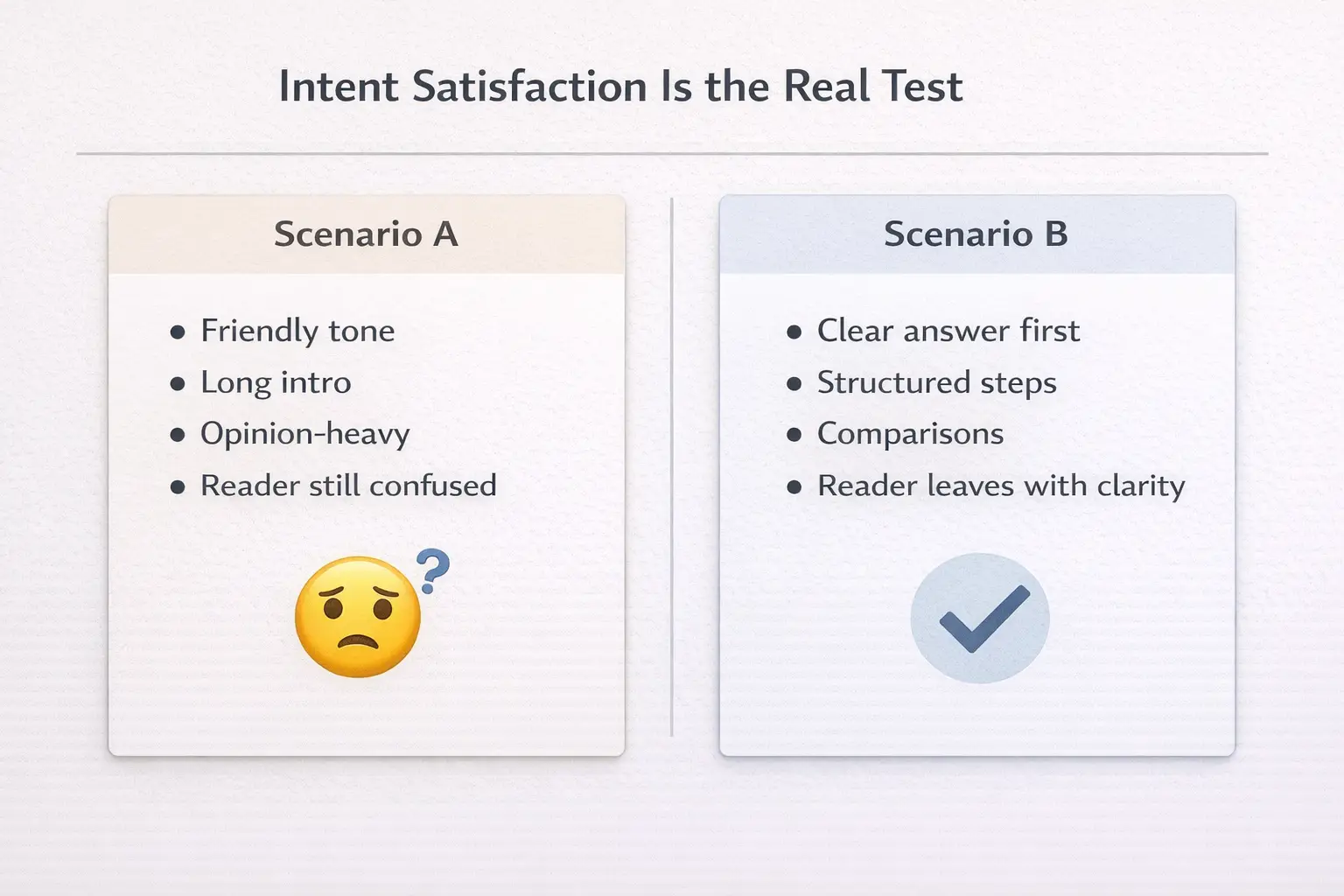
Search engines evaluate whether your page truly solves the user’s problem. Does it answer the query immediately? Does it resolve the task fully? Does it remove ambiguity instead of adding more?
Scenario A: A friendly article explains a topic casually, shares opinions, and circles around the question. The reader enjoys it but still needs another page to get a direct answer.
Scenario B: A structured guide opens with a clear definition, outlines steps, compares options, and addresses common confusion. The reader finishes with clarity and action.
The difference is not the tone. It is task completion.
If a page fails to satisfy intent, friendliness will not save it.
Warm Tone ≠ Depth of Coverage
A conversational style can make reading smoother, but smooth is not the same as thorough. Depth means covering the topic from multiple angles and anticipating what the reader might ask next.
Real depth includes:
- Clear comparisons between alternatives
- Simple frameworks to organise thinking
- Edge cases and exceptions
- Practical steps for real-world use
Without these layers, content feels pleasant yet incomplete.
Readability Is Only One Layer of Helpfulness
Short sentences and simple language improve user experience. They reduce friction. But clarity alone does not prove authority, originality, or completeness.
Readable content that lacks substance is still shallow.
Site-Wide Signals Can Override a Good Page
Helpfulness is not judged in isolation. One strong article cannot hide broader weaknesses.
If your site lacks topical focus, shows inconsistent expertise, or contains many thin pages, those patterns affect perception.
Quality is evaluated at scale, not just page by page.
What “Helpful” Actually Means in Measurable Terms?
Clear Intent Match
Helpfulness starts with alignment. Before writing a single paragraph, you need to define the dominant search intent. Is the query informational, transactional, or navigational? Each demands a different structure. An informational query needs explanation and clarity. A transactional query needs comparison, proof, and friction removal. A navigational query needs precision and direct access. When structure ignores intent, even good writing feels irrelevant.
Ask yourself:
- What action or understanding is the user trying to achieve?
- Does the introduction address that goal immediately?
- Is the layout built around completing that task efficiently?
Demonstrated Experience (Not Just Opinion)
There’s a big difference between sounding confident and proving competence. Anyone can state an opinion. Helpfulness increases when insight is backed by application, comparison, or process detail. This is where practical experience and E-E-A-T quietly influence quality.
Example contrast one: “I think this tool is effective.”
Stronger: “Here’s how I used this tool in three scenarios, and where it failed.”
Example contrast two: “This strategy improves traffic.”
Stronger: “When applied to long-tail queries, traffic increased because it reduced competition and clarified intent.”
The more observable your reasoning, the more credible and useful the content becomes.
Structural Helpfulness (Cognitive Ease)
- Immediate answer or summary near the top
- Clear, scannable subheadings
- Logical flow from problem to solution
- No decorative or vague section titles
When readers can find what they need without effort, engagement increases, and friction disappears.
Information Gain Over Repetition
If your article simply rearranges what already ranks, there’s no reason for it to outrank anything. Search engines look for information gain. That means offering a new angle, reframing a common idea, or applying insight to a specific context that others ignore. Applied analysis creates depth. Fresh synthesis creates differentiation.
If you don’t add value beyond the current top results, you won’t replace them.
This is exactly why long‑form content doesn’t always rank → — length alone never replaces originality and depth.
Turning the Cliché Into Something Actionable
Everyone says write for humans, but almost nobody explains what that actually looks like in practice.
The Vague Advice vs The Practical Pivot Table
| Vague Advice | Practical Upgrade |
|---|---|
| Write naturally | Write to be scanned |
| Focus on readers | Map friction points |
| Be authentic | Take a position |
| Quality over quantity | Increase information density |
The shift is subtle but powerful.
Write naturally sounds nice, but writing to be scanned forces structure. You think in subheadings, short paragraphs, and clean visual breaks instead of long, wandering blocks of text.
Focusing on readers feels abstract. Mapping friction points is concrete. It pushes you to spot confusion, objections, and unanswered questions instead of assuming clarity.
Being authentic sounds admirable, but it’s vague. Taking a position is different. It demands clarity. It carries risk. It makes the writing sharper.
Quality over quantity feels motivational. Increasing information density is practical. It forces tighter sentences and more insight-packed paragraphs.
Here’s the thing: once advice becomes specific, it becomes measurable.
- You can audit the scanning flow.
- You can list friction points.
- You can count redundant lines.
What this really means is improvement stops being subjective. It becomes trackable.
The “Fast Answer” Architecture
Most readers want clarity before context. Give it to them.
- Start with the conclusion. Answer the question directly in the first lines.
- Follow with an explanation. Show why the answer makes sense.
- End with expansion. Add nuance, examples, or edge cases.
When readers get value immediately, they stay for the depth.
The “Zero-Fluff” Filter
Before publishing, cut what doesn’t move the answer forward.
- Remove dictionary definitions.
- Delete generic introductions.
- Trim repeated summaries.
If a sentence doesn’t add clarity or insight, it goes.
The 2026 Layer: Why Utility Beats Tone in Modern Search Systems
From Helpful Content System to Experience & Utility Signals
Search systems have moved far beyond simply asking whether content sounds helpful. Early iterations of helpful content systems focused on intent alignment and avoiding thin pages. Now the evaluation goes deeper. Modern models analyse structural patterns, topical coverage, internal consistency, and whether the piece actually resolves the query without forcing the reader to hunt for answers.
What this really means is that utility is measurable. Depth is inferred through semantic layering. Clarity is tested through structure, not adjectives. Pages that anticipate follow-up questions, reduce ambiguity, and organise information logically send stronger signals than pages that just sound friendly or conversational.
Entity & Context Signals Matter More Than Friendly Voice
Authority today is contextual. When you reference tools like Google Search Console within the broader ecosystem of Google, you signal lived understanding rather than surface commentary. Systems recognise whether you understand how platforms connect, not just how to describe them politely.
- Referencing platform tools in a functional context
- Explaining relationships between systems
- Demonstrating applied ecosystem knowledge
The Human-Machine Interface Reality
Modern search systems model human evaluation patterns at scale. They scan structure, detect friction, and compare information density across pages. At the same time, real users skim fast and abandon quickly. You are writing for two evaluators: algorithms that parse structure and humans who demand clarity immediately. Utility satisfies both.
A Practical Checklist Before You Hit Publish
Before you publish, slow down and run this quick clarity check.
The 8-Point Helpfulness Test
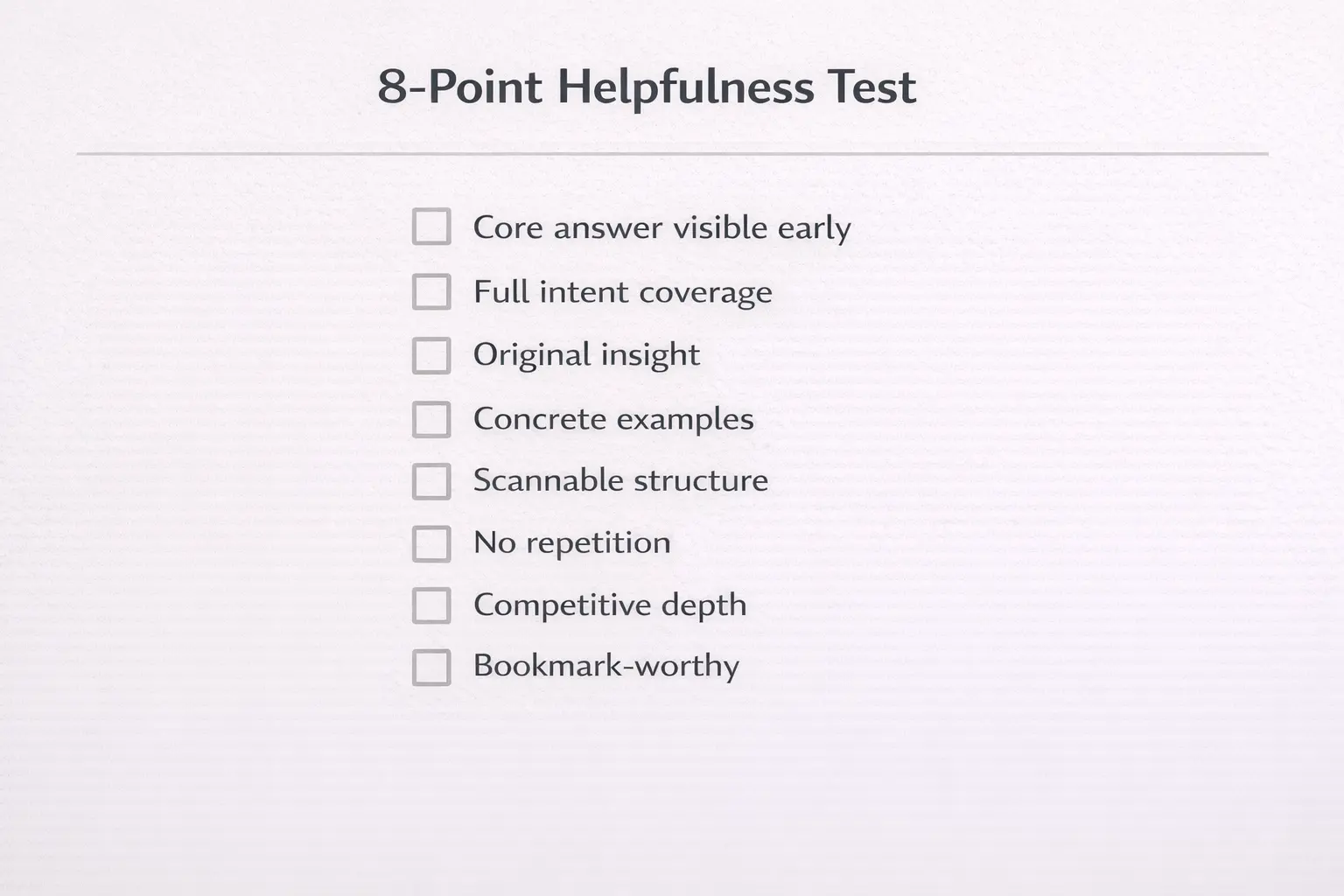
Use this as a final filter, not a formality.
- Is the core answer visible in the first 15%, or are readers forced to scroll?
- Does the piece solve the full search intent, including hidden follow-up questions?
- Is there an original angle, insight, or framing that adds something new?
- Are examples specific and concrete rather than vague generalities?
- Is the structure easy to scan with tight paragraphs and clear subheads?
- Have you removed repeated ideas that dilute impact?
- Would this genuinely compete with the current top five results?
- Is it strong enough that someone would save, share, or bookmark it?
If you hesitate on more than one, revise before publishing.
Conclusion: Writing for Humans Is the Starting Line, Not the Finish Line
Writing for humans makes your content easier to read. It sharpens clarity, improves flow, and keeps people engaged. That matters. But readability alone does not make something genuinely helpful. A friendly tone without substance is still thin. If the intent behind the search is not understood and answered with precision, the content falls short, no matter how smooth it sounds.
Real usefulness demands alignment with search intent, structured thinking, clear explanations, and credible support. Depth shows effort. Evidence builds trust. Structure reduces friction. This is what search engines measure through engagement and satisfaction signals. Writing for humans gets you on the track; demonstrable usefulness wins the race.
Frequently Asked Questions
Is “Write for Humans” still important for SEO?
Yes, but it’s foundational, not sufficient. Clear writing improves engagement and trust, yet rankings depend on intent match, depth, and structural clarity that fully satisfies the searcher.
Can conversational tone improve rankings?
Not directly. A natural tone can improve user experience and engagement signals, but tone alone does not create measurable usefulness or stronger search positioning.
Why does my helpful article still not rank?
Because helpful intent alone does not guarantee competitive strength.
• Incomplete intent match
• No clear information gained
• Weak structure or formatting
• Competitors covering more depth
Does Google evaluate content page-by-page or site-wide?
Both matter. Individual pages are evaluated for intent satisfaction and quality, but consistent topical focus, overall site patterns, and credibility signals influence how helpful your content is perceived.
What is the biggest mistake bloggers make with “people-first” content?
They confuse friendly writing with proven usefulness. Real value comes from structured depth, evidence, clarity, and solving the exact problem better than competing pages.
📎 Google’s official guidance: creating helpful content
— utility wins over tone, every time. —