How Does Google Handle Contradictory Information Across Your Site?
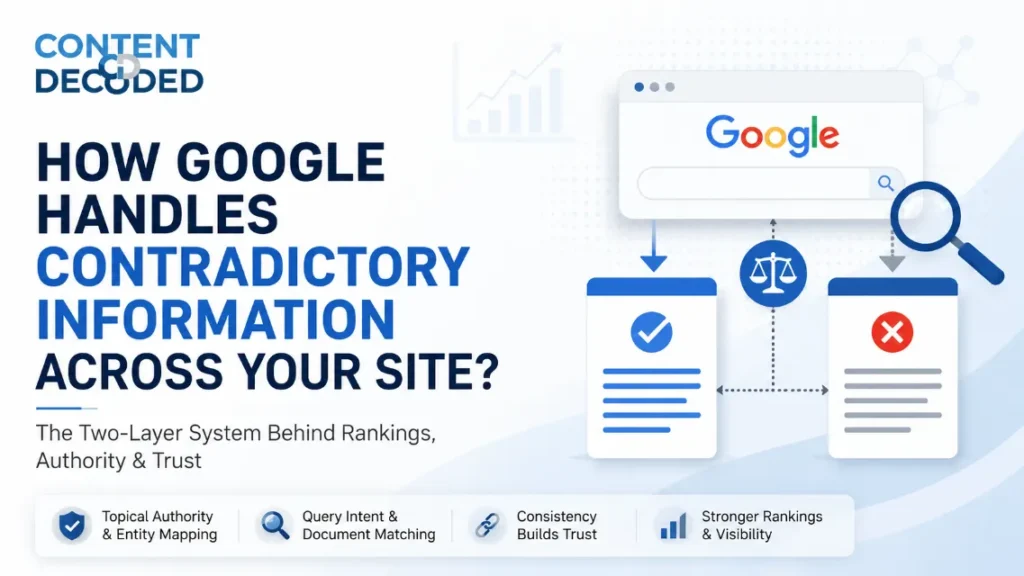
When one page on your site contradicts another, Google checks which version aligns with widely accepted information across trusted sources and ranks that one while ignoring the conflicting page.
Even if a query seems to match the weaker or incorrect page, Google usually avoids showing it and instead prefers the safer, more accurate answer. However, these contradictions still affect your site overall by weakening topical authority, confusing entity mapping, and reducing trust at the domain level, which can impact rankings beyond just those specific pages.
The Two-Layer System Behind Every Ranking Decision
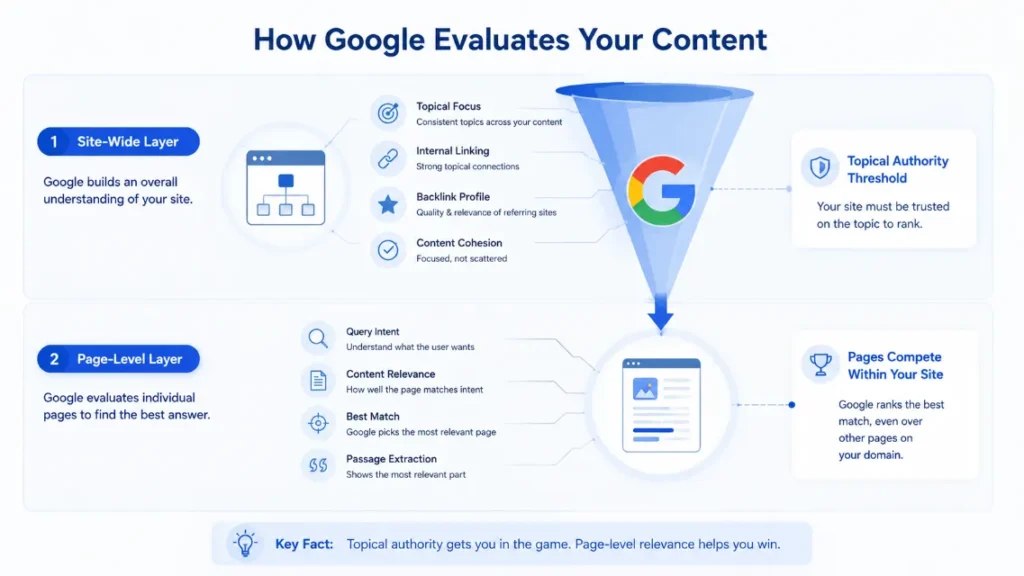
Google’s ranking system works in two clear steps, and each one has a very different role.
(Can this site rank here?)
(Which page should show?)
The first step is about eligibility. It answers whether your site deserves to rank in a topic at all.
The second step is about selection. It decides which exact page should appear for a specific query.
Both are always active in the background, and when your content is not aligned, they start pulling in different directions.
The Site-Wide Layer: Topical Authority and Entity Mapping
Before Google even considers showing one of your pages, it tries to understand what your website represents as a whole.
It is not focused on a single article here. It is looking at patterns across your entire site to answer a simple but important question:
What kind of site is this, and what topics can it be trusted on?
What Google is Actually Evaluating Here
At this level, Google builds a broad picture of your site using signals such as:
- The topics you cover again and again across different pages
- How your pages are connected through internal links
- The type and quality of websites linking to you
- Whether your content feels focused or scattered across unrelated subjects
All of these signals combine to form a kind of identity for your site.
The Authority Threshold Problem
Every site develops a boundary around what it can rank for easily.
For example, if your site consistently publishes about footwear, over time Google begins to associate your domain with topics like shoes, materials, sizing, and care. That becomes your natural area of strength.
Now if that same site suddenly publishes content about something completely different, like investment strategies, it struggles. Not because the page is poorly written, but because it does not fit the established identity of the site.
This is why topical authority matters so much.
It’s not enough for a page to be good on its own. It needs to make sense within the larger structure of your site.
The Page-Level Layer: Document Matching and Query Intent
Once your site clears that first layer and is considered relevant for a topic, Google moves to the second step, where it focuses on individual pages.
At this stage, the goal becomes very specific:
- Understand exactly what the user is searching for
- Checking if that query have different meaning
- Find which one is the dominant meaning for that query
- Find the page that best answers that query
- Extract the most relevant part of that page
This is where rankings are decided in real time. It is also the process of selecting sources for AI overviews.
The Key Idea: Pages Compete Inside the Same Domain
Even within your own site, pages compete with each other.
If you have multiple pages covering similar topics, Google has to choose which one is the best fit for a particular search. When those pages say similar things, it’s manageable. When they say different things, it creates a deeper problem in trust, ranking and authority.
The Snippet Problem: When Your Site Disagrees With Itself
Let’s take a simple example.
Your site has two pages:
- One page explains that leather shoes stretch over time
- Another page explains that leather shoes do not stretch much
Now imagine different users searching:
- “Earth has two moons.”
- “Earth has one moon.”
Google checks which page aligns with widely accepted information across trusted sources. It selects the page that is considered correct based on consensus and shows only that page in the results.
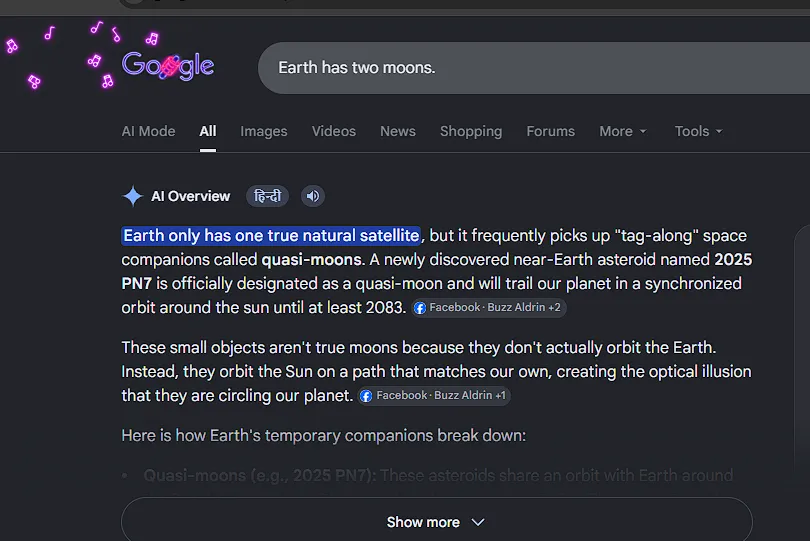
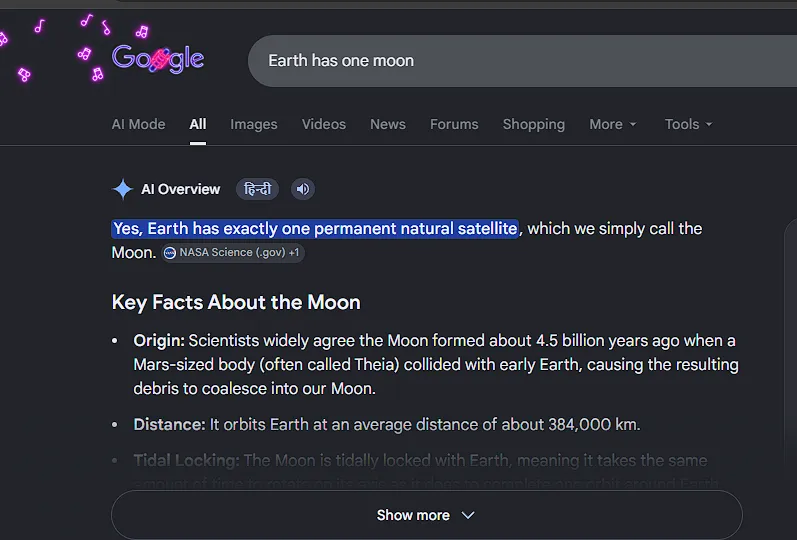
The screenshots show that Google’s AI Overview prioritises factual accuracy over a user’s biased or incorrect framing. When searched with the correct statement, “Earth has one moon,” the AI simply confirms the fact. When given the false premise, “Earth has two moons,” the system doesn’t validate the error; instead, it immediately corrects the claim by stating Earth only has one true natural satellite, before usefully explaining the nuance regarding temporary “quasi-moons” like 2025 PN7.
The conflicting or incorrect page is ignored and not included, even if the query wording seems to match it.
What this leads to
- Only the correct page appears in search results
- The incorrect or conflicting page gets filtered out
- Users see a single, consistent answer instead of mixed signals
Over time, this still creates a problem where your website appears inconsistent at a deeper level, even if Google hides the weaker page from search results.
The Real Risk: Breaking Your Entity Map
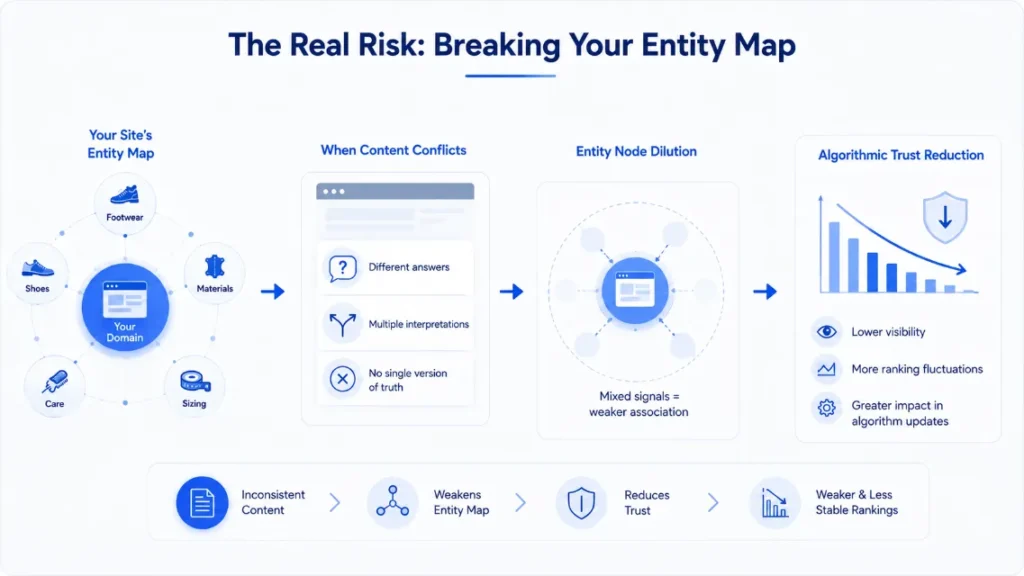
This is where the issue moves beyond content and into structure.
Google builds a structured understanding of your site, often described as an entity map. You can think of it as a network that connects your domain to specific topics and ideas.
When your content is consistent, this network becomes stronger and easier for Google to trust.
When your content conflicts, that structure starts to weaken.
What Actually Happens Inside that Map
Instead of reinforcing a clear understanding, your site begins to show:
- Different answers to the same question
- Multiple interpretations of the same topic
- No single clear version of truth
This makes it harder for Google to confidently associate your site with a specific idea or expertise.
Dilution of the Entity Node
When your content sends mixed signals, Google struggles to define what your site truly stands for.
Instead of seeing your site as a strong and reliable source on a topic, it begins to treat it as a site that covers the topic but without consistency.
This doesn’t immediately remove your rankings, but it reduces their strength and stability over time.
Algorithmic trust reduction
Consistency is one of the easiest ways for Google to measure reliability.
When your site frequently contradicts itself, it suggests problems like:
- Outdated content not being maintained
- Lack of clear editorial direction
- Weak control over how information is published
This leads to gradual effects such as:
- Lower visibility in competitive searches
- Increased ranking fluctuations
- Greater impact during algorithm updates
- Your content will not ranking well
It is not a penalty. It is a slow drop in trust.
Why Contradictions Matter More Than Keyword Cannibalization
Many people treat this issue as simple keyword cannibalisation, but that only explains part of the problem.
Cannibalisation is about multiple pages competing for the same keyword. Contradiction goes deeper because it affects how trustworthy those pages appear.
Key difference
| Issue | What happens |
| Cannibalization | Google chooses between similar pages |
| Contradiction | Google becomes less confident in both pages |
When pages are similar, Google can pick one.
When pages disagree, Google starts questioning the source itself.
That difference is what makes contradictions more damaging in the long run.
The Hidden Cost: Unstable Ranking Behavior
One of the most noticeable signs of internal contradictions is instability.
You might see patterns like:
- A page ranking well for a while and then dropping suddenly
- Another page from your site replacing it
- Traffic shifting between similar pages
- Snippets changing frequently
Why this happens
Because your site does not present a single clear answer, Google keeps testing different pages to see which one works better for different queries.
This constant switching creates unstable performance, even if your content is strong.
Why Google Doesn’t “Fix” Contradictions For You
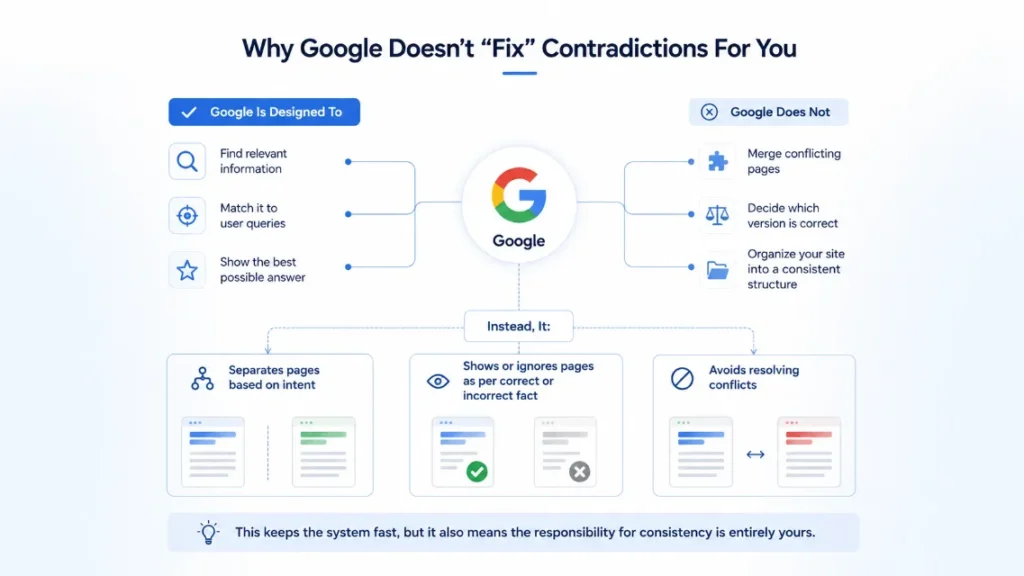
It’s important to understand that Google is not designed to clean up your content.
Its role is to:
- Find relevant information
- Match it to user queries
- Show the best possible answer
It does not try to:
- Merge conflicting pages
- Decide which version is correct
- Organize your site into a consistent structure
Instead, it takes a simpler approach:
- It separates pages based on intent
- It shows and ignores pages as per correct or incorrect fact
- It avoids resolving conflicts
This keeps the system fast, but it also means the responsibility for consistency is entirely yours.
How To Prevent Internal Contradictions From Weakening Authority
To maintain a strong and reliable site, the goal is straightforward:
Each topic should have one clear and consistent version of truth.
This doesn’t mean removing nuance. It means avoiding fragmentation across multiple pages.
Practical structure that prevents contradictions
| Situation | What to do |
| Pages give different answers to the same question | Keep the correct version and update or remove the conflicting one |
| Old content conflicts with updated facts | Fix the original page instead of publishing a new, separate version |
| Same topic explained differently across pages | Standardize the explanation and align all pages to one clear answer |
| Content written by different authors creates mixed messaging | Review and unify tone, facts, and conclusions across pages |
| Genuine topic has two valid sides | Present both viewpoints clearly within a single page instead of splitting them |
What this achieves
- Stronger authority signals
- Clear ownership of topics
- More stable rankings
- Better understanding for both users and search engines
The RAG and AI Overview Shift: Why This Problem Is Now Bigger
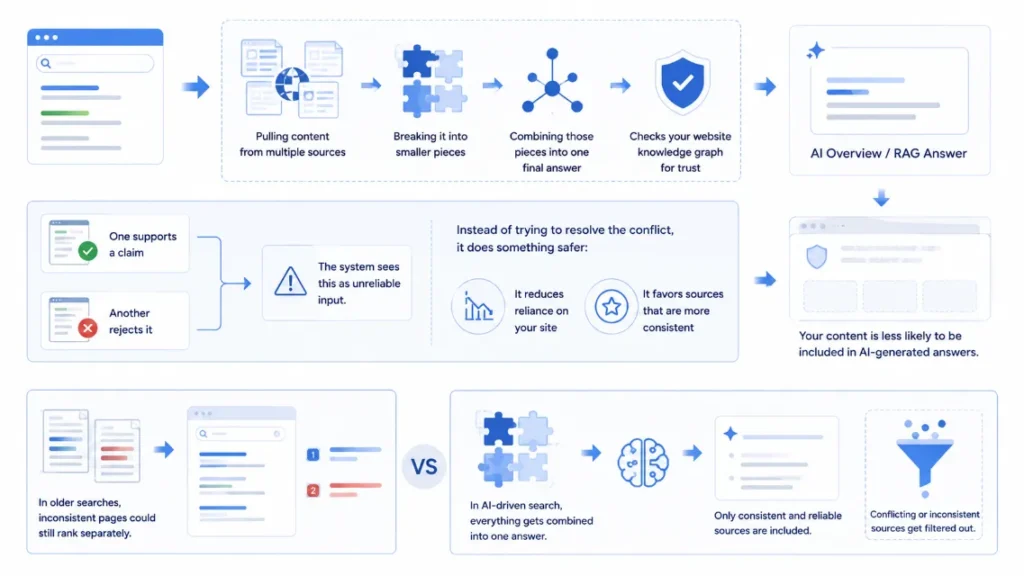
Everything discussed so far was already important in traditional search.
But with AI overviews and RAG-based systems, the impact of contradictions has increased.
What changed
Google is no longer just ranking pages. It is now:
- Pulling content from multiple sources
- Breaking it into smaller pieces
- Combining those pieces into one final answer
- Checks your website knowledge graph for trust
This means your content is no longer judged only as a full page but also as small chunks inside a larger answer.
What happens when your site contradicts itself in this system
If Google pulls two conflicting pieces from your site:
- One supports a claim
- Another rejects it
The system sees this as unreliable input.
Instead of trying to resolve the conflict, it does something safer:
- It reduces reliance on your site
- It favors sources that are more consistent
The outcome
- Your content is less likely to be included in AI-generated answers
- Your visibility drops even if rankings remain
- Competitors with cleaner structure get preferred
Why consistency now affects visibility, not just rankings
In older searches, inconsistent pages could still rank separately.
In AI-driven search, everything gets combined into one answer.
This means:
- Consistent sites get included
- Conflicting sites get filtered out
Not because they are wrong, but because they are not stable enough to trust in a combined answer.
The Real Takeaway
Google ranks pages, but it trusts sites. If your pages stay consistent, rankings become stronger and stable. If they contradict, even correct pages lose strength over time.
Quick Contradiction Audit (Use This on Your Site)
Instead of just understanding the problem, here’s a simple framework you can use immediately to find and fix contradictions on your site.
Pick any important topic and run this check:
Step 1: Find overlapping pages
Search in Google:
site:yourdomain.com “your topic”
Look for pages covering the same idea. It will also help to know if Google trusts your website for that topic or not.
Step 2: Compare answers directly
Open each page and check:
- Do they give the same conclusion?
- Are there conflicting statements?
- Is one page clearly outdated?
If the answer is “yes” to any conflict, you’ve found a problem.
Step 3: Fix using this rule
| Situation | What to do |
| Two pages say similar things | Merge into one stronger page |
| Two pages contradict each other | Keep the correct one, remove or update the other |
| Old vs new information | Update the old page instead of keeping both |
| Multiple weak pages | Combine into one complete guide |
Step 4: Lock a “single source of truth”
For every topic, decide:
- One main page
- One clear answer
- Everything else supports or redirects to it
Simple rule to remember
If two pages can answer the same question, you don’t need both.
That one change alone fixes most contradiction problems and strengthens your rankings faster than creating new content.
 Add Content Decoded as a preferred source