Meta Title vs H1: What’s the Real Difference, and When Should They Be Different?
Open any CMS, and you’ll see two fields: Meta Title and H1. Many site owners assume they must be identical, so they copy the same text. If both describe the page, why do two versions exist?
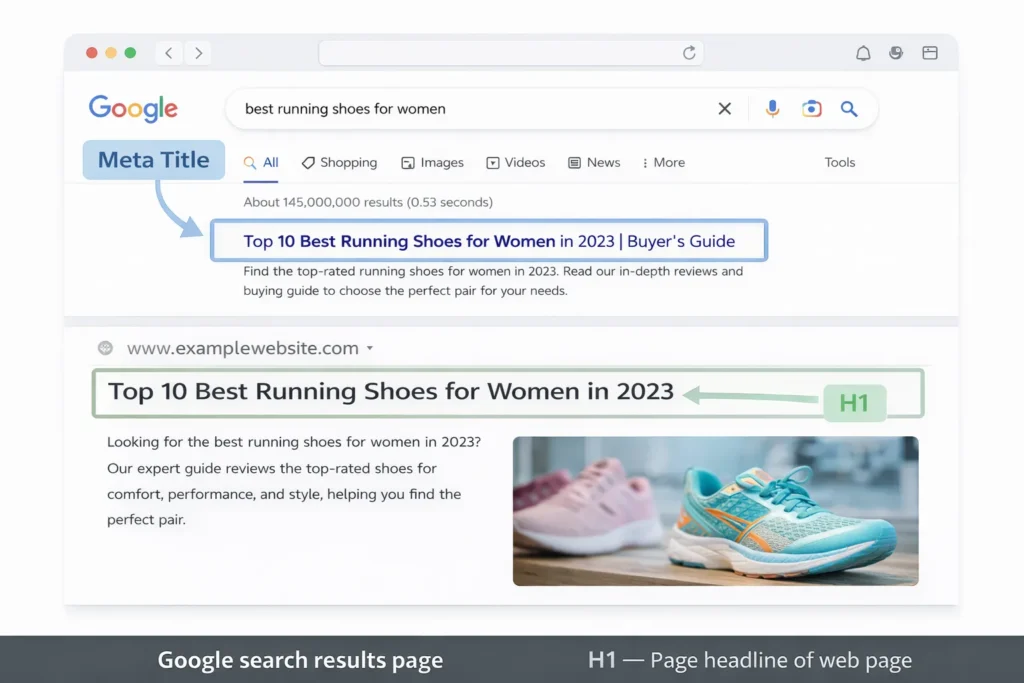
The reason is simple: they serve different roles. Meta Title appears in search results and drives clicks. H1 sits on the page and confirms the topic for readers and search engines.
Meta title wins the click. H1 keeps the reader.
Meta Title vs H1: The Differences That Actually Matter
Many people assume Meta Titles and H1s are the same thing with different names. They’re not. The difference isn’t technical; it’s strategic: one convinces someone to click, the other reassures them they’re in the right place.
| Feature | Meta Title | H1 |
|---|---|---|
| Where users see it | Search results | On the webpage |
| Main goal | Earn the click | Confirm the topic |
| Length limit | ~60 characters | Flexible |
| Audience | Searcher | Reader |
| SEO role | Ranking + CTR | Context + structure |
What this really means is simple. The meta title works before the visit, shaping visibility and click-through rates. The H1 works after the click, guiding readers and reinforcing relevance. Treating them as separate strategic elements helps both search performance and user experience.
Why Do People Confuse Meta Titles and H1 Tags in the First Place?
Confusion around meta titles and H1 tags happens because both often use similar wording. One appears in search results, the other sits on the page, yet many editors show them together.
They Often Look Identical in CMS Editors
In many CMS dashboards the SEO title field sits near the page heading, making them look like duplicate settings.
SEO plugin field labelled ‘SEO title’
The page editor auto-generating the H1
Blog templates repeating the same title
Google Sometimes Rewrites Titles Using H1
Search engines sometimes replace the meta title if it looks misleading or overly optimised compared with the page heading.
What triggers rewrites
Clickbait titles
Keyword-stuffed titles
Titles not matching page content
This is why both elements should clearly reflect the same topic online always.
Meta Title Explained: The Text That Competes in Search Results

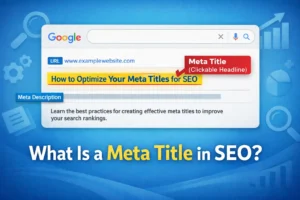
A meta title is the clickable headline users see before choosing a search result. It’s the first impression your page makes in search engines. If it doesn’t attract attention, people simply scroll past it.
If you’re setting this up for the first time, follow this guide on how to add a meta title
.Where Meta Titles Actually Appear
Meta titles appear in several places across the web and interface. While they help search engines understand the page, their main job is persuading humans who are still deciding what to click.
You’ll usually see them in:
Search engine results pages
Browser tabs
Social link previews (sometimes)
In practice, the meta title functions like an ad headline competing against other results.
The Real Goal of a Meta Title: Winning the Click
The main goal is improving click-through rate (CTR). Your title sits beside about nine competing results, so it must communicate value instantly. Strong titles place the main keyword early and promise a clear outcome.
| Weak Title | Strong Title |
|---|---|
| SEO Tips | 10 SEO Tips That Actually Increase Traffic |
Practical Meta Title Rules That Actually Matter
Use these simple rules when writing meta titles:
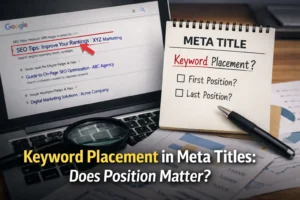
Put the main keyword at the beginning using proper keyword placement in meta titles
Keep only 1 per content or blog
Remove filler words
Keep length around 60 characters so it doesn’t get cut off in search results.
If you’re unsure what that limit actually means, see this guide on
meta title length.
Highlight a benefit or result
Add the brand at the end when useful
Simple formula: Keyword + Benefit + Brand
H1 Tags Explained: The Headline That Welcomes the Reader

The H1 is the headline readers see on the actual webpage. It quickly confirms what the page is about and assures visitors they’re in the right place.
Where H1 Appears on the Page
On most pages, the H1 sits at the top of the main content area. It introduces the primary topic and sets the direction for everything that follows.
topic confirmation
content structure
readability anchor
The Real Purpose of the H1: Clarity, Not Clickbait
After someone clicks a result, the H1 reassures them they chose the right page. It should reflect the promise of the title while clearly stating the article’s focus.
This practice is Bad–
Meta Title: Best SEO Tools for Beginners
H1: The SEO Tools Beginners Actually Need
Practical H1 Writing Tips
A good H1 reads like a natural headline and prepares the reader for the structure and depth of the article.
write naturally
expand beyond title
avoid keyword stuffing
use clear reader language
Clarity beats cleverness every time in strong page headings.
Should Meta Title and H1 Be the Same or Different?
There’s no universal rule here. Sometimes they should match exactly, and sometimes a small variation works better. The decision depends on the page type, search intent, and how you want the headline to read for users.
When Keeping Them Identical Works Best
For simple or functional pages, identical titles keep things clear and consistent. There’s usually no SEO benefit in adding variations.
Pages where this works best:
Contact page
Login page
About page
Simple informational articles
Using the same wording keeps the page straightforward and avoids unnecessary complexity.
When Changing Them Improves SEO and Readability
Variation helps when you want to target a broader keyword or make the headline sound more natural for readers. The meta title can stay optimised for search, while the H1 becomes more engaging and descriptive.
Example:
Meta Title: Best Email Marketing Tools
H1: Email Marketing Tools We Use to Grow Lists Faster
Advanced Strategy: Expanding Your “Semantic Coverage”
If your meta title is “Best SEO Tools”, your H1 could be “The SEO Tools Every Beginner Needs”. This allows you to target “Best SEO Tools” (high volume) in the title and “SEO Tools for Beginners” (specific intent) in the H1. This is “Semantic Expansion”.
The “Scent Match” Rule That Prevents User Drop-Off

The scent match rule means the promise that attracts a click must continue in the H1 users see. If the title and headline feel disconnected, readers quickly lose confidence and leave. A title promising quick tips but opening with a long guide, or promising tools while discussing theory, creates friction. When the message aligns from the title to H1, users feel they landed in the right place. That consistency strengthens trust, boosts engagement, and increases time on page.
Good: Title tools → H1 lists tools
Bad: Title tools → H1 explains theory
5‑Minute Tag Audit (do it now)
Open your page in a browser. Right‑click and choose “View Page Source”. Search (Ctrl+F) for <title> and <h1>. Ask yourself:
- 🔹 Are they repetitive without reason?
- 🔹 Does the H1 expand the promise?
- 🔹 Is the meta title under 60 chars?
- 🔹 Is there only one H1?
✔️ If you spot issues, tweak before publishing.
A Simple Formula to Write Meta Titles and H1s That Work Together
Meta titles earn the click. Its delivery is clear once the visitor lands. When they support each other, rankings and user experience both improve.
Start with the primary keyword. Identify the core search phrase your page targets.
Write the meta title for clicks. Add a benefit or hook that makes people want to visit.
Expand the H1 for clarity. Keep the keyword, but make the headline more descriptive and helpful.
Example:
Keyword: Email Marketing Tips
Meta Title: 10 Email Marketing Tips to Boost Open Rates
H1: Practical Email Marketing Tips to Increase Opens and Engagement
Quick Checklist Before Publishing Any Page
Before publishing a page, quickly confirm your meta title and H1 work together. A simple check prevents mixed signals for users and search engines.
- The keyword appears in meta title
- H1 clearly describes the page topic
- The meta title and H1 promise the same thing
- Meta title length avoids truncation in search results
- Only one H1 exists on the page
Truth vs. Fiction
Myth: “Google ignores the H1 if it doesn’t match the meta title.”
→ Truth: Google prefers the H1 to be the primary signal of page content, even if it differs from the title.
Myth: “You can only have one H1 tag on a page.”
→ Truth: While HTML5 allows multiple, keeping just one main H1 is still the gold standard for clear site structure.
FAQ: Meta Title vs H1
Is the meta title the same as the H1 tag?
No. They serve different purposes. The meta title appears in search results and helps attract clicks, while the H1 appears on the page and confirms the topic for readers. They can be similar, but they don’t have to be identical.
Can I use the same text for the meta title and H1?
Yes, especially for simple pages like contact, about, or straightforward blog posts. However, many pages benefit from slight variation, so the meta title focuses on search clicks while the H1 reads naturally for visitors.
Does Google use the H1 if the meta title is missing or weak?
Sometimes. Search engines may rewrite the title in search results if the meta title looks misleading, overly optimised, or doesn’t match the page content. In those cases, Google may pull wording from the H1 or other headings.
How long should a meta title and H1 be?
Meta titles should usually stay around 50–60 characters so they don’t get cut off in search results. H1 tags are more flexible and can be longer as long as they clearly describe the page topic.
Is it bad SEO if the meta title and H1 are different?
Not at all. It only becomes a problem if they promise different things. As long as both communicate the same topic and intent, variation can actually improve both click-through rate and readability.
— clarity compounds, confusion costs —
 Add Content Decoded as a preferred source