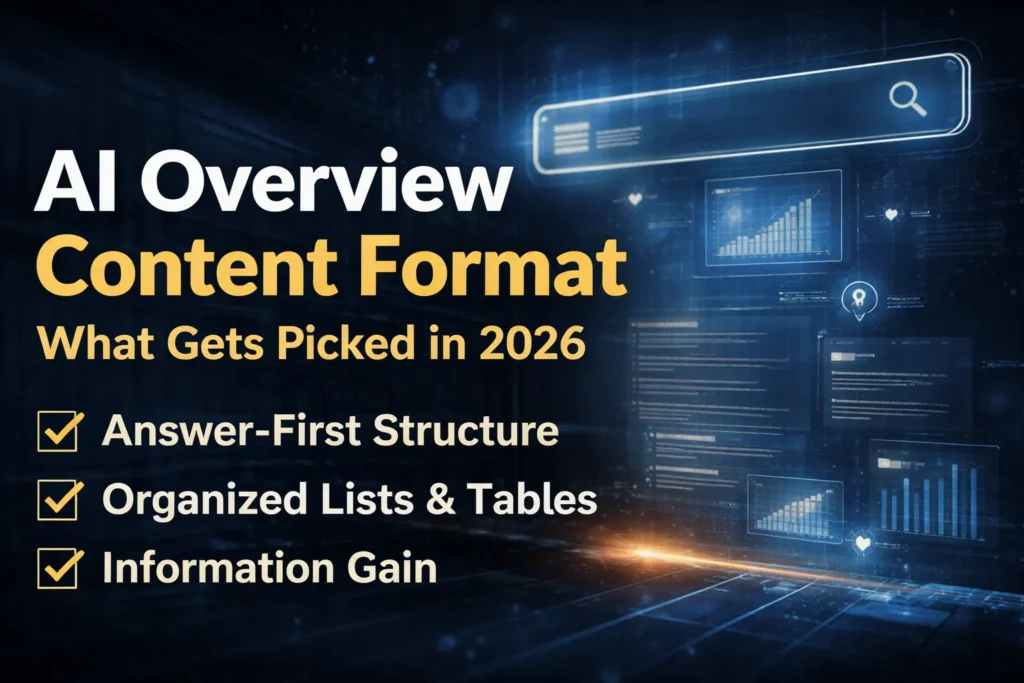
Actual Content Format That AI Overviews Prefer in 2026
AI Overviews prefer content that delivers a clear, self-contained answer at the very beginning and then expands into structured, verifiable detail with information gain that can be easily parsed, validated, and displayed.
Content that places a precise 40–60 word summary immediately under a heading, followed by logically organised lists, tables, and supporting insights, reduces interpretation effort for AI systems and significantly increases the likelihood of being selected as a source in AI Overview.
What Content Format AI Overviews Actually Prefer
Step 1: Start Every Section with a Direct Answer

Intro and each section should begin with a 40–60 word answer that fully addresses the question without needing extra context.
Key rules:
- Use the full subject name instead of pronouns
- Keep the sentence complete and self-contained
- Avoid vague phrasing or indirect openings
This block should feel like something that can be copied and pasted as a final answer.
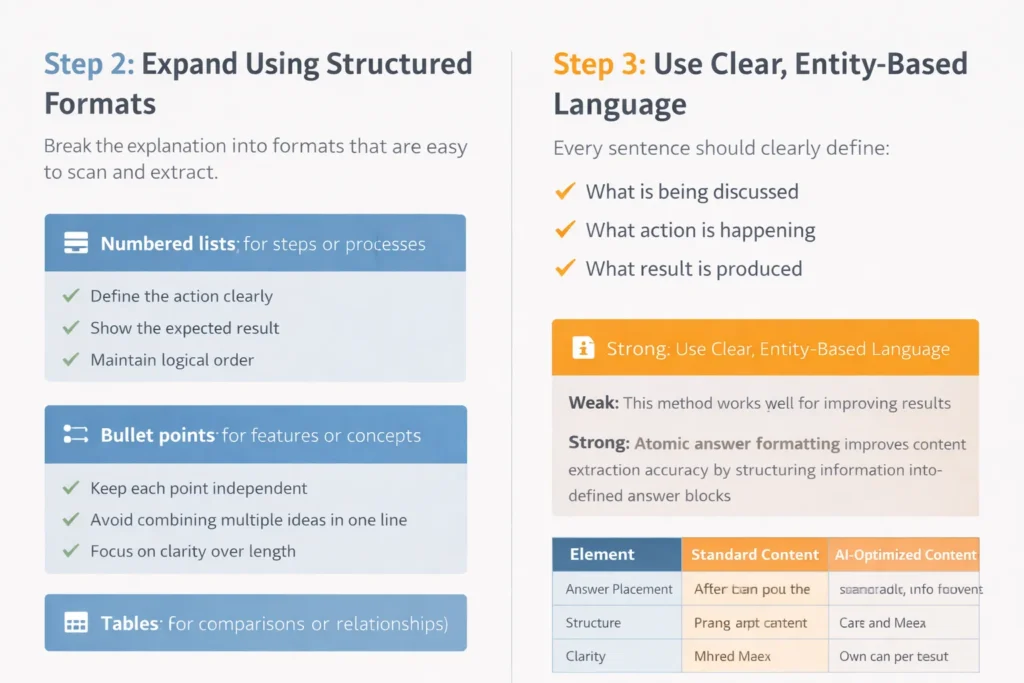
Step 2: Expand Using Structured Formats
Immediately after the answer, break the explanation into formats that are easy to scan and extract.
Use the right format for the right purpose:
- Numbered lists (for steps or processes)
- Define the action clearly
- Show the expected result
- Maintain logical order
- Bullet points (for features or concepts)
- Keep each point independent
- Avoid combining multiple ideas in one line
- Focus on clarity over length
- Tables (for comparisons or relationships)
| Element | Standard Content | AI-Optimized Content |
| Answer Placement | After introduction | Immediately under heading |
| Structure | Paragraph-based | Lists and tables |
| Clarity | Mixed ideas | One idea per block |
Step 3: Use Clear, Entity-Based Language
Every sentence should clearly define:
- What is being discussed
- What action is happening
- What result is produced
Example:
- Weak: This method works well for improving results
- Strong: Atomic answer formatting improves content extraction accuracy by structuring information into defined answer blocks
Clarity at this level makes the content easier to interpret and reuse.
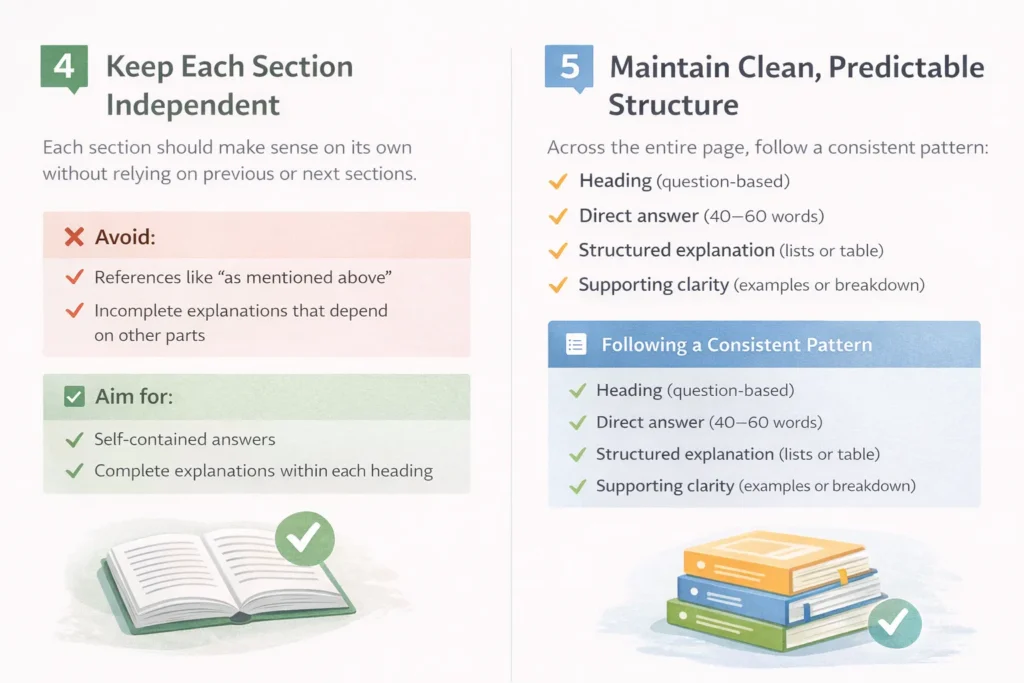
Step 4: Keep Each Section Independent
Each section should make sense on its own without relying on previous or next sections.
Avoid:
- References like “as mentioned above”
- Incomplete explanations that depend on other parts
Aim for:
- Self-contained answers
- Complete explanations within each heading
Step 5: Maintain Clean, Predictable Structure
Across the entire page, follow a consistent pattern:
- Heading (question-based)
- Direct answer (40–60 words)
- Structured explanation (lists or table)
- Supporting clarity (examples or breakdown)
This consistency helps both AI systems and readers quickly understand and navigate the content.
Quick Snapshot: What AI Overviews Prefer
| Factor | Preferred Format |
| Answer Style | Direct, complete, upfront |
| Structure | Lists, tables, short sections |
| Language | Specific and entity-based |
| Flow | Answer → Structure → Detail |
| Section Design | Independent and self-contained |
If a reader can go through one section and immediately understand both the answer and the structure behind it, that’s the exact format AI Overviews tend to pick up and display.
The 20-40-20-20 Content Strategy
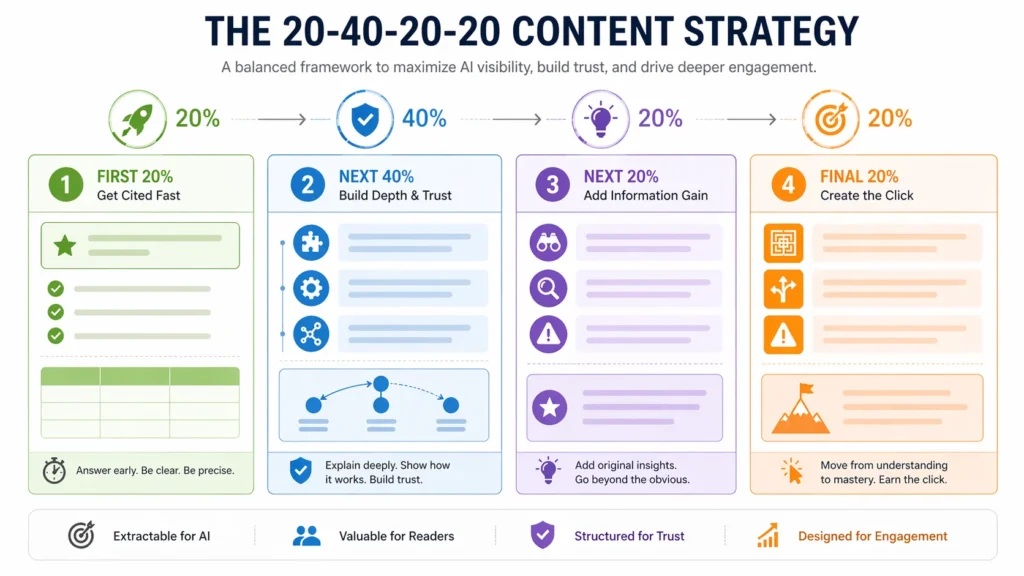
Mine, this framework provides a structured way to balance AI visibility and user engagement, ensuring that content is both extractable for machines and valuable for human readers.
Phase 1: The First 20% (Get Cited Fast)
The opening section is designed to establish authority and secure inclusion in AI-generated summaries by delivering immediate clarity.
This portion should:
- Present a fully formed atomic answer directly under the primary heading
- Include a concise supporting list that reinforces the main idea
- Optionally incorporate a compact table to clarify relationships or comparisons
The emphasis here is on speed and precision, ensuring that the core query is resolved within the first interaction by addressing the dominant user meaning behind the query, which can improve a page’s ability to rank for searches with multiple possible interpretations.
You can place the “Preferred Source” button right here so users can easily add your website. Once they do, your site will appear higher the next time they search for a query you’ve already covered—complete with a “Preferred” badge, and even featured in AI Overviews.
Phase 2: The Next 40% (Build Depth and Trust)
After establishing the answer, the content must expand into a more detailed explanation that demonstrates understanding and reliability.
This section should:
- Break down the concept into clearly defined components
- Explain the function and importance of each component
- Show how these elements interact within a broader system
Using structured formats throughout this phase ensures that complexity is introduced gradually without sacrificing clarity.
Phase 3: The Next 20% (Add Information Gain)
Information gain represents the layer where content differentiates itself by introducing original insights, observations, or nuanced explanations that are not commonly repeated.
Effective ways to achieve this include:
- Sharing observations derived from direct experience or testing
- Highlighting subtle factors that influence outcomes
- Addressing edge cases that are often overlooked in standard explanations
Illustrative insight:
Content sections that present a complete answer within a constrained word range are more frequently selected for extraction because they align closely with the structural patterns AI systems are trained to prioritise.
This type of detail increases both credibility and uniqueness.
Phase 4: The Final 20% (Create the Click)
The final segment transitions from explanation to depth by introducing elements that cannot be fully captured in a summarised format.
This includes:
- Complex scenarios where simple rules no longer apply
- Situational variations that require judgment or adaptation
- Common failure points that reveal limitations of the standard approach
By presenting these layers, the content creates a natural progression from understanding to mastery, encouraging deeper engagement.
Multi-Modal Formatting: Beyond Text
AI overviews increasingly favour content that can be represented across multiple formats, as this enhances usability and presentation flexibility.
Formats that improve visibility
- Short-form videos with accompanying transcripts
- Provide an additional layer of context while remaining indexable
- Tables for structured comparison
- Offer immediate clarity when evaluating options or methods
- Lists for organized detail
- Simplify complex information into digestible segments
Incorporating these elements allows content to be utilised across different output formats, increasing its overall utility.
Technical Requirements for AI Visibility
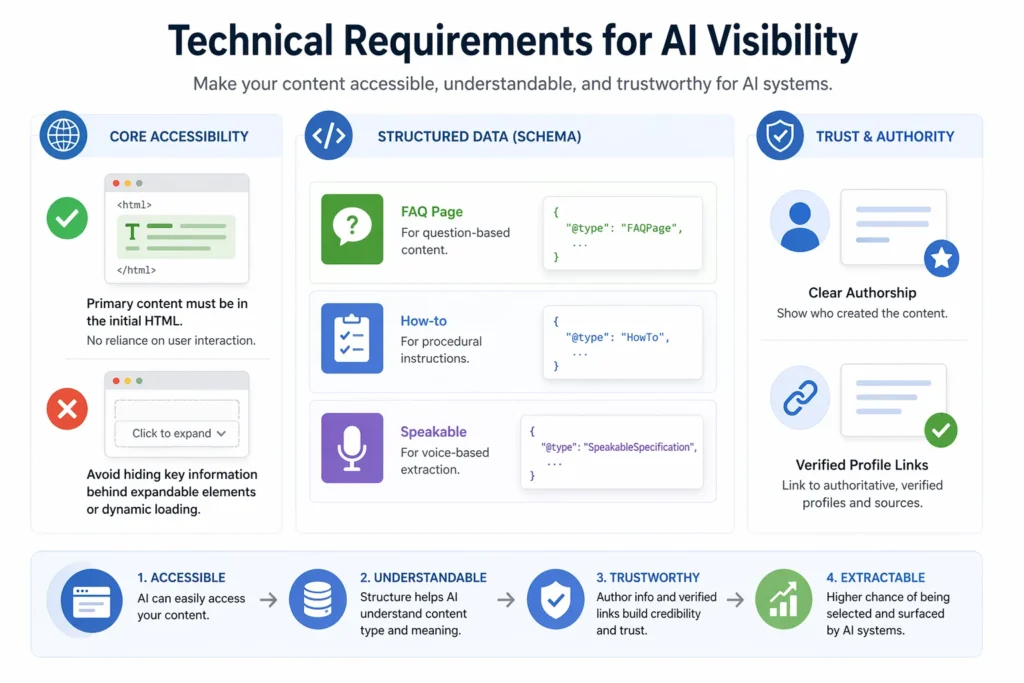
Content accessibility plays a critical role in determining whether it can be processed and extracted effectively.
Essential technical considerations
- Ensure that primary content is present in the initial HTML and not dependent on user interaction
- Avoid placing key information behind expandable elements or dynamic loading mechanisms
- Implement structured schema to define content types clearly:
- FAQ Page for question-based content
- How-to for procedural instructions
- Speakable for voice-based extraction
Additionally, clearly defined authorship and verified profile links contribute to trust signals that influence selection.
Writing Style That Works in 2026
The effectiveness of content depends not only on what is said but also on how clearly and efficiently it is expressed.
AI systems favour writing that:
- Communicates ideas with precision and minimal ambiguity
- Maintains a high information-to-word ratio
- Ensures each section remains self-contained and complete
Writing clarity comparison
| Less Effective | More Effective |
| This method can help improve outcomes over time | This method increases extraction accuracy by structuring answers clearly |
| It works in various situations | Atomic formatting performs best in structured content systems |
The distinction lies in specificity and directness.
Common Mistakes That Reduce Citations
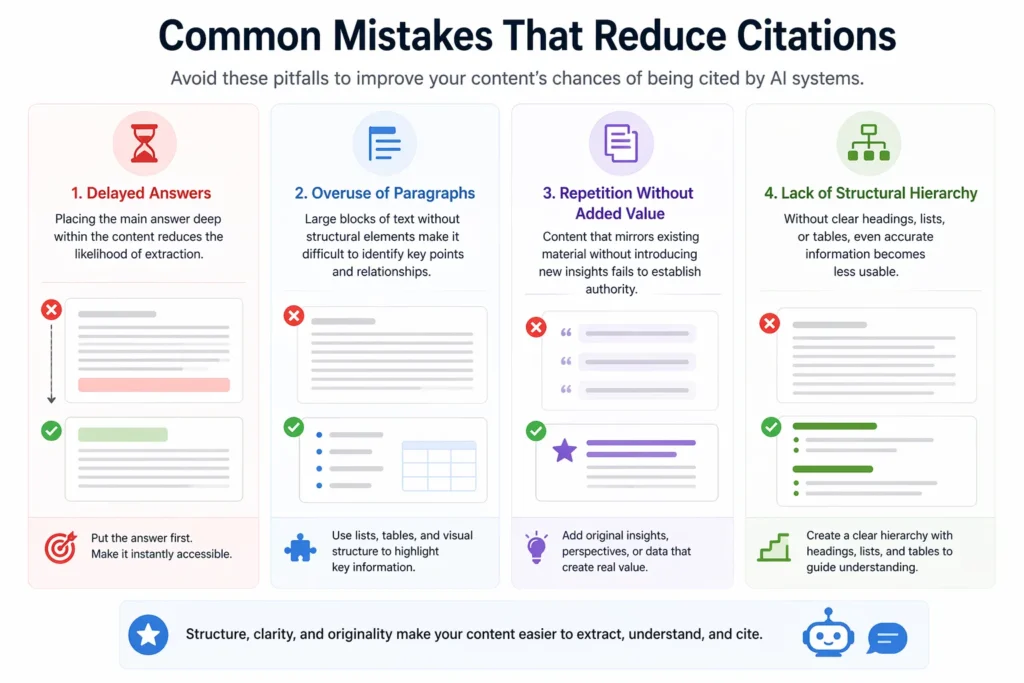
Delayed answers
Placing the main answer deep within the content reduces the likelihood of extraction, as AI systems prioritise immediately accessible information.
Overuse of paragraphs
Large blocks of text without structural elements make it difficult to identify key points and relationships.
Repetition without added value
Content that mirrors existing material without introducing new insights fails to establish authority.
Lack of structural hierarchy
Without clear headings, lists, or tables, even accurate information becomes less usable.
These are some mistakes which makes content not rank
Final Takeaway
The format preferred by AI Overviews is built around clarity, structure, and efficiency, where each section delivers immediate value and then expands into organised, verifiable detail.
When content is consistently
- Provides direct answers at the start of each section
- Uses structured formats to organize supporting information
- Introduces meaningful insights beyond common explanations
It becomes both easily extractable for AI systems and genuinely valuable for human readers, encouraging them to click through rather than simply increasing impressions without clicks.
One-line strategy:
Present information in a form that can be immediately understood, easily extracted, and meaningfully expanded
FAQ: AI Overview Content & Behavior
Why does AI Overview prefer answer-first content?
AI Overview is built to deliver direct answers quickly within limited space, so it prioritises content that provides a clear response upfront and then expands if needed. This reduces processing effort and allows the system to present useful information instantly.
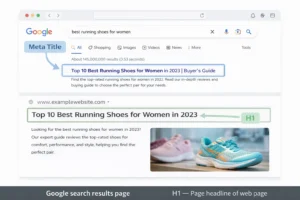
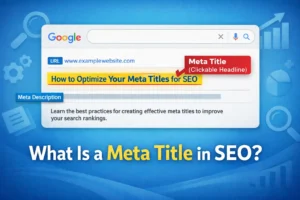
Do meta title and description affect AI visibility?
Meta titles and descriptions do not directly influence AI overview selection, but they still impact user behaviour. If they create curiosity or signal deeper value beyond the summary, they can improve click-through rates.
Why does AI Overview sometimes cite unrelated content?
AI Overview may extract a small section from a page that partially matches the query, even if the overall content is not fully relevant. The system focuses on usable fragments rather than the entire page context.
Does content length matter for AI overview ranking?
Content length alone does not determine visibility, but well-structured, concise sections perform better. Pages that deliver clear answers without unnecessary expansion are easier for AI systems to extract and display.
Can AI Overview summarise the entire article?
AI Overview can summarise key sections, but it usually prioritises clearly structured answer blocks. Content with deeper insights, context, or complexity often remains outside the summary and encourages users to explore further.
 Add Content Decoded as a preferred source