Why Is Your Content Not Ranking in 2026?
Your content is not ranking because it does not give Google a clear reason to choose it. It repeats what already exists, avoids taking a position, misses parts of the topic, and wastes crawl attention on low-value pages.
To rank in AI overviews and SERP, the fix is simple but not easy: say something new; give direct answers first; structure content so each section stands alone; cover the full topic without it; and stay consistent. When your page actually ends the search, rankings follow.
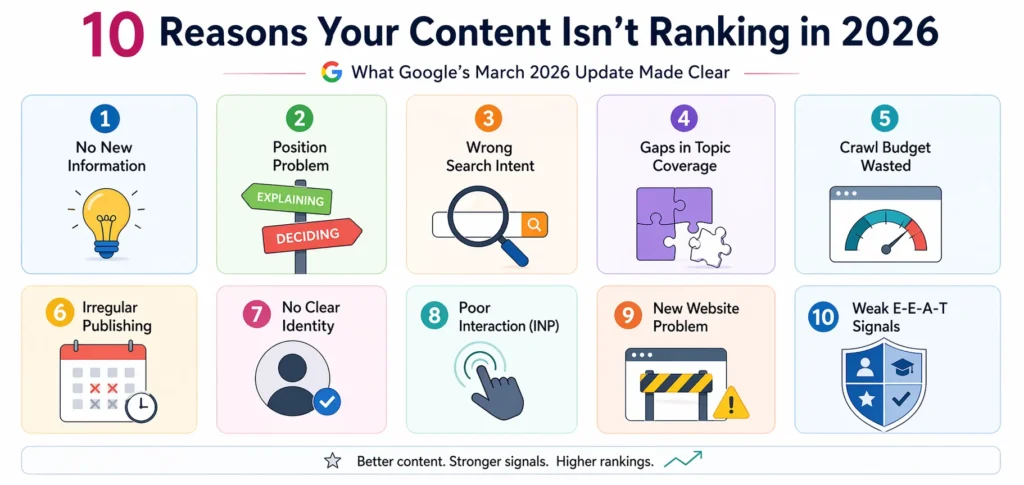
Reason No. 1: Your Content Adds No New Information
Google’s March 2026 core update made one thing very clear: content that just rewrites what’s already ranking is losing visibility — and losing it quickly.
This ties into a concept Google has patented called ‘information gain’. It’s about how much new and useful information your page adds compared to what’s already out there.
If someone can read your page and get the exact same understanding they’d get from any other top result, your content has zero information gain.
The solution isn’t to write more words. It’s to say something that only you could say. That might be:
- spotting a pattern others miss
- sharing a result that goes against expectations
- taking a clear position instead of listing every possible answer
Content that says “it depends” without clearly explaining what it depends on is now one of the fastest ways to lose rankings.
Reason No. 2: Your Content Has a Position Problem
Most content explains things. Very little content actually makes a decision.
AI-generated drafts, when posted without real editing, usually try to cover everything. They explain option A, explain option B, and then leave the reader to decide what to do. That may sound balanced, but it doesn’t help anyone.
Google has got better at spotting this pattern. Not by detecting AI, but by spotting content that has no clear point of view.
In 2026, pages that rank for competitive topics usually take a clear stance. They say what works most of the time, what fails in real situations, and why one option is better than another in specific cases.
If your content looks like it was written by someone who has never actually done the thing they’re talking about, it won’t stay ranked for long and will be considered as thin content.
Reason No. 3: You Answer the Wrong Search Intent
When someone searches for a solution, they usually want a clear answer — not a long explanation.
If your page only teaches but doesn’t solve the problem, people go back to search. That return is a strong signal Google uses to judge quality.
The structure that works now is simple: start with the answer. Don’t begin with background or buildup.
Everything after that should help the reader take action on the answer, not slow them down.
Also, each section of your page should make sense on its own. This matters more now because Google’s AI looks at sections, not just full pages.
If a section only makes sense after reading everything before it, it’s less likely to be picked for AI overviews — even if your page ranks.
Reason No. 4: Your Site Has Gaps in Topic Coverage
Topical authority is often misunderstood. It’s not about how much you publish. It’s about whether you fully cover a topic without missing key parts.
Google looks at all the questions around a topic. That includes beginner questions, common mistakes, and smaller related topics that don’t get searched as much but still matter.
If your site only covers the popular points and ignores the related ones, it looks incomplete.
After the March 2026 update, weak content is pulling entire sites down — not just single pages. A few low-quality posts can affect how Google sees your whole site.
Each page is now judged more on its own. Weak pages don’t get saved by a strong domain anymore.
A better approach is to map out the full topic first, then create content to fill the gaps — even if you do it slowly.
Reason No. 5: Crawl Budget Is Wasted on Low-Value Pages
This one is almost never discussed in basic SEO guides, but it affects more sites than most people realise.
Google allocates a limited amount of crawl budget to each website. If that budget is being spent on low-value pages — tag archives, paginated index pages, filtered URLs, and near-duplicate content — your actual articles get crawled less often and ranked less reliably.
The symptom is content that exists and is indexed but ranks unpredictably for keywords where it should be competitive.
Common sources of crawl waste:
- Category and tag pages that only show post excerpts
- Pagination pages with no unique content
- URL variations created by search filters or tracking parameters
- Redirect chains that consume multiple crawl hops before reaching the actual page
Fixing these does not improve content quality, but it ensures Google’s attention lands on the pages that deserve it.
Reason No. 6: Irregular Publishing Signals Site Abandonment
A site that posts heavily for a few weeks and then goes quiet does not look like an active resource. It looks like a project that was started and dropped.
Google doesn’t just look at when you publish content; it also looks at how consistently you stay active over time. If you post a lot all at once and then disappear, it performs worse than publishing at a steady pace, even if the total amount of content is the same. What matters more is consistency, not short bursts of activity.
One well-researched post every two weeks, published consistently over a year, builds stronger activity signals than thirty posts in one month followed by silence. It also builds topical coverage gradually, which compounds into authority over time.
Reason No. 7: Your Site Has No Clear Identity
Google builds trust by connecting content to known entities — real people, real organisations, and consistent identities.
A site with no author, inconsistent information across pages, or no presence outside its own domain exists in ambiguity. The content may be good, but it cannot be connected to anything Google already recognises.
This is not just about adding credentials like an author bio. It is about consistency. The same name, the same topic focus, the same accurate details appearing across the website and any external profiles — this consistency lets Google build a confident model of who is behind the content. That confidence affects how much weight the content carries in competitive searches.
Did you know you can build topical authority without an author bio check now?
Reason No. 8: Poor Interaction (INP)
A page can fail even if the content is good, simply because it feels slow when users interact with it.
INP is not just about loading speed—it measures how quickly your site responds when someone clicks, taps, or interacts.
If your page delays response after interaction, users lose trust and leave.
Reason No. 9: New Website Problem
A new or incomplete website often does not rank because it lacks basic trust signals. Even strong content struggles if the site itself looks unfinished or inactive.
Reason No. 10: Weak E-E-A-T Signals
Even if your content is accurate, it may still not rank if it does not show clear signs of experience, expertise, authority, and trust.
In 2026, Google is not just evaluating what is written—it is evaluating who is behind it and whether they have the right to say it.
What to Fix First
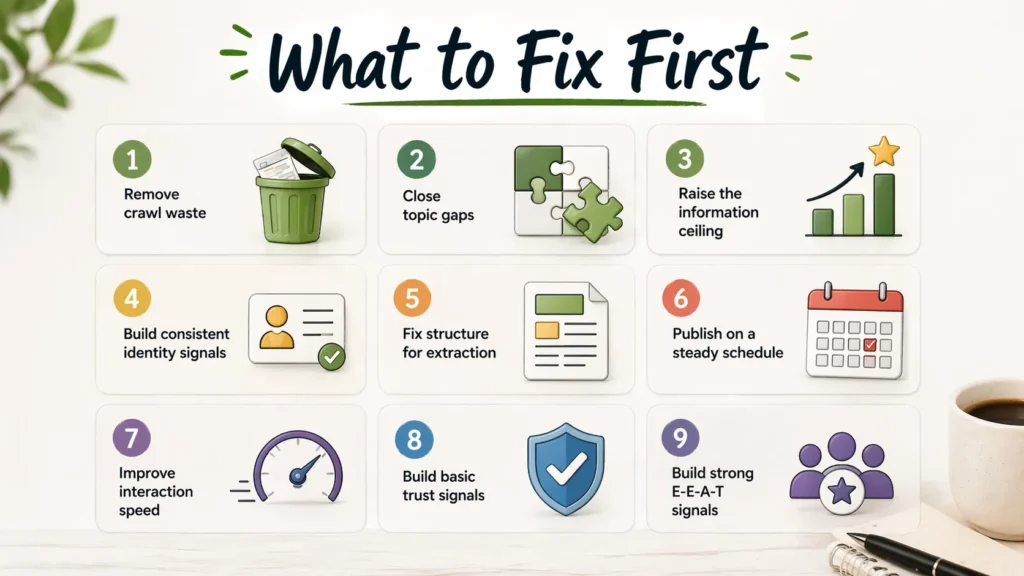
The order matters more than most guides acknowledge.
1. Remove crawl waste first — fix tag pages, parameter URLs, and redirect chains before anything else. This ensures Google’s attention goes where it should.
2. Close topic gaps before adding new posts — identify what your site is missing in its core topic area and fill those holes instead of adding more of what you already have.
3. Raise the information ceiling on existing content — find the posts closest to ranking and add the one layer of depth that no competitor has covered yet.
4. Build consistent identity signals — author name, consistent topic focus, and the same accurate details in every relevant place.
5. Fix structure for extraction — make sure every section of every post can be understood without the surrounding context. This is what gets content pulled into AI Overviews.
6. Publish on a steady schedule — slower and consistent beats faster and more irregular every time.
7. Improve interaction speed — reduce delays after clicks and taps by optimising scripts, cutting heavy JavaScript, and improving responsiveness.
8. Build basic trust signals — complete your site with clear pages (about, contact), consistent activity, and enough quality content to show it’s active and reliable.
9. Build strong E-E-A-T signals — show real experience through examples, keep your topic focus consistent, add a clear author presence, and ensure your content reflects practical knowledge that can be trusted.
Quick Diagnosis Table
| If you notice this | What it usually means | What to do |
| No rankings at all | Weak overall signals across site and content | Improve depth, structure, and consistency together |
| Discovered Currently Not Indexed | Setup or crawl issue | Fix indexing and reduce crawl waste |
| Content exists but ignored | Low information ceiling | Add deeper insights and close gaps |
| Multiple similar posts | Internal competition | Merge or separate topics clearly |
The Real Pattern Behind All of This
Every reason above points to the same root problem: the site has not yet given Google enough confident signals to prefer it over alternatives.
After the March 2026 core update, nearly 3 in 10 pages that reached the top 3 results were not even in the top 20 before the update. That means movement is possible — but only for pages that give Google a clear reason to trust them.
Trust is not one signal. It is a combination of content depth, topic consistency, structural clarity, identity, and steady activity. Sites that rank reliably have most of these working together.
The fix is not one change. It is closing the weakest signals systematically — which takes longer than most guides suggest but produces results that actually hold.
 Add Content Decoded as a preferred source