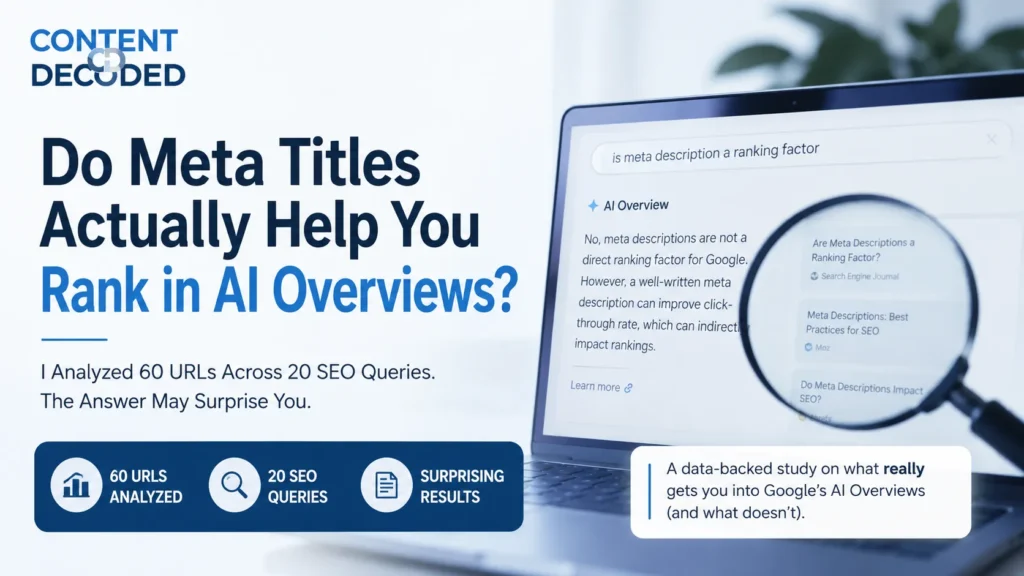
Does Your Meta Title Actually Help You Rank in AI Overviews?
I checked 60 URLs across 20 SEO queries. The answer is not what most people expect.
A meta title is not a direct ranking factor for AI overviews. But it is still a relevance signal — and how much it matters completely depends on what type of query you’re targeting.
You’ve probably heard this a hundred times: “Optimise your meta title, add your keyword, and keep it under 60 characters.” And for traditional Google rankings, that advice holds up.
But AI Overviews? That’s a completely different game.
I went through 60 URLs ranking across 20 different SEO-related queries – everything from “What is topical authority?” to “Is bounce rate a ranking factor?” – and manually matched every single meta title against its target query.
I found that almost 22% of websites ranked have no matching meta-title. Let’s know more about the “why” behind this and what AI overview checks beyond the meta title.
What I Analysed
20 queries. 3 URLs each. 60 meta titles total. I put every title next to its query and classified the match as one of three things:
- Exact match — the query phrase (or something very close) is in the title
- Partial match — some keywords match but it’s reworded or incomplete
- No match — the title has nothing to do with the query on the surface
Here’s what the numbers came out to:
| Match Type | URLs | Percentage |
| Exact Match | 23 out of 60 | 38% |
| Partial Match | 24 out of 60 | 40% |
| No Match at All | 13 out of 60 | 22% |
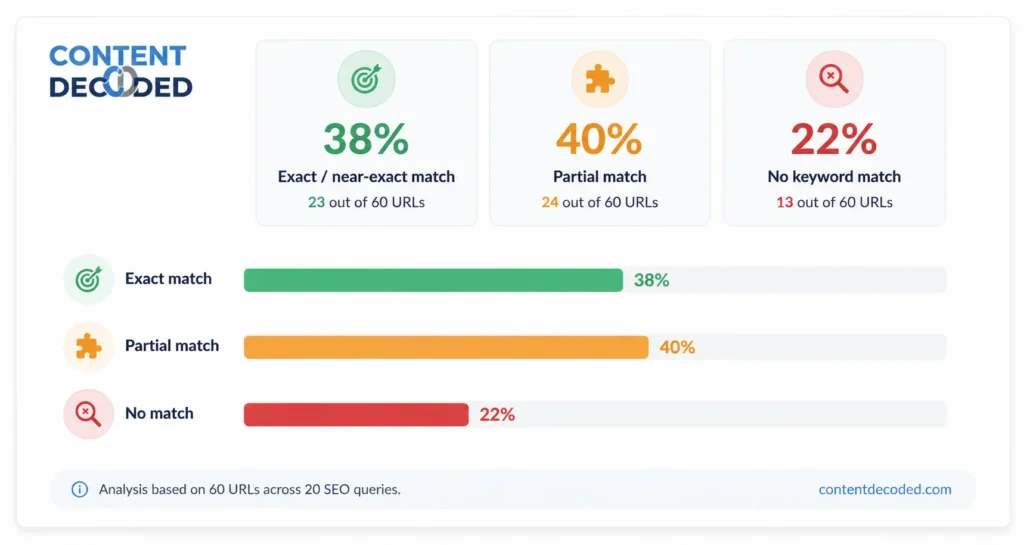
So almost 1 in 4 pages ranking in AI Overviews had a meta title that had zero keyword overlap with the query it was answering.
That’s the data. Now let’s talk about what it actually means.
The Most Surprising Examples From This Research
Before I get into the patterns, let me show you the actual examples that stood out most.
Semrush’s bounce rate blog — their page titled “What Is Bounce Rate? And How to Reduce It” is being pulled into AI Overviews for the query “Is bounce rate a ranking factor?” The title says nothing about ranking factors. Not a single word. Yet there it is.
Moz’s domain authority page — titled “Domain Authority: What It Is & How It’s Calculated” — gets cited for the query “Is domain authority a Google ranking factor?” Again, the title is about explaining the concept, not answering the myth.
Search Engine Land’s meta description guide — titled “SEO and meta descriptions: Everything you need to know in 2025” — ranks for “is meta description a ranking factor”. The query is specifically asking about ranking factors. The title doesn’t even hint at it.
Reddit threads and Google Support pages — they have the most unpredictable titles of anyone, and yet they rank. Reddit thread titles change, are user-generated, and are never optimised. Google’s own support pages use documentation-style titles like “Crawl Budget Management | Google Crawling Infrastructure”. Neither sounds like an SEO-optimised title. Both rank.
The conclusion from these examples: when the query is a myth-busting or yes/no question, Google’s AI doesn’t care much about what your title says. It cares about what’s inside the page.
Why Quora & Reddit Keep Appearing in AI Search Results
Platforms like Quora and Reddit show up constantly in AI-generated search overviews because they contain raw, first-hand user experiences. Instead of polished marketing copy or SEO-heavy blog posts, these platforms offer real opinions, personal case studies, nuanced discussions, and practical answers written by actual users.
What this signals is that AI overviews increasingly prioritize authentic UGC (user-generated content) over perfectly structured traditional blogs. Content that feels human, experience-driven, and discussion-based often performs better because it mirrors how people naturally ask questions and share knowledge online.
But Here’s Where Title DOES Matter
This is where it gets more nuanced and why you shouldn’t just throw title optimisation out the window.
When I broke down the match rates by query type, a clear pattern showed up:
“What is X” queries — Title match matters most here
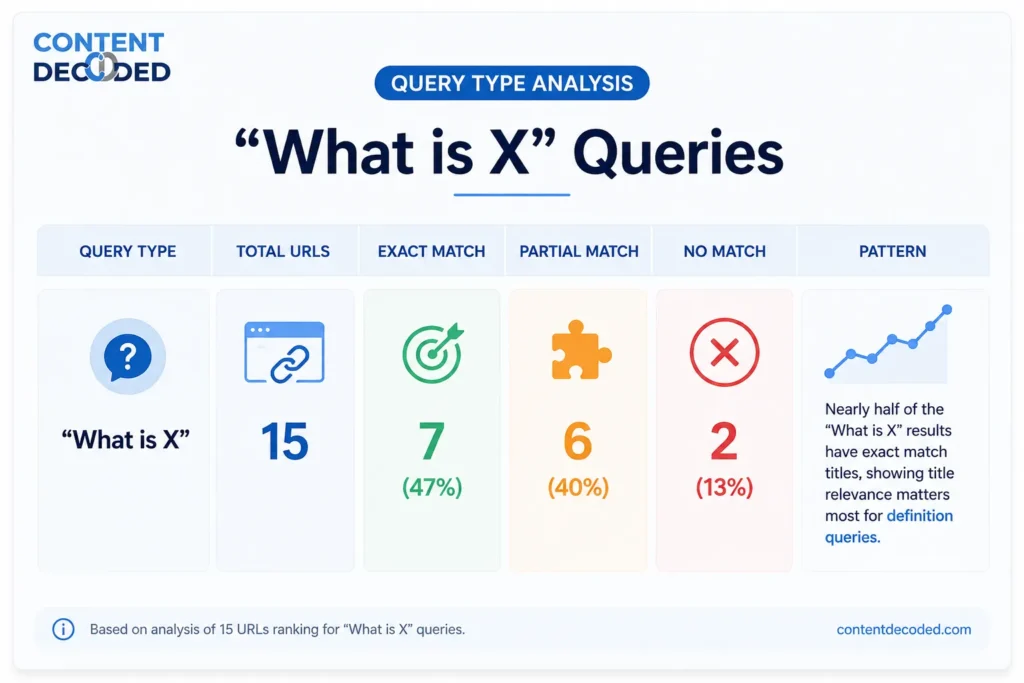
Out of 15 definition-style queries (What is topical authority? What is E-E-A-T? What is a crawl budget?) 7 pages had exact title matches. That’s 47% — the highest of any category. And both Semrush and Ahrefs — the two most frequently pulled sources in AI Overviews — literally have “What Is” in their titles for almost every definition post they write.
Semrush’s topical authority post: ‘What is topical authority?’ (+ How to build it) Ahrefs’ version: “What Is Topical Authority in SEO & How to Build It?”
They know something. When someone asks a definition question, Google’s AI is looking for a page that clearly positions itself as the answer to that exact question. A title that mirrors the question is a strong early signal of relevance.
“How to X” queries – Title rewording is fine
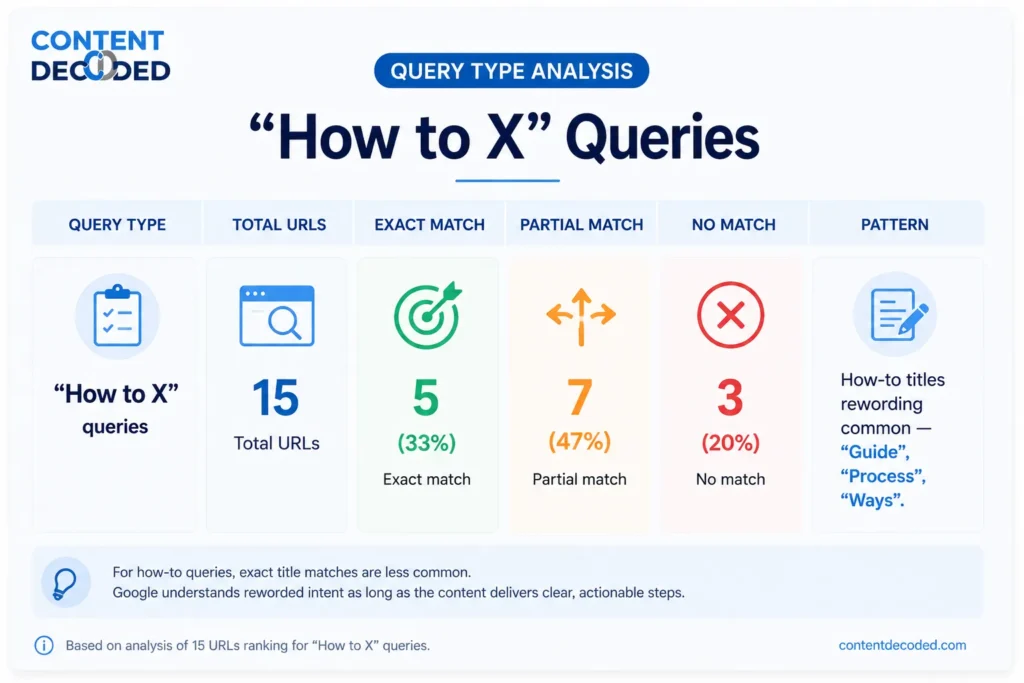
For process-based queries, the exact match rate drops to 33%. Ahrefs ranks for “how to do a content audit” with a title that says, “Follow Our Content Audit Process (Template Included)”. “No ‘how to’ in sight. Kontent.ai ranks with “A Practical Guide on Conducting a Successful Content Audit” — completely different phrasing.
Google understands that “guide”, “process”, “template”, and “steps” all mean the same thing as “how to” in intent terms. For how-to queries, what matters more is whether your content actually has a clear, numbered, actionable structure — not whether your title has the exact phrase.
Note – Here, AI Overview likely expects a video-first result because it’s a “how-to” query. That means YouTube videos or blog posts with embedded videos can rank higher, even if the title match isn’t very strong.
“X vs Y” queries – Even the order doesn’t matter
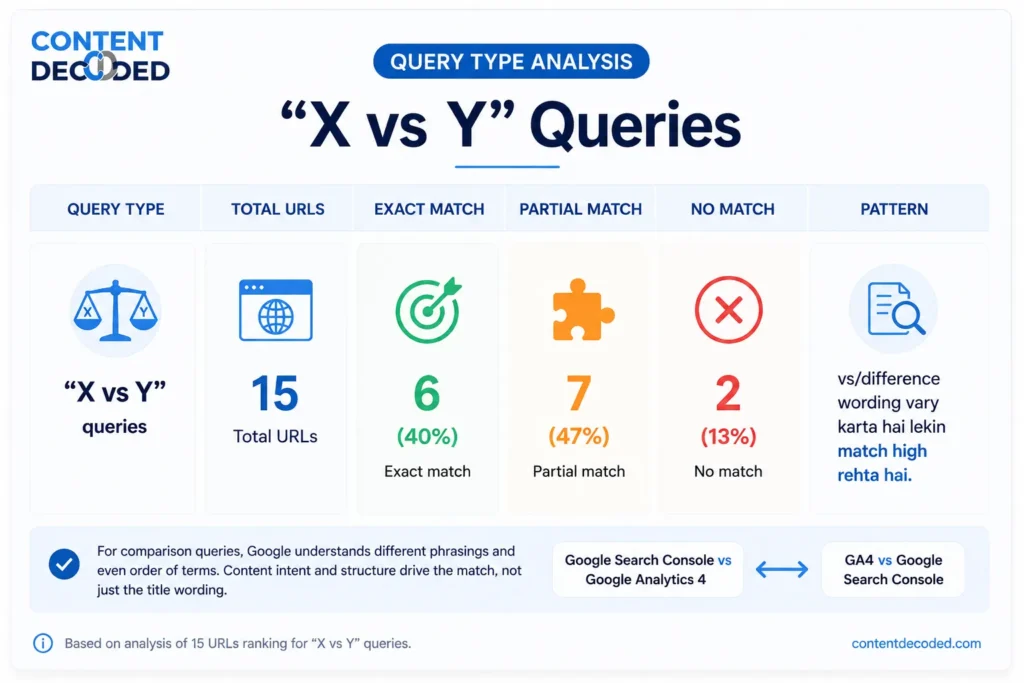
This one was genuinely funny to discover. Oneupweb’s page titled “Google Search Console vs. Google Analytics 4: An Explainer” ranks for the query “GA4 vs Google Search Console difference” — which has the products in reverse order. Google matched the intent, not the sequence.
DMI’s page about “SEO, GEO, and AEO” ranks for “SEO vs GEO difference” despite the title not even having the word “vs” in it. For comparison queries, the AI seems to look at the content structure (do you have a side-by-side comparison? Do you answer “What’s the difference?” far more than the title phrasing?
“Is X a ranking factor?” queries the title, which is basically irrelevant
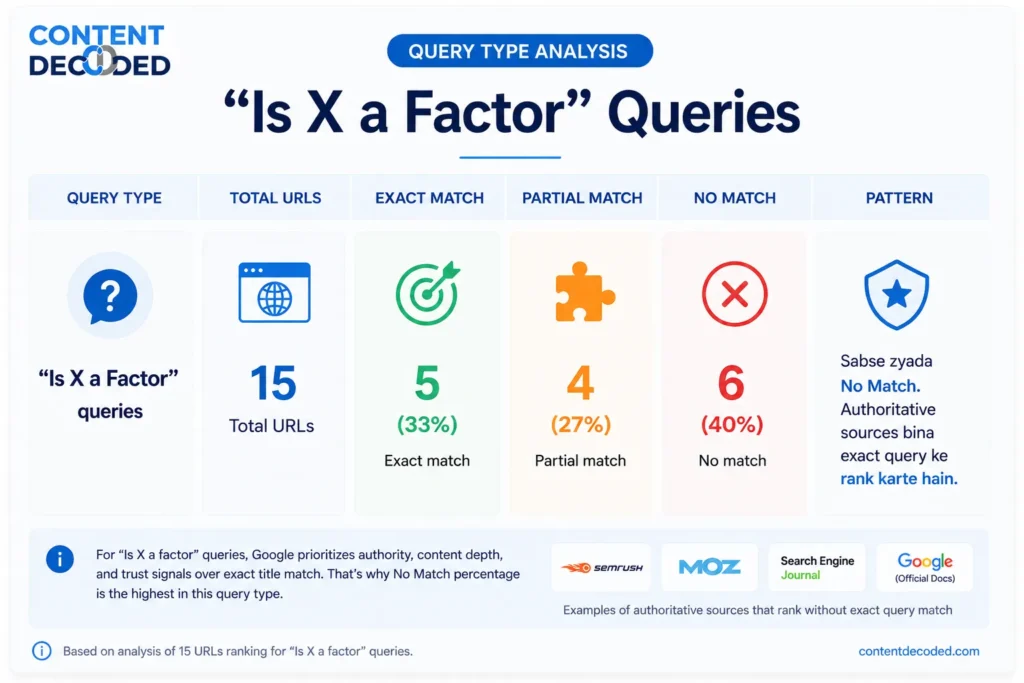
This is the most interesting category. 40% of the 15 pages in this group had zero keyword overlap in their titles. The myth-busting query type is the one where authoritative sites with deep content consistently outrank pages that perfectly optimise their titles.
Why? Because Google’s AI is trying to answer a question that requires credibility. It’s not just “What is bounce rate?” — it’s “Is bounce rate actually making a difference to my rankings?” To answer that confidently, the AI pulls from sources it trusts, and trust is built on domain authority, content depth, author credentials, and primary source citations. Not title tags.
So What Actually Gets You Into AI Overviews?
Based on what ranked across these 60 pages, here’s what’s doing the real work:
A clear answer in the first 50 words. Every single high-authority page that ranked — Semrush, Ahrefs, Search Engine Journal, Google’s own docs — answers the question directly at the top. No 300-word intro. No “In this article we’ll explore.” Just the answer.
Citing primary sources. Pages that linked to Google’s official documentation or Google Search Central blog posts or referenced John Mueller’s statements directly were consistently pulled. The AI needs something it can trust as a source of truth. Your personal opinion isn’t enough.
Content that matches the full intent. For “Is page speed a ranking factor?” — Google’s own blog post titled “Using page speed in mobile search ranking” ranks despite not having “Is it a ranking factor?” in the title anywhere. But the content answers that exact question definitively. Intent match beats title match every time.
Author and site credibility signals. Reddit ranks. Moz ranks. Ahrefs ranks. What do they have in common? Thousands of backlinks, years of content, named authors with real credentials, and consistent topical coverage. A perfectly optimised title on a thin page from a new site won’t beat any of these.
The Power of Format-Intent Matching: Beyond the title, your content must mirror the structure the AI expects to display. If you’re targeting a “how-to” query, use numbered lists; for comparisons, use tables. Matching the AI’s preferred output format is often the final nudge needed to secure a citation over a traditionally optimised page.
Why Meta Title Is Still Worth Getting Right
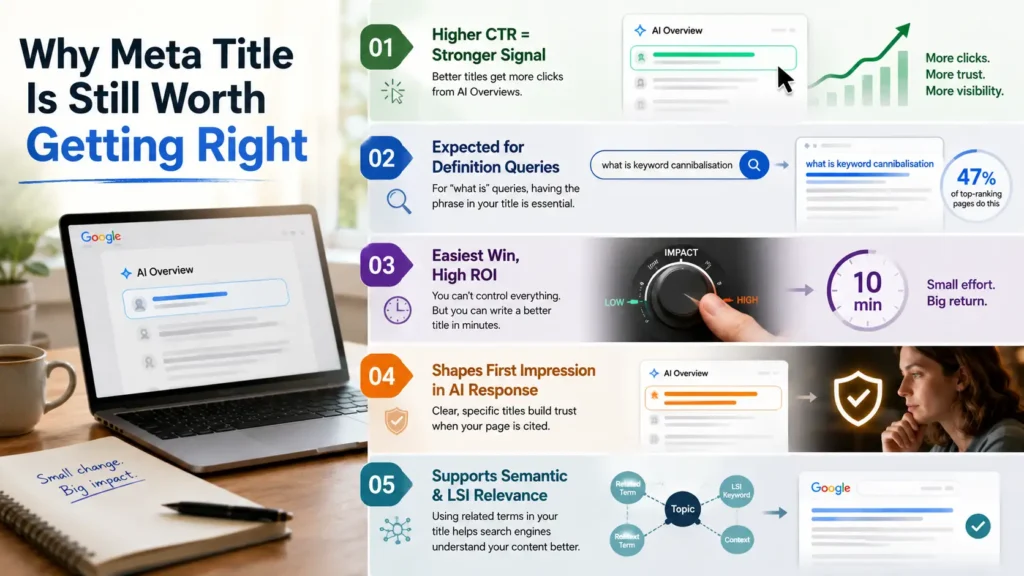
Even with all of this, don’t make the mistake of ignoring your title. Here’s why it still matters:
CTR affects which pages stay in AI Overviews. Google measures how people interact with the sources it cites. A title that clearly signals the answer to someone’s question gets more clicks from the overview panel. More clicks = more signal that this page is actually useful = more likely to stay cited.
For definition queries, it’s a real signal. If you’re trying to rank for “what is keyword cannibalisation”, having that phrase in your title isn’t optional — it’s expected. 47% of the pages doing this well have it in their title. Don’t make Google work harder to understand what your page is about.
It’s the easiest thing to control. You can’t easily change your domain authority overnight. You can’t manufacture 500 backlinks by tomorrow. But you can write a better title in 10 minutes. Use it as your minimum-effort, high-ROI optimisation.
Titles shape the first impression in the AI response. When Google cites your page, it often shows the title alongside the snippet. A vague or clickbait-y title makes the citation look weak, and users may not trust it. A clear, specific title reinforces credibility.
Semantic and LSI keywords in the meta title also help in ranking. That’s why in the modern era, keyword placement in titles doesn’t matter much, and blogs rank without proper placement.
Pro-Tips for 2026
- Prioritise Headings over Meta Titles: If you go “No Match” on the title for branding, ensure your heading is a perfect mirror of the user’s question. It means your H1 and title must match and be relevant as per content.
- Optimise for “Information Gain”: Include one unique data point or original image that other sites don’t have; this matters more to AI than your title tag.
- Use Schema as a Safety Net: Always use FAQ or article schema to “hand-feed” the AI the answers that your title might be omitting.
Final Thoughts
A meta title alone won’t get you into AI overviews. But a bad title can keep you out.
A website without exact match title but a direct answer early always can beat a website with exact match title but no early answer.
The 22% of pages ranking with zero title-keyword matches are all from high-authority sources — Semrush, Moz, Reddit, and Google itself. They’ve earned the right to rank on content alone. If you’re not at that authority level yet, your title has to do more heavy lifting.
The query type matters more than most SEO guides acknowledge. Write your title differently depending on what you’re targeting:
- For “what is” queries: match the question closely in your title
- For “how to” queries: focus on delivering the steps; title rewording is fine
- For comparison queries: make sure both terms are in your title; order does not matter
- For myth/ranking factor queries: focus on building trust through your content and sourcing — the title is almost secondary
And most importantly – write for the answer first and the algorithm second. Every page doing well in AI Overviews right now is doing one thing right: it answers the question clearly, quickly, and with proof. That’s what the AI is looking for, and it’s what readers are looking for too.
Your meta title is the door. What’s inside the room is what actually keeps people there.
This analysis is based on a manual meta title study of 60 URLs across 20 SEO-specific queries, where matches were classified by comparing page titles against target queries at both the word and intent levels.
Please note that these findings reflect a specific sample size within the SEO niche. Because AI overviews are constantly evolving and generative in nature, results may vary significantly based on your industry, site authority, and the specific intent of your target keywords. This data should be used as a directional guide for testing rather than a universal ranking rule.
 Add Content Decoded as a preferred source