

How to Do Keyword Research Without Being an SEO Expert
Keyword research is the process of finding the exact words and questions your potential customers search for on Google.
It helps you understand what people are looking for, what problems they want to solve, and what information they need before making a decision.
As a non-SEO person, you don’t need expensive SEO tools or technical knowledge to do keyword research.
Your job is simply to understand what your potential customers search for on Google when they have a problem you can solve. Find those search terms, understand what they want, and create content that answers their questions.
Step 1: Start With Customer Problems
Before using any tool, think about your customers.
Ask yourself:
- What problems do they have?
- What questions do they ask before buying?
- What does your product or service help them with?
Turn those problems into simple search phrases.
Example
If you sell ergonomic office chairs:
- back pain from sitting
- best chair for long hours
- office chair with lumbar support
- chair for standing desk
People usually search for their problem first, not the product and it is the first principle of SEO.
Step 2: Find More Keyword Ideas
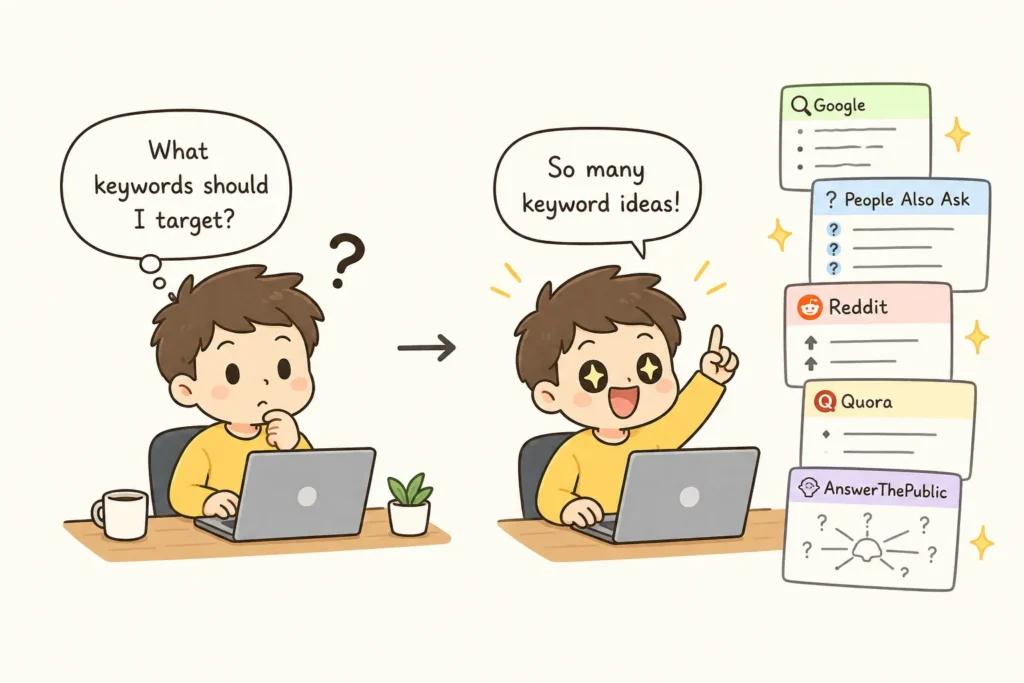
Now expand your list using free tools.
Google Search
Type your topic into Google and look at:
- Search suggestions
- People Also Ask
- Related Searches
These are real searches people make.
Reddit and Quora
Search for your topic and read the questions people ask.
The titles of posts often become great keyword ideas because they use natural language.
AnswerThePublic
Enter a topic to see common questions people ask around it.
Step 3: Understand Search Intent
Not every keyword has the same goal. Think about what the person wants.
Learning
They want information.
Examples:
- why does my back hurt while sitting
- what is lumbar support
Comparing
They are looking at different options.
Examples:
- best ergonomic chair
- mesh vs leather office chair
Ready to Buy
They already know what they want.
Examples:
- buy ergonomic chair online
- ergonomic chair price
If your goal is more sales, focus on comparison and buying keywords first.
Step 4: Check If People Search for It
Before creating content, make sure people actually search for the topic.
Free tools include:
- Google Keyword Planner
- Ahrefs Free Keyword Generator
- Ubersuggest
You don’t need perfect numbers.
The goal is simply to confirm there is interest.
Even a keyword with only a few monthly searches can bring valuable customers if they are ready to buy.
Best Free Keyword Research Tools
| Tool | Best For |
| Google Search | Search suggestions and related questions |
| Google Keyword Planner | Search volume |
| Ahrefs Free Keyword Generator | Search volume and competition |
| AnswerThePublic | Question ideas |
| Customer language and pain points |
Note: Most keyword tools show estimated search volumes, not exact numbers. Use them only to validate ideas, not as your main research method. Also, don’t rely on keyword difficulty or competition scores, as they’re often based on outdated metrics like backlinks.
Focus on Long-Tail Keywords

Instead of targeting broad topics, target specific searches.
Instead of:
ergonomic chair
Try:
best ergonomic chair for lower back pain
Specific searches usually have:
- less competition
- clearer intent
- higher chance of converting into customers
Find Keywords From Customer Pain
People search because they have a problem. Start there.
Problem
My back hurts after sitting all day.
Possible searches:
- how to stop back pain while sitting
- why does my back hurt at work
- best chair for lower back pain
The closer your content matches their problem, the better.
Use Google Search Console (If You Already Have a Website)
Google Search Console shows what people already searched before visiting your website.
Pay attention to:
- Keywords where your pages rank between positions 4 and 20
- Keywords with lots of views but few clicks
- Question-based searches like how, why, best, and cost
Improving these pages is often easier than creating new ones.
Learn From Competitors
You don’t need expensive software.
Look at:
- their blog topics
- page headings
- FAQs
- customer reviews
- Reddit discussions about them
Negative reviews are especially useful because they reveal problems customers still want solved.
Look for Trending Topics
Some searches become popular before SEO tools notice them.
Use:
- Google Trends
- Exploding Topics
- YouTube search suggestions
Creating content early gives you a better chance of ranking before competition grows.
Use AI for Brainstorming
AI tools like ChatGPT, Gemini, and Claude can help generate keyword ideas.
Example prompts:
Prompt 1: The Pain Point Generator
“I offer [insert product/service]. My target audience is [describe ideal customer]. List 15 specific problems, questions, or frustrations they type into Google when looking for a solution like mine. Categorize them into Informational, Comparison, and Ready-to-Buy questions.”
Prompt 2: Find More Specific Keyword Ideas
“Here is my seed keyword: [insert main keyword]. Act as a potential buyer with high urgency. Provide 20 long-tail search queries incorporating modifiers like ‘best for’, ‘vs’, ‘how to fix’, ‘cost of’, or ‘alternative to’.”
Prompt 3: Group Similar Keywords Together
“Take this list of 10 keywords [paste keywords]. Group them into 3 distinct content clusters and suggest a main page title + 3 subheadings for each cluster.”
Use AI for ideas, not as your only source.
Don’t Rely Too Much on SEO Tools
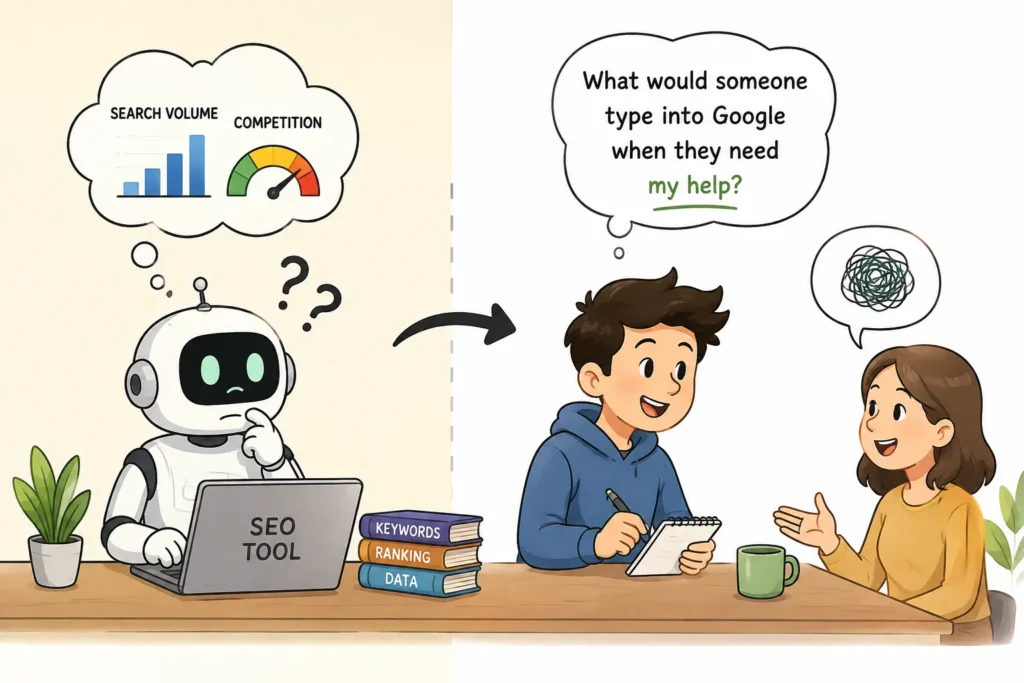
Keyword tools are helpful, but they don’t know your customers. Search volume and competition scores are estimates.
Sometimes a keyword with very little search volume brings better customers than one searched thousands of times.
Always ask:
What would someone type into Google when they need my help?
That question is often more valuable than any SEO score.
Avoid Creating Multiple Pages for the Same Topic
Don’t write separate articles just because the wording is slightly different.
For example:
- how to fix a leaking faucet
- repair a dripping tap
- fix a leaky faucet
These all answer the same question.
Instead, create one complete guide that naturally includes different wordings.
This helps Google understand your content and prevents your pages from competing with each other.
My Approach to Keyword Research
I don’t use keyword research tools to find topics for this website.
Instead, I focus on:
- Following new trends in my industry.
- Brainstorming real problems that I face and that others are likely facing too.
- Building free tools that solve those problems.
- Using Google Search Console to see what people already search for.
- Using Google Autocomplete, People Also Ask, and Related Searches to discover new ideas.
This approach has helped me rank for many keywords than using exact match keywords that most SEO tools report as having 0 monthly searches.
A Simple Challenge
Take any keyword or topic from this website and check it in your favorite SEO tool. In many cases, it will show 0 search volume.
Yet those pages still receive real traffic from Google.
That’s because SEO tools only estimate search data. They can’t measure every search people make, especially new, niche, or long-tail searches. Real users matter more than tool estimates.
Final Tips
- Start with customer problems, not keyword tools.
- Use free sources like Google, Reddit, and Search Console.
- Focus on search intent instead of search volume.
- Target specific long-tail keywords.
- Create one complete page for one topic instead of many similar pages.
- Write for people first. Search engines reward helpful content.
Final Takeaway
If there’s only one thing you remember from this guide, let it be this:
Think like your customer, not an SEO expert.
Put yourself in your customer’s shoes and ask:
“If I had this problem, what would I type into Google?”
The first natural phrase that comes to your mind is often your best keyword.
Don’t chase higher search volume, keyword difficulty, or tool scores. Instead, focus on the exact words real people would use when they need help.
When you create content that genuinely solves those problems, you’re doing keyword research the right way.
 Add Content Decoded as a preferred source