
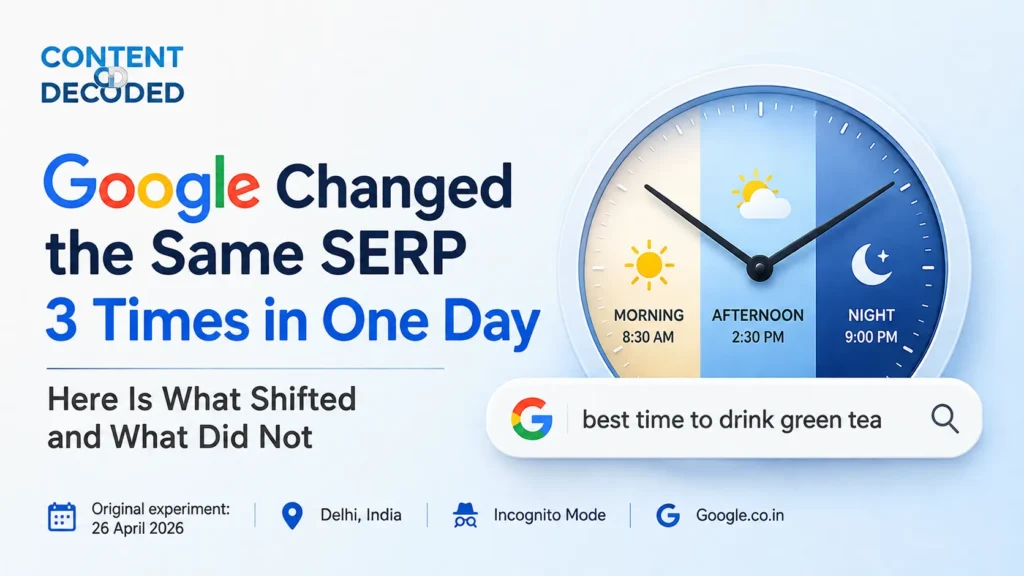
Google Changed the Same SERP 3 Times in One Day — Here Is What Changed and What Did Not
Original experiment conducted on 26 April 2026 | Delhi, India | Incognito Mode | Google.co.in
Most SEO professionals check keyword rankings once a day. Maybe once a week. A tool pulls the data at 3 AM, sends a report, and that becomes the benchmark.
Here’s the reality: that snapshot is incomplete because Google can change the same SERP multiple times in a single day.
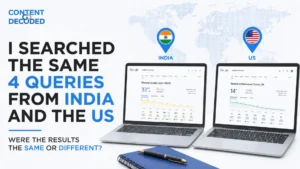
To measure it, I ran a structured experiment. I selected four keywords across the four major search intent types, searched each one three times in one day at fixed intervals, and captured full-page screenshots in Chrome incognito mode to reduce personalisation effects.
The result was clear: rankings stayed more stable than most people think, but AI Overviews, ads, People Also Ask boxes, and SERP features changed constantly.
The keywords:
- best time to drink green tea — Informational intent
- best credit card for students in India 2026 — Commercial investigation intent
- buy wireless earbuds under 2000 — Transactional intent
- Amazon India login — Navigational intent
The sessions:
- ☀ Morning: 8:30–8:43 AM
- 🌤 Afternoon: 2:34–2:37 PM
- 🌙 Night: 9:07–9:09 PM
What I found changed how I think about SERP monitoring entirely.
Here’s how each keyword behaved across the day — starting with informational intent.
Keyword 1: best time to drink green tea (Informational Intent)
What Changed
AI Overview Evolved With the Time of Day
This was the most striking finding of the entire experiment.
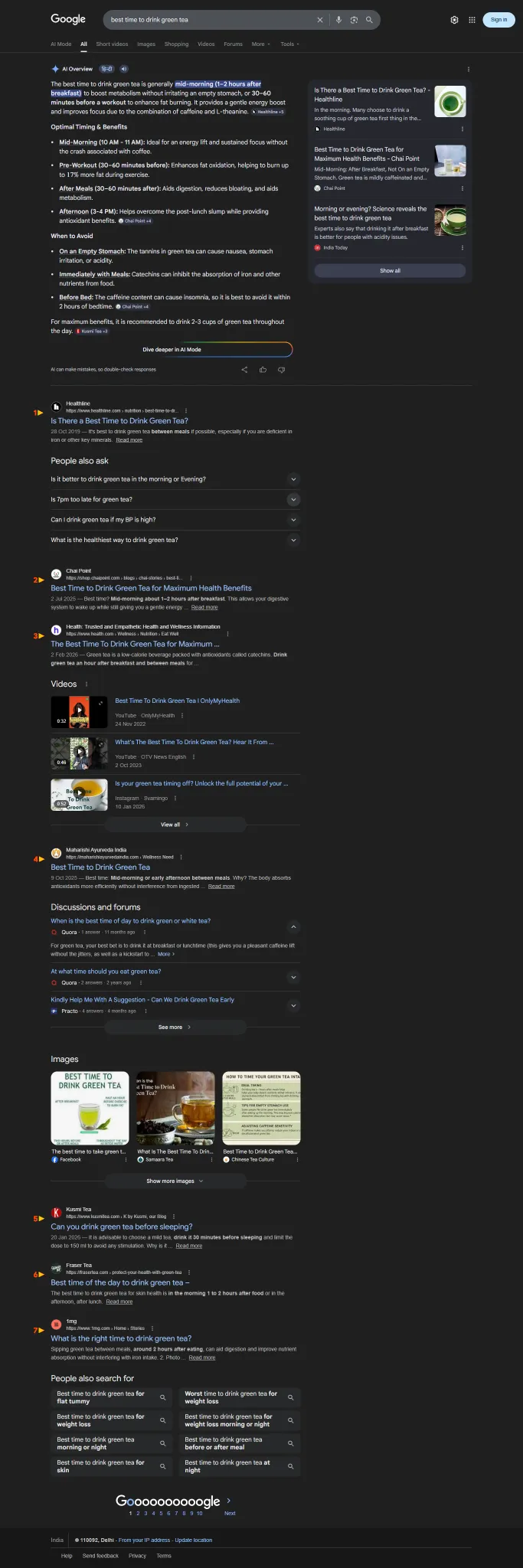
Morning (8:32 AM): AI Overview led with “mid-morning (1–2 hours after breakfast). “ Clean bullet format. Sources: Healthline and Chai Point.
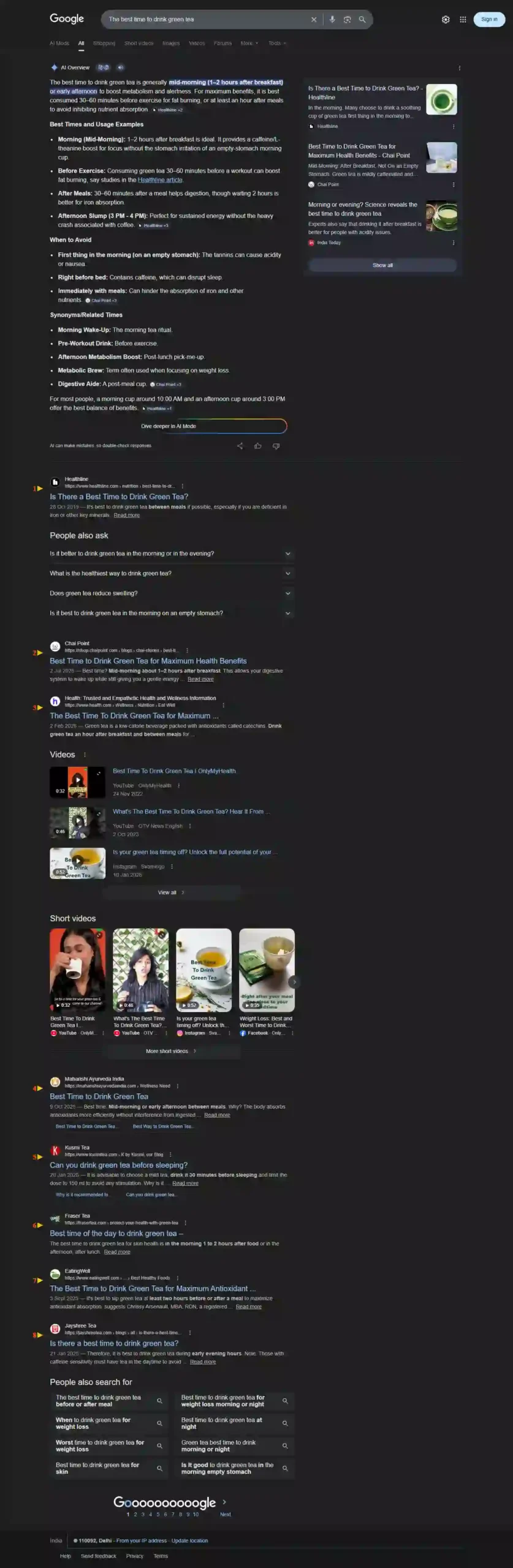
Afternoon (2:34 PM): Updated to “mid-morning or early afternoon” — the afternoon window was not in the morning version. A new “Synonyms/Related Times” section appeared, listing terms like “Morning Wake-Up Ritual” and “Pre-Workout Drink”.
Night (9:07 PM): A new “Optimal Timing for Specific Goals” section appeared — breaking down recommendations for weight loss, energy, digestion, and antioxidant absorption. And a warning was added that did not exist in either earlier session: “Avoid drinking it in the late evening if you are caffeine sensitive, as it may affect sleep quality.”
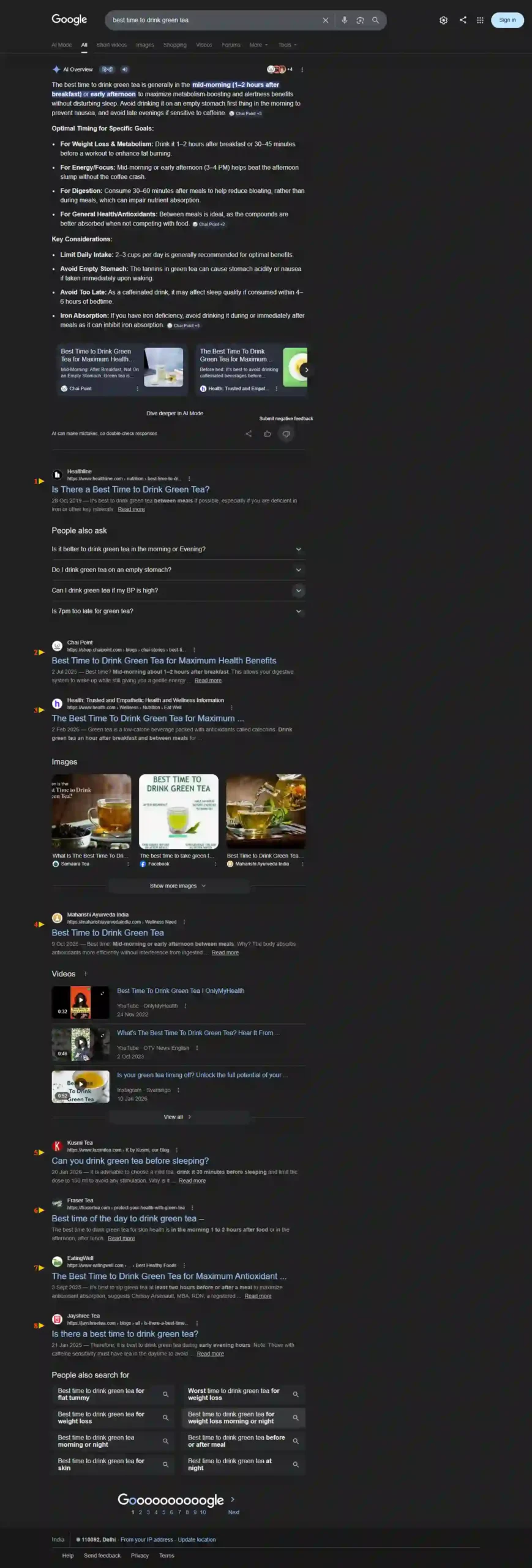
Same query. Same sources. Three progressively different answers — tracking the time of day.
People Also Ask Questions Rotate Every Session
| Session | PAA Questions |
| Morning | Morning or evening? · Is 7pm too late? · BP issue? · Healthiest way? |
| Afternoon | Morning or evening? · Healthiest way? · Reduce swelling? · Empty stomach? |
| Night | Morning or evening? · Empty stomach? · BP issue? · Is 7pm too late? |
Two questions dropped between morning and afternoon. Two returned at night. The PAA box is not static — it recalibrates continuously.
Short Videos and Images Sections Alternated
Short Videos: absent in morning, present in the afternoon, gone at night. Images block: present in morning, gone in afternoon, back at night. They effectively swapped slots across the day.
What Did NOT Change
All four organic positions – Healthline (#1), Chai Point (#2), Health.com (#3), and Maharishi Ayurveda (#4) – did not move a single spot across all three sessions.
Why This Matters
Google’s AI Overview for informational queries appears to be temporally aware. The AI progressively added time-relevant guidance — afternoon option at 2 PM, evening warning at 9 PM — that was absent earlier. Two users searching the same query at different times of day received meaningfully different AI-generated guidance, while seeing identical organic results below it.
What You Should Do
- Stop optimising only for organic rank. The AI Overview has more visual real estate than your #1 result. If your content is not being cited as a source, you are invisible to a large portion of users before they ever reach the organic listings.
- Cover all temporal angles in your content. Address morning, afternoon, and evening — with specific caveats for each. Content that covers time-based nuance comprehensively is more likely to be cited across AI Overview sessions at different times of day.
- Monitor AI Overview separately from rank tracking. Your SEO tool will confirm you are #1. It will not tell you the AI Overview above your result changed its messaging three times today.
- Track PAA questions weekly. They rotate faster than rankings. New PAA questions = new content gaps you can fill before a competitor does.
Keyword 2: best credit card for students in India 2026 (Commercial Investigation Intent)
What Changed
AI Overview Served Three Different Card Lists in One Day
| Session | Cards in AI Overview | What Changed |
| Morning | IDFC FIRST WOW · Kotak 811 · AU Bank LIT · Fibe Axis · ICICI Travel | Baseline |
| Afternoon | IDFC FIRST WOW · Kotak 811 · Fibe Axis (reordered) · AU Bank LIT · SBI Student Plus | ICICI out, SBI in; order shifted |
| Night | IDFC FIRST WOW · Kotak 811 · Axis Insta Easy (new) · ICICI Travel (back) · AU Bank LIT | SBI out, Axis Insta Easy in, ICICI returned |
ICICI Travel Card was in the morning list, removed at noon, and back by night. SBI Student Plus entered in the afternoon and was gone six hours later. Axis Insta Easy appeared only in the night session. A student searching at 8 AM, 2 PM, and 9 PM would have received three different card recommendations from the same query.
The AI Overview Structure Grew More Detailed Over Time
Morning: Simple bullet list + “Key Considerations” section.
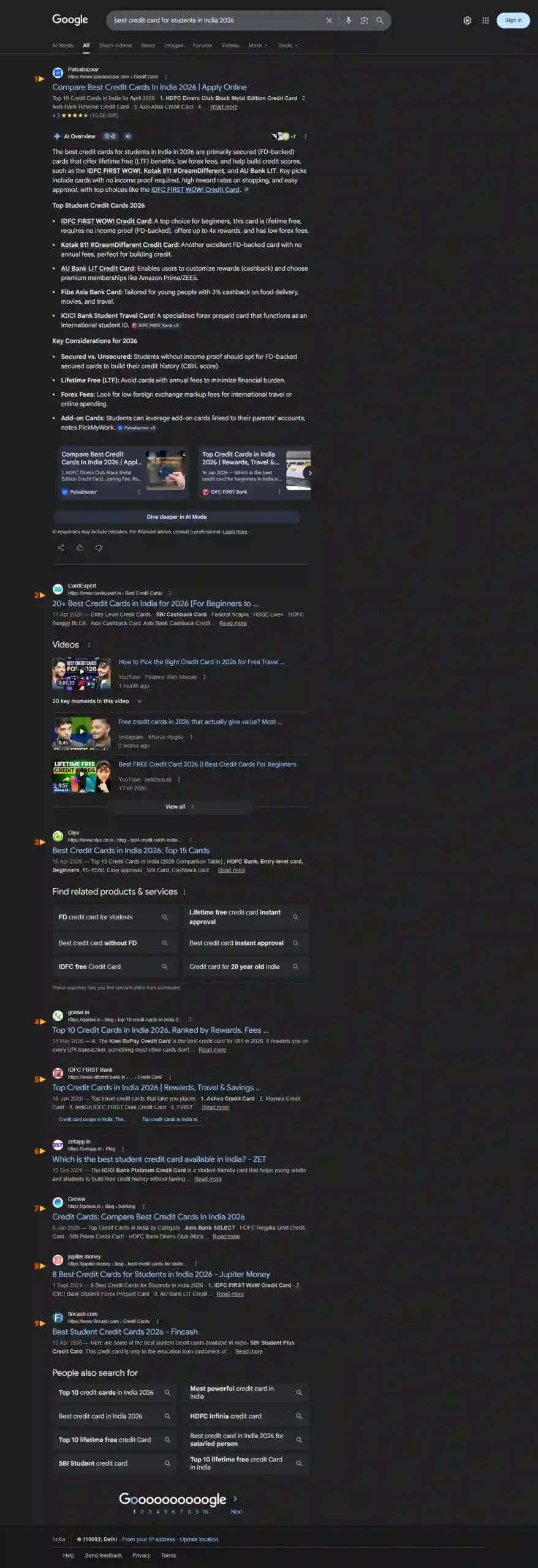
Afternoon: Category labels added to each card — “Best Overall,” “Best for Beginners,” “Best for Lifestyle”. New section explaining FD-backed cards, CIBIL score context, and income proof requirements.
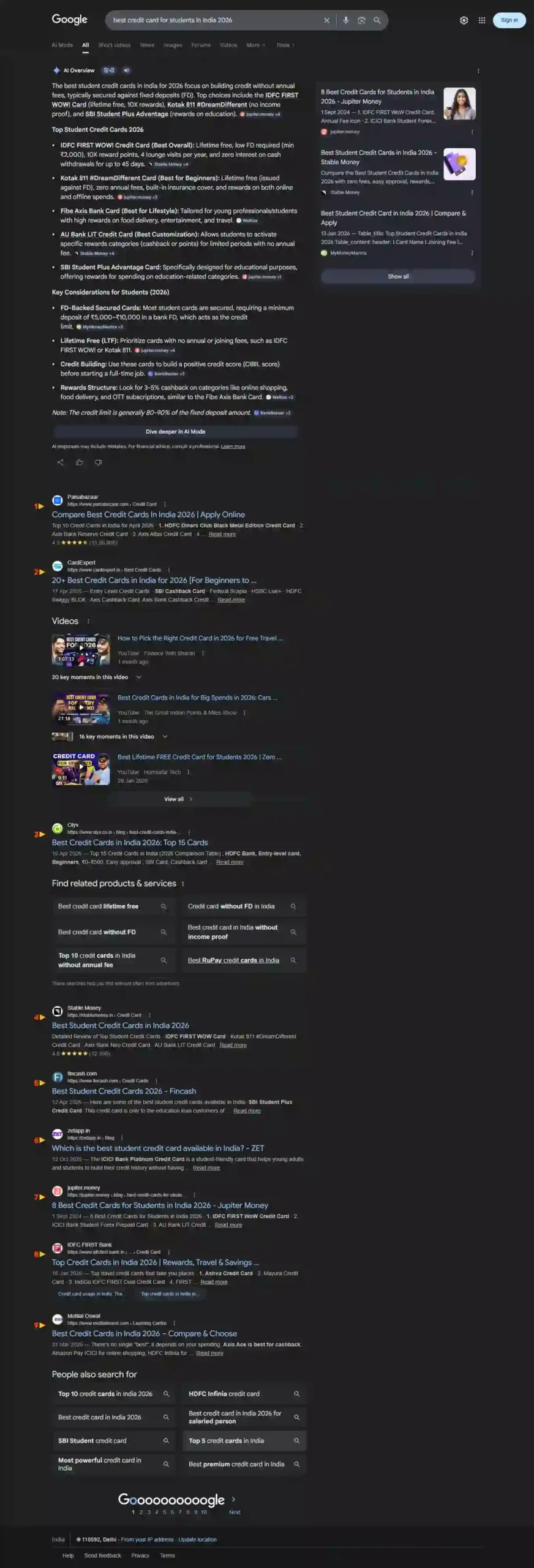
Night: Expanded further, with an upgraded disclaimer that was absent in earlier sessions: “Credit card terms and interest rates are subject to change. Always review the latest terms from the issuing bank before applying.”
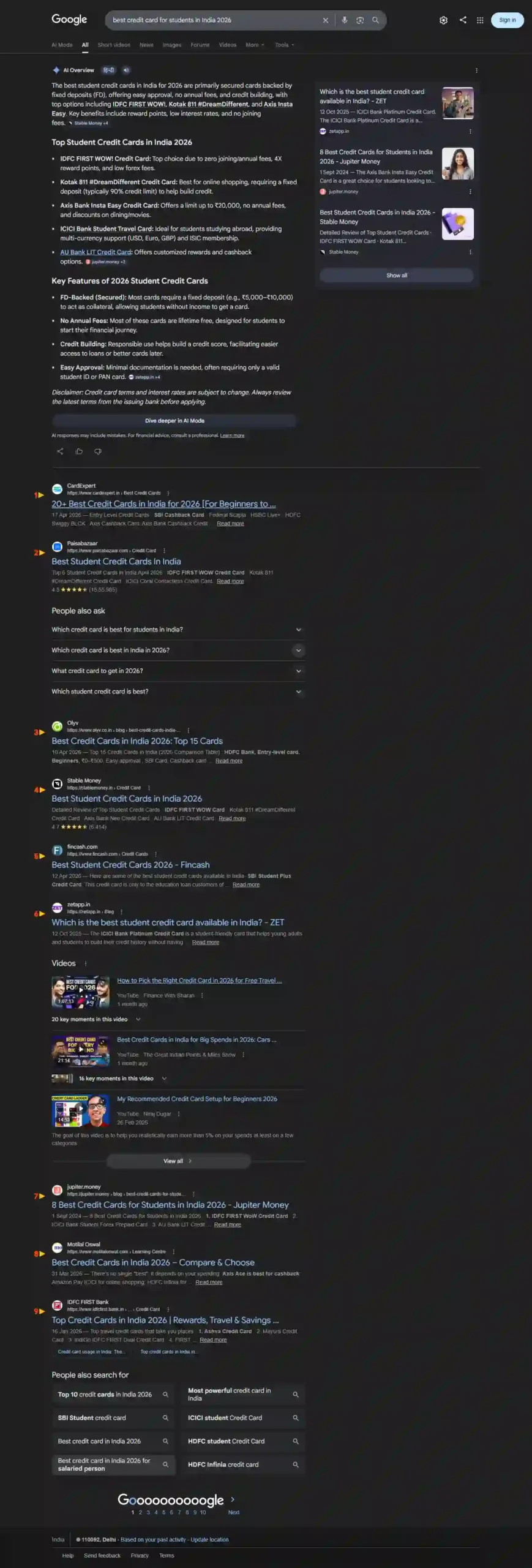
Organic #1 and #2 Swapped Positions Overnight
Paisabazaar held #1 for the morning and afternoon sessions. By night, CardExpert had taken #1 and Paisabazaar dropped to #2. Not a gradual shift — it flipped between the afternoon and night sessions. Three new domains — Stable Money, Fincash, and Motilal Oswal – entered the top 10 across the day, some appearing in only one session.
Zero Paid Ads — All Day
Not a single paid ad appeared across all three sessions on a high-value finance keyword. This suggests either budget exhaustion by morning, dayparting gaps in advertiser strategy, or Google classifying this query as “research-phase” rather than “conversion-ready” — and suppressing ads accordingly.
What Did NOT Change
- Paisabazaar and CardExpert stayed in the top 2 all day — only their order flipped.
- AI Overview was present in all three sessions without exception.
Why This Matters
AI Overview presence in a commercial SERP is not a stable feature — it is a live recommendation engine that recalibrates throughout the day. A brand that was recommended at 8 AM may be absent at 2 PM. For brands not in the AI Overview at all, the problem is compounding: the AI Overview consumed the top third of the screen, and a user who clicks “Dive Deeper in AI Mode” may never reach organic results or click at all.
What You Should Do
- Getting into the AI Overview citation list is now a higher priority than ranking #1 organically. Focus on formats used by consistently cited sources — direct comparisons, clear tables, and “best for X” positioning.
- Use “best for [specific persona]” framing. The AI Overview labeled every card — “Best Overall,” “Best for Beginners,” “Best for Lifestyle.” Content that maps products to specific user types is far more likely to be extracted and cited than generic listicles.
- Audit your paid search dayparting on finance keywords. Zero ads appeared all day on a credit card keyword — if your competitors have this gap, that is an opening. But also verify your own ads are actually showing at the times you think they are.
- Track position flips, not just ranking drops. A swap between #1 and #2 will not trigger an alert in most rank trackers because the domain is still “in the top 2.” For high-competition keywords, the exact order matters — monitor it daily.
- Own one angle deeply rather than covering everything shallowly. The AI cited Stable Money for IDFC FIRST WOW specifics, Paisabazaar for overall comparison, CardExpert for beginner picks. Each site owns a distinct angle. AI citations go to specialists, not generalists.
Keyword 3: buy wireless earbuds under 2000 (Transactional Intent)
What Changed
AI Overview Was Absent All Day — Deliberately
Three searches. Zero AI Overviews. For “buy intent” queries, Google shifts the SERP architecture entirely to shopping-focused features — product carousels, deals sections, price comparisons, local store listings. This is not a gap in Google’s system. It is a deliberate classification decision.
Organic Rankings Below the Shopping Carousels Shifted Every Session
| Rank | Morning | Afternoon | Night |
| #1 (below shopping) | boAt generic collections | boAt “Earbuds Under 2000” specific URL | MMI (new domain) |
| #2 | Noise | Noise | 91Mobiles |
| #3 | 91Mobiles | 91Mobiles | Noise |
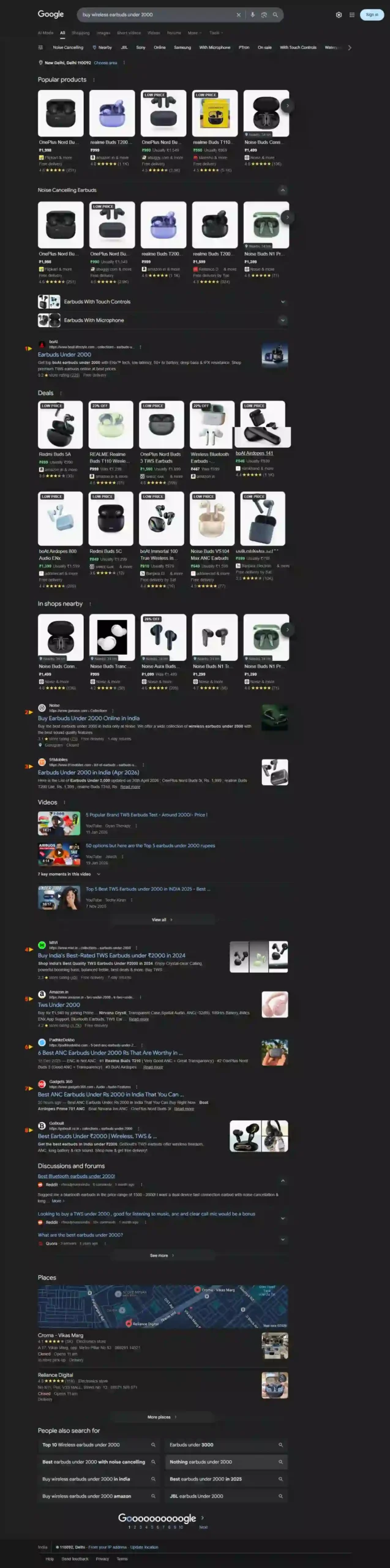
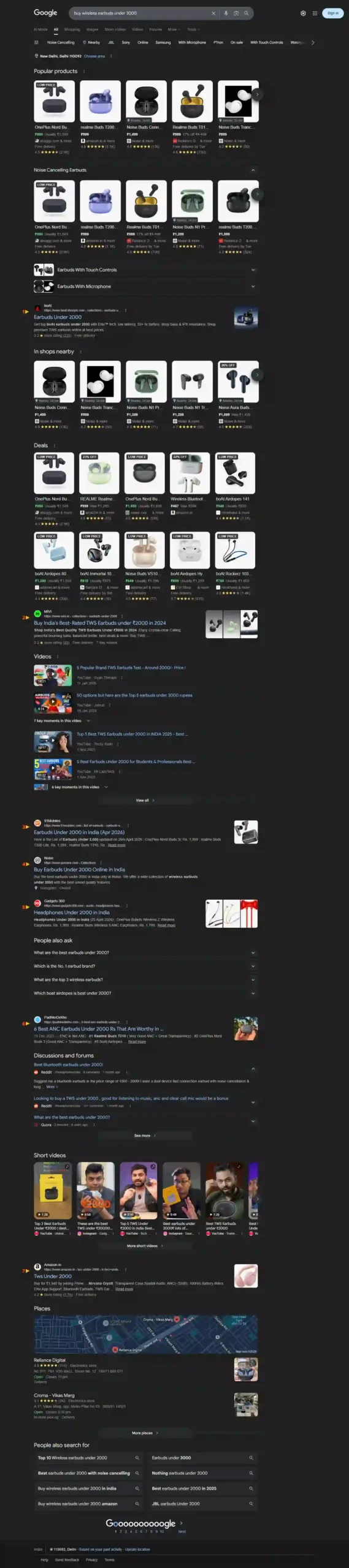
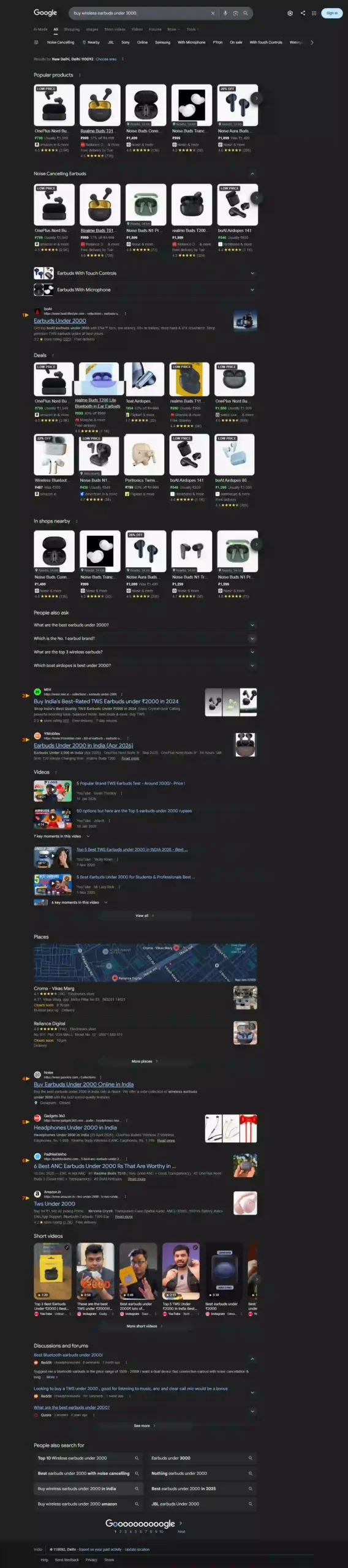
The top organic slot changed in every session. By night, MMI — a domain absent in the morning entirely — had taken position #1. Note that even within the same brand (boAt), the specific URL that ranked changed between morning and afternoon.
New SERP Features Appeared Mid-Day
- People Also Ask: Absent in morning, appeared in afternoon with 3 questions, held through night.
- Short Videos carousel: Absent in morning, 5 YouTube Shorts in afternoon, gone at night.
- “In Shops Nearby”: Present in all three sessions — Croma and Reliance Digital, same positions throughout.
Shopping carousel categories (Popular Products, Noise Cancelling, Touch Controls) remained stable, but product order and pricing within them shifted across sessions — driven by real-time inventory and pricing data.
What Did NOT Change
- AI Overview: absent in all three sessions
- “In Shops Nearby” store listings: identical across all three sessions
- Shopping UI as the dominant above-fold format: consistent throughout
Why This Matters
For transactional queries, organic rank #1 is structurally a second-place position. Before a user reaches it, they scroll past a product filter bar, a Popular Products carousel with 6–8 items, a category carousel, and occasionally a Deals section — all with prices, images, ratings, and buy buttons. Many users convert from the carousel and never reach organic results.
What You Should Do
- For ecommerce, Google Shopping feed optimisation is more urgent than blog content on transactional keywords. An unoptimised feed with poor images or missing attributes will not appear in carousels regardless of your organic ranking.
- Include the budget ceiling in your product titles and descriptions. “Under 2000,” “₹2,000,” “below 2000” — Google’s Shopping carousels match on these attributes. If your feed does not include them, you will not surface for budget-specific queries.
- Target comparison and review content for the organic slots, not product pages. The organic results below the carousel were dominated by list articles from 91Mobiles, Pocketsomething, and similar sites. A product page from your ecommerce site is unlikely to rank there — a “Best Earbuds Under 2000” editorial article has a far better shot.
- Optimise your Google Business Profile if you have physical stores. The “In Shops Nearby” section was present and stable across all three sessions — it is consistent, visible real estate on a transactional SERP that most brands underinvest in.
- Track Shopping carousel visibility separately from organic rank. Standard rank trackers do not measure carousel appearances. Use Google Search Console’s Shopping tab and Google Merchant Center performance reports for this data.
Keyword 4: Amazon India login (Navigational Intent)
This was the experiment’s control keyword — navigational queries are supposed to be boring. User wants a site, Google sends them there.
It turned out to be the most volatile keyword of the day.
What Changed
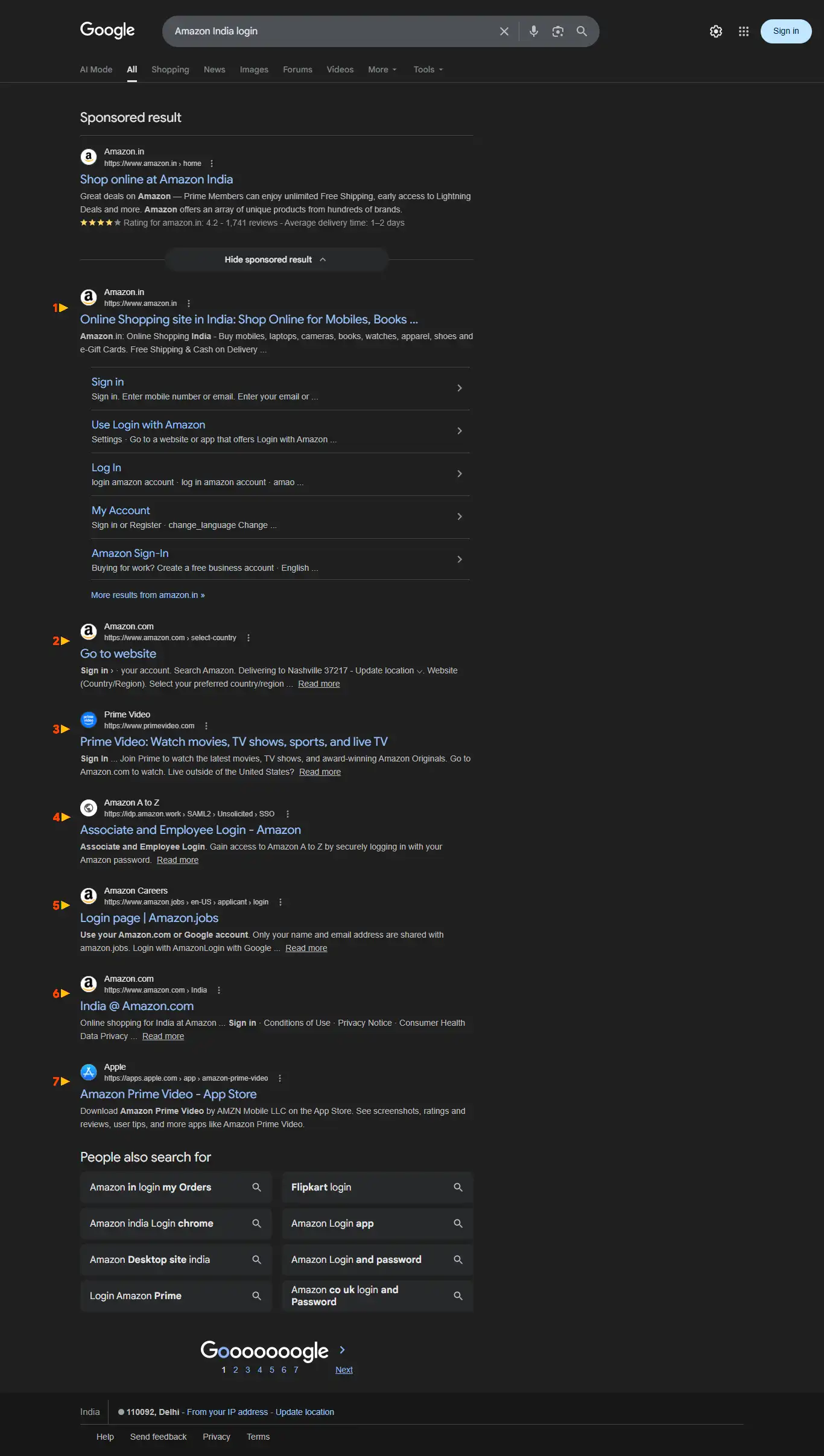
Amazon ran paid ads on its own brand keyword — but only from afternoon onwards.
| Session | Ad Present? | Format |
| Morning | ✗ No | — |
| Afternoon | ✓ Yes | Sponsored result, 2 sitelinks |
| Night | ✓ Yes | Same ad + ⭐ star ratings added |
At 8:43 AM — no ad. By 2:37 PM — Amazon was bidding on its own brand name. By night, Google had added star ratings to that same ad, suggesting live A/B testing of ad formats between sessions.
Organic sitelinks under #1 shifted every session. “Amazon Seller Central” disappeared after morning and never came back. The order of Sign in / Log In / Use Login kept changing.
Results #3–#7 were completely different across all three sessions. Prime Video was at #3 in the morning, gone in the afternoon, back at night. Apple App Store appeared only at night. The employee login portal (Amazon A to Z) oscillated in and out.
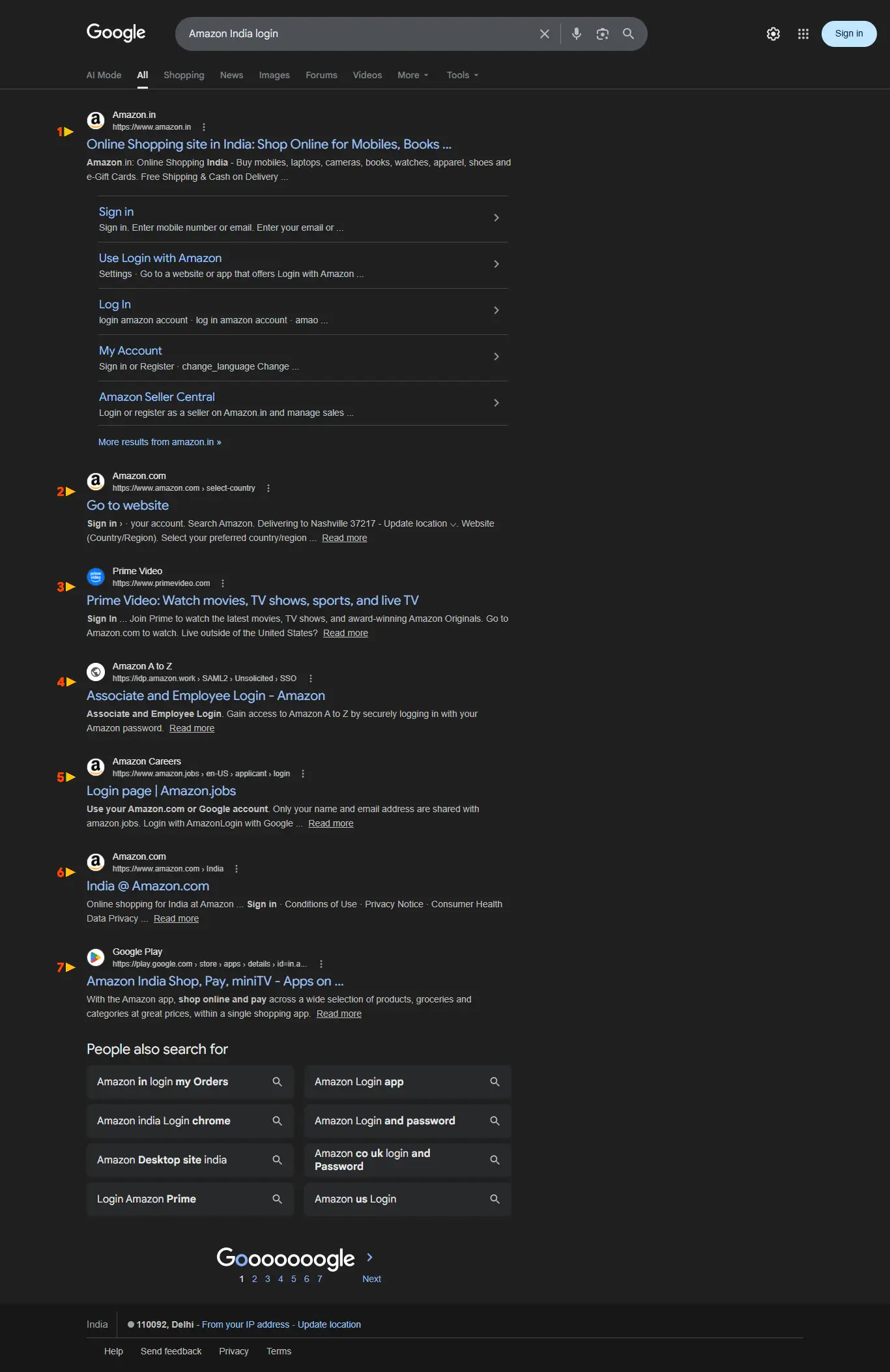
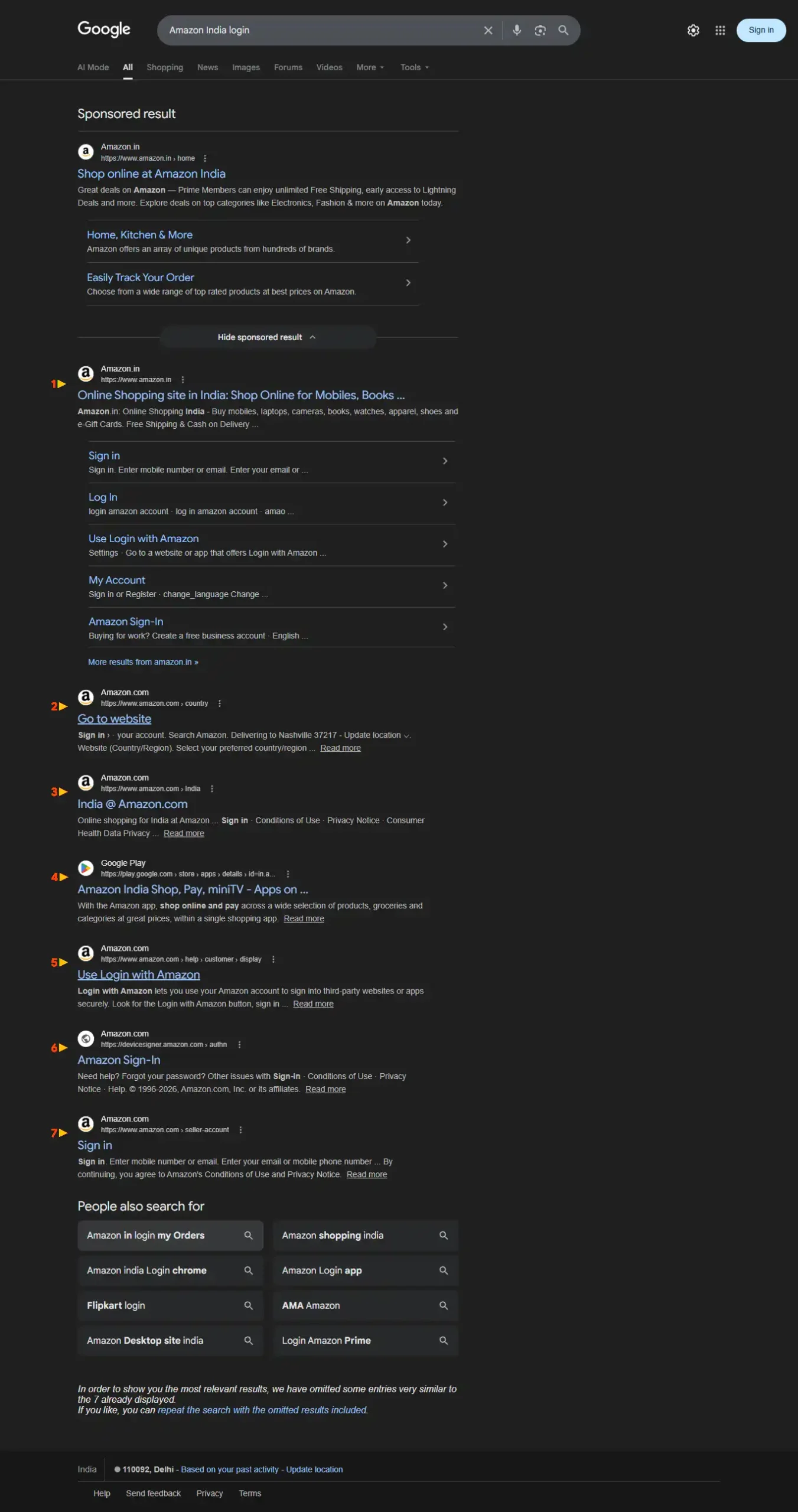
What Did NOT Change
Amazon.in held the #1 position across all three sessions without any movement. Despite volatility in ads, sitelinks, and lower-ranking results, the primary navigational result remained completely stable.
Why This Matters
If Amazon’s navigational SERP shifted six times in one day, no brand’s SERP is truly stable. The two specific risks:
- Competitors can run ads on your brand keyword during specific dayparts — and you will not see them unless you check at those exact times.
- Positions #3–#7 on your own branded SERP are not yours by default. They are contested.
What You Should Do
- Search your own brand name in incognito at morning, afternoon, and evening. Check if competitor ads appear at any point. Takes 10 minutes, costs nothing.
- Run a branded paid search campaign. If a competitor bids on your brand name, paid ads sit above your organic #1. Your own branded campaign is low-CPC and gives you control over the click.
- Audit your sitelinks in Google Search Console. Google chooses sitelinks dynamically — if an outdated page is showing, you can demote it. Most brands never do this.
The Master Summary: What Changed, What Did Not
Features That Were Completely Stable Across All 3 Sessions ✅
| Feature | Stability |
| Organic #1 position (all four keywords) | Unchanged — same domain, all three sessions |
| AI Overview: Presence/Absence by intent type | Consistent — present for informational/commercial, absent for transactional/navigational |
| “In Shops Nearby” local results | Croma and Reliance Digital, same position, all sessions |
| Video carousel (regular long videos) | Present whenever it appeared, same sources |
Features That Shifted Continuously 🔄
| Feature | What Changed |
| AI Overview content | Changed every session for both informational and commercial keywords |
| People Also Ask questions | 1–2 questions rotated every session |
| AI Overview card/product recommendations | Three different lists across three sessions (credit card keyword) |
| Paid ad presence | Amazon: absent in morning, present afternoon and night |
| Paid ad format | Amazon’s ad gained star ratings between afternoon and night sessions |
| Organic positions #3–#7 | Fluid across all four keywords |
| SERP feature set | Short Videos, Images, and Discussions sections appeared and disappeared across sessions |
| Credit card organic #1 | CardExpert and Paisabazaar swapped positions between afternoon and night |
Why SERPs Change Within a Single Day
Understanding the ‘what’ is useless without the ‘why’. Here is the short version of what drives intraday SERP volatility:
1. AI Overview is a live generation system, not a cached document. Google’s AI Overview does not retrieve a saved answer — it generates a response at query time, pulling from indexed sources. This means the output can differ run to run, especially as Google adjusts its prompts, sources, and confidence thresholds.
2. Google runs continuous A/B tests on SERP layouts. Google runs thousands of experiments simultaneously — on which features appear, in what order, and in what format. Any given user on any given query could be in a test bucket that sees a different SERP than someone else searching the same thing at the same time.
3. Advertiser budgets are time-bound. Paid ads are governed by daily budgets, bid strategies, and dayparting settings. An advertiser whose budget runs out by noon simply disappears from the SERP. Others who set their bids higher for peak hours appear only during those windows.
4. Real-time user behaviour signals influence rankings. Google uses click-through rate, dwell time, and engagement signals to refine ranking decisions. A piece of content that gets strong engagement in the morning may temporarily rank higher by afternoon.
5. Freshness signals spike for time-sensitive queries. For queries where time-of-day matters (like “best time to do X”), Google may factor in temporal context when generating responses.
The Big Takeaway: You Are Tracking the Wrong Things
Most SEO teams track one thing: keyword ranking. A position number, pulled once a day, compared to last week’s position number.
This experiment suggests that model is incomplete.
Here is what actually matters on a modern Google SERP:
- Are you present in the AI Overview? This is now the most visible feature on informational and commercial SERPs. A #1 ranking below an AI Overview that recommends your competitor is worth less than it used to be.
- What are the PAA questions rotating through your target keyword? These are live topic signals. New PAA questions = new content Google is trying to answer = new opportunities for you to publish targeted content.
- Is your competitor running ads on your brand keyword — and when? A once-daily rank check at 3 AM will not catch a competitor’s dayparted ad campaign that runs 12 PM to 8 PM.
- For transactional queries — are you in the Shopping carousel? Organic rank #1 below a full shopping carousel is a second-place position in terms of user attention.
- What does your SERP look like right now — not yesterday? In one day, across four normal keywords, there were 26 distinct SERP changes. If your monitoring cadence is weekly, you are making strategic decisions on a snapshot that may have been obsolete within hours.
The Action Plan
This week:
- Search your 5 most important keywords in incognito mode at three different times. Screenshot the results. Note AI Overview presence, PAA questions, paid ad presence, and who holds #1.
- Check if any competitor is running ads on your brand keyword.
This month:
- Audit your content against AI Overview source patterns. Which content format does Google’s AI cite for your target queries? Study their content structure and replicate the format.
- Review your Google Shopping feed if you are in e-commerce. Unoptimised feeds are invisible in Shopping carousels.
- Set up a PAA tracking system — even a simple Google Sheet where you note PAA questions weekly for your top 10 keywords.
Ongoing:
- Add AI Overview monitoring to your SEO reporting. A rank tracker that does not capture AI Overview content is telling you an incomplete story.
- Treat SERP monitoring as a continuous process, not a daily data pull. The SERP is a living document. Your strategy should treat it as one.
This experiment was conducted on 26 April 2026 using four keywords across three time intervals, with 12 full-page SERP captures taken in Chrome incognito mode (desktop) on Google.co.in from Delhi, India.
SERP behaviour may vary by location, device, and query phrasing.
If you run a similar experiment and notice different patterns — or the same ones — I’d genuinely like to hear what you find.
 Add Content Decoded as a preferred source








Leave a Reply