How to Get Natural Backlinks Without Outreach or Creating Manually
Most people try to manually create backlinks—profiles, directories, and random submissions—thinking more links mean better SEO. In reality, a lot of that effort leads to little or no impact.
I didn’t do any of that.
I focused only on writing content that actually solves something clearly—and ended up getting two backlinks naturally, without asking anyone.
That’s what natural backlinks are: links you don’t create yourself but earn because your content helps someone else’s content.
So the approach becomes simple:
- Create something worth referencing
- Make it easy to understand
- Solve a specific problem properly
Do this well, and backlinks start coming to you instead of you chasing them.
The rest of this blog breaks that down in detail using real examples and practical steps.
Proof: My Case Study (2 Natural Backlinks)
Let’s start with something concrete, because this is where most advice usually falls apart—there’s a lot of theory around backlinks, but very little real, verifiable proof.
In my case, I earned two completely natural backlinks to Content Decoded without sending a single email, request, or message. Both came purely because the content was useful enough to be referenced.
Here’s a clear breakdown:
| Factor | Proof 1 | Proof 2 |
| Source Type | Newsletter / Editorial | Blog |
| Website | Beta Briefing (Operator’s Edge) | junoo.shop |
| Content Linked | AI Overview Sources breakdown | High impressions, low clicks guide |
| Link Type | Natural citation | Contextual in-content link |
| Outreach Done | None | None |
| Purpose of Link | Citing original insight | Solving a specific problem |
Proof 1: Editorial Citation (Beta Briefing)
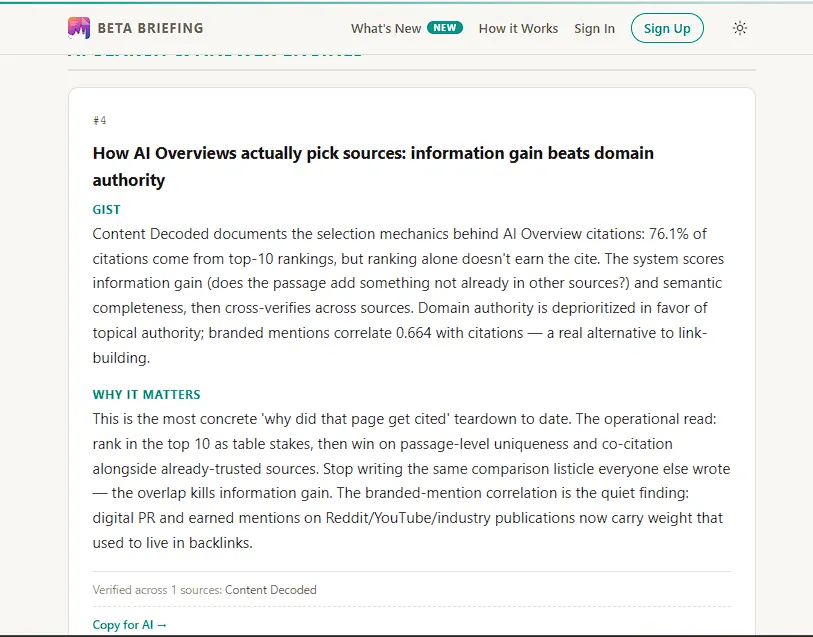
In April 2026, I published a detailed article on how Google selects AI Overview sources. It wasn’t just another opinion piece—it included structured reasoning, specific observations, and clear breakdowns of how selection works.
Within 24 hours, that article was picked up by Beta Briefing’s “Operator’s Edge” newsletter.
They didn’t just mention it casually—they described it as “the most concrete teardown to date” on the topic and linked back to my site as a source.
No outreach. No introduction. No connection.
Proof 2: Contextual Problem-Solver Link (junoo.shop)
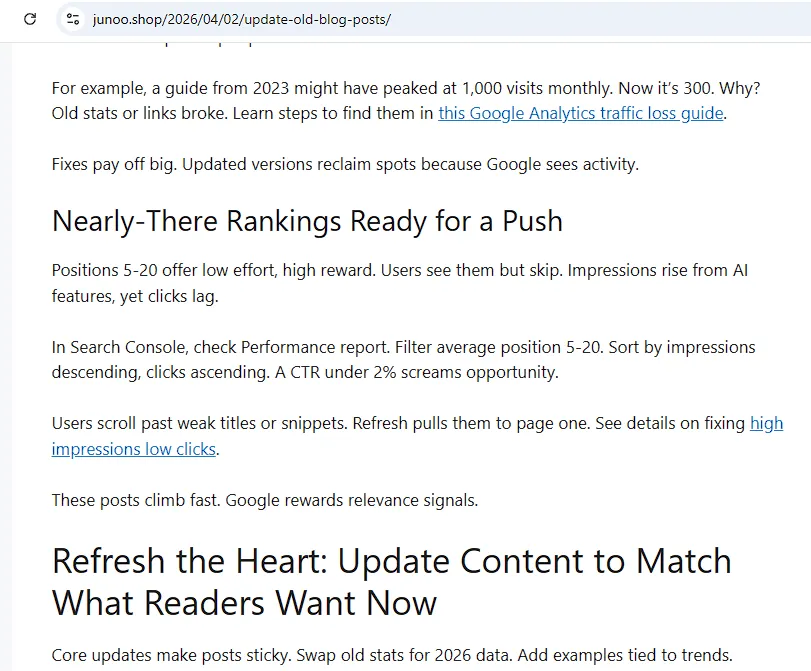
The second backlink came from a completely different type of source—a blog post on junoo.shop.
They were writing about updating old content for better traffic and reached a point where they discussed pages that rank between positions 5–20 but have low click-through rates.
At that exact point, they needed to guide readers deeper into the problem.
So they linked to my article on:
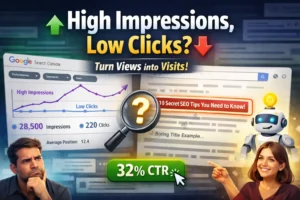
“High impressions but low clicks — reasons and fixes.”
What These Two Examples Prove
These are two very different types of backlinks:
- One is an editorial citation from a newsletter
- The other is a contextual link inside a blog
But both follow the same pattern.
| Pattern | How It Showed Up |
| Content added something new | AI Overview breakdown with original insights |
| Content solved a clear problem | Low CTR guide for ranking pages |
| Content was easy to use | Structured and scannable |
| No outreach needed | Both links happened naturally |
The Real Takeaway
You don’t need a large website or a strong backlink profile to start earning links.
What actually matters is much simpler:
- Your content should give something others cannot easily recreate
- It should solve a real, clearly defined problem
- It should be structured so others can quickly understand and use it
When those conditions are met, backlinks stop being something you chase—and start becoming something your content attracts on its own.
What to Do to Get Natural Backlinks
Now let’s move into the practical side, because this is where most people get stuck.
If you want backlinks without asking for them, your content needs to meet a few clear conditions.
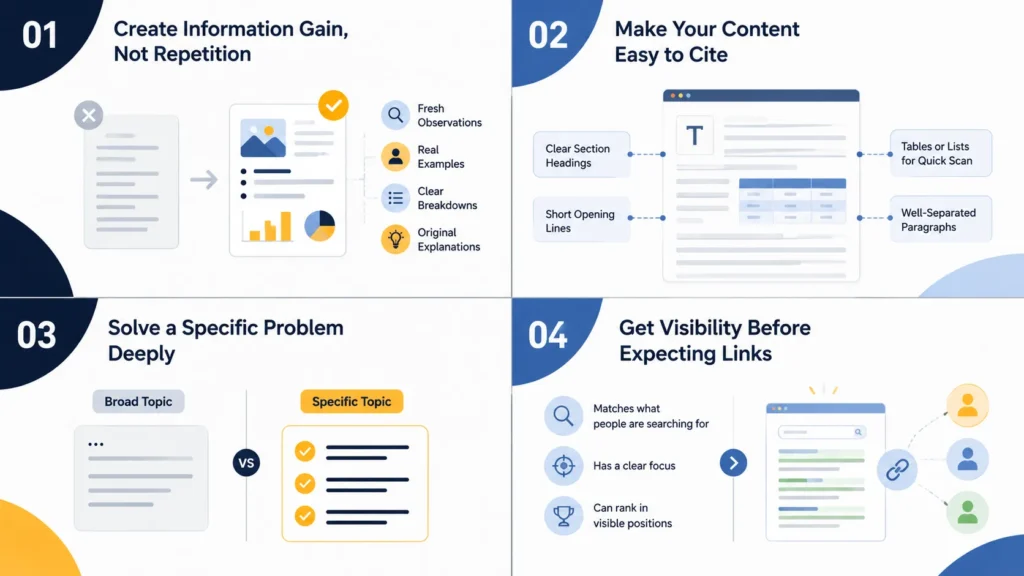
1. Create “Information Gain”, Not Repetition
A large portion of content online repeats what already exists. It may be well-written, but it doesn’t add anything new.
That kind of content rarely earns backlinks.
What actually gets cited includes:
- Fresh observations
- Real examples
- Clear breakdowns
- Simple but original explanations
Instead of asking whether your content is “good”, ask a better question:
“Is there at least one thing here that someone else would need to reference?”
If the answer is no, the chances of getting backlinks drop significantly.
Tip – You can find real and firsthand data by doing research, running a poll on social media platforms, getting feedback from the customer, identifying trends and new updates in your niche and keeping your knowledge up-to-date.
2. Make Your Content Easy to Cite
Even strong insights can go unnoticed if they are difficult to extract.
Writers, bloggers, and researchers don’t read every word—they scan quickly to find useful pieces they can reference.
So your structure should help them, not slow them down.
Here’s what works well:
- Clear section headings that explain what each part contains
- Short opening lines that directly answer the topic
- Tables or lists that summarize ideas quickly
- Well-separated paragraphs instead of large text blocks
This doesn’t just improve readability—it increases the chances of your content being picked up and cited.
3. Solve a Specific Problem Deeply
Broad topics rarely attract backlinks because they don’t give a strong reason to link.
Specific topics do.
Here’s a simple comparison:
| Broad Topic | Specific Topic |
| SEO tips | How to fix high impressions but low clicks |
| Content writing | How to update old blog posts for better traffic |
| Website growth | How to improve click-through rate from search |
When your content focuses on a clear, narrow problem and explains it properly, it naturally becomes a reference point for others writing on related topics.
Check your blog topical authority with this topical authority checker tool.
4. Get Visibility Before Expecting Links
Backlinks don’t appear in isolation. They usually come after your content becomes visible. If your content is not ranking then it can’t get backlinks.
If no one sees your page, no one links to it.
So before thinking about backlinks, make sure your content:
- Matches what people are searching for
- Has a clear focus
- Can rank at least within visible positions
Once your article starts appearing in search results, it enters the flow where:
- Writers discover it
- Bloggers use it as reference
- Curators include it in their content
That’s when backlinks begin to form naturally.
Limitations of Manually Created or Outreached Backlinks
Manual link building still exists, but its effectiveness is not what it used to be.
Let’s look at the main limitations clearly.
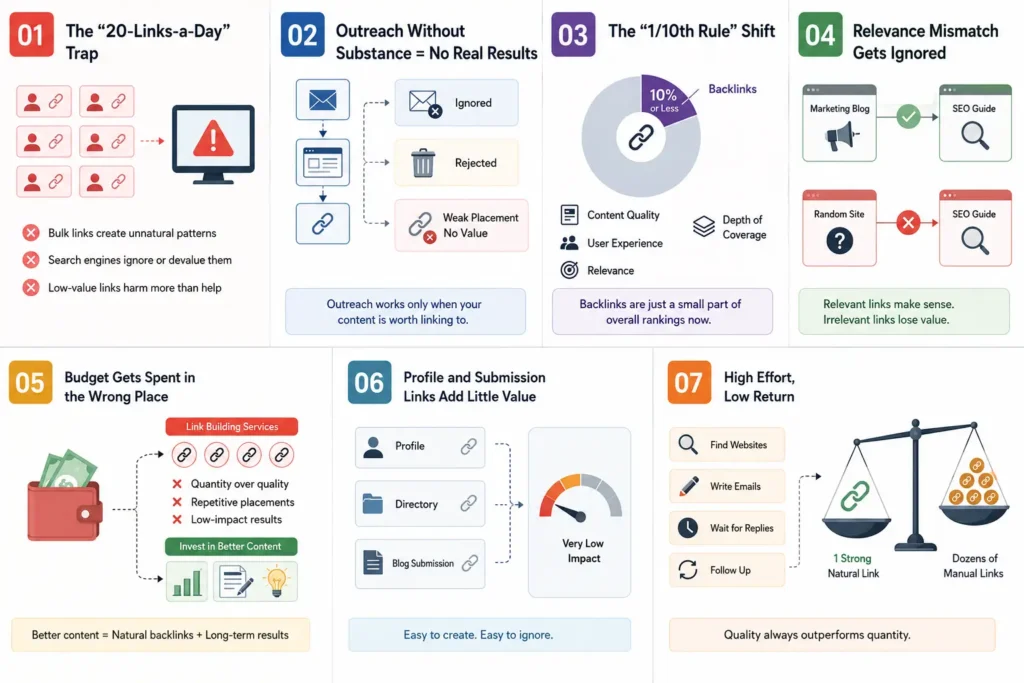
1. The “20-Links-a-Day” Trap
Creating backlinks in bulk—whether through profiles, comments, or directory submissions—might feel productive, but it creates patterns that don’t occur naturally.
Real websites don’t suddenly get dozens of unrelated links in a single day from profile pages or low-value platforms.
This kind of activity sends a clear signal that the links are being created deliberately rather than earned. As a result, search engines tend to either ignore those links or reduce their impact significantly.
2. Outreach Without Substance = No Real Results
Outreach sounds simple in theory—find websites, send emails, ask for a link.
But the outcome depends entirely on the quality of your content.
If your content doesn’t add something new or useful:
- It gets ignored
- It gets rejected
- Or it ends up placed on weak pages that bring no value
In simple terms, outreach cannot fix average content. It only works when there’s already something worth linking to.
3. The “1/10th Rule” Shift
Backlinks used to carry a much larger weight in rankings.
Now, they are just 10% or less of a bigger picture that includes:
- Content quality
- User experience
- Relevance
- Depth of coverage
If most of your time is spent trying to build links while ignoring these areas, the overall growth stays limited.
A better return usually comes from improving content rather than chasing links.
4. Relevance Mismatch Gets Ignored
Links only make sense when they connect related topics.
For example:
- A marketing blog linking to an SEO guide → makes sense
- A random, unrelated site linking to the same guide → raises questions
When links come from unrelated sources, they lose meaning. Even if the site looks strong on paper, the lack of context reduces the value of that link.
Natural backlinks, on the other hand, usually come from relevant content, which makes them far more effective.
5. Budget Gets Spent in the Wrong Place
A common approach is to invest in “off-page SEO” services that focus mainly on building links.
The problem is that this often leads to:
- Quantity over quality
- Repetitive placements
- Low-impact results
The same effort, if used for creating stronger content—like research, examples, or structured guides—can generate backlinks without ongoing cost.
6. Profile and Submission Links Add Little Value
Links from profiles, directories, or basic blog submissions are easy to create.
That’s exactly why they carry very little weight.
Since anyone can generate them at scale, they don’t represent a real endorsement. As a result, their impact is minimal, even if they are marked as “dofollow”.
So while the backlink count increases, the actual benefit often does not.
7. High Effort, Low Return
Manual outreach takes time at every step:
- Searching for websites
- Writing personalized emails
- Waiting for replies
- Following up
Even when it works, the link placement may not be ideal or relevant.
In contrast, a single strong, natural backlink from a relevant source can deliver more value than dozens of manually created links.
Benefits of Natural Backlinks
Now compare that with what happens when backlinks are earned naturally.
1. They Reflect Genuine Trust
A natural backlink is a decision made by someone who found your content useful enough to include.
That’s a strong signal—not just for search engines, but for overall credibility.
2. They Are Highly Relevant
Natural links usually come from content that is closely related to your topic.
This relevance makes them more meaningful and effective.
3. They Build Momentum Over Time
One natural backlink can lead to more.
As your content gets discovered through existing links, more people start referencing it.
This creates a steady, compounding effect.
4. They Bring Engaged Visitors
Unlike many manually placed links, natural backlinks often generate real traffic.
People click them because they are placed in the right context, which leads to:
- Better engagement
- Longer time on page
- Higher interaction
These signals indirectly support your overall SEO performance.
Natural Backlinks are part of broader concept “Natural SEO” where rankings, clicks, backlinks and revenue happens automatically by white hat SEO without manipulation, without forced tactics but everything naturally as per rules.
Why GSC Shows Some Links and Not Others
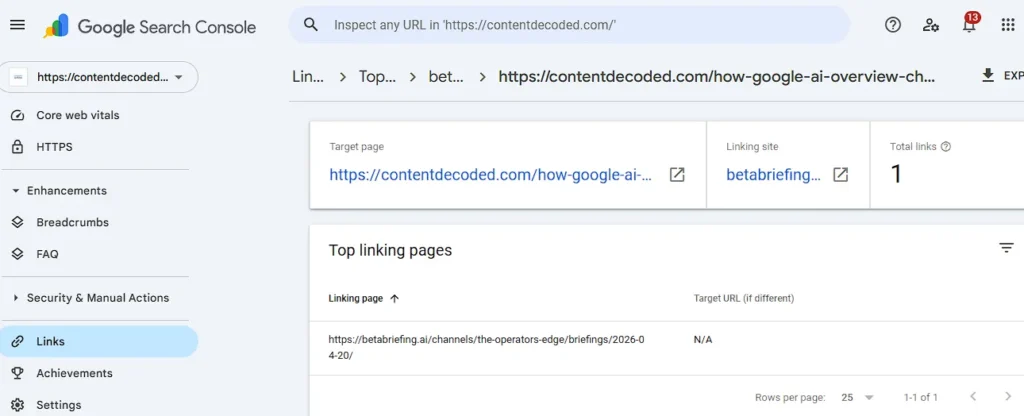
This is a common confusion point.
You may know a link exists but still not see it in your reports, as my one backlink by Betabriefing is shown on GSC, but that Junoo one has not appeared. Here’s why that happens.
1. It Shows a Sample, Not Everything
Google Search Console does not display all backlinks. It shows a selected portion.
So missing links in the dashboard does not mean they are not counted.
2. Crawling Frequency Varies
New websites are not crawled as often as established ones.
If the linking page hasn’t been revisited yet, the link won’t appear.
3. Reporting Takes Time
There is usually a delay between when a link is discovered and when it appears in reports.
During this time, the link may already be contributing value even if it is not visible.
Why Natural Links Often Beat Manually Created Links
This is where things become clearer.
A smaller, natural backlink can sometimes outperform a larger, manually created one.
Here’s a simple comparison:
| Factor | Manual Link | Natural Link |
| Intent | Created deliberately | Occurs naturally |
| Relevance | Can vary | Usually strong |
| Trust | Lower | Higher |
| Risk | Can be flagged or ignored | Safe |
| Long-term value | Uncertain | Stable |
| Type | Repeated | Variation and many types |
Key Reasons Behind This
- Context matters more than size: A relevant mention in the right place carries more weight than a forced link on a bigger site.
- Natural patterns look real: Search engines trust links that appear organically across different sources.
- Lower risk: Natural links don’t trigger filters or penalties.
- Better engagement: They bring users who are actually interested in your content.
Final Thoughts
Backlinks still matter, but the way you approach them should change from here.
Instead of spending time creating links manually, shift your focus to what actually attracts them.
Going forward:
- Improve your existing content so it becomes worth referencing
- Write on specific problems instead of broad topics
- Add one clear, citable insight in every article
- Keep your structure simple so others can easily use your content
- Becming a source in AI overview also helps to get natural backlinks
If you do this consistently, backlinks won’t feel like a separate task anymore—they’ll become a natural result of the work you’re already doing.
 Add Content Decoded as a preferred source