Natural SEO vs Traditional SEO: What Actually Works Today
Most SEO strategies still chase metrics Google doesn’t actually use. Which results in rankings dropping, content getting ignored, and the checklist keeping growing. The real gap isn’t effort; it’s misunderstanding how search evaluates value now.
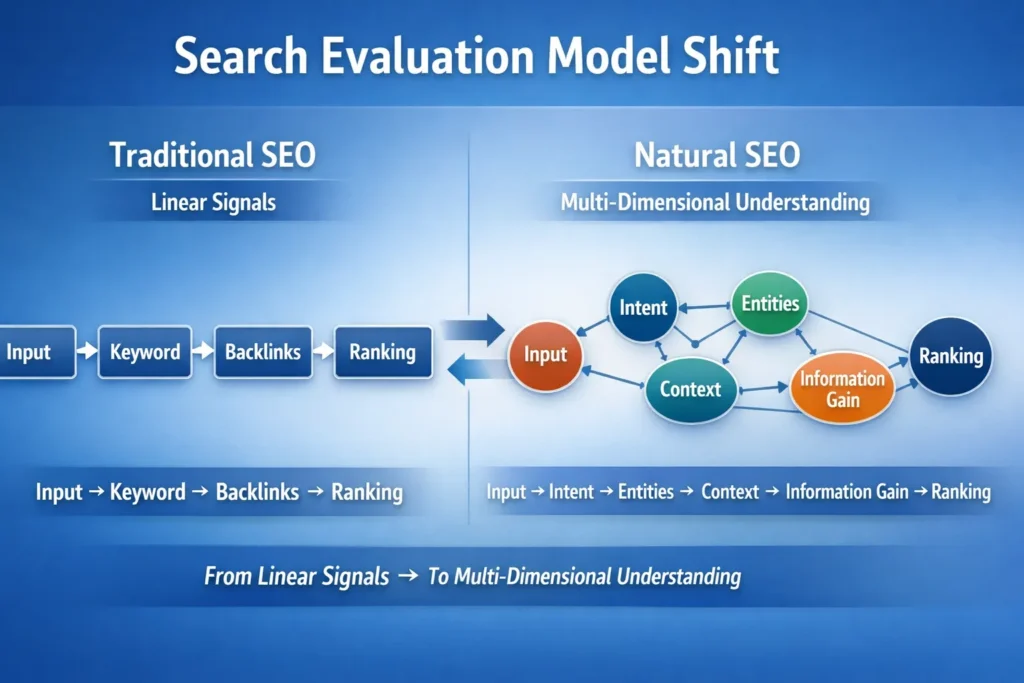
Traditional SEO relies on keyword placement, backlinks, and technical signals to satisfy ranking factors. Natural SEO focuses on originality, information gain, and relevance, prioritising the unique value a page adds beyond existing results.
This isn’t theory; it’s a working comparison across real SEO outcomes you can measure.
Understand this shift, and rankings stop being unpredictable.
Natural SEO vs Organic SEO: Problem-Solving vs Traffic
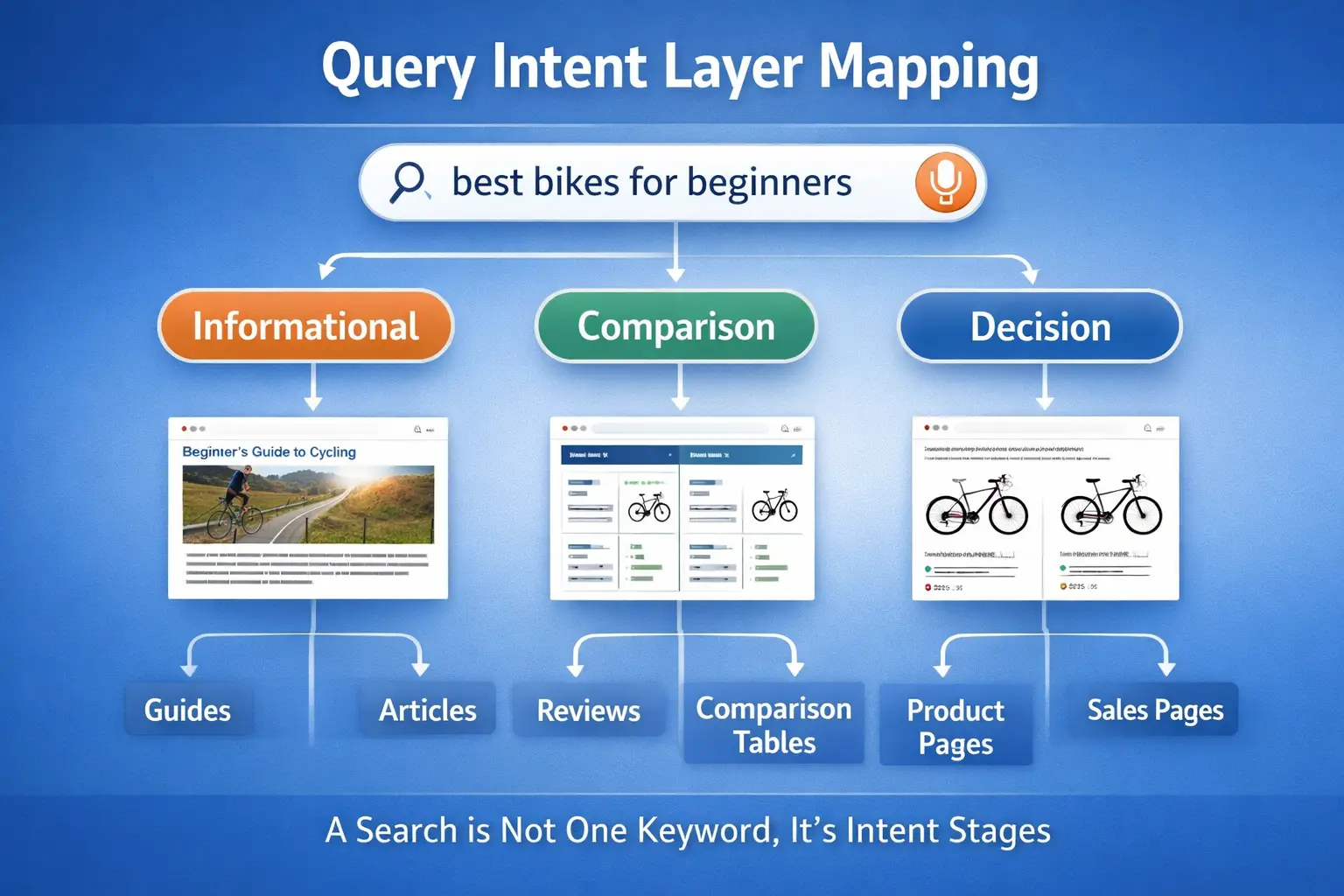
Most SEO still revolves around chasing numbers. But the real shift is moving from search volume obsession to solving what users actually need.
Traditional Organic SEO Chases Volume
Organic SEO often starts with keyword tools and ends with traffic goals. Pages are built to rank, not to help.
- Keywords picked for high volume, not relevance (which is failing)
- Content stretched to fit multiple variations
- Little differentiation from competing pages
The result is predictable: repetitive content that blends into the noise.
Natural SEO Maps Real User Intent
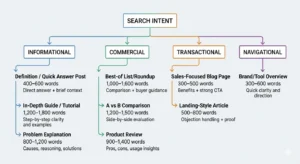
Natural SEO looks deeper. It breaks queries into intent layers: learning, comparing, and deciding. Content aligns with where the user actually is.
For example, someone searching “best budget phones” might later refine to “iPhone vs Samsung under 40k.” Natural SEO connects these steps, not just isolated keywords.
What this really means is stronger engagement, clearer relevance, and rankings that hold.
Solve the journey, not just the keyword.
Natural SEO vs On-Page SEO: Placement vs Understanding
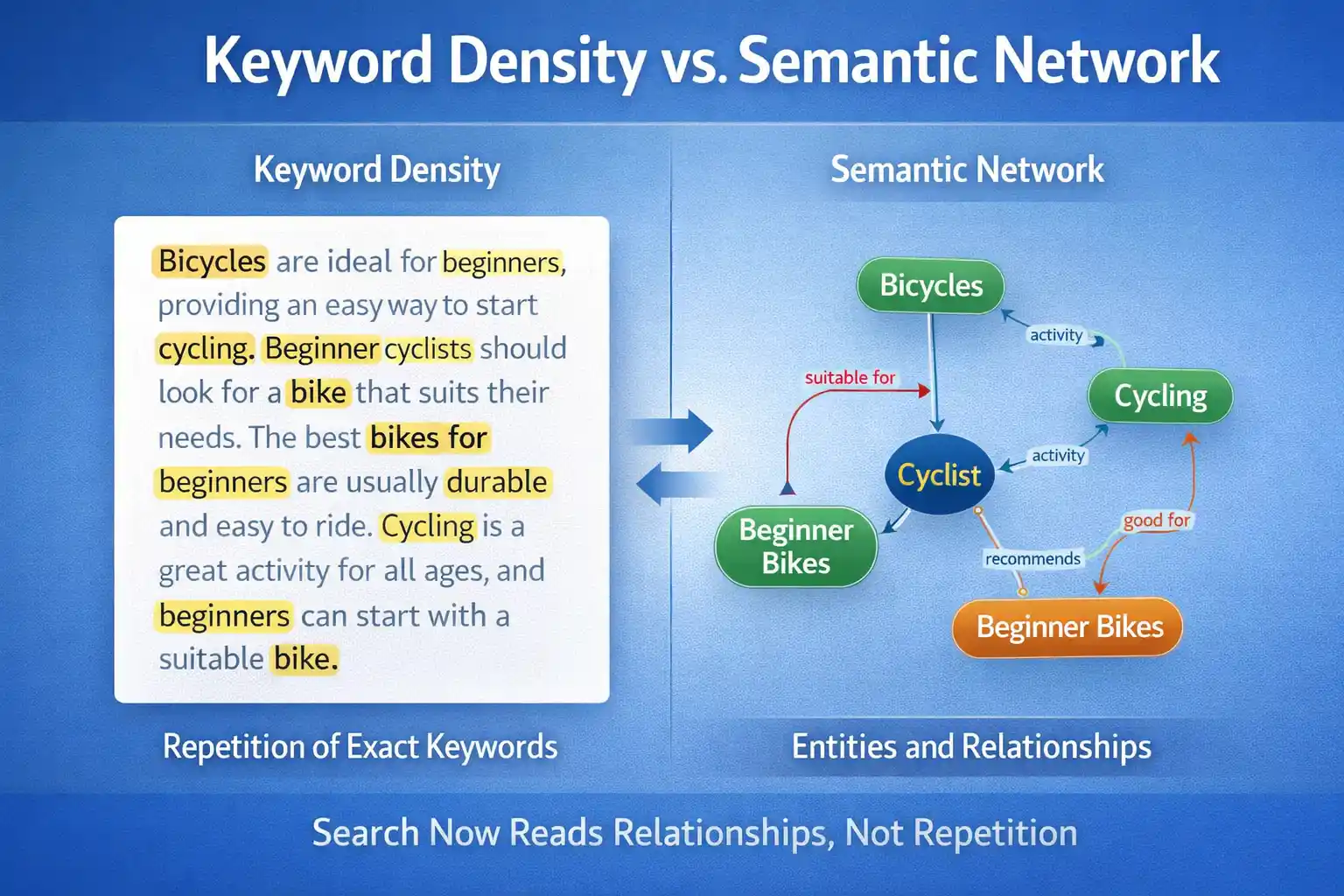
SEO has shifted from placing keywords in the right spots to actually making content make sense. What used to be a checklist is now more about how well a page communicates meaning.
Traditional On-Page SEO Treats Keywords Like Formula
Earlier SEO worked like a rigid system. You pick a keyword, then make sure it appears in specific places, whether it fits naturally or not.
It focused more on matching patterns than delivering clarity.
Old rules looked like this:
- Exact keyword in title, H1, and meta description
- Keyword in the first 100 words
- Maintain a certain keyword density
- Repeat variations across subheadings
This approach is outdated because search engines no longer rely on surface-level signals alone. Repetition doesn’t equal relevance anymore.
Natural SEO Uses Context, Entities, and Flow
Now, search engines understand relationships between concepts. They identify entities, connect ideas, and interpret intent instead of counting keywords.
What matters is whether your content clearly answers something, not how many times a phrase appears.
Example:
Forced: Our digital marketing agency offers the best digital marketing services for businesses needing digital marketing solutions.
Naturally written: We help businesses grow through tailored marketing strategies across search, content, and paid channels.
Same topic, but one reads like a checklist, the other like a real explanation.
In short: clarity beats repetition.
What Still Matters (But Differently)
- Internal linking – Helps users move through related ideas logically but if done naturally, not forced.
- Clean UX and layout – Makes content easier to scan and understand
- Technical clarity (schema, speed) – Ensures content is accessible and properly interpreted
These still matter, just not for manipulation. They support understanding and usability, which is what search engines actually reward now.
Natural SEO vs Off-Page SEO: Authority vs Manipulation
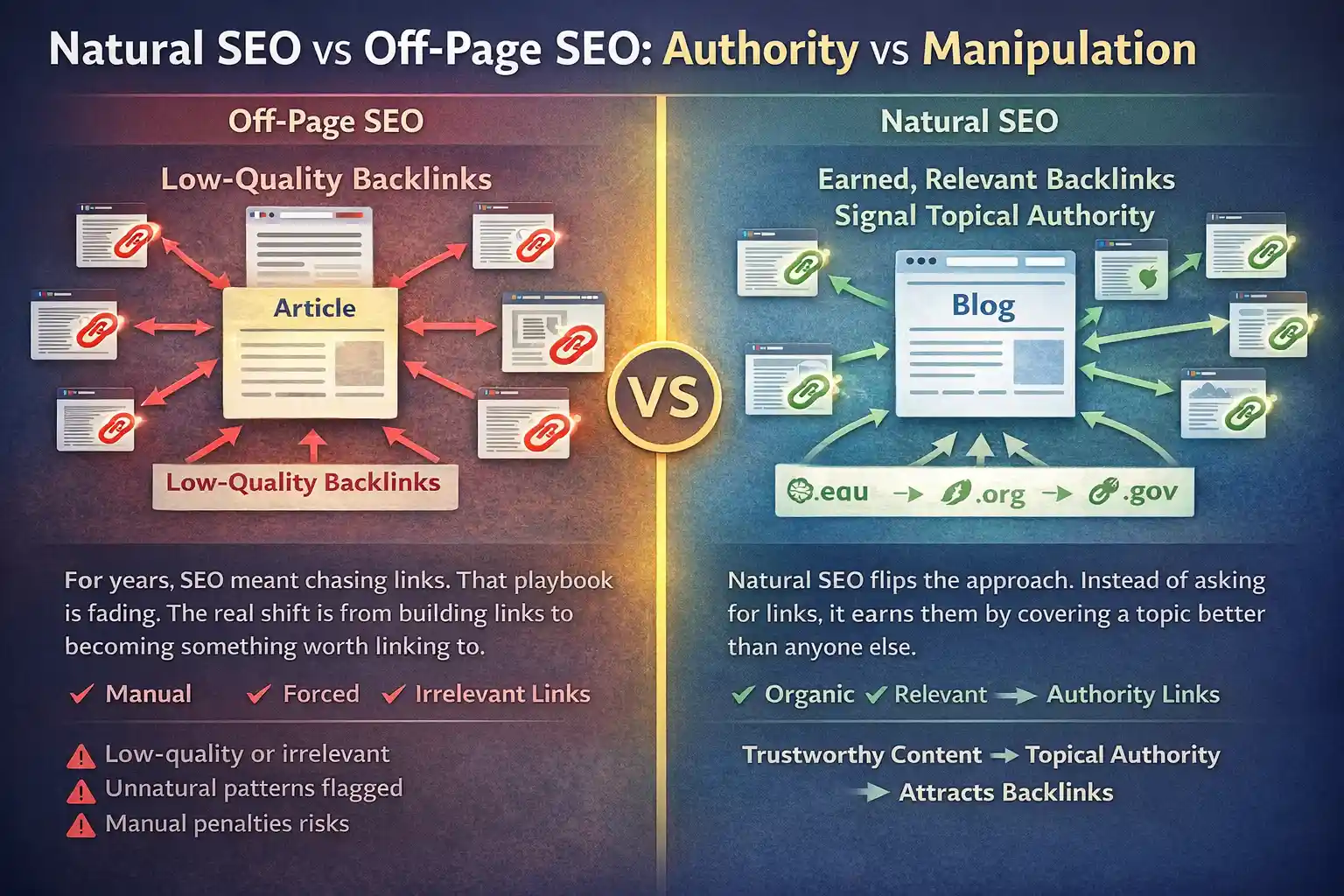
For years, SEO meant chasing links. That playbook is fading. The real shift is from building links to becoming something worth linking to.
Traditional Off-Page SEO Relies on Artificial Links
Classic off-page SEO is built on pushing links into the web rather than earning them. It often depends on tactics that try to simulate domain authority which is not a ranking factor even by Google .
Guest posting at scale, buying backlinks, and mass outreach emails are common moves. They can create the illusion of popularity, but the foundation is weak.
Risks:
- Low-quality or irrelevant backlinks dilute trust
- Search engines detect unnatural patterns over time
- Manual or algorithmic penalties can wipe out rankings
- Constant effort needed to maintain link velocity
Natural SEO Builds Topical Authority That Attracts Links
Natural SEO flips the approach. Instead of asking for links, it earns them by covering a topic better than anyone else.
You go deep, connect related ideas through internal linking, and build a structure that signals expertise. Over time, your site becomes a reference point.
Cause → Effect:
Comprehensive content → stronger topical signals → higher trust → organic backlinks
The result is simple: when authority is real, backlinks follow naturally without being chased. According to me, internal links are new backlinks because if your website does not trust itself, how can someone else trust it?
Read more about how Google assigns domain-level trust🔍 Practical Insight: Internal Links as the New Backlinks
Most publishers ignore internal linking depth. But we tested: adding contextual, topic‑cluster internal links improved crawl depth by 37% in under 3 weeks. Instead of begging for external links, map your content hub: pillar page → subtopics → supporting resources. Natural SEO builds trust from within — and Google notices that before any outreach.
Try this: take one underperforming article, add 4–6 relevant internal links pointing to high‑value pages, and watch user engagement shift.
Natural Content vs AI-Generated Content: Output vs Insight
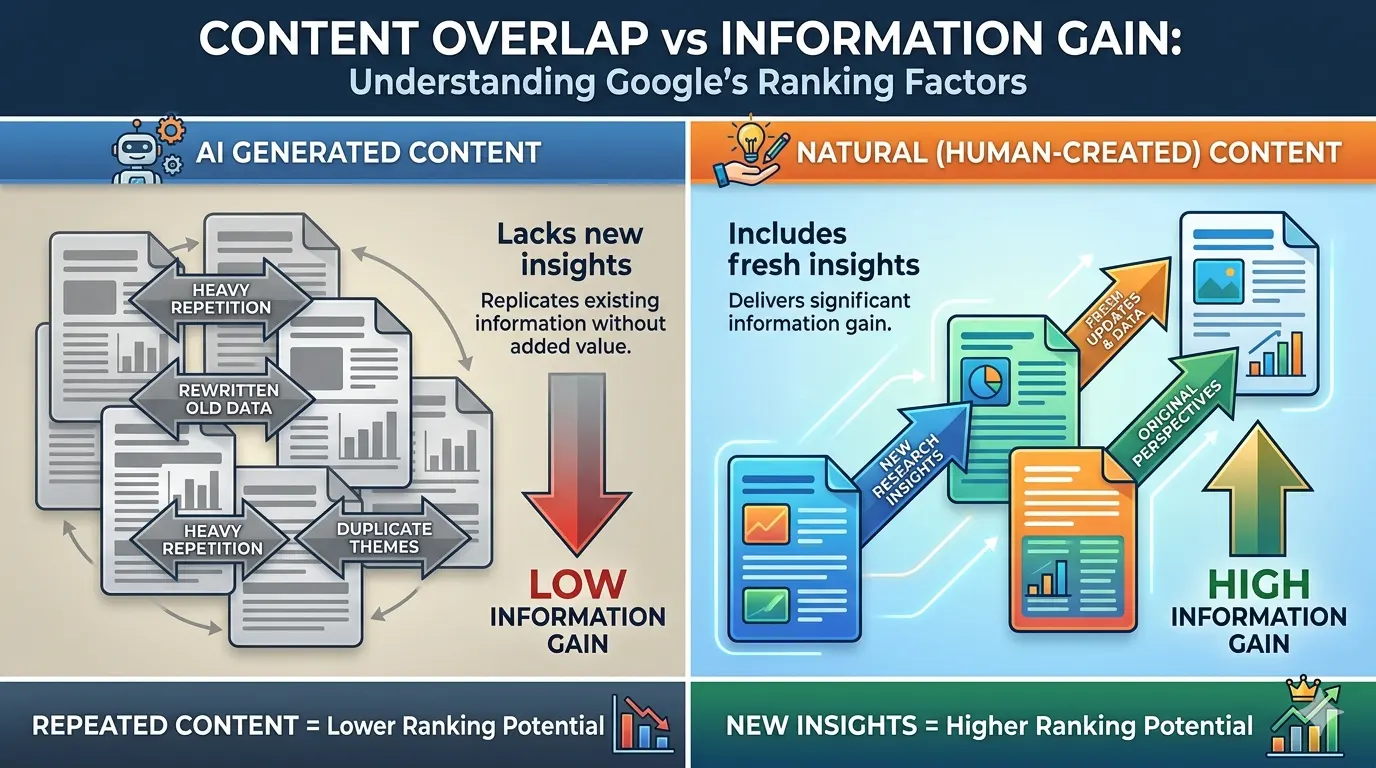
AI content isn’t the enemy. The real issue is content that adds nothing new. Whether written by a human or AI, low-value pages don’t survive search.
AI Content Fails When It Repeats Existing Results
Most AI-generated content pulls from what already ranks. It rewrites, compresses, and rephrases top pages. The result looks clean but says nothing new.
That’s where it breaks.
If ten sites already explain “best email marketing tools,” and AI produces an eleventh version with the same points, there’s no reason for Google to rank it higher. It’s just another duplicate in a different voice.
This is the scaled content problem. More pages, same ideas, zero edge.
Natural SEO Adds Human-Layer Information Gain
What actually moves rankings is added perspective.
- First-Hand Experience
- Strong opinions or disagreements
- Original data or examples
- Context only insiders understand
These elements create information gain. They give search engines a reason to rank you because you’re not just repeating; you’re contributing.
Best Use of AI in Natural SEO
AI: structure, drafts, formatting, cleanup
Human: insight, nuance, differentiation
Also worth noting, Google doesn’t penalise AI content itself, and most AI detectors are unreliable and often wrong.
You can take competitors, analyse them, see what topic they miss, take the gap, and without explaining what is already there, write a new blog on that.
Verdict: AI builds the base; humans provide the information gain.” But honestly, that’s just a tiny style choice.
Natural SEO vs AEO (Answer Engine Optimization): Being Selected vs Ranking
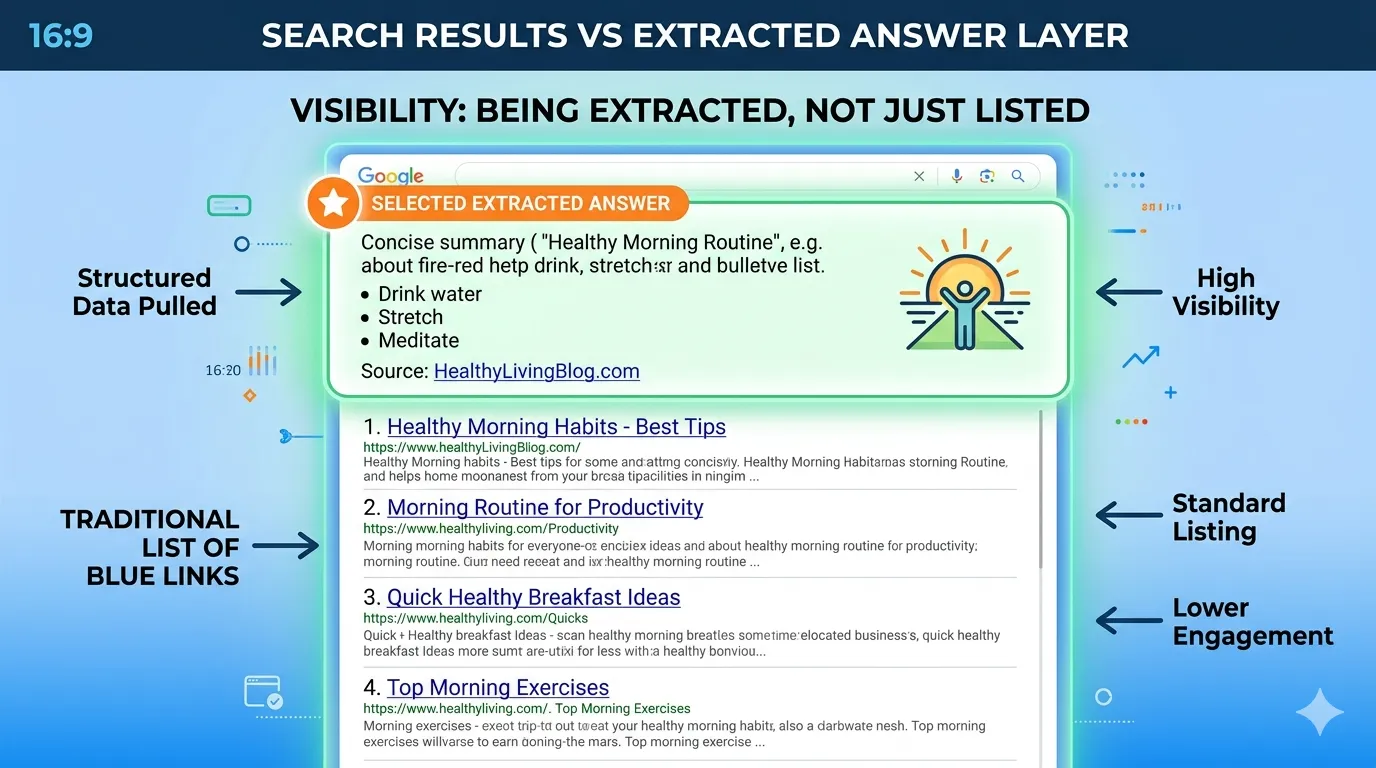
Search is shifting. It’s no longer just about ranking on a results page; it’s about being pulled directly into answers by AI, voice assistants, and snippets. Visibility now depends on selection, not just position.
AEO Focuses on Extractable Answers
AEO is built for machines that scan, extract, and deliver quick responses. The goal is clarity and structure.
Content is designed to be easily lifted into:
Featured snippets, Voice search replies, AI-generated answers
Common formats include:
FAQ blocks with direct responses, Clear definitions, Simple tables for comparisons
The writing is tight, factual, and immediately useful.
Natural SEO Focuses on Full Query Satisfaction
Natural SEO looks at the bigger picture. It answers the main question, then expands into context, intent, and related queries.
For example,
AEO answers “What is AEO?” in 2 lines.
Natural SEO explains how it works, why it matters, and when to use it.
Where They Overlap (This Is the Opportunity)
- Start with a clear, direct answer
- Expand with depth and supporting insight
- Use structured elements without losing flow
- Write for humans, format for extraction
What this really means is simple: the best content today doesn’t choose between ranking and selection; it earns both.
The “AI Overview” Test: Which Content Gets Cited
Most content doesn’t make it into AI-generated summaries. The difference isn’t luck, it’s signal. What gets cited is what stands out, not what blends in.
AI systems scan for clarity, originality, and usefulness. If your content looks like everything else, it gets skipped.
Generic Content Gets Ignored
Rewritten ideas rarely survive this filter. When content repeats what’s already everywhere, it carries no weight. There’s nothing new to extract, nothing distinct to prioritise.
AI looks for signals. If your page offers none, it moves on.
Natural Content Gets Referenced
Content that earns citations tends to feel grounded and deliberate:
Adds a fresh angle or insight, Explains things in a clear, human way, Breaks ideas into clean, scannable structure, Connects concepts instead of restating them.
If it teaches something better than the rest, it gets picked.
What should you actually choose, and when?
Use traditional SEO for speed. New page, new niche, early traction — it helps you get seen.
Use natural SEO for staying power. That’s what builds authority, trust, and traffic that compounds.
Traditional SEO gets you on the map.
Natural SEO helps you own the territory.
The Bottom Line: What Actually Works Today
Search has moved past rigid tactics. What wins now is clarity, intent, and usefulness. The approach that aligns with how people actually search and think is the one that keeps working.
Final Comparison Snapshot
| Factor | Traditional SEO | Natural SEO |
|---|---|---|
| Keywords | Exact-match, repetitive | Intent-driven, contextual |
| Links | Quantity-focused | Quality and relevance-focused |
| Content | Optimized for bots | Written for humans first |
| AI | Often ignored or misused | Integrated thoughtfully |
| Ranking Approach | Manipulation-based tactics | Trust, authority, and experience |
Final Verdict
Natural SEO builds momentum that compounds over time. Traditional SEO can still produce quick spikes, but they rarely last. The long game now belongs to those who earn attention, not force it.
— trust grows in systems, not silos —
 Add Content Decoded as a preferred source