
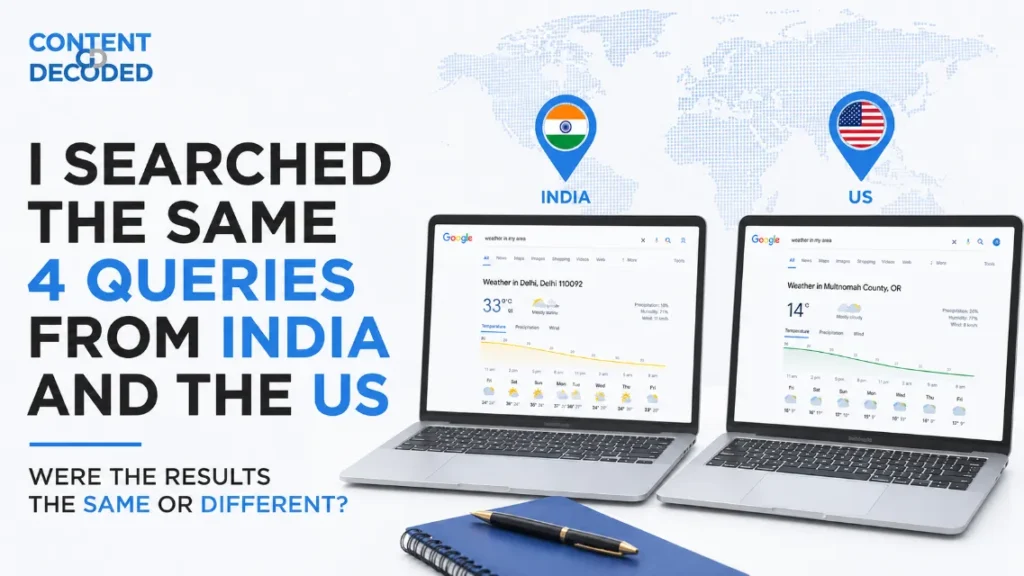
I Searched the Same 4 Queries from India and the US — Were the Results the Same or Different?
Yes, Google knows where you are — and it goes deeper than just your country. It can detect your city, your county, and sometimes even your PIN code. But how it uses that location changes depending on what you’re actually searching for. If you search anything using “in my city, country”, then Google uses your location, and the answer would differ, but if you search something universal, like the capital of France, then location doesn’t matter, and the answer would be the same.
It started with a simple question I had while using Google: Does Google actually know where I am when I search something vague like “news in my country” or “weather in my area”? And if yes, how accurate is it?
I decided to test it. Same queries, two locations — India and the US — and compared what Google returned.
Here’s what I found.
The Setup
I ran 4 queries from India (no VPN, Delhi-based connection) and then the same 4 queries using a US-based VPN (Multnomah County, Oregon).
The queries were:
- Capital of my country
- What time is it in my city
- weather in my area
- news in my country
No special tools. Just Google searches, screenshots, and observation.
Query 1: “Capital of My Country”
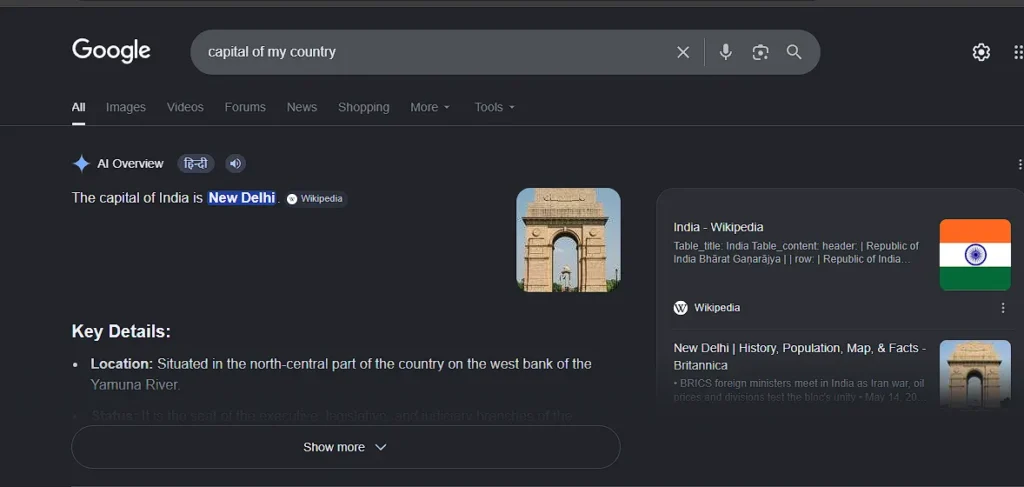
India: Google showed an AI Overview. It correctly identified the country as India and returned New Delhi as the capital. It also offered a Hindi language option for the overview — something I didn’t expect.
US: Google showed an AI Overview here, too. But what was different was the phrasing. It explicitly said: “Based on your current location in the United States, the capital of your country is Washington, D.C.”
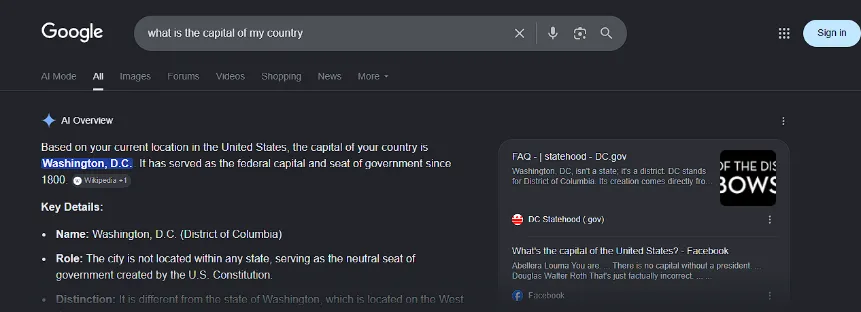
Google in the US didn’t just answer — it told me why it was answering that way. It acknowledged its own location logic out loud. The India result just gave the answer without explaining how it knew.
Query 2: “What Time Is It in My City”
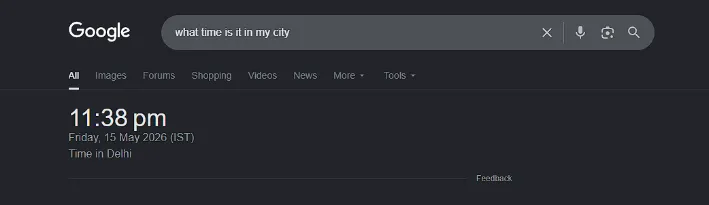
India: Returned 11:38 PM, IST, Time in Delhi. Clean, accurate.
US: Returned 11:14 AM, PDT, Time in Multnomah County, OR.
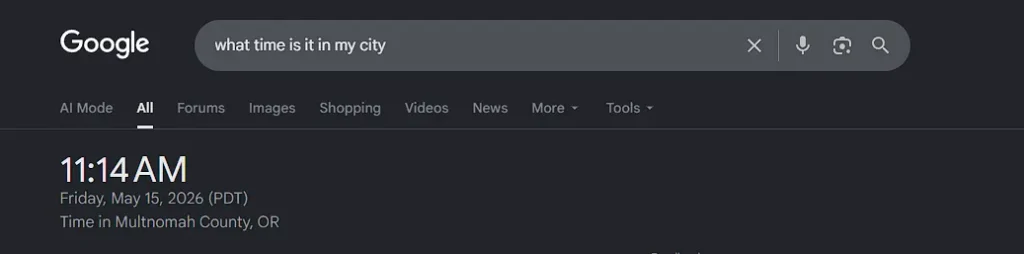
Both worked correctly. But the precision level was interesting — Google didn’t say “Time in Oregon” or “Time in the US.” It went down to the county level. Multnomah County is where Portland is located, and Google pinpointed that without me asking for it.
Query 3: “Weather in My Area”
India: No AI Overview. Directly showed a weather widget — temperature, precipitation, wind — for New Delhi, Delhi 110092. It even had a PIN code level of detail.
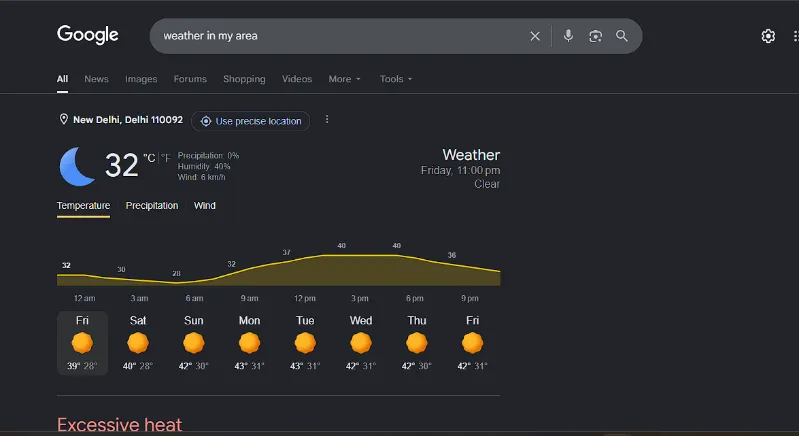
US: Weather widget appeared for Multnomah County, OR. Temperature in Fahrenheit. No AI Overview here either.
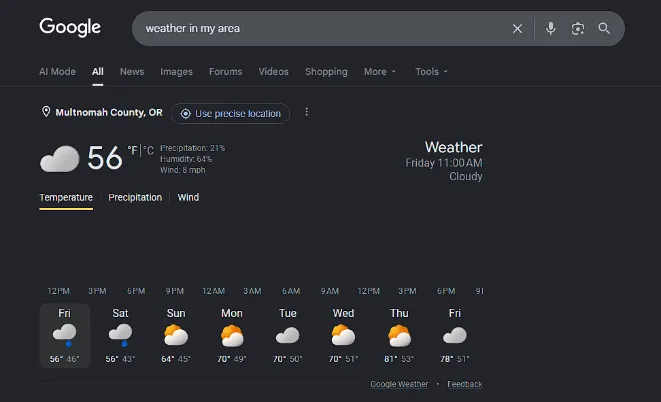
Both locations got accurate results. But India’s result was more granular in terms of the address shown (PIN code), while the US result stayed at the county level — same as the time query.
One other difference: India’s result showed a warning for “Excessive heat” below the widget. That’s a real-time contextual signal Google added based on conditions — not something I queried for.
Query 4: “News in My Country”
This one was the most interesting.
India: The Hindu and India Today appeared in the top results. Both are genuinely India-specific outlets. No AI Overview.
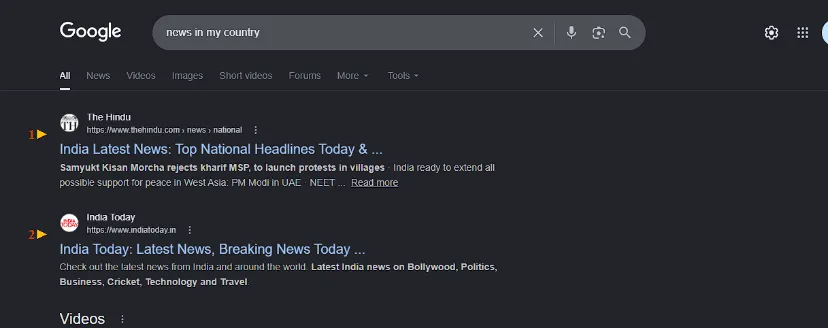
US: BBC, CNN, and NBC appeared. Here’s the thing — the BBC is a UK outlet, not American. CNN and NBC are US-based, but the results weren’t US-specific news. They were international outlets that happened to be popular in the US.
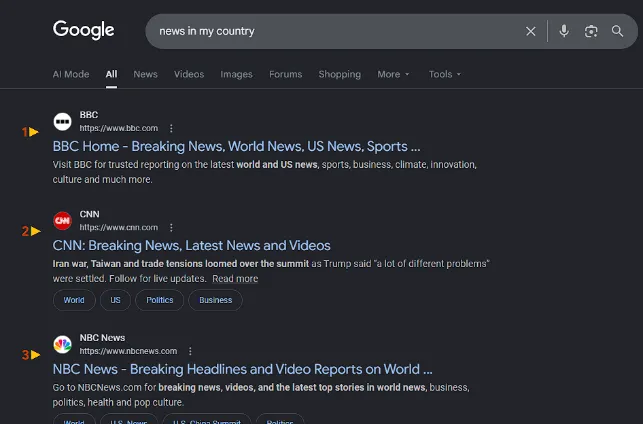
So for the news query, Google in India matched country to outlet fairly well. Google in the US returned BBC, CNN, and NBC — and this actually makes sense. The BBC has a dedicated US edition, CNN and NBC are headquartered in the US mainland, and all three cover American news extensively. Google likely treated these as the most trusted and relevant sources for a US user, not because it failed to detect the country, but because these outlets genuinely serve that audience.
What These Results Reveal About Google’s Location Awareness
A few things stood out across all four queries:
Google resolves “my” differently depending on what you’re asking. For time and weather, it went hyper-local — county-level in the US and PIN-code level in India. For “country” queries, it stayed at the national level. Same word, “my”, different interpretation based on what makes sense for the query type.
AI Overview only appeared for the capital query – a pattern worth noting. Time changes every second, weather changes every day, and news changes every hour. None of those got an AI Overview. The capital of a country stays the same for decades. That seems to be the threshold — Google triggers AI Overview when it’s confident the answer won’t change anytime soon. Dynamic answers get widgets or links. Static, verifiable facts get an AI Overview.
The US result explained its reasoning. India didn’t. When the US result said, “Based on your current location in the United States,” it was being transparent about how it arrived at the answer. That kind of self-explanation didn’t appear in any of the India results. Whether that’s an AI overview behaviour difference or something else, I’m not sure — but it was noticeable.
Google accurately detected the VPN location down to the county level. The VPN was set to Multnomah County, Oregon, and Google returned results specific to that county — not generic US results. It didn’t just read “US” from the IP and stop there. It went deeper, to the county level, which means Google is extracting more granular location data from the IP address than most people assume — VPN or not.
What This Means for Search Results and Content Strategy
None of this is groundbreaking on its own. But it shows that Google’s location interpretation isn’t a single system running the same logic everywhere. The granularity, the format, and even whether Google explains itself — all of it shifts based on query type and location.
So if you optimise your content according to local searches and locations and cover them deeply, Google can use you to show results, and make your content format AI overview-ready, verifiable and confident enough so AI Overview can choose you as a source for results.
The word “my” in a search query is doing more work than it looks like. And Google is making judgement calls about what “my” means based on what you’re actually asking — not just where you are.
That part, I didn’t expect going in.
One Thing I’m Still Thinking About
The US result explicitly said, “Based on your current location in the United States” — Google showed its reasoning. No Indian result did that.
Is that an AI overview behaviour difference? A regional rollout thing? Or does Google only explain itself when it thinks the user might question the answer?
I don’t have a clean answer for that yet. But it’s the part of this experiment that stuck with me the most.
You can also search the above queries from your location and comment below the result, and also if you find something new, extra or weird.
Related: Google Changed the Same SERP 3 Times in One Day — Here Is What Changed and What Did Not
 Add Content Decoded as a preferred source









Leave a Reply