How to Use Google’s New Generative AI Performance Reports to Win the AI Search War
On June 3, 2026, Google officially announced the rollout of Search Generative AI performance reports inside Google Search Console, introducing a new way for website owners to understand how their content appears within AI-driven search features.
This update focuses on giving direct visibility into how pages perform inside experiences like AI Overviews, AI Mode, and AI-powered Discover results, areas that were previously difficult to track with any level of accuracy.
The reports are currently being rolled out to a limited set of websites as part of an early testing phase, allowing Google to refine the data and gather feedback before making the feature widely available.
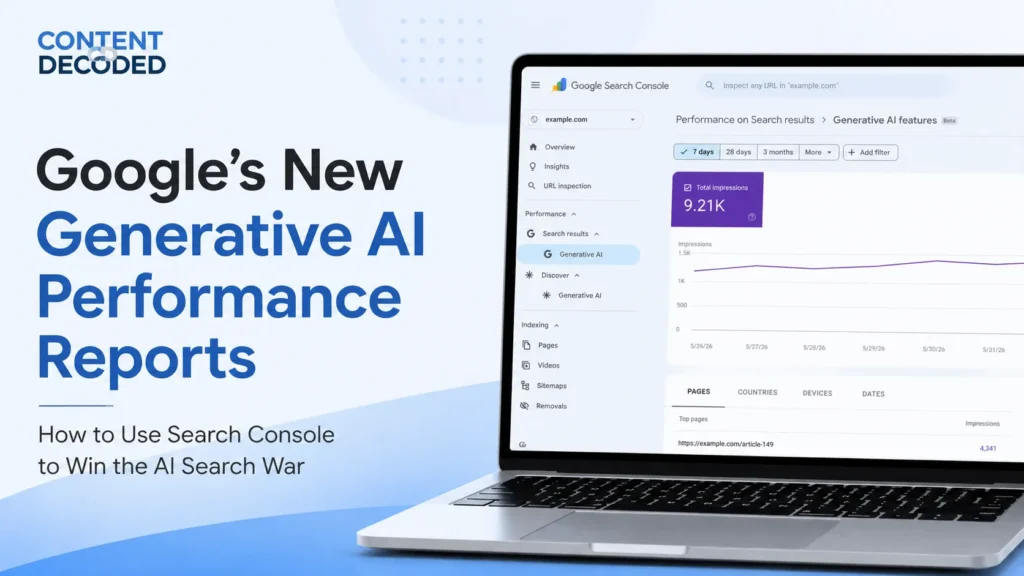
With this release, site owners can now access structured data around impressions, pages, countries, devices, and performance over time, specifically tied to generative AI features, making it the first time Google has provided dedicated reporting for AI-based search visibility within its core tools.
The Real Shift Nobody Should Ignore
When Google introduced Search Generative AI performance reports inside Google Search Console, it was not just another small feature update that you check once and forget about.
It marked a deeper shift in how search works and how success should be measured.
Search is no longer only about ranking on page one or getting clicks from blue links, because now a large part of visibility happens inside AI-generated answers where users may never even visit your website.
What this really means is simple:
- Earlier, success was about ranking
- Now, success is about being included in AI answers
And for the first time, you can actually measure that inclusion instead of guessing.
What Google Actually Released (Without the Fluff)
Instead of getting lost in long announcements, it helps to focus only on what is useful and actionable.
Google is currently testing a dedicated report that shows how your content appears inside generative AI features such as:
- AI Overviews
- AI Mode
- AI-powered Discover results
This report gives you a clear view of your AI visibility using simple but powerful metrics.
Here’s a breakdown that makes it easier to understand:
| Metric | What It Shows | Why It Matters |
| Impressions | How often your content appears in AI answers | Helps you understand your actual visibility |
| Pages | Which URLs are used in AI results | Shows which content Google prefers |
| Countries | Where your content is being shown | Helps in targeting specific regions |
| Devices | Whether users see you on mobile or desktop | Useful for content formatting decisions |
| Dates (hourly to monthly) | How performance changes over time | Helps track trends and sudden changes |
Right now, this feature is only available to a limited number of websites, but the rollout itself tells you where things are heading, and that direction matters more than early access.
The Death of Guesswork (Finally)
Until now, most SEO decisions around AI were based on assumptions, incomplete data, or third-party tools that tried to simulate what was happening in search results.
The problem with those tools was simple:
- They could not fully match real user behavior
- They could not track real-time AI changes
- They often showed different results for different users
So even if you used them regularly, you were still working with uncertainty.
Now, with data coming directly from Google, you are finally looking at source-level information, which removes a large part of the confusion.
Instead of asking unclear questions like:
- “Am I visible in AI results?”
You can now answer more practical questions like:
- “Which pages are appearing?”
- “How often are they being shown?”
- “Is my visibility improving or dropping?”
This shift from guessing to measuring is what makes this update important.
From SEO to GEO: A Quiet but Massive Shift
There is a bigger change happening underneath all of this, and it is something many people are still not fully paying attention to.
We are slowly moving from traditional SEO to something new, often referred to as Generative Engine Optimization (GEO).
Here’s how the focus is changing:
| Traditional SEO | Generative Engine Optimization |
| Ranking on search pages | Being included in AI answers |
| Targeting keywords | Answering intent clearly |
| Building backlinks | Building trust and clarity |
| Getting clicks | Getting visibility inside AI |
This new report acts like a guide that shows you what kind of content works in this new system.
You can now:
- Identify which pages are selected by AI
- Study how those pages are written
- Understand patterns in structure and clarity
- Improve other pages based on real examples
This is not about copying content, but about understanding what makes certain pages easier for AI to use.
The Ultimate Blueprint: What Works vs What Fails
One of the most useful things you can do with this report is compare performance between pages that succeed and pages that do not appear at all.
Instead of making random improvements, you can base your decisions on real data from your own website.
Here’s how to approach it:
When you look at high-performing pages, check:
- Whether the content answers questions directly without unnecessary delays
- Whether the structure is clean with clear headings and sections
- Whether the language is simple and easy to understand
- Whether the content includes useful explanations instead of just definitions
Then compare with low-performing pages:
- Are they harder to read or poorly structured?
- Do they take too long to reach the main point?
- Do they repeat common information without adding value?
This comparison gives you a practical understanding of:
- What to improve
- What to avoid
- What to scale
And the best part is that this insight comes from your own data, not general advice.
AI Search Is Not Stable (And Now You Can Prove It)
One feature that deserves more attention is the ability to track performance over different time periods, especially at an hourly level.
At first glance, this may look like a minor detail, but it reveals something important about how AI search behaves.
AI results are not fixed.
A page that appears in an AI answer at one time may disappear later and then return again.
With this report, you can now track that behavior clearly.
What to observe:
- Sudden increases in impressions may indicate temporary inclusion
- Drops may show that your content was replaced by another source
- Stable patterns suggest stronger trust from the system
This helps you understand whether your content is:
- Consistently trusted
- Occasionally used
- Or rarely considered
That kind of clarity was not possible before.
The Zero-Click Reality Nobody Can Ignore
There is one important detail in this report that you should not overlook.
You only see impressions, not separate data for clicks coming specifically from AI features.
This reflects a larger shift in user behavior.
Many users now:
- Get answers directly from AI
- Do not click on any links
- Leave after reading the response
So if you notice that:
- Your impressions are increasing
- But your traffic is not growing
It does not automatically mean your content is underperforming.
It may simply mean your content is being used in a way where users do not need to click.
This changes how you should think about success, because visibility and traffic are no longer the same thing.
The Real Threat to Informational Content
This shift creates a challenge, especially for websites that focus heavily on basic informational content.
Simple and generic content is easier for AI to summarize, which means users may get what they need without visiting your site.
To stay relevant, content needs to go beyond basic explanations.
Content that will struggle:
- Simple definitions
- Rewritten common knowledge
- Repetitive information
Content that will perform better:
- Clear explanations with depth
- Real insights or opinions
- Practical examples and experience
The goal is to create content that adds something meaningful, not just something correct.
What You Should Do Right Now
Even if you do not yet have access to this report, you can start preparing your approach based on how things are changing.
1. Check if You’re Included
Open Google Search Console and look for any new sections related to generative AI performance.
2. Identify Your Important Pages
If you have access, focus on:
- Pages with high AI impressions
- Pages with no visibility
This helps you understand where you stand.
3. Study Patterns Carefully
Look at:
- Structure and formatting
- Clarity of writing
- How quickly the content answers questions
Avoid copying, but learn from what is working.
4. Improve Existing Content
Instead of creating too much new content, focus on improving what you already have by making it clearer, more structured, and more useful.
5. Track Changes Over Time
Use the date filters to:
- Monitor growth
- Identify drops
- Understand stability
This helps you make better decisions based on trends instead of one-time data.
The Bigger Picture: This Is an AI-First Internet Now
This update is not just about adding a new report.
It shows a clear direction.
When Google builds tools specifically to track AI visibility, it is telling you that this is no longer an experiment.
AI is becoming a core part of how search works.
That means:
- Visibility inside AI matters
- Structure and clarity matter more
- Traditional rankings alone are not enough
Understanding this early gives you an advantage.
Final Thought
Many people will treat this as just another update and move on without changing how they work.
That would be a mistake.
This report gives you direct insight into how your content is used in AI-driven search, which is something that was not possible before.
The sooner you start understanding and using this data, the better positioned you will be as search continues to evolve.
Because at this point, it is clear that the way success is measured in search is already changing.
For More Updates Check This- Introducing Search Generative AI performance reports in Search Console
 Add Content Decoded as a preferred source