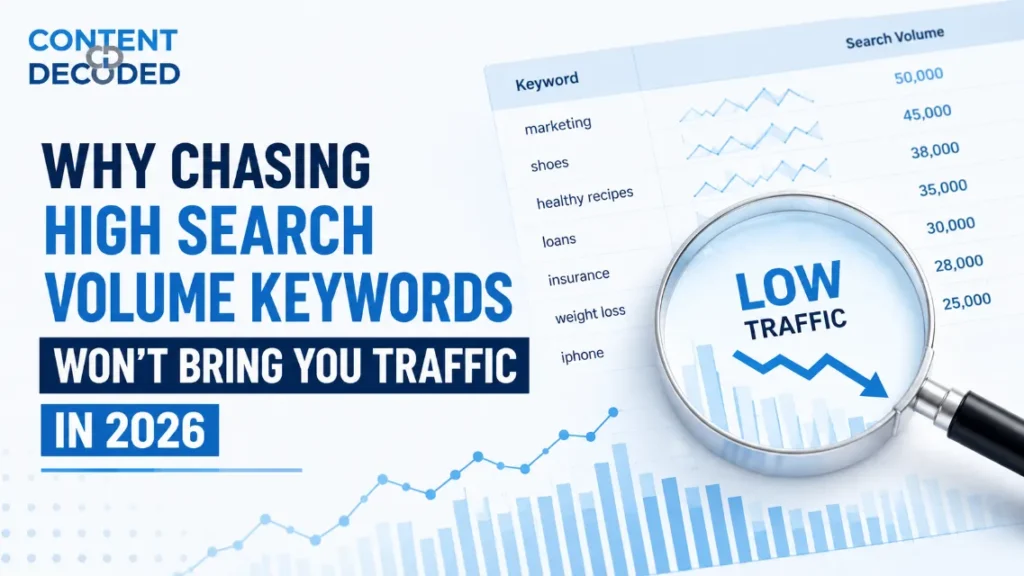
Why Chasing High Search Volume Keywords Won’t Bring You Traffic in 2026
High search volume keywords won’t bring you traffic in 2026 because they show how many people search, not how useful or valuable those searches are.
A keyword showing 50,000 searches might look like a huge opportunity, but that number doesn’t tell you who is searching, what they actually want, or whether they will ever click your website. In most cases, it doesn’t even guarantee real traffic anymore.
For a long time, marketers relied on a simple idea: more searches should mean more traffic, and more traffic should lead to more business. That worked when search results were simpler and competition was lower.
But things have changed.
Today, search engines often answer queries directly on the results page, and broad keywords attract mixed audiences with very different needs. What looks like a high-opportunity keyword in a tool often turns out to be low-quality traffic in reality.
That’s why many businesses still invest in high-volume keywords that look impressive in reports but fail to deliver meaningful results.
The Three Ways Volume Data Misleads You
To understand why this happens, you need to look at how search volume behaves in practice. There are three major issues built into how people interpret keyword data, and each one creates a gap between expectation and reality.
The Intent Diversity Problem
High-volume keywords almost always look attractive because of their size, but they come with a hidden problem: they attract very different types of users at the same time.
For example, a keyword like ‘marketing’ may have millions of searches, but those searches are coming from completely different groups:
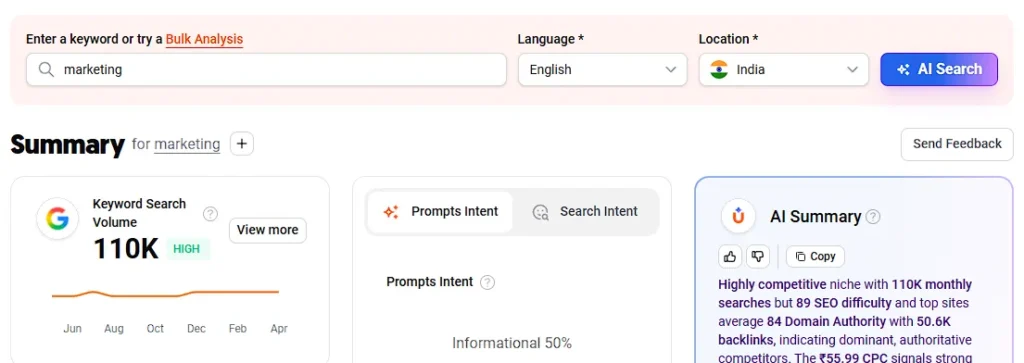
- Students trying to understand basic concepts for assignments
- Beginners exploring what marketing actually means
- Job seekers researching career paths
- Business owners casually browsing ideas
- A small portion of people who are actually ready to buy services
When you create content for such a broad keyword, you are trying to speak to all these groups at once. That usually leads to content that feels general and unfocused, because it cannot fully satisfy any one group.
This creates a chain reaction:
- The reader does not find exactly what they were looking for
- They leave quickly
- Engagement signals drop
- Search engines reduce your ranking over time
To make this clearer, compare the two approaches below:
| Approach | Keyword Type | Audience | Result |
| Old Thinking | What is SEO | Mixed audience | Low engagement, high competition |
| Better Thinking | SEO for school website | Specific audience | Higher relevance, better conversions |
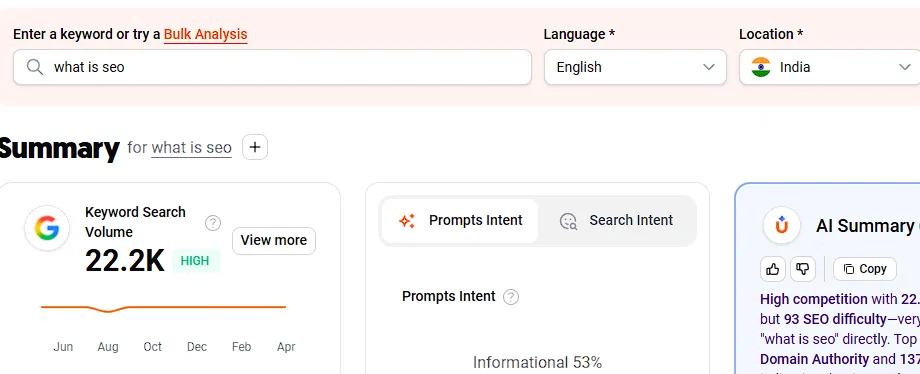
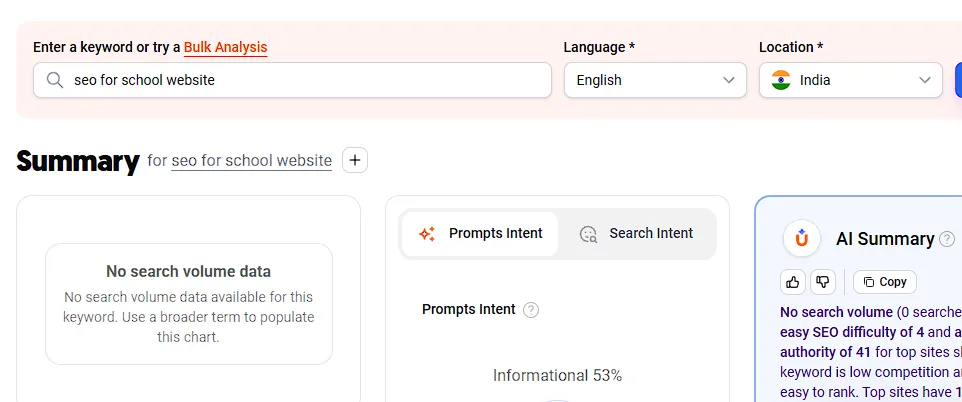
The second keyword may show little or no search volume, but the intent behind it is clear. The person searching already knows what they need, which makes that traffic far more valuable.
The AI Overview and Zero-Click Reality
Even when a keyword shows strong search volume, there is another factor that reduces its value: many users never click on any result at all, but your website impressions will increase.
60% of Google searches now end without a single click to any website, according to data from many research studies.
Search results pages now include:
- AI-generated answers
- Featured snippets
- Quick definitions
- Related questions
- Ads and local listings
These elements often answer the user’s question directly on the page. As a result, users get what they need without visiting any website.
Here’s what this means in practice:
- A keyword may show 10,000 searches
- Only a portion of those users actually click
- Those clicks are divided among ads, large websites, and other features
By the time your page appears, the available traffic is already limited.
A simple example helps explain this:
- Search: what is CRM
- Search volume: high
- Actual behavior: user reads a short answer and leaves
Even though the keyword looks strong in a tool, the opportunity for real traffic is much smaller than expected.
Ranking in AI overview is also very important to get user trust and maximise the chances of clicks, so make your content format AI-overview friendly by solving their problem early.
The Annual Averaging Trap
Another common issue is how keyword tools present their data. Most tools show an average based on the past 12 months, which creates a smooth number that hides real patterns.
For example:
- A keyword may show 5,000 searches per month
- In reality, it might get:
- 40,000 searches in one or two peak months
- Almost no searches for the rest of the year
This pattern is common in industries like:
- tax services
- education admissions
- seasonal businesses
- event-related searches
When you rely on the average, you may end up creating content at the wrong time, when demand is actually low.
The Big Lie of Keyword Tool Accuracy
Keyword tools are useful, but it is important to understand how they work. They do not have direct access to exact search data from Google. Instead, they estimate using:
- past advertising data
- user behavior samples
- their own calculation models
Because of this, the numbers you see are not exact values. They are best understood as rough indicators.
Data Bucketing: The Copy-Paste Numbers
You may notice that many similar keywords show nearly identical search volumes. For example:
- what is SEO
- what is CRM
- what is social media marketing
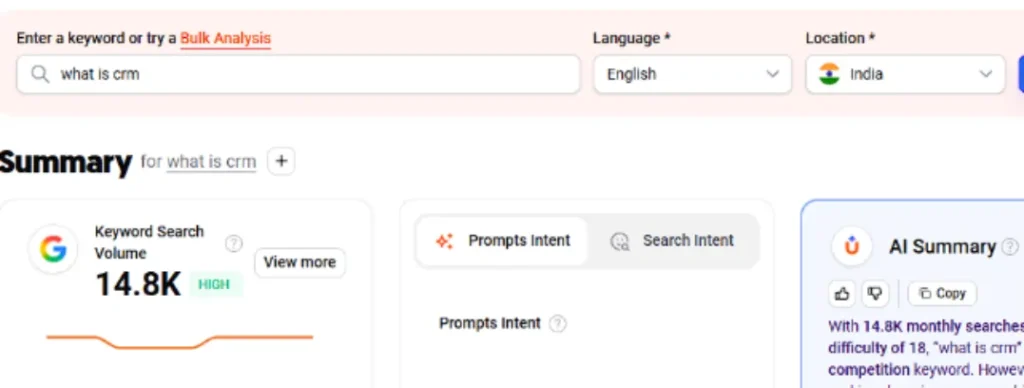
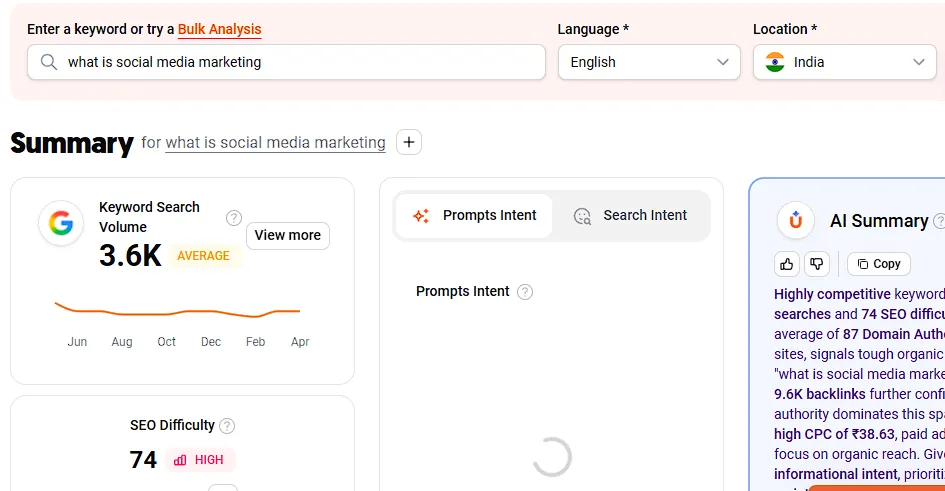
These often display the approx. numbers, not the absolute numbers.
This happens because tools group similar queries together when they do not have precise data. They assign an estimated value to the group, and that number appears as a specific monthly volume.
This can make different keywords look equally valuable, even when their real demand may vary.
The Time-Lag Flaw
Another limitation is that keyword tools rely on past data. They reflect what people searched over the previous months, not what is gaining attention right now.
For example:
- A current topic may show low or zero volume, like SEO in 2026
- An older version of the same topic may show higher volume, like SEO in 2025
Click on the below images to study them easily.
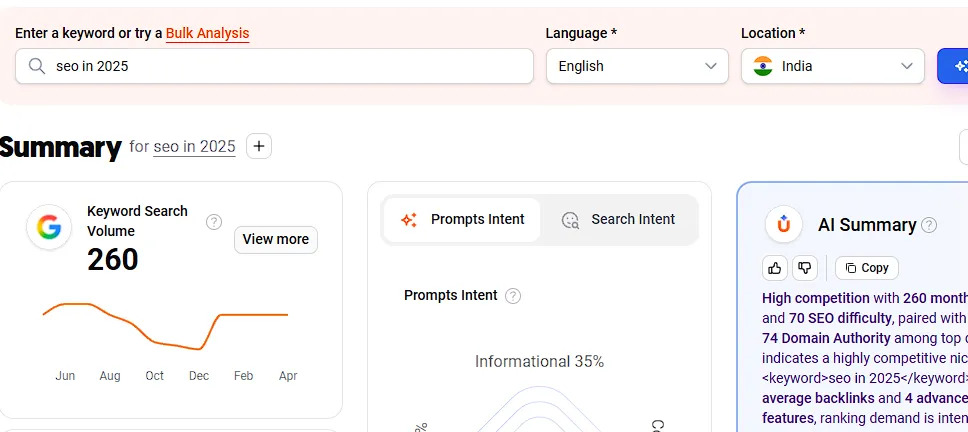
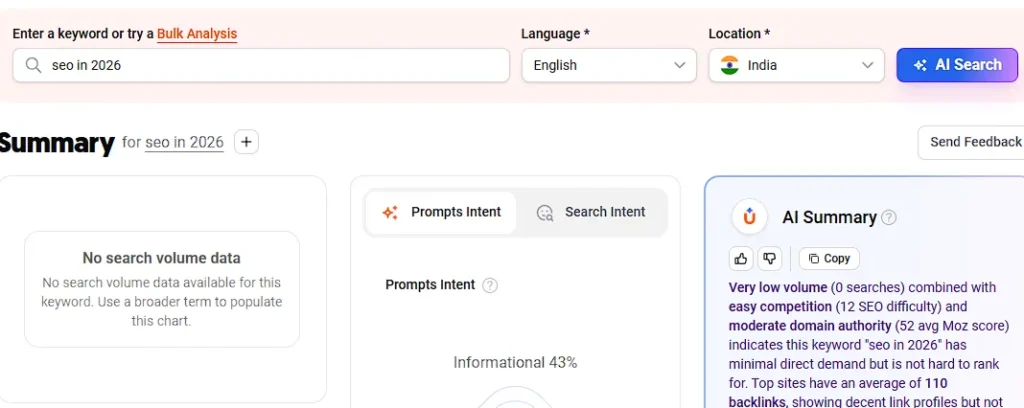
This delay means you are often seeing trends after they have already peaked.
By the time a keyword appears attractive in a tool, it is usually:
- more competitive
- already covered by many websites
A Better Way: Keyword Research from Google Search Console
Another simple way to find better keywords is by doing keyword research from Google Search Console. Instead of guessing, you look at what your site is already getting impressions for. These are real queries people are typing, even if they show low or zero volume in tools. By improving content around those terms or creating dedicated pages for them, you build on existing signals instead of starting from scratch.
Even now, non-SEO people can do keyword research easily.
Intent Is the Only Metric That Actually Matters
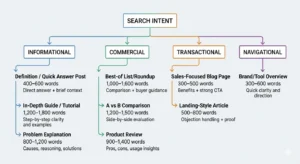
Since search volume alone is not reliable, the focus needs to shift to something more meaningful: search intent.
Search intent explains what the user wants to achieve when they type a query.
| Intent Type | What the User Wants | Conversion Value | Example |
| Informational | To learn something | Low | what is CRM |
| Navigational | To find a specific site | Medium | HubSpot login |
| Commercial | To compare options | High | best CRM for real estate |
| Transactional | To take action | Very high | CRM pricing |
Most high-volume keywords fall into the informational category. These users are still exploring and are not ready to make decisions.
Lower-volume keywords are often:
- more specific
- closer to action
- more valuable for business results
The Hidden Goldmine: Zero-Volume Keywords
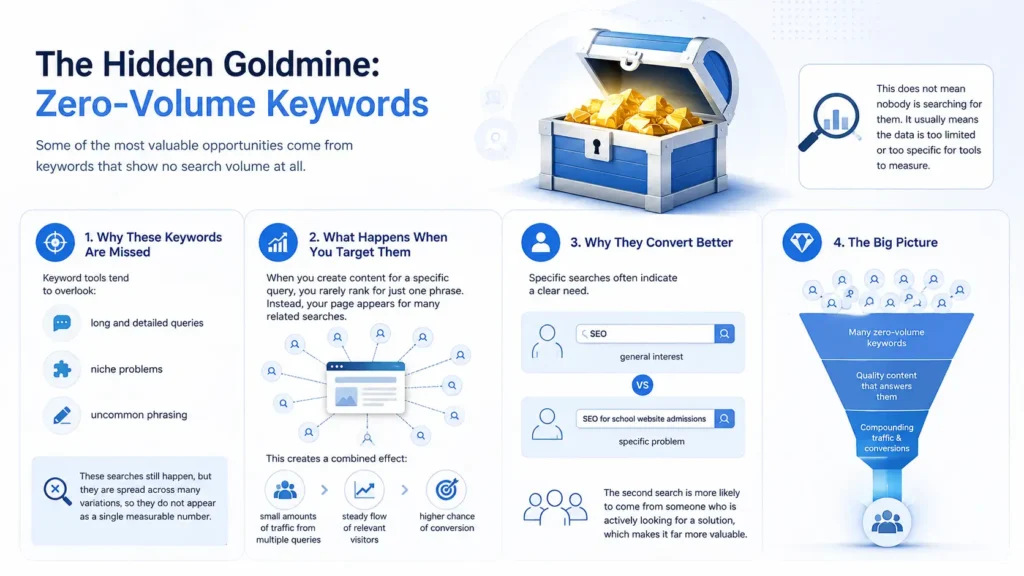
Some of the most valuable opportunities come from keywords that show no search volume at all.
This does not mean nobody is searching for them. It usually means the data is too limited or too specific for tools to measure.
Why These Keywords Are Missed
Keyword tools tend to overlook:
- long and detailed queries
- niche problems
- uncommon phrasing
These searches still happen, but they are spread across many variations, so they do not appear as a single measurable number.
What Happens When You Target Them
When you create content for a specific query, you rarely rank for just one phrase. Instead, your page appears for many related searches.
This creates a combined effect:
- small amounts of traffic from multiple queries
- steady flow of relevant visitors
- higher chance of conversion
Why They Convert Better
Specific searches often indicate a clear need.
Compare:
- SEO → general interest
- SEO for school website admissions → specific problem
The second search is more likely to come from someone who is actively looking for a solution, which makes it far more valuable.
The Hidden Problem: Rankings Without Real Traffic
It’s very common to see reports like “You’re ranking #3 for a 10,000-search keyword” — but when you check actual traffic, it’s almost nothing.
This happens for two simple reasons:
- Most clicks never reach you
Search pages are filled with AI answers, ads, maps, and quick results. Even if you rank high, your link may still sit far below what users actually see. - The content doesn’t match real intent
If someone clicks and doesn’t immediately find a clear answer, they leave within seconds. This tells Google your page isn’t helpful, and over time your visibility drops.
So the ranking looks good on paper, but it doesn’t translate into real visitors.
Why Keyword Stuffing No Longer Works
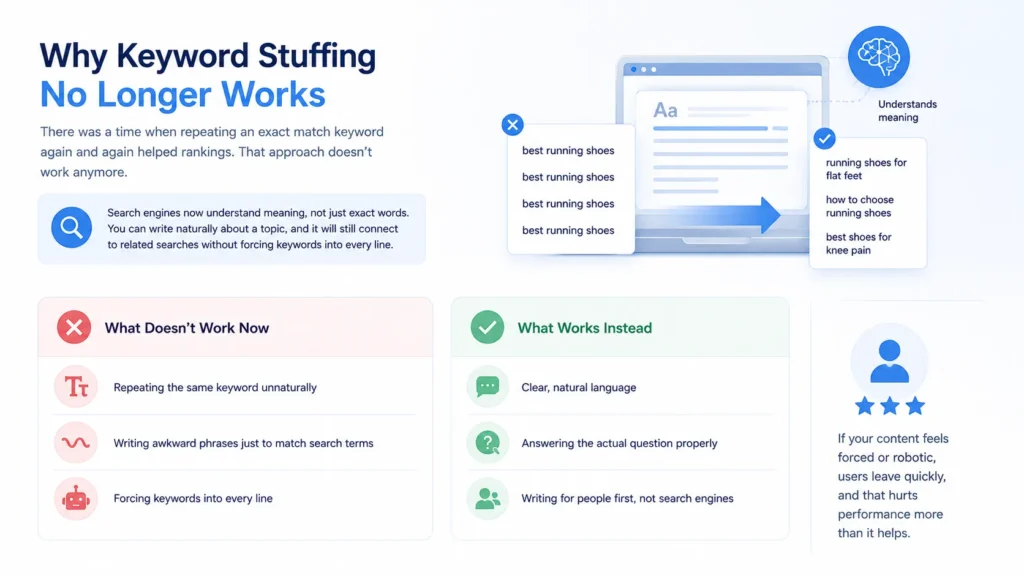
There was a time when repeating an exact match keyword again and again helped rankings. That exact match keyword approach doesn’t work anymore.
Search engines now understand meaning, not just exact words. You can write naturally about a topic, and it will still connect to related searches without forcing keywords into every line through semantic entity.
What doesn’t work now:
- Repeating the same keyword unnaturally
- Writing awkward phrases just to match search terms
What works instead:
- Clear, natural language
- Answering the actual question properly
- Writing for people first, not search engines
If your content feels forced or robotic, users leave quickly, and that hurts performance more than it helps.
Why New Websites Lose the High-Volume Game
Large websites have advantages that new websites do not:
- established authority
- strong natural and earned backlink profiles
- long history of trust
Because of this, they can rank for broad keywords even with average content.
New websites do not have these signals, so competing directly on high-volume keywords becomes very difficult.
When a new site publishes similar content, search engines have no strong reason to rank it above established sources.
Your Solution: The “Loophole & Specificity” Framework
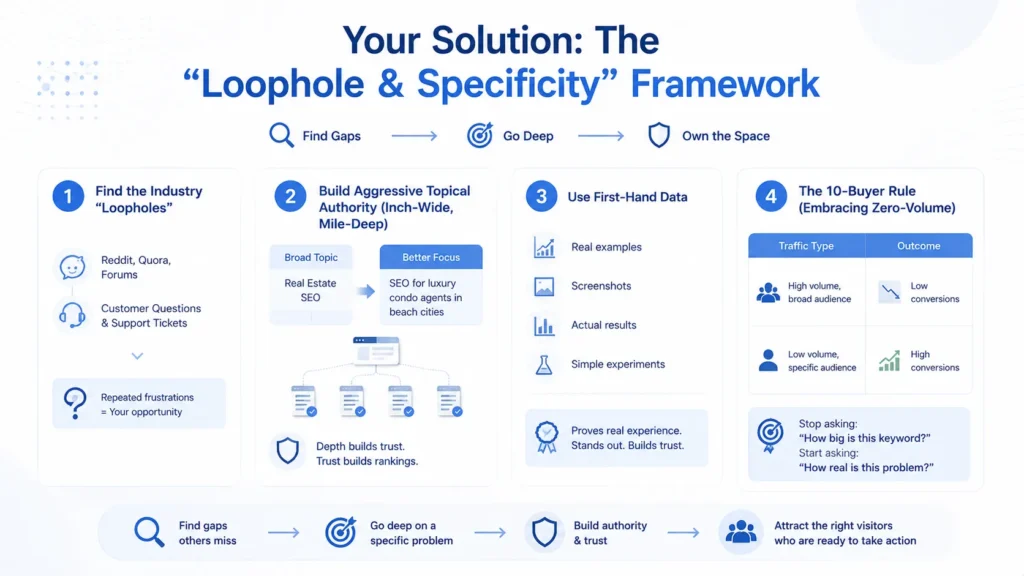
The approach that works now is simple: stop chasing broad topics and start solving specific problems better than anyone else. Instead of competing where everyone is already crowded, you find gaps and go deep.
Step 1: Find the Industry “Loopholes”
Don’t focus on what competitors are ranking for. Focus on where they are failing.
Where to look:
- Reddit, Quora, industry forums
- Customer questions and support tickets
What to look for:
- Repeated frustrations
- “I tried X but it doesn’t work for my case.”
That missing piece is your opportunity. If people are struggling to find a clear answer, you can step in and own that space.
Step 2: Build Aggressive Topical Authority (Inch-Wide, Mile-Deep)
Pick a very specific niche and cover it completely.
| Broad Topic | Better Focus |
| Real Estate SEO | SEO for luxury condo agents in beach cities |
What to do:
- Create one main page
- Add multiple supporting articles
- Cover every small variation
Depth builds trust. Trust builds rankings.
Depth commands trust. Trust wins rankings.
Over time, this loop establishes undeniable topical authority.
Step 3: Use First-Hand Data
Generic content is everywhere. Real experience stands out.
Most generic articles are commodity content, meaning they repeat what already exists. What works now is non-commodity content, where you add something original or practical.
Include:
- Real examples
- Screenshots
- Actual results
- Simple experiments
This proves your content is based on real work, not just theory.
For example, on my own website you can see I do many analyses and experiments and collect data, although they are on a small scale, but they still can contribute to a big conclusion.
Step 4: The 10-Buyer Rule (Embracing Zero-Volume)
Focus on quality over quantity.
| Traffic Type | Outcome |
| High volume, broad audience | Low conversions |
| Low volume, specific audience | High conversions |
A few highly relevant visitors are more valuable than thousands of random ones. When someone searches for a very specific problem, they are much closer to taking action.
The shift is simple:
Stop asking, “How big is this keyword?”
Start asking, “How real is this problem?”
The Long Game: Earning Broad Keywords
High-volume keywords can still be targeted, but only after building a strong foundation.
The process looks like this:
- Start with specific, low-competition topics
- Build credibility through consistent content
- Expand into broader keywords over time
This gradual approach increases the chances of success.
The Final Filter
Before working on any keyword, apply these three checks:
1. Is the query specific and problem-focused?
It should reflect a real need, not just general curiosity.
2. Is existing content weak or incomplete?
There should be room for improvement.
3. Can you add something new or more useful (real information gain)?
The content should offer clear value that is not already repeated across other pages.
If all three conditions are met, the keyword is worth pursuing.
Final Thought
High search volume often looks like opportunity, but it can be misleading without context.
Focusing only on large numbers can lead to:
- low engagement
- limited conversions
- wasted effort
A better approach is to focus on:
- clear intent
- specific problems
- useful solutions
Because in the end, success does not come from attracting the most traffic.
It comes from attracting the right audience.
Ready to find your first loophole? Audit your last 3 blog posts against our final filter below.
 Add Content Decoded as a preferred source