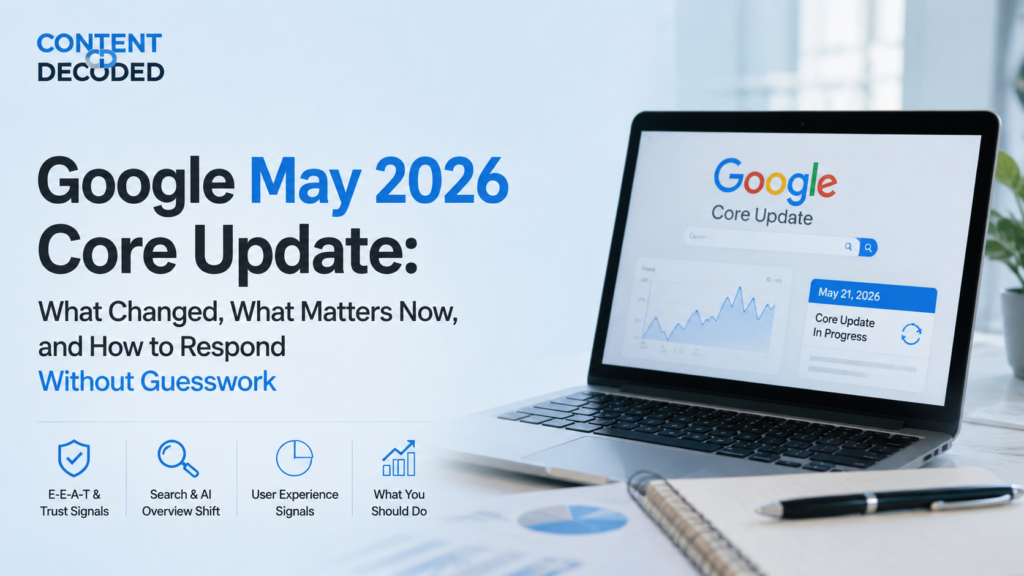
May 2026 Core Update: What Actually Changed, What Matters Now, and How to Respond Without Guesswork
On May 21, 2026, Google rolled out its second major core update of the year, and while the official wording makes it sound like a routine improvement, the reality is that this update is part of a much larger shift in how search works and how content is judged.
If you are tracking your website traffic right now, you may already be seeing sudden jumps, drops, or confusing patterns that don’t seem to follow logic. That does not mean something is broken. It simply means the system is still adjusting.
Core updates do not behave like instant switches. They work gradually, testing and recalibrating results across different systems before settling into a stable pattern.
Quick Snapshot of the Update
| Feature | Details |
|---|---|
| Launch Date | May 21, 2026 |
| Rollout Duration | Up to 2 weeks |
| Scope | Global across all regions and languages |
| Affected Areas | Search results, Discover, Featured Snippets |
This table gives you the basic context, but what actually matters is what is changing behind the scenes, because that is what will affect your rankings in the coming weeks.
First, Understand This: It’s Not “Just Another Update”
Google has described this as a regular update, but if you look at the direction search is moving in, it becomes clear that this is part of a deeper transition rather than a small adjustment.
Much of this shift connects directly to what was introduced during Google I/O 2026, where search was presented as something far more interactive and intelligent than before.
Instead of simply listing links, search is now moving toward giving answers, building summaries, and even creating dynamic results that behave more like tools than pages.
What this really means is that your content is no longer just competing with other websites. It is competing with how clearly and quickly it can deliver value in a system that may not even require a click.
Here’s a cleaner, sharper version of your idea:
For example, I recently saw Google’s new “Ask” button, which recommends products through a simple conversational interface. It essentially acts like a personal shopper, guiding users toward purchase decisions without even requiring them to visit a website. With innovations like this, Google is clearly pushing AI in a direction that could fundamentally change how search engines work.
What This Update Is Really Optimizing For
1. E-E-A-T Is No Longer Optional
The idea of Experience, Expertise, Authoritativeness, and Trust has been around for years, but with this update it is being applied more strictly and more consistently across different types of content.
Instead of just checking whether information is correct, the system is now looking at who is providing that information and whether they appear reliable in a real-world sense.
Here is how that plays out in practice:
- Content that shows real experience, such as personal testing, case studies, or detailed explanations based on actual use, is being treated more seriously than general summaries
- Articles written without clear authorship or without any sign of credibility are finding it harder to compete, especially in topics that affect health, money, or legal decisions
- Pages that explain a topic but do not go deep enough or do not add anything new are being replaced by content that feels complete and trustworthy
The key idea is simple: it is no longer enough to explain something well, you also need to show why your explanation should be trusted over others.
2. The AI Content Flood Forced Google’s Hand
The amount of AI-generated content published in the past year has changed the web completely, and most of it follows similar patterns, which makes it easy to spot.
Because of this, Google has started filtering content that feels repetitive or overly predictable, even if it is technically correct.
Some common patterns that are now being picked up include:
- Content that follows the same sentence length and structure throughout the article
- Articles that repeat ideas already covered by dozens of other pages without adding anything new
- Writing that stays at a surface level and avoids going deeper into the topic
This does not mean AI content is banned, but it does mean that content without originality or depth is being pushed down, often very quickly.
3. User Experience Is Quietly Carrying More Weight
User experience has always mattered, but now it is being connected more directly to how helpful your content actually feels when someone visits your page.
This includes technical factors, but it also goes beyond them.
Some of the key areas being considered are:
- How fast your page loads, especially on mobile devices
- Whether the layout is clean and easy to read without distractions
- How quickly a user can find the answer they came for
- Whether the page feels smooth and easy to interact with
Here is the important part: good performance alone is not enough. A fast page that does not satisfy the user will still struggle, while a well-structured page that keeps people engaged will perform better over time. Focus is shifting on making your website more mobile-ready.
4. The Rise of AI Overviews and “No-Click” Search
Search results are changing in a way that directly affects how users interact with content.
AI-generated summaries are now appearing in a large portion of searches, and these summaries often answer the question before the user clicks on any result.
Some important observations:
- A significant percentage of searches now include AI-generated summaries at the top
- Most of the content used in these summaries comes from pages that already rank on the first page
- Users are increasingly getting answers without visiting multiple sites
This means your goal is not to chase AI features directly. Instead, you need to:
- Rank strongly in regular search results
- Structure your content clearly so it can be easily understood
- Present information in a way that can be extracted quickly
If you do this well, your content naturally becomes part of these new formats.
The Big Shift Most People Are Missing
Backlinks Are No Longer the Whole Game
Backlinks still matter, but they are no longer the deciding factor they once were.
There is a noticeable shift toward how deeply a website covers a topic rather than how many links it has collected.
Here is how that shift looks:
| Old Approach | New Direction |
|---|---|
| Focus on getting more backlinks | Focus on covering a topic completely |
| Publish many separate short articles | Build fewer but stronger and deeper pages |
| Target individual keywords | Build authority around entire topics |
In simple terms, a site that clearly understands and explains a subject in depth can now compete with larger sites, even if it does not have the same number of links.
What You Should Do (And What You Should Avoid)
Step 1: Do Nothing During the Rollout
This is one of the hardest things to follow, but also one of the most important.
During the rollout period, rankings will move up and down in ways that do not reflect the final outcome.
You might see:
- A strong keyword suddenly drop far down the rankings
- The same keyword return to its original position a few days later
These movements are temporary and part of the testing process.
Making changes during this time can actually make things worse because you are reacting to unstable data.
Step 2: Analyze Only After Stability Returns
Once the update has fully rolled out, you can start looking at your data with more clarity.
Instead of focusing on daily changes, compare:
- Performance before May 21
- Performance after the update settles
This gives you a clearer picture of what has actually changed.
Step 3: Fix Intent Mismatches First
One of the most common reasons for ranking loss is a mismatch between what your page offers and what Google now expects for that search.
For example:
- If a keyword now shows product pages but your content is informational, your page will struggle
- If users expect a quick answer but your page is long and indirect, engagement will drop
In such cases, improving the existing content is not enough. You need to adjust the entire approach to match what users are actually looking for.
Step 4: Clean Up Weak Content
Not every page on your site adds value, and keeping low-quality content can affect your overall performance.
Look for:
- Pages with very little useful information
- Multiple articles covering the same idea without adding depth
- Content that no longer matches current search intent
Then take action:
- Combine similar pages into one stronger article
- Remove pages that do not serve any purpose
This helps improve the overall quality of your site.
Step 5: Strengthen Trust Signals
Trust is becoming more visible and more important.
To improve this, make sure your site clearly shows:
- Who wrote the content and why they are qualified
- How users can contact you
- Where your information comes from
- That your site is real and accountable
These signals may seem basic, but they play a strong role in how your content is evaluated.
The Signals You’ll See During the Update
1. The “Wobble Effect”
During the rollout, rankings will move in unpredictable ways, sometimes changing dramatically within a few days.
This is normal and does not require action.
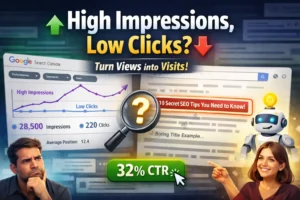
2. Impressions Up, Clicks Down
You may notice that your pages are still appearing in search results, but fewer users are clicking on them.
This often happens because answers are being displayed directly in search results, reducing the need for clicks.
3. Category-Wide Drops
If multiple pages within the same topic lose visibility at the same time, it usually means your site’s authority in that area has been reassessed.
This is different from a single page losing rank and requires a broader improvement strategy.
4. Engagement Drops (Pogo-Sticking)
When users visit your page and leave quickly, it signals that the content did not meet their expectations.
Over time, this can affect your rankings because it suggests that your page is not the best answer for that query.
How to Make Your Content Stand Out Now
1. Lead With Clear Answers
Start your content by addressing the main question directly, so users immediately find value without needing to scroll too much.
2. Use Question-Based Structure
Organizing your content around clear questions makes it easier for both users and search systems to understand your page.
3. Add What AI Can’t Replicate
This is where you can create a real advantage.
Focus on:
- Personal insights based on real experience
- Unique observations that are not widely repeated
- Clear opinions that help users make decisions
Content that feels human, thoughtful, and specific stands out more than content that simply repeats general information.
The Real Takeaway
This update is not about punishing websites for small mistakes. It is about raising the standard for what counts as useful and reliable content.
Sites that rely on repetition, shallow explanations, or volume without depth are gradually being filtered out.
At the same time, content that is clear, trustworthy, and genuinely helpful is being pushed forward.
The simplest way to understand this shift is to think about the reader.
If someone visits your page and feels satisfied enough that they do not need to return to search, you are moving in the right direction.
If they leave looking for a better answer, then there is still work to do.
 Add Content Decoded as a preferred source