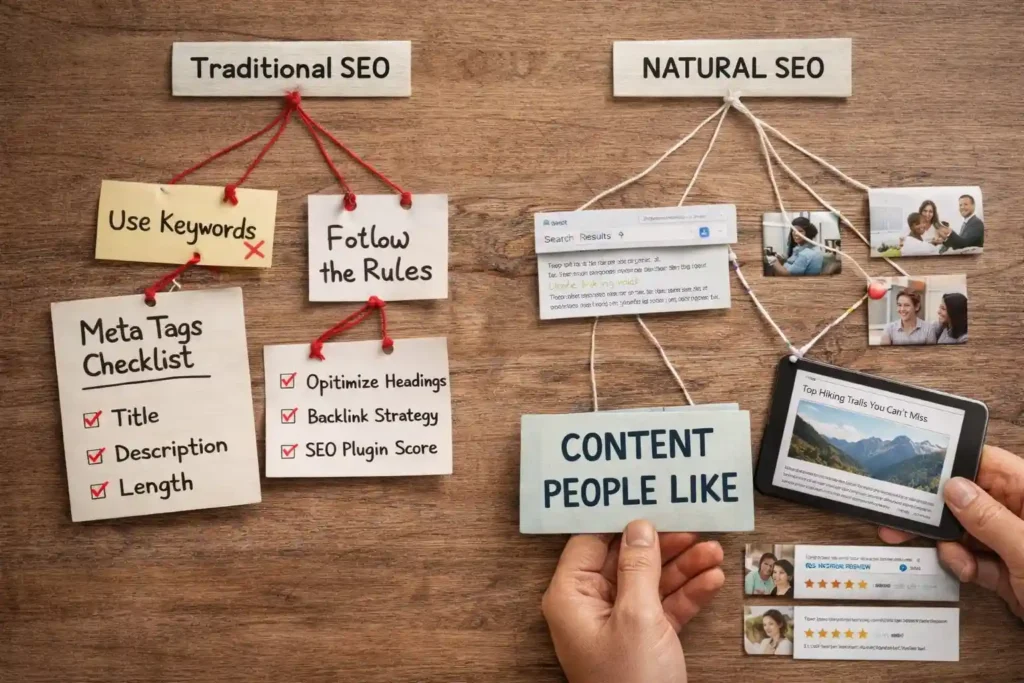
What Is Natural SEO & Why Current SEO Isn’t Working Anymore
Natural SEO is simply creating useful, original content without relying on checklists or rigid SEO rules. The focus is on information gain — adding something genuinely new, clearer, or more honest than what already exists. If a page doesn’t do that, it doesn’t deserve to rank, no matter how “correct” it looks.
Most people would group this under Organic SEO, but if you compare approaches closely (see Natural SEO vs Traditional SEO), the difference becomes obvious…, but in practice, Organic SEO has become heavily checklist-driven — keywords, meta tags, structure, all done by the book. Natural SEO moves away from that mindset. It still respects search intent, but it prioritises clarity and value over ticking boxes.
I realised this the hard way. I published blogs after doing everything right — keywords, headings, links, meta tags — and still saw no results. Meanwhile, other pages ranked higher without following half those rules. That’s when it clicked: the difference wasn’t optimisation, it was usefulness.
That’s what led me to think differently. Not about how to satisfy algorithms, but how to actually say something worth ranking.
What “Natural SEO” Actually Means to Me
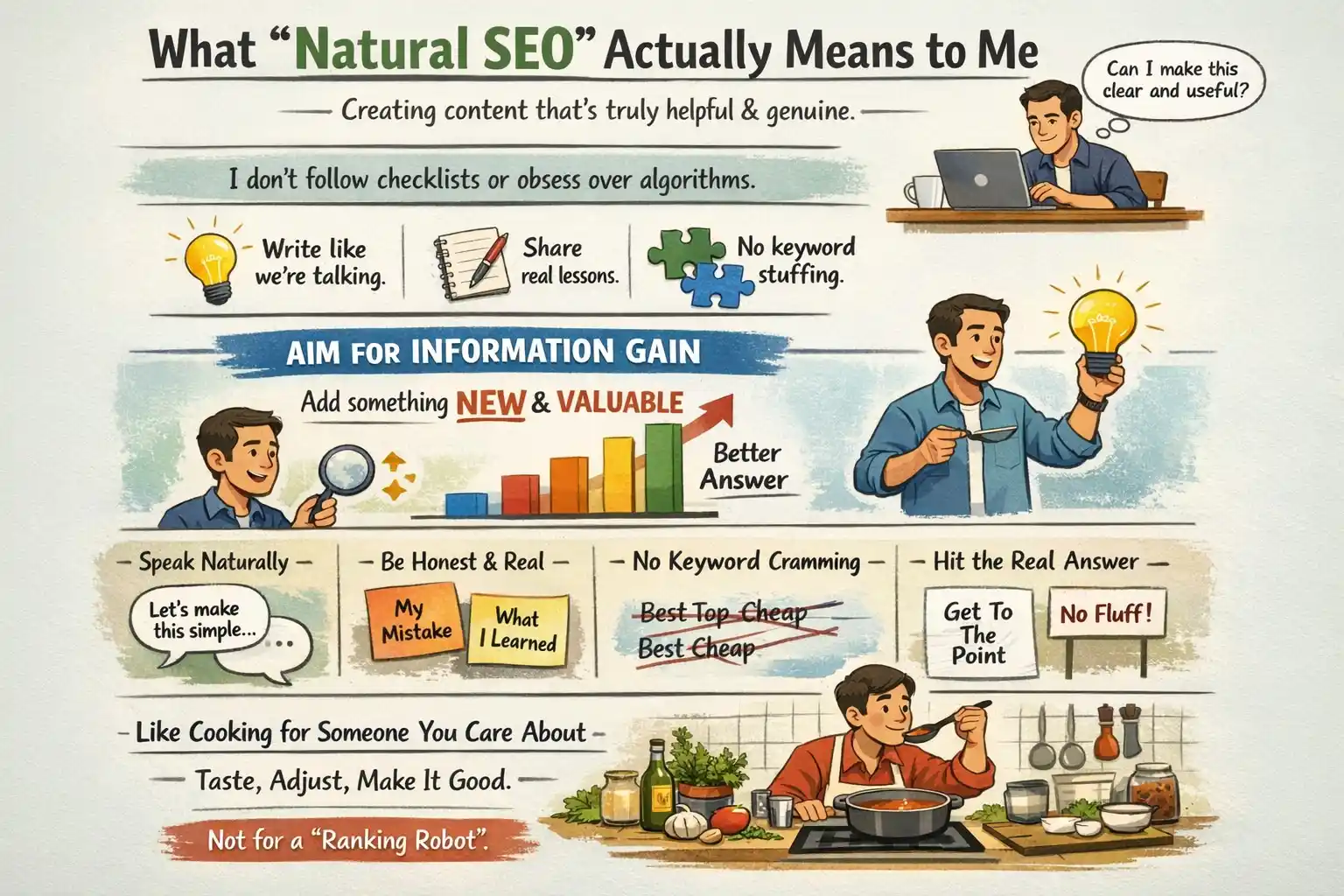
When I think about Natural SEO, I’m not thinking about algorithms first. I’m thinking about whether what I’m saying can save your time and give you a real, direct answer.
Natural SEO is simply creating useful, original content without checking any checklist or hardcore SEO rules.
What I try to achieve while writing is “information gain”. If I’m not adding something new, clearer, or more honest than what is already ranked, then there is no point in my content, and it may not rank even if it is right.
What This Looks Like in Real Content
Here’s how this shows up when I actually sit down to write:
- I write the way I’d explain it to you in a real conversation, not like a textbook
- I include real mistakes or lessons I’ve learned instead of pretending everything is perfect
- I don’t force keywords into sentences where they don’t belong
- I focus on answering the actual question instead of stretching the word count
Think of it like cooking for someone you care about. You don’t measure every spice to impress a machine. You taste, adjust, and make sure it’s actually good to eat.
Why Do I Hate Checklist SEO? See the Trap
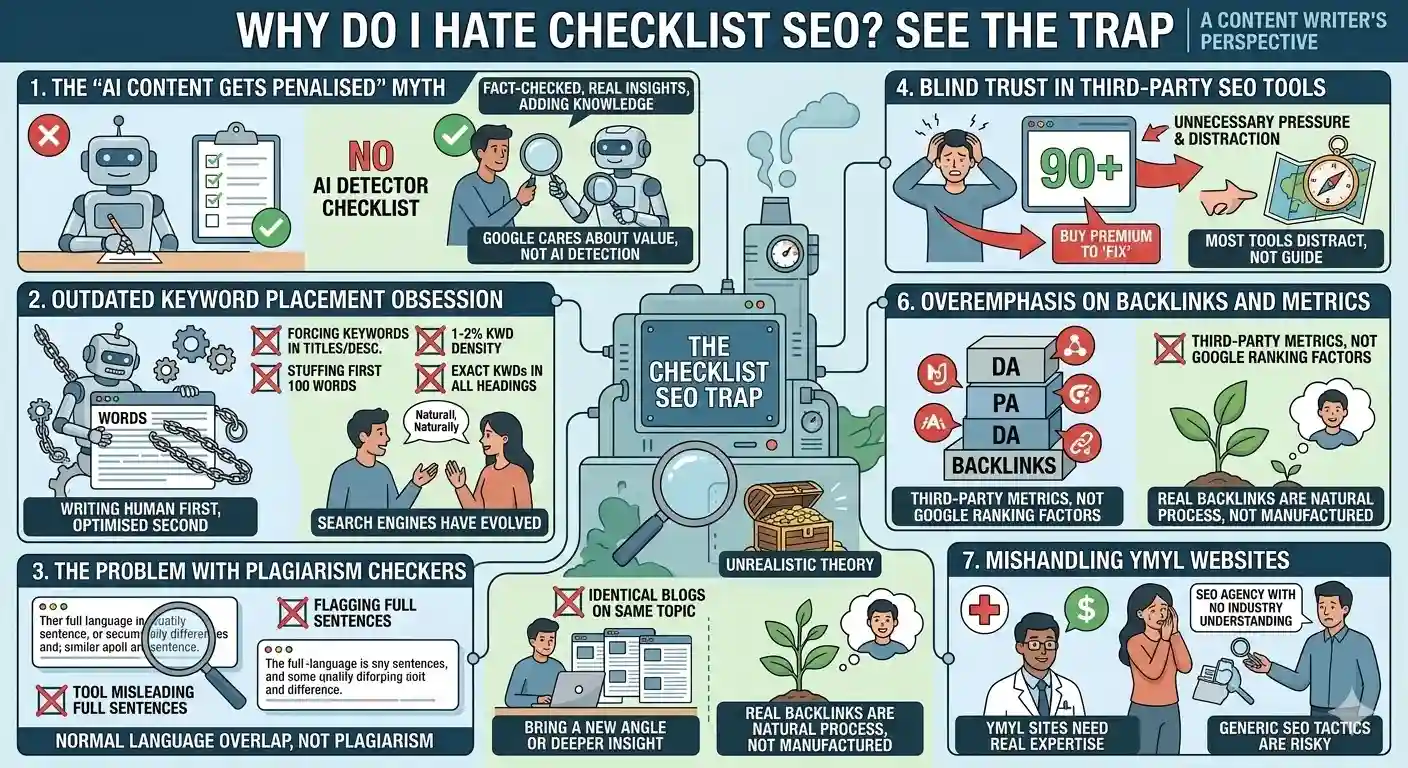
I hate checklist SEO very much, not because it did something wrong, but because it has many deficiencies and many unnecessary things which confuse the students and the website, and they start seeing it as something hard and very skilled.
I hate some specific rules while I am a content writer working in an SEO agency, so I’ll tell you what rules I hate.
1. The “AI Content Gets Penalised” Myth
This is probably the rule I dislike the most.
People keep saying AI content won’t rank or will get penalised by Google. That’s not entirely true. What actually gets into trouble is low-quality content—stuff that’s generic, unverified, or written without any real understanding.
If you fact-check properly, include real insights, and add your own knowledge, the content becomes useful. And that’s what matters.
Google isn’t running some AI detector checklist behind the scenes. It cares about value, not whether a human or AI typed the first draft.
2. Outdated Keyword Placement Obsession
This whole keyword placement formula feels stuck in the past.
Things like:
- forcing exact keywords into meta titles and descriptions
- stuffing them into the first 100 words
- maintaining a 1–2% keyword density
- repeating exact keywords in every heading
That approach just makes content sound unnatural. Search engines have evolved way beyond this. Writing should feel human first, optimised second.
3. The Problem with Plagiarism Checkers
I don’t trust these tools much.
Sometimes they flag full sentences as duplicates just because one or two words match somewhere else. That’s not plagiarism—that’s normal language overlap.
These tools can be misleading, and Google doesn’t penalise content for such minor similarities anyway.
4. Blind Trust in Third-Party SEO Tools
This is another big one.
People get a 90+ score on an SEO plugin and assume their blog will rank. Or they see backlink numbers going up followed by increase in DA and think their real authority is increasing.
That’s not how it works.
Most of these tools create unnecessary pressure and push you toward buying premium versions just to “fix” scores. Instead of guiding, they often distract.
Personally, I only trust Google Tools and they are enough for tracking SEO performance and improving rankings.
5. Chasing “High Volume, Low Competition” Keywords
This idea sounds good in theory, but doesn’t make much sense in reality.
If a keyword truly has high search volume, it will naturally have competition . And if there are already 100+ articles on the same topic, what’s the point of adding one more identical blog?
It’s better to bring a new angle or deeper insight than chase numbers blindly.
6. Overemphasis on Backlinks and Metrics
There’s way too much focus on backlinks, DA, and PA.
Many people treat increasing these numbers as proof that SEO is working. But these are third-party metrics—Google doesn’t use them as ranking factors; instead, it uses some internal factors, especially internal authority and topical authority.
Also, natural backlinks aren’t something you artificially build. They happen when someone genuinely finds your content useful and decides to reference it.
That’s a natural process, not a manufactured one.
7. Mishandling YMYL Websites
This is something I strongly disagree with.
Websites that fall under YMYL (Your Money or Your Life) need real expertise. But often, owners hand them over to SEO agencies that don’t understand the industry at all.
That’s risky.
These sites need experienced people who actually know the subject, not just someone applying generic SEO tactics.
Final Note
These are personal opinions based on what I’ve observed and experienced.
They’re not meant to attack anyone—just to question practices that don’t really make sense anymore and encourage a more practical approach to SEO.
Why Natural Content Ranks Faster in the Current Era (Even Without “SEO”)
We’ve moved past the era of stuffing keywords and tweaking tags. What actually moves rankings now is how people respond to what you write. Once you see that shift, everything else clicks into place.
Google doesn’t rank pages. It ranks reactions.
I’ve seen this play out over and over. Two pages target the same keyword, but the one that feels right wins.
Why? Because Google watches what happens after the click.
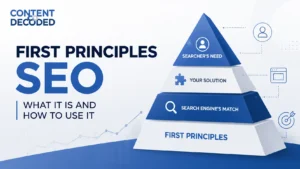
If your content pulls people in, keeps them reading, and answers their questions without dragging things out, you’re sending strong signals without trying. Natural writing does this automatically because it follows how people actually think. This aligns directly with first principle thinking in SEO—focusing entirely on solving the user’s fundamental need rather than forcing artificial optimizations.
Forced SEO writing breaks that flow. People leave. Rankings follow.
Good content doesn’t chase rankings. It earns reactions.
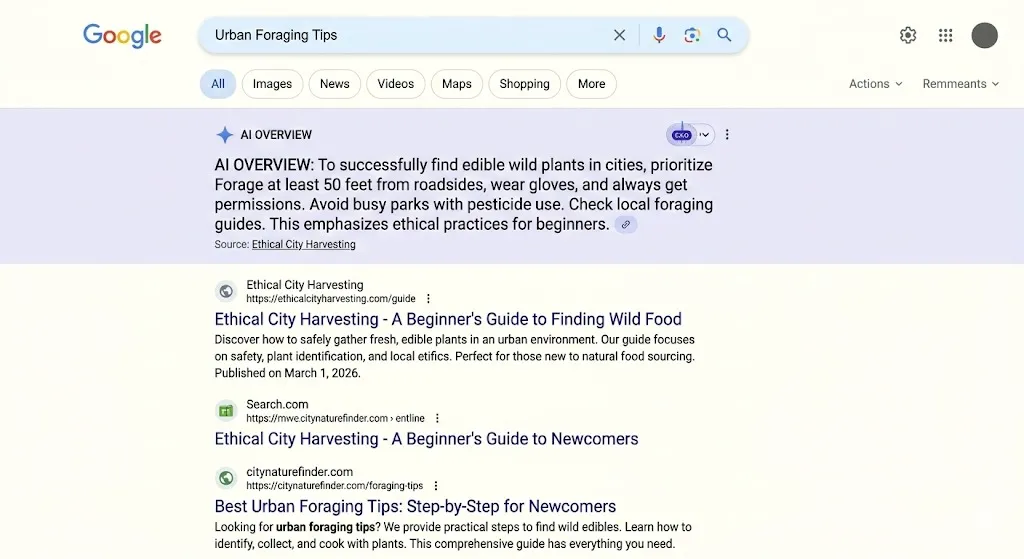
The rise of zero-click and AI answers
A lot of the time now, users don’t even click. The answer shows up right on the results page.
So what is Google looking for? Content it can trust, lift, and summarise cleanly.
If your writing feels stitched together or overly optimised, it gets skipped. But when it’s clear, direct, and sounds like someone who actually understands the topic, it can choose as a source for AI overview .
Most blogs miss this because they try to sound optimised instead of understandable.
Information gain is the real ranking factor
If you’re repeating what’s already out there, you’re invisible . Google already has that version.
What stands out now is new value. A sharper insight. A clearer explanation. Something grounded in real experience.
When I write, I’m not asking if I covered everything. I’m asking if I added something useful or different.
That’s the difference.
For example, instead of explaining what keyword research is (which everyone has done), I might show how I actually decide which keywords are a waste of time — that shift alone creates visibility.
Natural SEO vs Checklist SEO
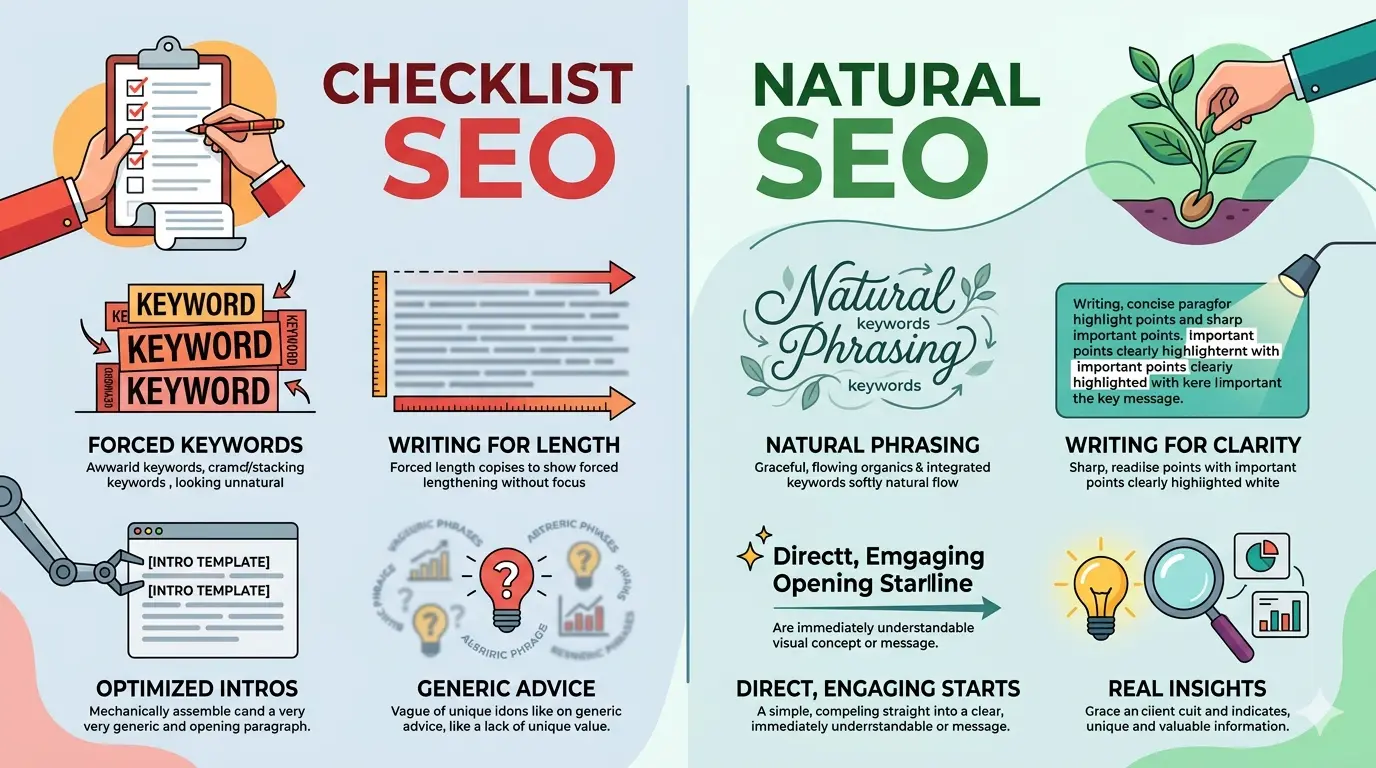
Now, let’s have a view about how natural SEO is different from checklist SEO.
| Checklist SEO | Natural SEO |
|---|---|
| Forced keywords | Natural phrasing |
| Writing for length | Writing for clarity |
| Optimized intros | Direct, engaging starts |
| Generic advice | Real insights |
Here’s the thing: one tries to game the system, the other earns attention. When you write like a human who understands the topic and respects the reader’s time, you don’t just rank better, you hold attention longer, and that’s what search engines are quietly rewarding now.
Why Writing For User = Writing For Algorithm Automatically
Let’s take the example of Rancho from the movie 3 Idiots. He said, ‘Don’t run after success, but follow excellence. If you follow excellence, success itself will come to you.’
Now let’s try to decode the example from our situation: we do a checklist SEO and stress about keyword placement, content length, meta tag optimisation, keyword density, optimising for AI overview, optimising for AI bots, optimising for FAQs, etc. We use all these techniques just to please the algorithm to rank us. We follow quick success here and forget about the user.
But when we forget all these rules and just write our content and blog just to please users to buy our products or take help from our guide, then the content automatically gets better and is easy for an AI overview to cite your website, because that comes from first-hand experience.
The “Fear-Based SEO Industry” You Should Stop Listening To
Now the SEO industry is becoming more fear-based; people invent new terms, new tools, and new kinds of fear to sell their SEO packages or to sell their 50k course, or SEO gurus just sell their tools as the fear they create themselves.
Why Do They Create Fear?
As told before, these fears and new SEO terms are invented just to sell their course to students, saying that if they do not take their course, they may remain behind
They do so just to sell their SEO packages to business owners, and they easily accept that because they don’t have knowledge about it.
What is the reality?
The reality is that, yes, things change when Google updates come. Yes, SEO requires some effort, but in reality, it is not as hard as it is often seen. Even today, business owners can write and publish their content and handle their website with rankings and traffic.
✍️ Practical Insight: My “Write for One Reader” Exercise
Try this before your next post: picture one specific person—someone who asked you a question recently. Write directly to them. No fluff, no keyword targets. Answer what they actually asked, then go deeper if they’d push back. I used this for a client in a tricky niche. Result? Page 1 in three weeks without link building. Why? Because real clarity outperforms checklist content. Your turn: open a doc, name the reader, and start the conversation.
Exceptions of Natural SEO
Now I am going to tell you some exceptions of Natural SEO.
- The first requirement is knowledge of handling websites, as it requires the platform of your website, which you can learn easily for free from YouTube.
- You can hire a web developer for the first-time setup of your website and all listings (if you don’t know about this), and then later learn about listing products and writing a blog to promote your product.
- You should know how to build topical authority because topical authority is real, and Google ranks on the basis of it. Calculate Your website’s topical authority here
- Your site must be clean and all device-friendly; otherwise, your natural content can also get stuck.
- You require knowledge to analyse Search Console, Analytics and Bing Webmaster to know what works and what does not.
How to Write Content That Ranks Without “Trying to Rank”?
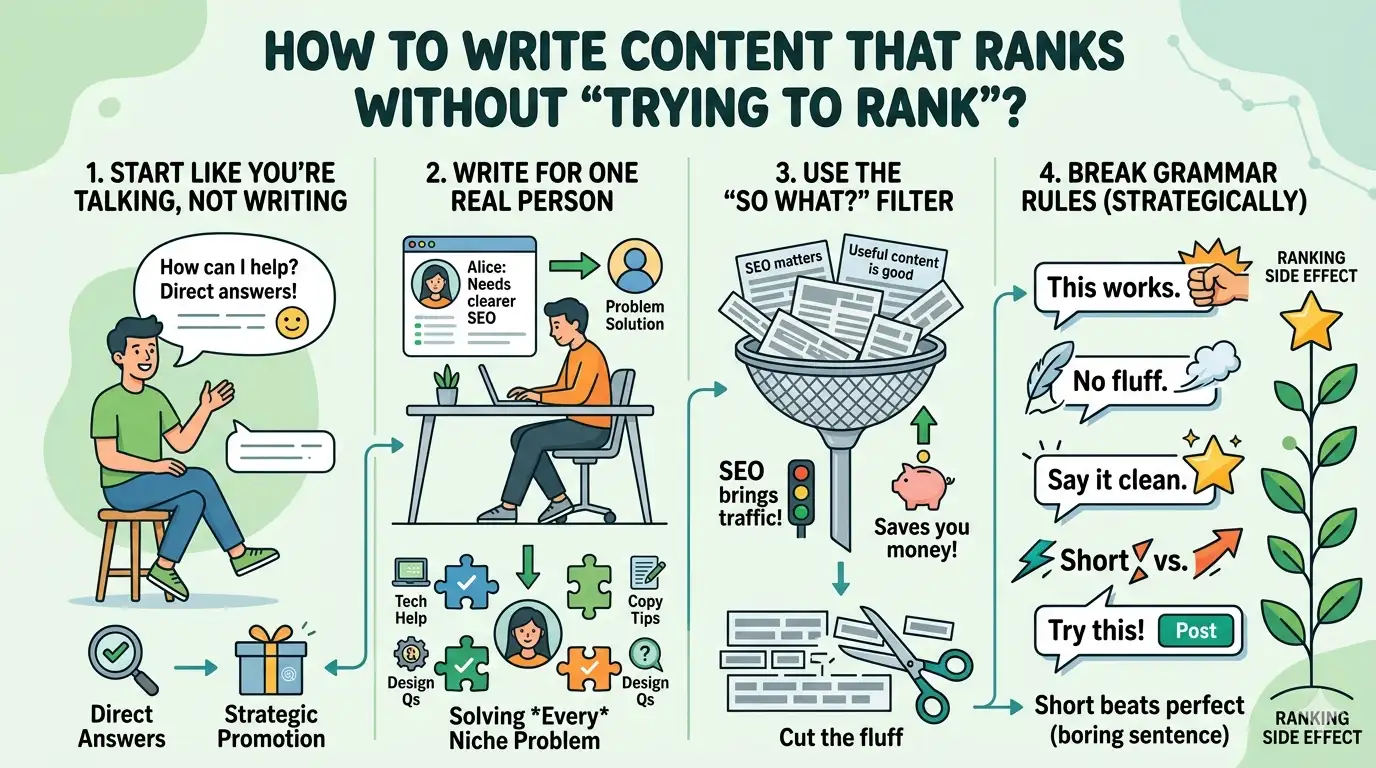
To write, first avoid the checklist I hate above. Most content fails because it sounds like content. I focus on clarity, not algorithms. When you write like a human who actually understands the topic, ranking becomes a side effect.
Start Like You’re Talking, Not Writing
When you write any content, you should write as if you are talking to your customer. Then, what you say to him should either give a direct answer to them or explain when you need a definition and when to promote ourselves.
Write for One Real Person
Just choose one customer in mind with the problem and target them. Maybe it’s a large group or just 1 person. Try to solve every problem in your niche or industry.
Use the “So What?” Filter
Every line must earn its place. If it doesn’t answer “so what?”, I cut it.
Example: “SEO matters” → “SEO brings consistent traffic you don’t pay for.”
Break Grammar Rules (Strategically)
Short beats perfect. Fragments hit harder.
Example lines:
This works.
No fluff.
Say it clean.
Try this on your next post.
The Bottom Line: Stop Chasing SEO, Start Being Worth Reading
Rankings don’t come from tricks; they come from substance. I’ve seen it over and over—when I focus on writing something genuinely useful, structured clearly, and grounded in original thinking, search visibility follows on its own. You don’t need to outsmart algorithms; you need to respect your reader’s time. When you say something fresh and say it well, we all benefit—readers stay, share, and return. That’s what search engines pick up on.
Ranking isn’t the goal. It’s the side effect of being worth reading.
— trust grows in systems, not silos —
 Add Content Decoded as a preferred source