
High Impressions but Low Clicks in Google Search Console: Real Reasons + Fixes
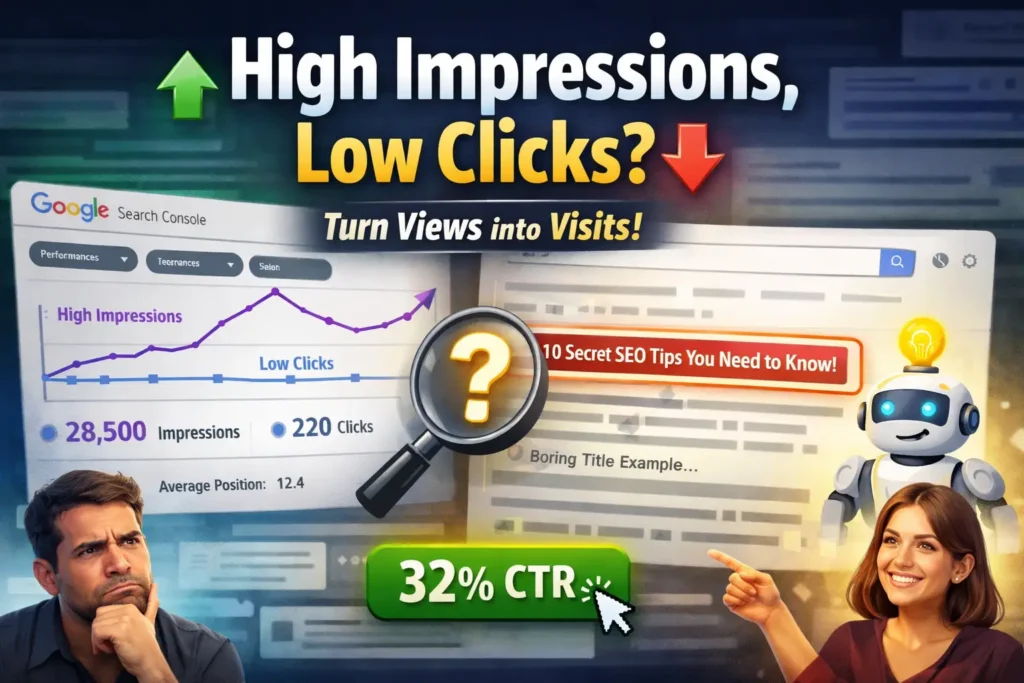
Your Google Search Console impressions are climbing, but your traffic is flat. In 2026, this “ghost traffic” usually stems from three modern shifts: AI Overviews satisfying users before the click, position 8–20 visibility where you’re seen but ignored, or a format mismatch where your page doesn’t mirror the user’s intent.
To fix this, you must stop writing descriptive titles and start creating a “Curiosity Gap”—answering the primary query just enough to prove authority while withholding the proprietary “how-to” that only a click can reveal. Visibility is just an invitation; the click is the only win that scales.
The Real Reasons Behind The Problem
High impressions feel like progress, but clicks tell the truth. If your pages are visible but not getting traffic, something deeper is off. Let’s stop guessing—these are the actual causes inside GSC data.
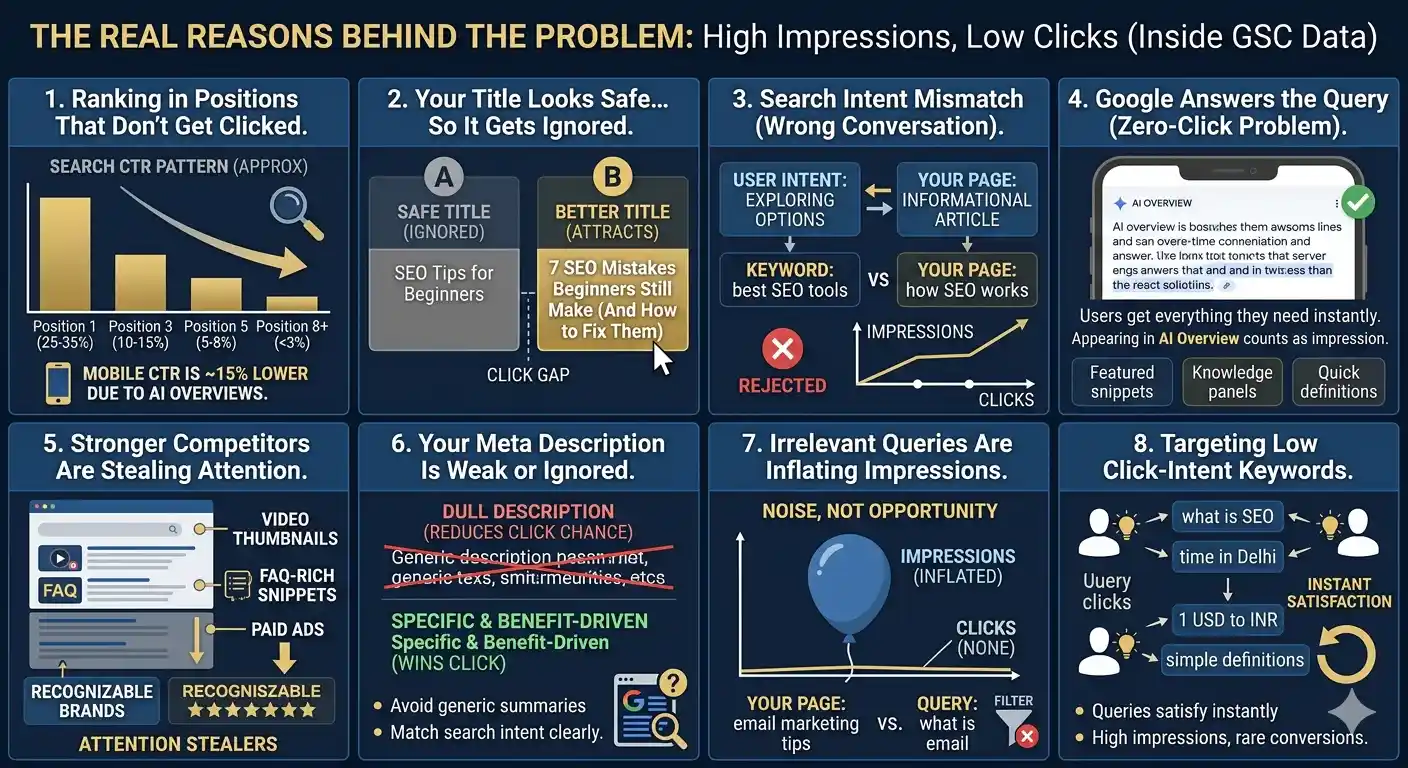
You’re ranking… But in Positions That Don’t Get Clicked
Ranking on page one isn’t enough if you’re sitting near the bottom. Positions 8–20 collect impressions, but users rarely scroll that far. Visibility increases, but engagement doesn’t follow.
CTR pattern (approx):
- Position 1: 25–35%
- Position 3: 10–15%
- Position 5: 5–8%
- Position 8+: <3%
Note: These numbers are 15% lower on mobile due to AI Overviews
Your Title Looks Safe… So It Gets Ignored
Safe titles blend in. They describe, but they don’t attract.
| Bad Title | Better Title |
|---|---|
| SEO Tips for Beginners | 7 SEO Mistakes Beginners Still Make (And How to Fix Them) |
| Content Writing Guide | Why Your Content Isn’t Ranking (And What Actually Works) |
What this really means is you have a click gap. You rank, but your title doesn’t compete for attention.
Search Intent Mismatch (You’re Showing Up in the Wrong Conversation)
You appear for keywords that don’t match what users expect.
Example:
Keyword: best SEO tools
Your page: how SEO works
Google tests your page, users don’t engage, and clicks stay low. Impressions rise because you’re being shown, but rejected.
Google Answers the Query Without Needing You (Zero-Click Problem)
Sometimes users get everything they need directly on the results page. Your content helps power that answer but earns no click.
- Featured snippets
- AI Overviews
- Knowledge panels
- Quick definitions
For example, for my blog about “Meta Title Length”, I got 300+ impressions without a click, then I found the reason that AI overview gives answers directly in one line.
Note – Appearing in an AI Overview counts as an impression even if the user doesn’t scroll to your organic link.
To improve both visibility and engagement, focus on writing content in a format that AI overviews rank while still making it compelling enough for real readers to click and explore further.
Stronger Competitors Are Stealing Attention (Even Below You)
Ranking higher doesn’t guarantee clicks. Strong brands and richer results pull attention away.
- Recognizable brand names
- Video thumbnails
- FAQ-rich snippets
- Paid ads pushing organic down
Ranking is placement. Winning clicks is perception.
Your Meta Description Is Weak or Ignored
A dull or missing description reduces your chance to convert impressions into clicks. And if Google rewrites it poorly, you lose control entirely.
- Keep it specific and benefit-driven
- Match search intent clearly
- Avoid generic summaries
Irrelevant Queries Are Inflating Impressions
Not all impressions are useful.
Example:
Your page: email marketing tips
Query shown: what is email
These mismatches inflate numbers but bring no clicks. It’s noise, not opportunity.
You’re Targeting Low Click-Intent Keywords
Some searches don’t need a click at all.
- what is SEO
- time in Delhi
- 1 USD to INR
- simple definitions
These queries satisfy instantly. High impressions here rarely convert, no matter how well you rank.
How to Diagnose High Impression Low Click Issues Inside Google Search Console
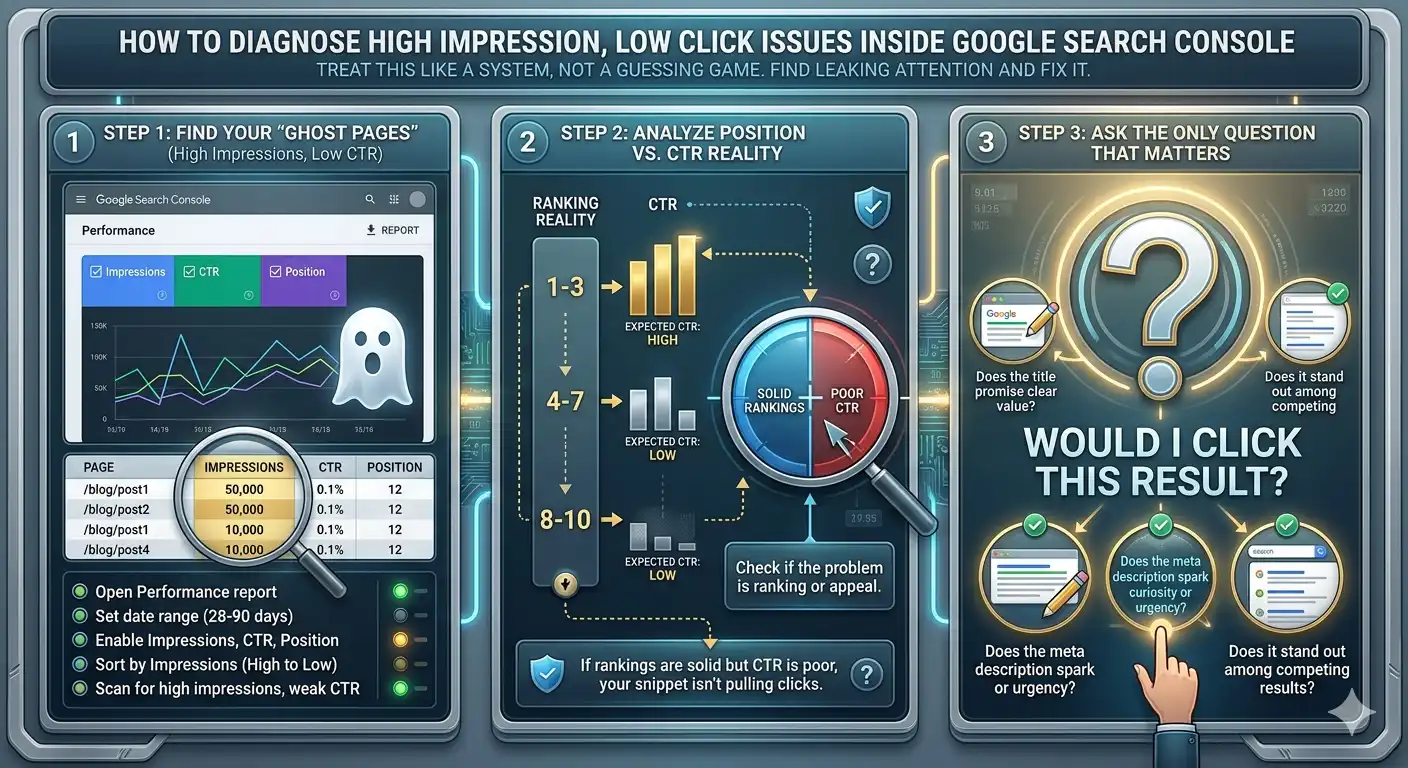
Treat this like a system, not a guessing game. The goal is simple: find where attention is leaking and fix it with precision.
Step 1: Find Your “Ghost Pages” (High Impressions, Low CTR)
- Open Performance report
- Set date range (last 28–90 days)
- Enable Impressions, CTR, Position
- Sort by Impressions (high to low)
- Scan for pages with strong impressions but weak CTR
These are your ghost pages getting seen but ignored.
Step 2: Analyze Position vs CTR Reality
Check if the problem is ranking or appeal.
| Position | Expected CTR |
|---|---|
| 1–3 | High |
| 4–7 | Medium |
| 8–10 | Low |
If rankings are solid but CTR is poor, your snippet isn’t pulling clicks.
Step 3: Ask the Only Question That Matters
Would I click this result?
- Does the title promise clear value?
- Does the meta description spark curiosity or urgency?
- Does it stand out among competing results?
Fix High Impressions but Low Clicks (Actionable Framework That Works)
Now fix what’s actually broken.
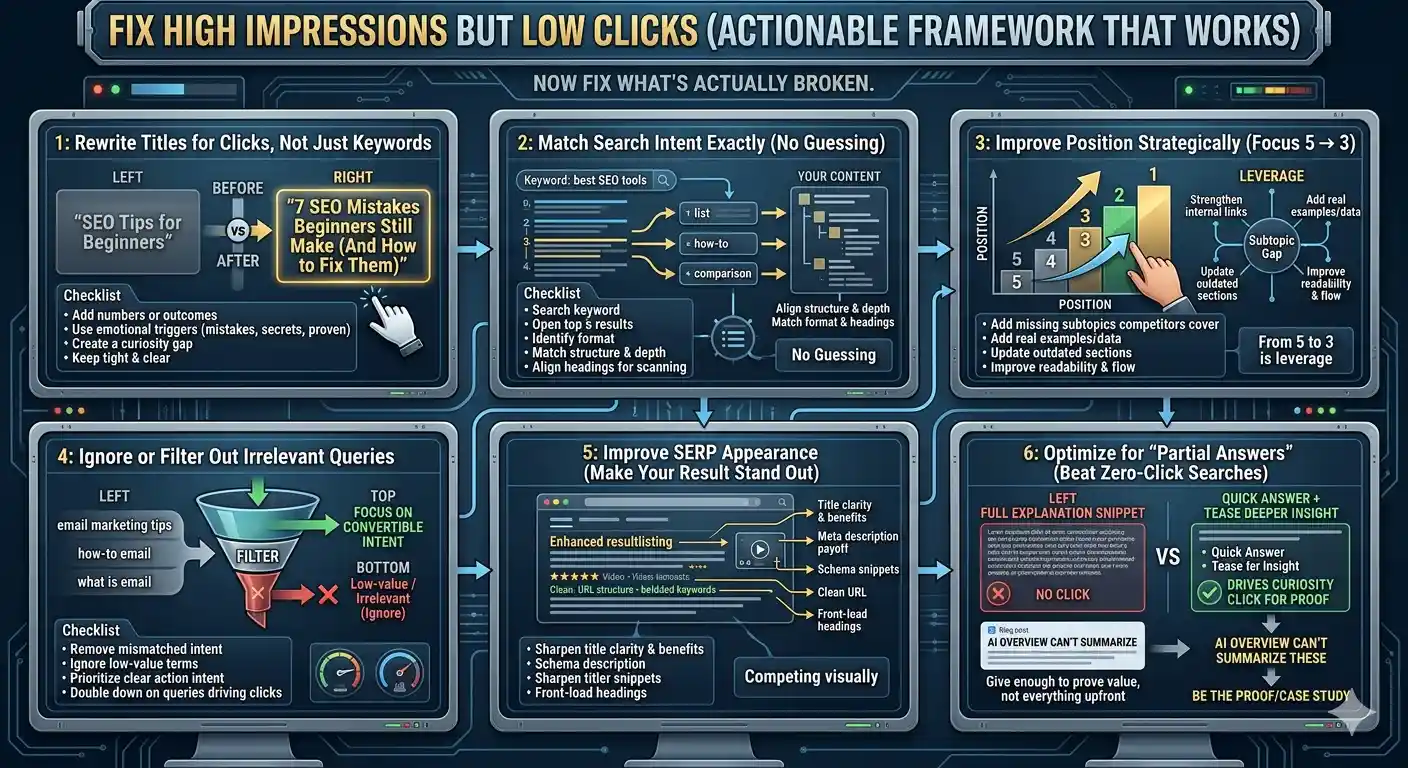
Fix 1: Rewrite Titles for Clicks, Not Just Keywords
Ranking titles and clickable titles aren’t the same. One gets seen; the other gets chosen.
Before vs After
“SEO Tips for Beginners” → “7 SEO Mistakes Beginners Still Make (And How to Fix Them)”
“Email Marketing Guide” → “Email Marketing That Converts: 5 Tactics That Actually Work”
Checklist
Add numbers or specific outcomes
Use emotional triggers (mistakes, secrets, and the proven)
Create a curiosity gap without being vague
Keep it tight and clear
Fix 2: Match Search Intent Exactly (No Guessing)
If your format doesn’t match what users expect, clicks drop instantly.
Steps
Search your keyword
Open top 5 results
Identify format (list, how-to, comparison, etc.)
Match structure and depth
Align headings with what users are scanning for
Fix 3: Improve Position Strategically (Focus 5 → 3)
Going from position 50 to 10 is hard. Moving from 5 to 3 is leverage.
How to improve
Add missing subtopics competitors cover
Strengthen internal links from relevant pages
Include real examples or data points
Update outdated sections
Improve readability and flow
Fix 4: Ignore or Filter Out Irrelevant Queries
Not every impression is worth optimising.
Focus on intent that can actually convert.
Checklist
Remove queries with mismatched intent
Ignore low-value informational terms
Prioritize keywords with clear action intent
Double down on queries already driving clicks
Fix 5: Improve SERP Appearance (Make Your Result Stand Out)
You’re competing visually, not just logically.
Improvements
Sharpen title clarity and benefits.
Write meta descriptions with a clear payoff
Use clean URL structure
Add schema where relevant
Front-load value in headings
Fix 6: Optimize for “Partial Answers” (Beat Zero-Click Searches)
Give enough to prove value, not everything upfront.
Before vs After
Full explanation in snippet → no reason to click
Quick answer + tease deeper insight → drives curiosity
The only way to beat AI is by being the “proof” or “case study” that the AI can’t summarise in one sentence.
Insight: The goal isn’t to answer fully. It’s to make the click feel necessary.
30-Minute Audit: Turn Ghost Impressions Into Clicks
Grab your Search Console: Filter pages with >500 impressions and CTR below 2%. Pick the top 3. Then apply the fix framework:
- ✍️ Rewrite title – add a number, curiosity, or mistake.
- 📝 Update meta description – make the benefit crystal clear.
- 🎯 Check intent alignment – does your H1 match the search result format?
- 🧪 Add a “why click” hook within first 100 words.
One sharp tweak often lifts CTR by 20–30% without moving a single ranking.
The Hidden Insight Most People Miss About This Problem
High impressions with low clicks feels frustrating at first. It looks like something’s broken. But it isn’t. It’s actually a signal most people misread.
What this really means is Google is already putting you in the room. You’re being shown, tested, and compared. That’s not failure—it’s early-stage validation. The problem isn’t reach. It’s what happens in the split second someone decides whether you’re worth their click.
You don’t need visibility—you need persuasion. Titles, meta descriptions, and intent alignment are doing the heavy lifting here. If they don’t spark curiosity, clarity, or relevance, impressions won’t convert. Fix that layer, and the same visibility you already have starts turning into traffic without needing to rank higher.
Quick Action Plan: Fix Your Low CTR Pages in the Next 30 Minutes
- Rewrite your title to add curiosity, numbers, or a clear benefit
- Tighten your meta description to highlight value in one crisp sentence
- Match search intent by checking what top-ranking pages are promising
- Add emotional or power words that trigger urgency or interest
- Clean up your URL to make it short, readable, and relevant
- Test a fresh angle by slightly shifting your headline focus
Final Reality Check: Impressions Are Opportunity, Clicks Are Execution
Getting seen isn’t the win—it’s the invitation. Impressions mean you’re in the room, but clicks decide whether anyone actually walks over to hear what you have to say. Visibility without action is just noise.
This isn’t a traffic issue. It’s a positioning one. Tighten how you present, sharpen what you promise, and make the next step obvious.
If people see you but don’t click, the problem isn’t traffic—it’s how you show up.
Learn more about free Google SEO tools and how to rank higher in search results. Read More
— trust grows in systems, not silos —
 Add Content Decoded as a preferred source


Leave a Reply