Domain Age is a Ranking Factor? Truth or Myth
There’s a very common belief in SEO that older domains naturally rank higher, and at first glance, it feels logical because a website that has existed for years should have more trust than something launched last week.
But here’s what actually happens in real-world SEO.
People notice that many top-ranking sites are old, and they assume age is the reason. In reality, age is just the timeline within which those sites built strong signals like content, backlinks, and authority.
So let’s clear this up properly.
Domain age does not help you rank directly. What you do with that domain over time is what matters.
📌 The Short Answer
- Domain age is not a direct ranking factor
- Google does not give preference just because a domain is older
- A new website can compete if it does the right things from the start
If two domains exist—one registered 10 years ago and one registered yesterday—but both have no content, no backlinks, and no activity, then:
Both are equal in Google’s system.
There is no hidden advantage just because one is older.
Why People Still Believe Domain Age Matters
This myth exists because people are observing the outcome but misunderstanding the cause.
Yes, many older domains rank well. But that’s not because they are old—it’s because of what they’ve built over time.
What older domains usually have:
- More backlinks collected naturally over the years
- More content covering different topics
- Stronger internal linking structure
- Better brand recognition and trust signals
So when people say, “Old domains rank better”, what they’re actually seeing is:
“Sites with more history and effort rank better.”
And that’s very different.
The Official Reality: Age Isn’t a Ranking Signal
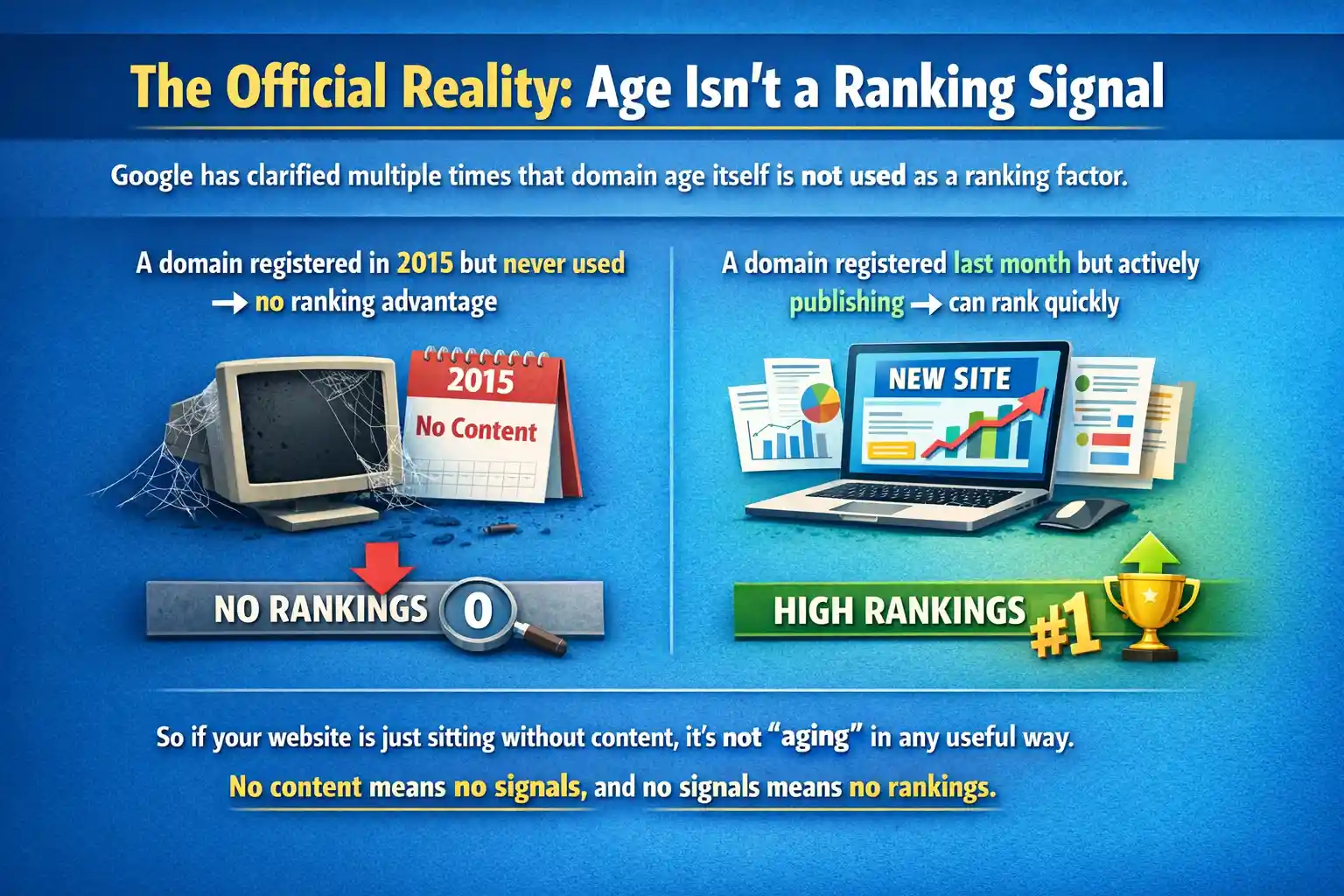
Google has clarified multiple times that domain age itself is not used as a ranking factor.
A domain does not gain authority just by sitting idle.
For example:
- A domain registered in 2015 but never used → no ranking advantage
- A domain registered last month but actively publishing → can rank quickly
So if your website is just sitting without content, it’s not “ageing” in any useful way.
No content means no signals, and no signals means no rankings.
What Actually Matters More Than Domain Age
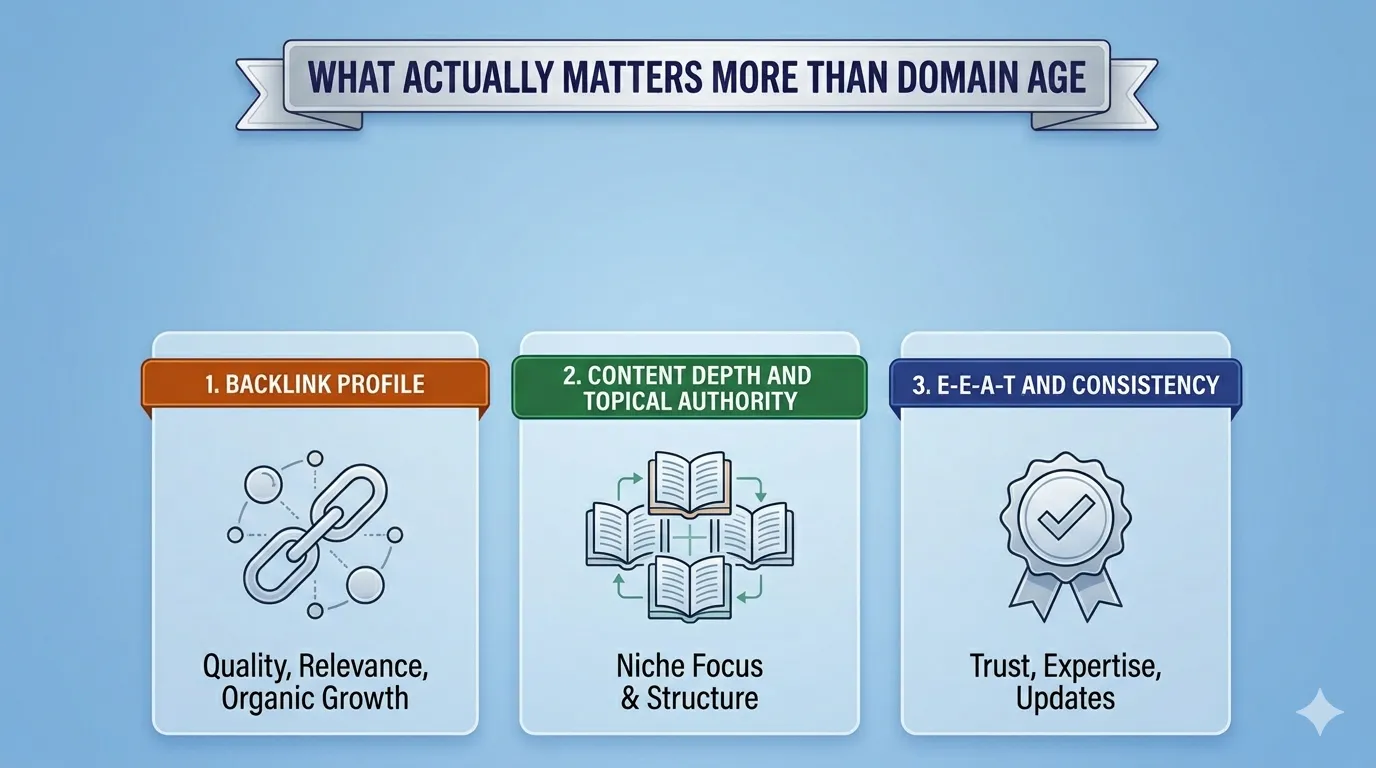
Instead of focusing on age, it’s better to understand what actually moves rankings today.
1. Backlink Profile
Backlinks are one of the strongest signals, but again, they are earned—not inherited through age.
Older sites often have more links simply because they’ve had more time, but what really matters is the following:
- The quality of links, not the number
- Whether links come from relevant websites
- Whether links are built naturally over time
A new site with a few strong and relevant backlinks can easily compete with an older site that has weak or spammy links.
2. Content Depth and Topical Authority
This is where many older websites gain an advantage, but it’s not something a new site cannot achieve.
A strong website today usually has:
- Content focused around a specific niche
- Multiple articles connected to each other
- Clear structure showing expertise on one topic
But here’s the shift happening now:
A new website that publishes 10–20 high-quality, connected articles in a short time can build topical authority faster than an older site that posts randomly.
3. E-E-A-T and Consistency
Google looks at overall trust, which comes from:
- Experience
- Expertise
- Authority
- Trust
These are not given because of domain age. They are built through:
- Regular publishing
- Useful and accurate content
- Consistent updates
A website that keeps improving is seen as more trustworthy than one that simply exists—credentials alone don’t build that trust
Domain Age vs Content Age
Most people focus on domain age, but what actually matters more is content freshness and updates.
Here’s a simple comparison:
| Feature | Impact on Rankings |
|---|---|
| Domain Registration Date | Almost no impact |
| First Indexed Date | Low impact |
| Content Freshness | High impact |
| Last Updated Date | Very high impact |
| Backlink Age | Medium impact |
What this metric means in simple terms:
- A fresh and updated article can beat an old outdated one
- Google prefers current and relevant information
- Keeping content updated is more important than how old your domain is
The “Sandbox” Myth — Let’s Address It Clearly
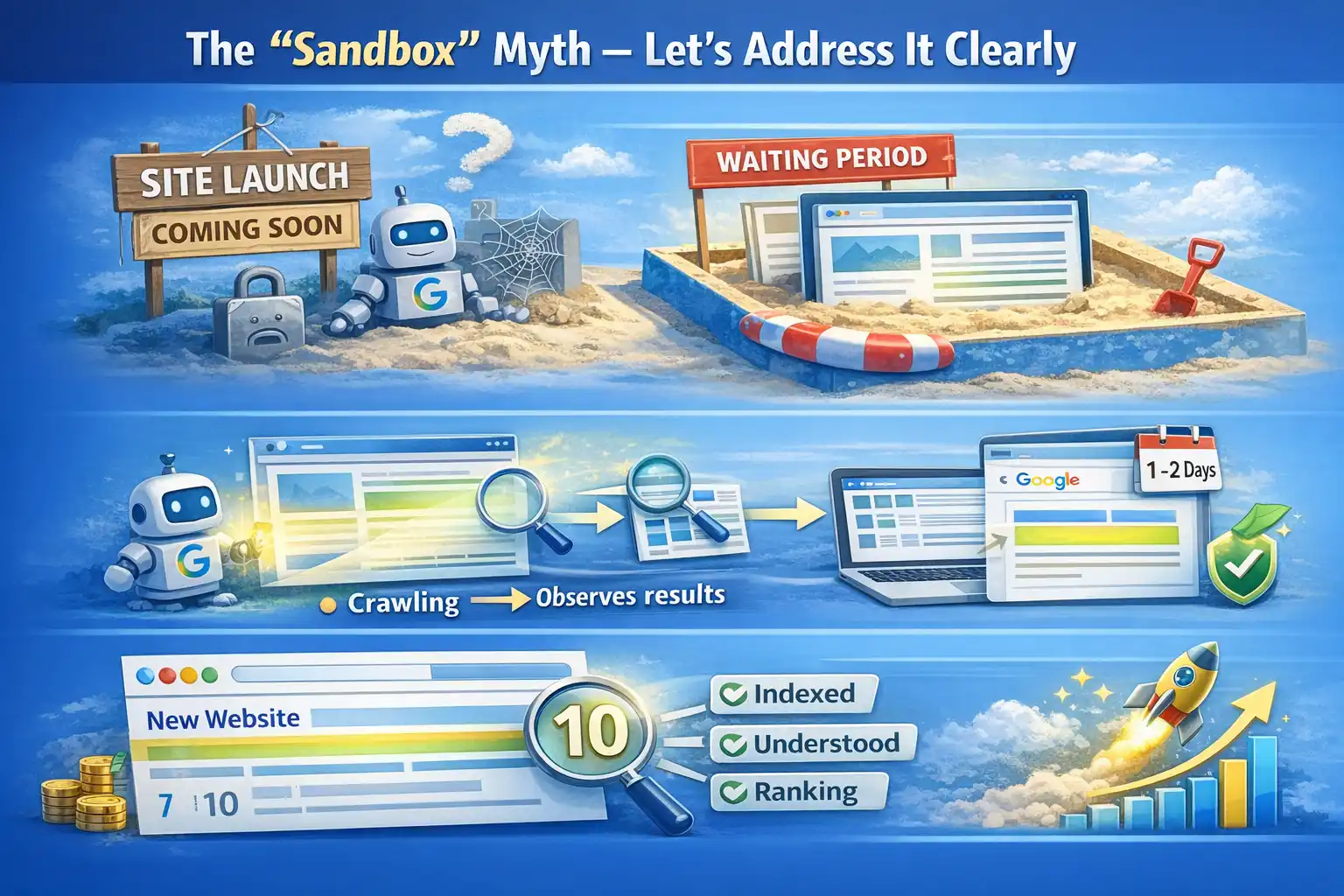
There’s a strong belief that new websites are held back for months.
But in reality, there is no fixed “waiting period”.
Google does not block new domains automatically. If your website is not appearing for domain name it is another problem.
What actually happens:
- Google crawls your website
- It tries to understand your content
- It observes how users interact with your pages
If your website is well-built and active, you can:
- Get indexed within 1–2 days
- Start appearing in search results quickly
- Even rank on deeper pages early
And this is important to understand:
Ranking on Page 10 in the first few days is a success signal. In fact, this early visibility is often part of how Google tests new content—if you’ve ever noticed pages ranking briefly and then dropping, here’s a clear explanation of why new pages rank then disappear.
It means:
- Your site is indexed
- Google understands your topic
- You are part of the ranking system
From there, growth depends on consistency.
Why Some New Sites Feel “Stuck”
This usually has nothing to do with age.
It’s mostly about slow or unclear execution.
Common mistakes:
- Publishing very slowly
- No clear topic or niche
- No internal linking
- No updates after publishing blog
- Not complete website yet or slow creation
When a site behaves like this, Google treats it as low priority.
⚡ The “Day 2” Reality (What Actually Works)
If you take a more active approach, results can come much faster.
Comparison:
| Approach | Result |
|---|---|
| 1 blog every 2 weeks | Slow growth |
| 5–10 blogs at launch | Faster recognition |
| No traffic signals | Weak trust |
| Early traffic + engagement | Strong signals |
A technically clean website with good content can start ranking quickly, even if it is new.
When Domain Age Becomes a Disadvantage
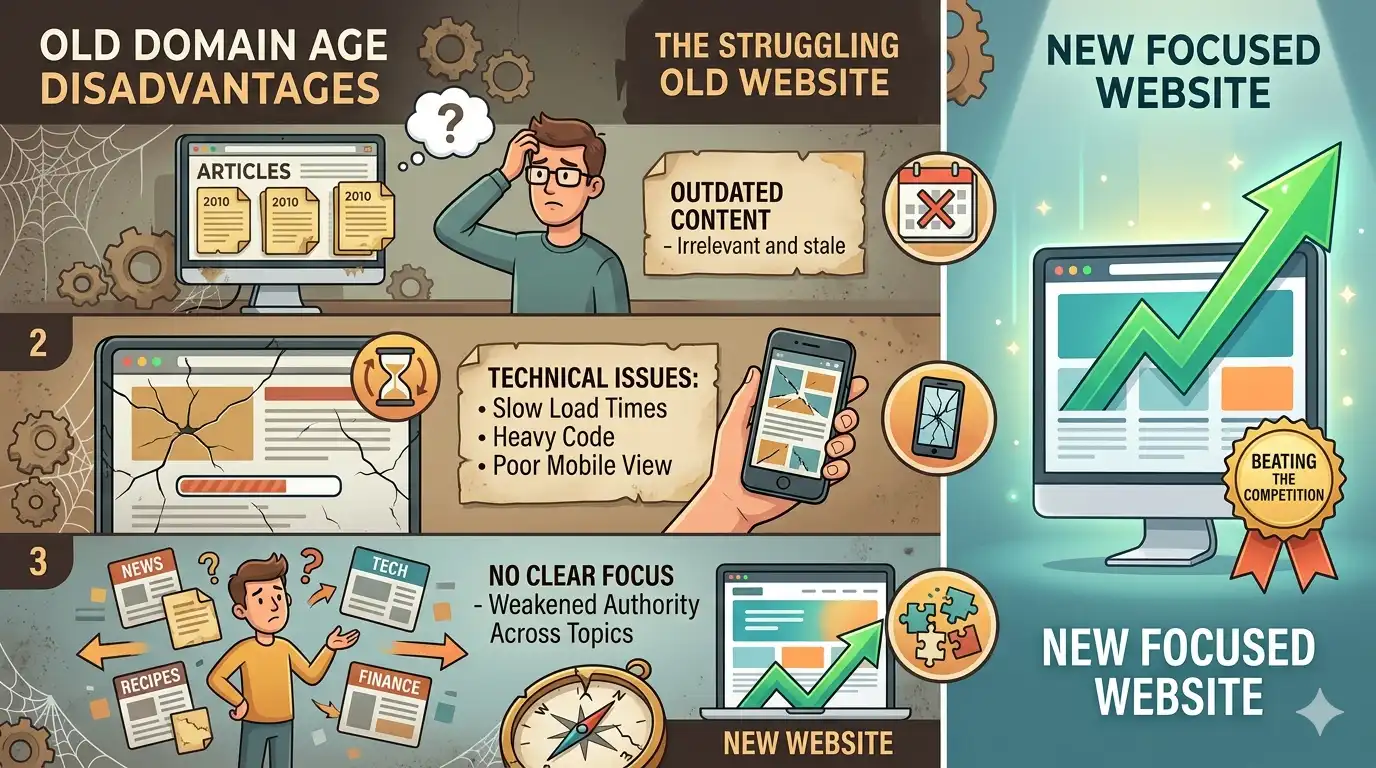
This is something many people ignore.
Being old is not always an advantage.
Older sites often struggle because:
1. Outdated Content
Content becomes irrelevant if not updated regularly.
2. Technical Issues
Old websites often have:
- Slow speed
- Heavy themes or plugins
- Poor mobile experience
3. No Clear Focus
Trying to cover too many topics weakens authority.
A new focused website can easily beat this.
There Are Many Old Websites That Don’t Rank at All
This is the strongest proof that domain age alone does not work.
You can find many domains that are 5–10 years old but still get no traffic.
Common reasons:
- No consistency in publishing
- Content is not updated
- No clear niche or direction
- No topical authority
- Low-quality content
- Stopped publishing after not seeing results
These sites had time, but they didn’t use it properly.
Many New Websites Start Ranking in 1–2 Months
This is happening more often now, especially when the basics are done right.
Why new sites succeed quickly:
- Technically strong website (fast, clean structure)
- Faster loading speed
- High-quality and updated content
- Consistent publishing
- Publishing even when not ranking (this shows long-term intent)
- Clear topical authority from the start
Google is not just checking content—it is also observing behavior.
Consistency and patience send strong signals.
My own website is only 2 months when I write this blog but still ranking for many keywords and got 300-400 impressions with 2-3 clicks daily which shows that Google start trusting my website.
📈 Practical Step: The “30-Day Authority Sprint”
If you are launching a new domain, here’s a practical framework: publish 8-12 pillar articles around one core topic within the first 30 days. Interlink them strategically. Use internal links from day one. Submit your sitemap to GSC. Within weeks, Google recognizes your topical focus and often boosts rankings faster than aged but inactive domains. Try this: pick a micro-niche, write 5 detailed guides, link them contextually, and track impressions after 14 days — you’ll see the difference.
The Real Concept: Domain Reputation, Not Domain Age
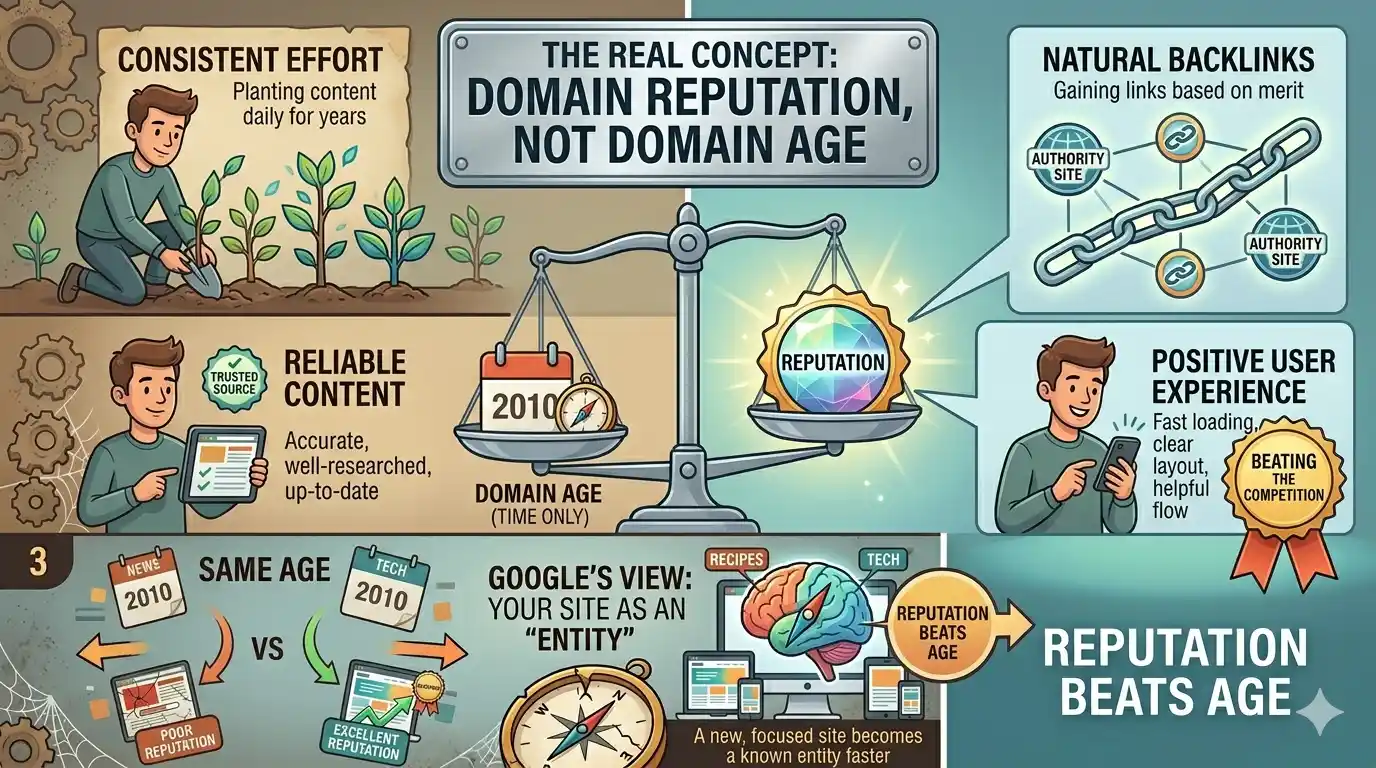
Instead of thinking about age, it’s better to think about reputation.
Age only gives you time to build that reputation.
Reputation is built through:
- Consistent effort
- Reliable content
- Natural backlinks
- Positive user experience
Two domains can have the same age but completely different results because their reputation is different.
Google now doesn’t just see your site as a URL, it starts treating it like an “entity” once it understands what you’re about. A new site can become a known entity much faster if it sticks to a clear niche instead of trying to cover everything.
The “Trust Compound” Effect
Trust builds slowly, but once it builds, it helps everything you publish later.
If your website:
- Publishes regularly
- Maintains quality
- Gains stable backlinks
Then over time:
- Your content gets indexed faster
- Rankings improve more easily
- Google trusts your future content more
But again, this comes from activity, not just age.
See how trust signals works across multiple pages
Strategy: What You Should Focus On
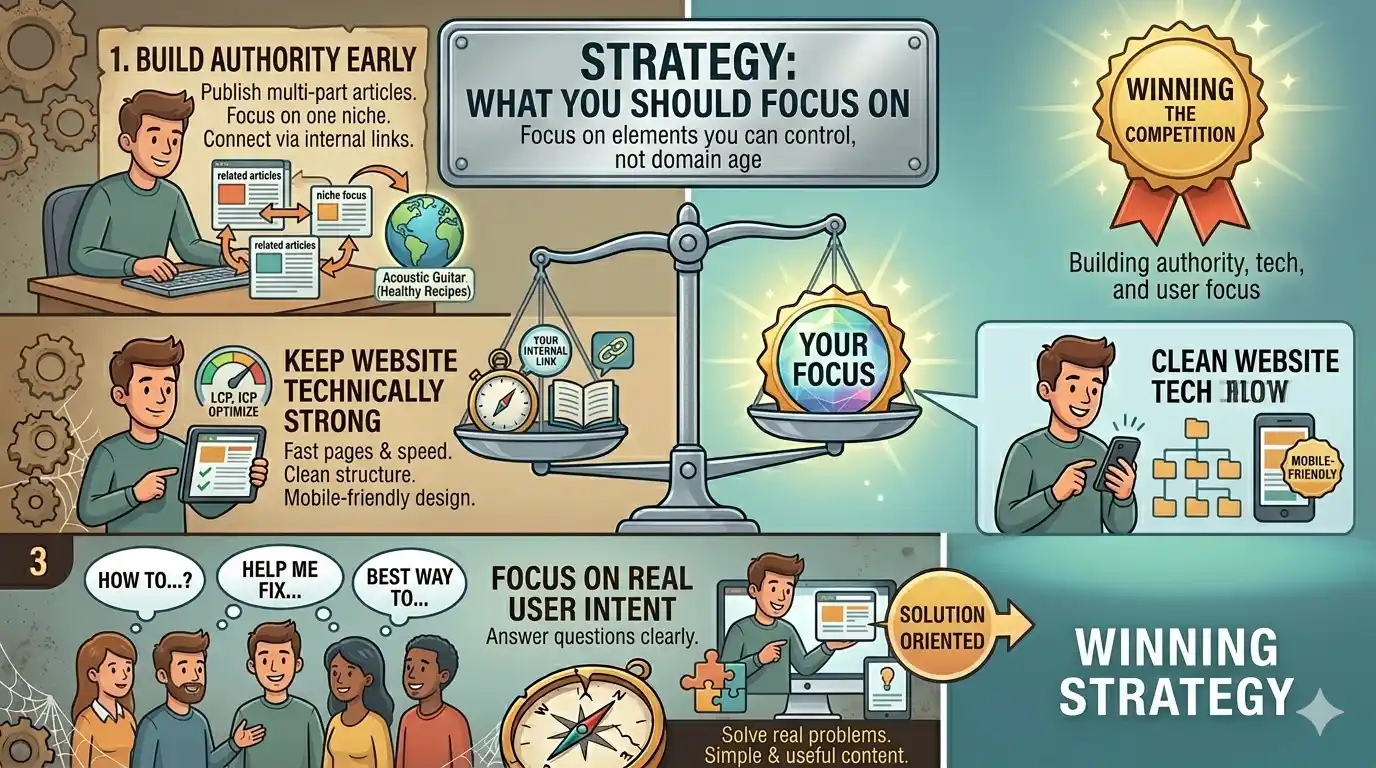
If you are starting a new website, don’t worry about how old your domain is.
Focus on things you can control.
1. Build Authority Early
- Publish multiple related articles
- Focus on one niche
- Connect content through internal links
2. Keep Website Technically Strong
- Fast loading pages and speed (LCP, ICP) optimize
- Clean structure
- Mobile-friendly design
3. Focus on Real User Intent
- Answer questions clearly
- Solve real problems
- Keep content simple and useful
The Final Verdict
Domain age is not a ranking factor.
It does not give you automatic advantage.
It only reflects how long you had the chance to build something.
A new website with strong execution can outperform an old website that has stopped improving.
One Clear Takeaway
Stop thinking:
“How old is this domain?”
Start thinking:
“What has this website actually done over time?”
That is what Google measures, and that is what decides rankings today.
— trust grows in systems, not silos —
 Add Content Decoded as a preferred source