
Is Your Website Spammy? The Warning Signs Most Site Owners Miss
There is no single thing that makes a website spammy. Instead, spammy websites usually show a pattern of warning signs such as copied content, low-effort AI articles, intrusive ads, deceptive design, hacked pages, expired domain abuse, parasite SEO, or large amounts of mass-produced content.
A website does not have to trigger every sign to be considered low quality. Even a few of these issues can create a poor experience for visitors and damage a site’s visibility in search results.
Many website owners don’t notice these problems at first because their pages may still be indexed and receiving traffic. However, as search systems become better at identifying low-quality experiences, these warning signs become much harder to ignore.
The User-First Principle Behind Modern Search
At the core of Google’s quality guidelines is a simple principle: put the user first. There is nothing wrong with making money from a website through advertising, affiliate marketing, or sponsored content. Most successful websites do exactly that.
The difference is how that money is earned. A high-quality website creates value for visitors first and monetises that value responsibly. A spammy website does the opposite, putting revenue ahead of user experience.
Helpful Website
Publishes useful guides, practical tools, and original insights while maintaining a reasonable advertising experience.
Low-Value Website
Fills pages with intrusive popups, excessive distractions, and content that provides little value to visitors.
Both websites are trying to generate revenue. The difference is that one genuinely helps its audience while the other prioritizes monetization over user experience. This distinction plays a major role in how search engines evaluate website quality today.
How Google Decides Whether a Website Is Spammy
Many people think Google automatically labels a page as spam and removes it from search results. That isn’t how the process works.
Google uses a combination of automated systems and human feedback. The company employs Human Search Quality Raters whose job is to review search results and evaluate whether pages are genuinely helpful or low quality.
These raters cannot directly change rankings or remove websites from Google. Instead, their feedback helps Google improve its ranking systems so they can better identify low-quality content in the future.
When reviewing a webpage, raters look for signs that suggest the page exists mainly for rankings, clicks, or revenue rather than helping users. Some of the common signs they investigate include:
- Unoriginal or copied content
- Low-effort AI-generated pages
- Aggressive advertising
- Deceptive design
- Hacked pages
- Expired domain abuse
- Site reputation abuse (Parasite SEO)
- Mass-produced content
To verify their findings, raters may compare content with other websites, search for copied text, and even check a domain’s history to understand how it has changed over time.
The warning signs explained below are some of the most common reasons a page may be considered spammy or low quality.
Sign #1: Your Content Adds Nothing New
One of the most common reasons websites struggle today is because their content doesn’t offer anything new. Many site owners search for a topic, review the top-ranking pages, and publish a rewritten version of the same information. The title, headings, and wording may change, but the value remains largely the same.
This becomes a problem because the article doesn’t provide any additional value beyond what already exists. Good content doesn’t need groundbreaking research, but it should provide some form of information gain by adding something useful to the conversation.
Examples include:
- Personal experience
- Real-world examples
- Original opinions
- Case studies
- Updated information
- Clearer explanations
A simple test is to ask yourself: if this article disappeared tomorrow, would readers lose anything valuable? If the answer is no, the content may not be providing enough value. The websites that perform best over time are usually the ones that contribute something useful rather than repeat what already exists.
Sign #2: AI Is Writing Everything and You’re Barely Editing
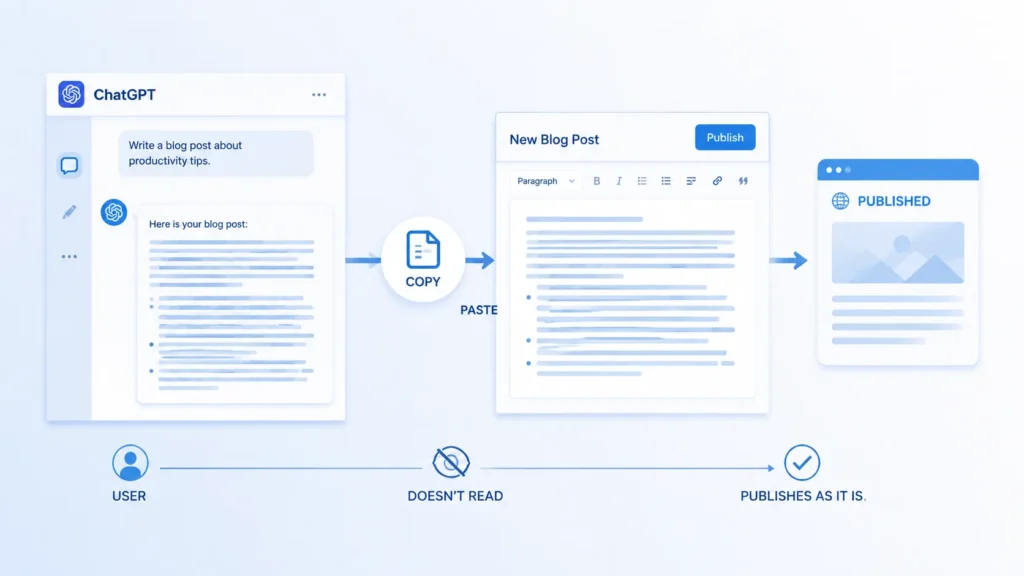
AI has become part of content creation, and there is nothing wrong with using it as a tool.
The problem starts when website owners let AI do all the work without adding any human input.
Many articles today are generated in minutes and published immediately. They contain information that is already available on hundreds of other websites.
The content may be readable and grammatically correct, but it often lacks originality, experience, and unique value. The issue isn’t the use of AI itself; it’s publishing the draft with little editing, fact-checking, or additional input from a real person.
Good content usually involves:
- Fact checking
- Editing
- Adding personal knowledge
- Including examples
- Improving clarity
- Updating outdated information
AI can help create a draft, but readers still expect useful information that feels genuine and helpful.
If every article sounds generic and interchangeable, visitors will quickly notice.
Sign #3: Your Ads Are Ruining the Experience
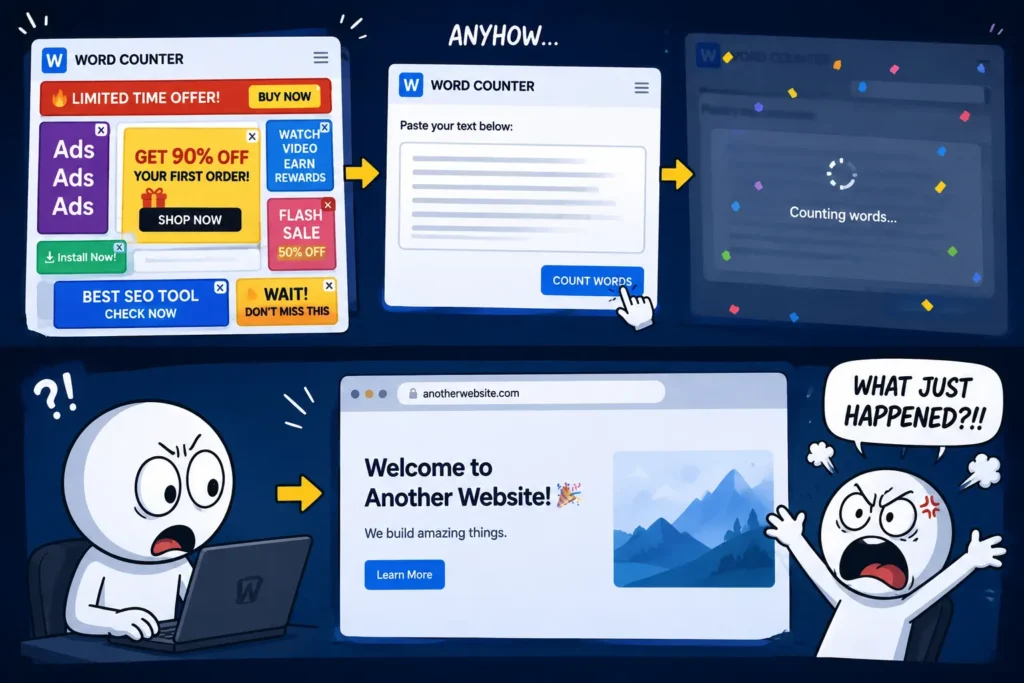
Ads help many websites stay profitable, and most visitors understand that. The problem starts when advertisements make it difficult to access the content or tool they came for.
Imagine This Scenario
A visitor opens a word counter tool to quickly check a document. Instead of using the tool immediately, they encounter several obstacles before they can access the feature they came for.
Instant Popup
A large popup appears the moment the page loads.
Excessive Banner Ads
Multiple ads push the actual tool below the fold.
Autoplay Videos
Videos start automatically and distract from the page’s purpose.
Blocked Controls
Ads cover buttons, forms, or important input fields.
Misleading Clicks
Clicking the main button opens an advertisement instead of performing the expected action.
When visitors must fight through distractions before accessing the content or tool they need, the page creates frustration rather than value. Search engines increasingly consider these experiences when evaluating page quality.
The same issue can occur with blog posts, where visitors must close popups, scroll past large ads, or deal with constant interruptions before reaching the actual content. When accessing the content becomes more difficult than it should be, the website can quickly start feeling spammy.
When ads become more important than the content itself, a website begins to feel spammy. A simple rule is to keep the content as the main focus and use ads to support it, not compete with it.
Sign #4: Your Website Uses Deceptive Design
Some websites intentionally mislead users, while others create confusing experiences without realising it. Either way, visitors lose trust.
Deceptive design happens when a website encourages users to take one action but secretly does something else. Instead of helping visitors achieve their goal, the page tries to generate clicks, ad revenue, or other benefits for the website owner.
Common examples include:
- Download buttons that are actually advertisements.
- Tool buttons that redirect users to another website.
- Fake notifications or warning messages.
- Misleading links that lead somewhere unexpected.
- Confusing popups designed to trick users into clicking.
- Back-button hijacking, where pressing the browser’s back button opens another page or prevents visitors from leaving normally.
Imagine clicking a button labelled “Start Tool” and being sent to a completely different website. Most users would feel tricked. The same applies when visitors try to leave a page but are repeatedly redirected elsewhere instead.
A website should always be clear about what each button, link, or action does. Visitors should never be surprised after clicking something, because trust is difficult to build and very easy to lose.
Sign #5: Your Site Has Been Hacked
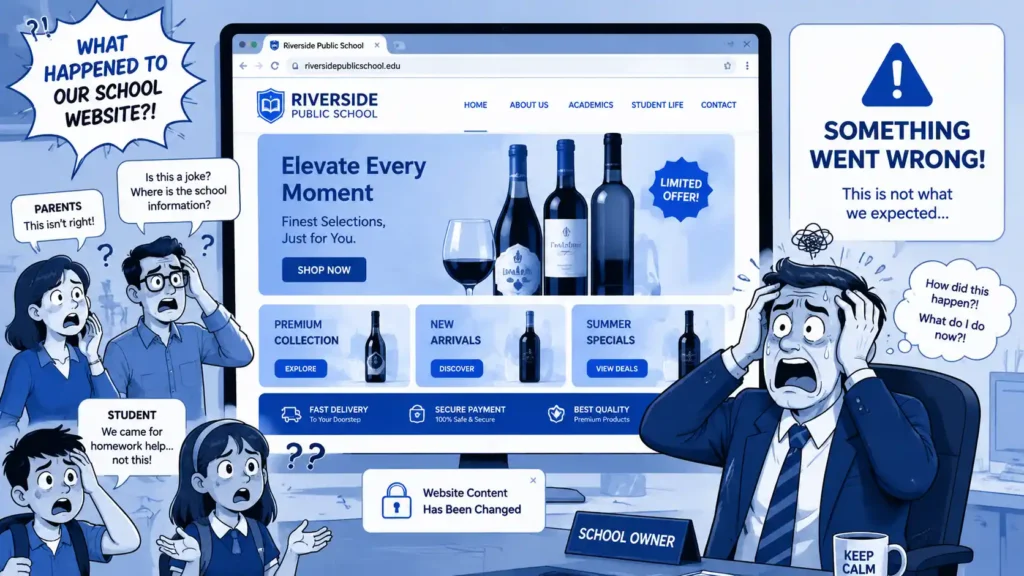
Many website owners assume hacked websites are only a security issue.
In reality, they are also a quality issue.
When a website gets hacked, visitors no longer receive the experience they expected.
Imagine someone visits a school website looking for school information.
Instead, they find:
- Gambling advertisements
- Suspicious links
- Fake products
- Malware downloads
The visitor doesn’t know who is responsible.
They only know that the website is unsafe.
Because of this, hacked pages are treated very seriously.
Website owners should regularly:
- Update plugins and software
- Monitor unusual activity
- Use secure hosting
- Enable security protections
- Check Google Search Console for warnings
Keeping a website secure protects both visitors and your reputation.
Sign #6: You Bought an Expired Domain for Rankings
Buying expired domains used to be a popular shortcut in SEO.
The idea was simple.
Purchase a domain that already has authority and use its history to gain rankings more quickly.
The problem appears when the new website has nothing to do with the old one.
Imagine an educational website that existed for years.
The domain expires.
A new owner buys it and turns it into a casino affiliate website.
Visitors expecting one thing suddenly find something completely different.
This creates a trust problem.
Search engines want websites to be relevant and consistent. When a domain changes direction completely, especially for ranking purposes, it can raise concerns about quality and authenticity.
Building a brand naturally takes longer, but it creates a much stronger foundation over time.
Sign #7: Your Entire Site Feels Mass-Produced
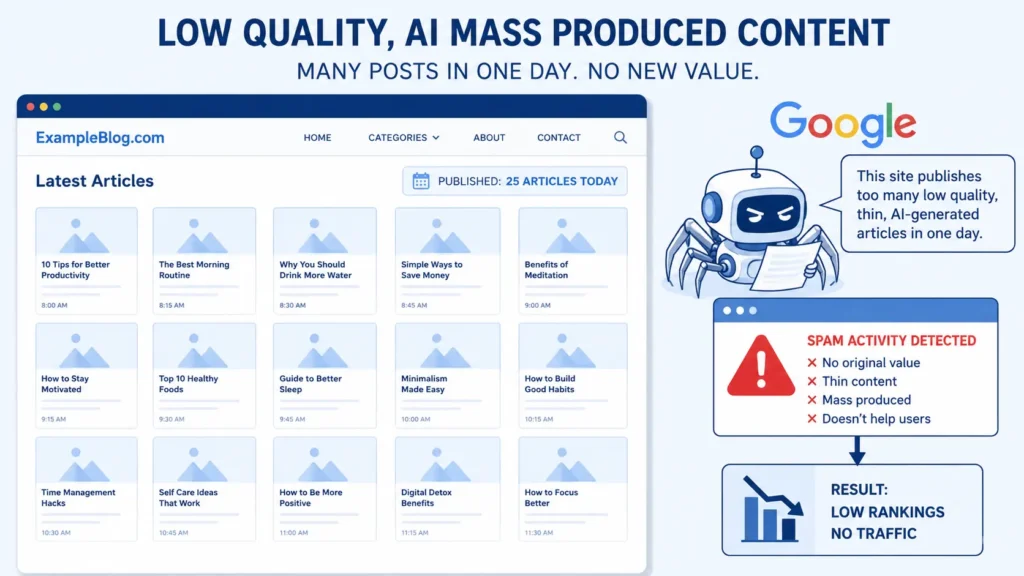
Sometimes a single article is not the problem.
The problem is the overall pattern across the website.
When every page follows the exact same structure, uses the same writing style, and offers very little unique information, the site can start to feel manufactured rather than helpful.
Signs of mass-produced content often include:
- Large numbers of similar articles
- Repetitive introductions
- Generic advice
- Little expertise
- Thin content across many pages
Visitors may not notice this on one page.
But when search engines evaluate the website as a whole, these patterns become much easier to spot.
A smaller website with genuinely useful content is often more valuable than a huge website filled with repetitive articles.
Quality matters far more than quantity because taking a few days’ break from publishing won’t cause your rankings to drop.
Sign #8: You’re Publishing Third-Party Content Just for Rankings
Some websites allow outside companies or writers to publish content on their domain simply to take advantage of the website’s reputation and authority.
This becomes a problem when the content has little connection to the website’s main purpose and exists mainly to rank in search results.
For example, a trusted news website publishing casino reviews, loan offers, or coupon pages created by third parties may raise quality concerns if the content is not properly reviewed or genuinely useful to its audience.
Common warning signs include:
- Content that has nothing to do with your website’s main topic.
- Pages created mainly to target search traffic.
- Third-party articles with little editorial review.
- Sponsored content that provides little value to readers.
- Sometimes it creates contradictions across your website
Publishing guest posts or sponsored content is not automatically a problem. The issue starts when outside content is added mainly to benefit the publisher rather than the people visiting the website.
If a page would not make sense for your regular audience, it probably should not be there in the first place.
How to Make Your Website Spam-Free
The good news is that most spam signals can be fixed by focusing on one thing: creating a website that genuinely helps visitors.
You don’t need complicated SEO tricks. Instead, follow a few simple principles:
Create Original Content
Publish unique content instead of rewriting what already exists.
Add Real Value
Include your own insights, examples, research, or experiences whenever possible.
Stay Topically Focused
Cover subjects that align with your website’s primary purpose and audience.
Use AI Responsibly
Use AI as a productivity tool while keeping human review, editing, and expertise involved.
Protect User Experience
Ensure ads, popups, and banners do not interfere with the main content.
Maintain Content Quality
Remove guest posts or third-party content that offers little value to visitors.
Keep Your Website Secure
Use HTTPS, reliable hosting, regular updates, backups, and security monitoring.
Monitor Site Health
Review Search Console regularly for security alerts, indexing issues, or manual actions.
Avoid Risky Shortcuts
Stay away from expired domain abuse, copied content, and mass-produced low-value pages.
Focus on helping visitors first. Websites that consistently provide useful information, a good user experience, and trustworthy content are far more likely to succeed over the long term.
A simple rule to remember is this:
If a page helps visitors more than it helps you, you’re usually moving in the right direction. If it exists mainly to gain traffic, clicks, or revenue, it may eventually become a quality problem, and it creates the problem of ranking on Day 2, but then the ranking drops after some days.
The safest long-term strategy is to build a website that people would still find useful even if search engines didn’t exist.
The Hidden Signal Most Site Owners Ignore
Many website owners spend a lot of time focusing on algorithms while overlooking something equally important: how real people react to their website. User satisfaction is one of the strongest indicators of quality because it reflects whether visitors actually found the page useful.
Think about what happens after someone clicks a search result. If they leave almost immediately because the content is disappointing, confusing, or difficult to use, that sends one signal. If they stay, read the content, explore other pages, and return in the future, that sends a very different signal. Useful websites naturally earn attention, engagement, and repeat visitors.
While no single metric determines quality, websites that consistently satisfy users tend to perform better in the long run than websites focused only on technical tricks or short-term SEO tactics.
How to Tell if Your Website Is Becoming Spammy
The easiest way to identify problems is to review your website honestly.
Ask yourself these questions.
Content
- Does the content offer something original?
- Is there genuine expertise behind it?
- Would readers learn something useful?
User Experience
- Can visitors access the main content immediately?
- Are advertisements reasonable?
- Is the website easy to use?
Trust
- Is the site secure?
- Are facts accurate?
- Is there clear information about who created the content?
Purpose
- Was this page created to help users?
- Or was it created mainly to attract traffic?
The answers usually reveal where improvements are needed.
The Future of Search Makes This Even More Important
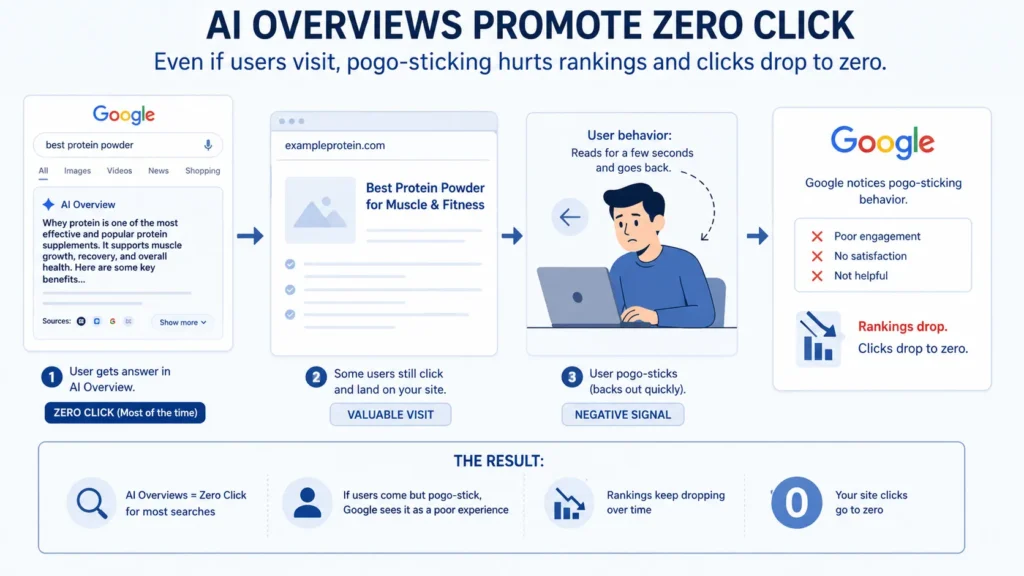
Search is changing quickly.
AI Overviews and other search features mean users often get answers directly within search results.
As a result, fewer people click through to websites.
This means every visit matters more than before.
When someone chooses your website, they expect a good experience.
If they find:
- Generic content
- Excessive advertising
- Poor usability
- Misleading design
- Website not mobile-ready
They are unlikely to stay.
The websites that continue growing are usually the ones that provide something genuinely useful that cannot be easily replaced.
Those sites give visitors a reason to choose them over countless alternatives.
Your Actionable Checklist to Avoid the “Lowest” Rating
Based on your brilliant summary, here is the ultimate webmaster checklist to guarantee your site always stays in Google’s good graces:
| Category | What to Do (Your Framework) | Why Google Rewards It |
| UX & Ads | Keep the tool or article completely unobstructed. Never let pop-ups cover the text entry boxes or buttons. | Fulfills the page’s true purpose seamlessly. |
| Content Creation | Write with Information Gain. Add a personal case study, a unique statistic, or an original quote to every article. | Signals original effort and unique human insight. |
| Niche Focus | Stick rigidly to your website’s main theme. Say “no” to trendy keywords that don’t match your brand. | Builds undeniable Topical Authority. |
| Security | Pair a reliable host with automated security scanning and Google Search Console alerts. | Protects the user from malware and malicious redirects. |
| Domain Strategy | Build a brand from scratch, or deeply audit a domain’s history on the Wayback Machine before buying. | Avoids triggering algorithmic “Expired Domain Abuse” flags. |
Final Thoughts
Most spammy websites become spammy gradually when their focus shifts from helping visitors to chasing traffic, clicks, or revenue.
A simple question can help evaluate any page:
If this page disappeared tomorrow, would people lose something valuable?
If the answer is yes, you’re likely creating something worthwhile. If not, there is probably room for improvement.
The best strategy is still the simplest: create useful content and put visitors first.
 Add Content Decoded as a preferred source