First Principles Theory in SEO: What It Is and How to Use It
Most SEO advice starts with tactics: use the right keywords, build backlinks, improve page speed, add schema, or write 2,000 words. First-principles thinking starts somewhere else by asking a more basic question: Why does a search engine exist in the first place?
The answer is simple. People use search engines because they have a question, problem, or goal they want to solve. They search for something, and the search engine tries to connect them with the most useful result.
Once you understand this, SEO becomes much simpler. Instead of starting with a list of SEO tactics, you start by understanding what the person is looking for and how your website can give them the best possible answer.
What Is First Principles Thinking in SEO?
First principles thinking means breaking a problem down to its most basic truths instead of following existing rules or common practices.
In SEO, it starts with three things:
- The person searching has a need.
- Your website can solve that need.
- The search engine wants to connect the person with the best useful result.
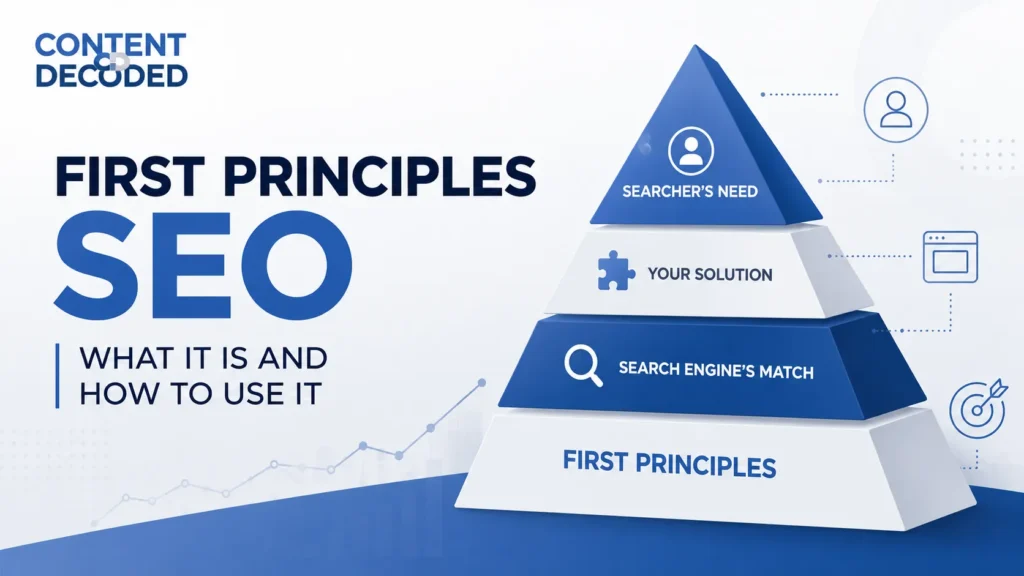
So the basic SEO relationship is:
Searcher’s need → Your solution → Search engine’s match
Everything else is there to support this.
Keywords, content, links, page speed, website structure and other SEO practices matter because they help search engines understand, trust, access, or deliver your solution.
It is actually Natural SEO where we do SEO completely naturally without artificial or forced tactics.
That is the foundation.
The First Principle of SEO
The first principle is simple: understand what the searcher wants and give them the best possible solution.
It is not about writing the longest article, using the most keywords, or adding the most SEO tricks. It is about creating the page that best solves the searcher’s need.
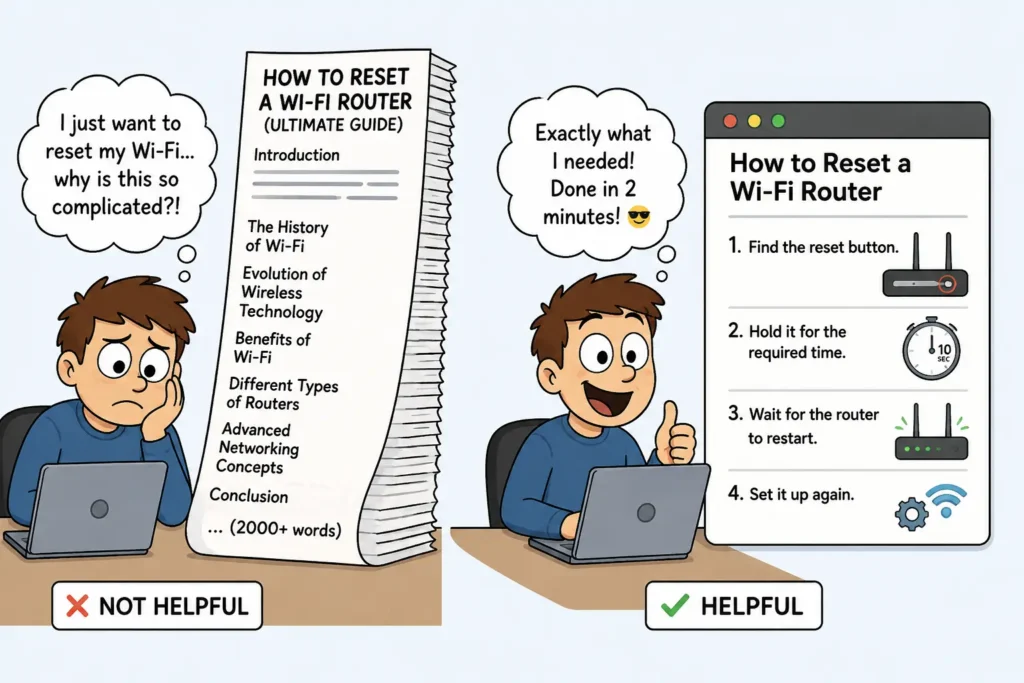
For example, someone searches: “How to reset a Wi-Fi router”
They probably don’t need a 2,000-word article about the history of Wi-Fi.
They need clear steps:
- Find the reset button.
- Hold it for the required time.
- Wait for the router to restart.
- Set it up again.
If your page gives them exactly that, you have solved the real problem.
Why First Principles Matter in SEO
First Principles matter in SEO because if you don’t understand the customer’s final goal or user intent, you have already lost. No amount of keywords, links, or SEO can fix a page that does not solve what the customer actually wants.
SEO changes constantly. Tools, search features, algorithms, and tactics all change over time, with new approaches becoming popular while older ones stop working.
But the basic reason people use search does not change. People search because they want something.
They may want to:
- Learn something
- Find a product
- Compare options
- Solve a problem
- Find a business
- Complete a task
- Make a decision
Your job is to understand that need and serve it better than competing pages.
This gives you a strategy that does not depend on chasing every new SEO trend.
How to Apply First Principles to SEO
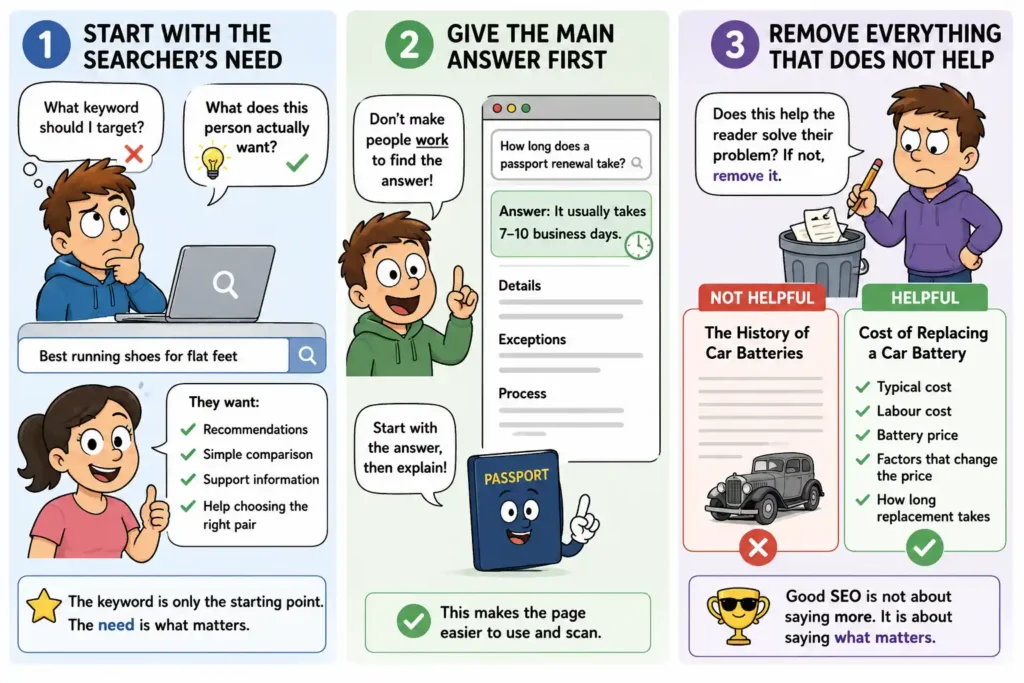
1. Start With the Searcher’s Need
Don’t start with “What keyword should I target?” Start with “What does this person actually want?”
Take the search “Best running shoes for flat feet.” The person may want recommendations, a simple comparison, support information, and help choosing the right pair.
The keyword is only the starting point. The need is what matters.
2. Give the Main Answer First
Don’t make people work to find the answer. Put the most important information where they can see it quickly.
If someone searches “How long does a passport renewal take?”, start with the answer, then explain the details, exceptions, and process below it. This makes the page easier to use and scan.
3. Remove Everything That Does Not Help
Adding more information does not automatically create more value. Ask yourself about every section: Does this help the reader solve their problem? If not, remove it.
For “Cost of replacing a car battery,” the reader probably needs:
- Typical cost
- Labour cost
- Battery price
- Factors that change the price
- How long replacement takes
They probably don’t need a long history of car batteries.
Good SEO is not about saying more. It is about saying what matters.
The Four Parts of SEO Through First Principles
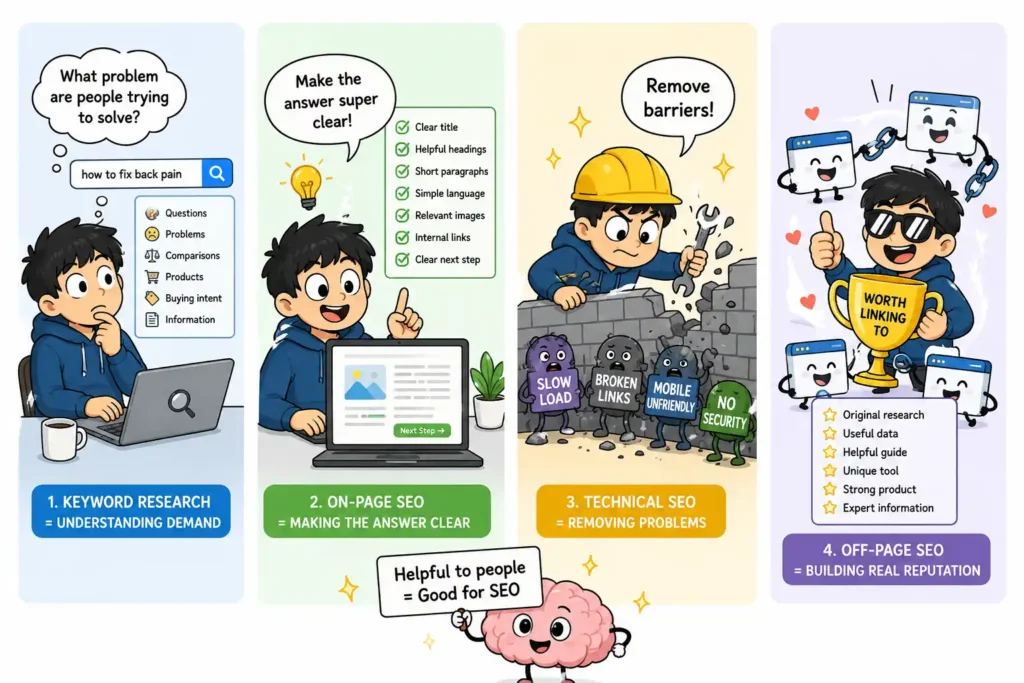
First principles also make the main areas of SEO easier to understand.
1. Keyword Research = Understanding Demand
Keyword research is not just about finding high-volume keywords. It is about understanding what people want, including the questions they ask, problems they have, products they want, comparisons they make, and information they need before buying.
Instead of asking “Which keyword has the most searches?”, ask “What problem are people trying to solve with this search?” That question usually leads to better content.
2. On-Page SEO = Making the Answer Clear
On-page SEO is simply about making your page easy to understand. That means:
- A clear page title and H1
- Short paragraphs
- Helpful subheadings
- Simple language
- Relevant images
- Useful internal links
- A clear next step
Your page should make sense to a person before you worry about how it looks to an SEO tool. Think of it as a conversation: the searcher asks a question, and your page answers.
3. Technical SEO = Removing Problems
Technical SEO sounds complicated, but the basic idea is simple: make sure your website works properly.
People should be able to:
- Open your pages
- Get pages loaded fast without wasting time
- Use your site on mobile
- Move between pages
- Find what they need
- Complete important actions
- Trust that the site is secure
Search engines also need to discover and understand your pages. Technical SEO is mainly about removing barriers so neither the user nor the search engine has to fight with your website.
4. Off-Page SEO = Building Real Reputation
Links from other websites can help show that your website is useful and trusted. But instead of chasing backlink numbers, ask: “Why would another website want to mention or link to me?”
The answer should be because you created something worth mentioning, such as:
- Original research
- Useful data
- A helpful guide
- A unique tool
- A strong product
- Expert information
- Something genuinely worth referencing
The goal is not to collect links. The goal is to become worth linking to.
Know here: How To Get Natural Backlinks Without Manual Link Building
What Happens When Competitors Are Similar?
Sometimes several websites provide a good answer. So what makes one result better than another?
Think about the total experience.
1. Relevance
Does the page actually answer the search?
2. Clarity
Can the person understand the answer quickly?
3. Usefulness
Does the page give them enough information to take the next step?
4. Trust
Can they see why they should believe the information?
5. Experience
Is the website easy to use, accessible and free from unnecessary obstacles?
These are useful questions because they focus on the real purpose of SEO: Helping the right person find the right solution.
SEO Myths vs. Reality
Myth 1: You need 1,000+ words to rank
Reality: Word count does not decide whether a page ranks. If the reader gets a complete answer in 100 words, those 100 words can be enough. The goal is to satisfy the search, not hit a word count.
Myth 2: You need high DA/PA and lots of backlinks to rank
Reality: Backlinks can help, but quality matters more than quantity. Naturally earned links from relevant, trusted websites are valuable. Random or low-quality backlinks cannot replace useful, high-quality content.
Myth 3: You must use only one H1 or your page won’t rank
Reality: More than one H1 does not automatically stop a page from ranking. However, one clear H1 is usually best because it makes the main topic easier for both readers and search engines to understand.
Myth 4: You need a specific keyword density to rank
Reality: There is no magic keyword density. Use relevant words naturally where they help explain the topic. If a keyword feels forced, it is probably unnecessary.
Myth 5: You need a fixed number of internal links to rank
Reality: There is no perfect number of types of internal links. Add them when they genuinely help the reader find related information. If a link feels forced, you probably don’t need it.
Myth 6: More SEO optimisation always means better rankings
Reality: SEO should support the content, not get in its way. When optimisation becomes forced or distracts from the reader’s goal, it can make the page worse instead of better.
A Simple First-Principles SEO Process
You can use this process for almost any SEO project.
Step 1: Identify the search
What are people searching for?
Step 2: Understand the need
Why are they searching for it?
Step 3: Define the best answer
What would completely solve their problem?
Step 4: Build the simplest useful page
Give them the important information without unnecessary filler.
Step 5: Make it easy to use
Improve structure, speed, navigation, readability and accessibility.
Step 6: Add proof
Use real experience, evidence, examples, reviews, sources or other information that supports your claims.
Step 7: Make it discoverable
Use clear titles, headings, links and a sensible website structure so search engines can understand the page.
Step 8: Keep improving
Look for gaps, outdated information and questions the page still does not answer.
The First-Principles SEO Checklist
Before publishing a page, ask:
- What does the searcher want?
- Did I answer that need directly?
- Is the main answer easy to find?
- Did I remove unnecessary information?
- Is the page easy to read and scan?
- Does the information appear trustworthy?
- Can people easily take the next step?
- Can search engines discover and understand the page?
- Would I genuinely recommend this page to someone who asked this question?
That last question is especially useful.
If you would not recommend your own page to a real person, it probably needs more work.
The Core Idea
First-principles SEO can be reduced to one simple idea:
Don’t build a page to satisfy an SEO checklist. Build the best solution for the person searching.
Keywords help you understand what people are looking for. Content gives them the answer. Website structure makes that answer easy to find, while technical SEO removes barriers. Trust and reputation show that your solution is worth considering.
All of these work toward the same goal: helping the right person find and use the right solution.
That is the foundation of SEO. The tactics will keep changing, but the principle remains the same.
 Add Content Decoded as a preferred source