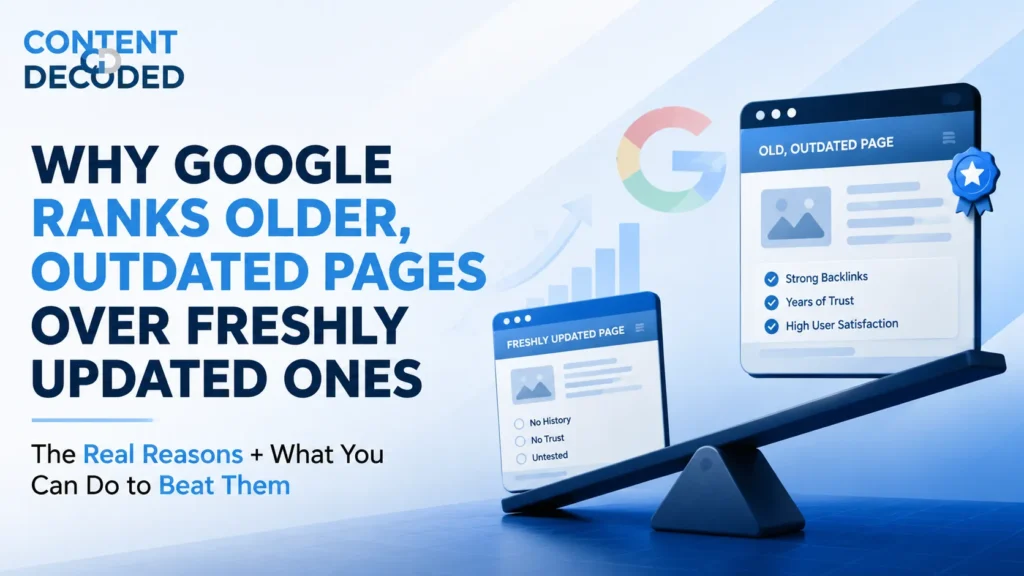
Why Google Ranks Older, Outdated Pages Over Freshly Updated Ones
You spend hours researching, rewriting, and improving a blog post. You add more details, better explanations, and fresh information. But when you check Google rankings, an old article written years ago is still sitting at the top.
This happens to almost every SEO professional and website owner.
The reason is simple: Google does not rank pages just because they are newer or because they have better writing. It relies heavily on trust, history, and proof that a page has already helped users.
Quick Summary
Google ranks old pages because they have built years of trust, authority, and proof that they satisfy users. To replace them, your content must give Google a stronger reason to trust you.
| Why Old Pages Keep Ranking | How to Overcome It |
| Years of backlinks, internal links, and historical trust | Improve the existing URL, build stronger internal links, and create content with more value |
| Evergreen topics create a closed SERP where freshness matters less | Find gaps in existing results and provide a significantly better answer |
| Small updates do not show enough improvement | Make meaningful changes with new sections, insights, data, and experience |
| New pages provide no information gain | Add original research, experiments, unique opinions, or practical examples |
| Competing against your own old pages | Consolidate content and use 301 redirects instead of keeping duplicate pages |
| Content does not match user intent | Focus on one search intent and solve the user’s problem quickly |
| Big websites dominate competitive keywords | Target zero-volume and long-tail topics where user demand exists but content is weak |
| New websites lack trust, especially in sensitive niches | Build authority slowly through expertise, real experience, and niche-focused content |
| AI can summarise generic information | Become a teacher by sharing unique knowledge, frameworks, tools, and real-world insights |
Here are the main reasons why older pages often beat freshly updated content in detail.
1. Old Pages Have Years of Trust and Authority
The biggest advantage of an old page is its history.
Over time, that page may have collected backlinks from other websites, gained strong internal links from its own website, and built a record of satisfying users.
Google has years of data showing that people clicked that page, stayed on it, and found useful answers. A new page has no such history.
From Google’s point of view, replacing a page that has worked well for years with an unknown page is a risk.
If users are happy with the old result, Google has little reason to change the ranking.
Check Now If Google trusts and knows your website or not.
2. Fresh Content Only Matters for Certain Searches
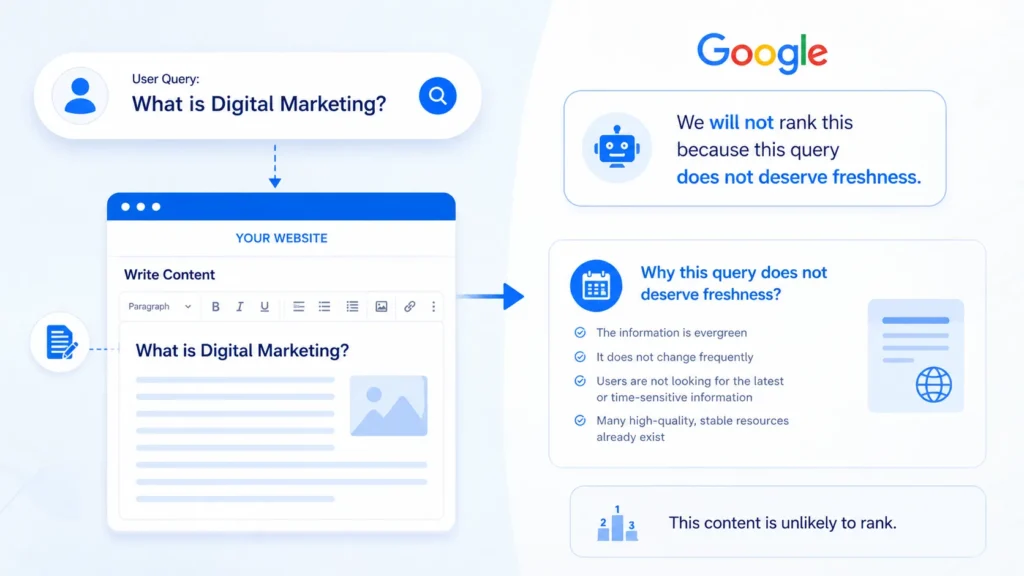
Many people believe Google always prefers new content, but that is not true.
Google gives importance to freshness mainly when the topic changes quickly, such as breaking news, new product releases, trends, or seasonal events.
For evergreen topics where the answer does not change much, Google usually trusts pages that have already proven themselves. These search results often become a “closed SERP,” where older trusted pages hold their positions for years because freshness has little impact on the accuracy of the answer.
For example, a page explaining a basic concept or a simple process can remain useful for many years. A new article will only replace it if it provides a much better experience and stronger value.
3. Small Updates Usually Do Not Change Rankings
Many website owners update a page by changing a few sentences, adding an image, fixing links, or changing the published date.
These are maintenance changes, not meaningful improvements.
Google looks for real improvements that make the content more useful today.
Adding new sections, including original research, sharing personal experience, answering missing questions, or improving the structure of the content can make a much bigger difference.
Simply making a page newer does not mean Google will treat it as a better result.
4. Your New Content May Have No Information Gain
One of the biggest reasons new pages fail is the lack of information gain. If your article repeats the same definitions, tips, and examples already ranking on Google, there is no reason for Google to replace those pages.
Ask yourself: “What does my content provide that users cannot find elsewhere?”
This could be your own experience, original data, unique insights, case studies, screenshots, experiments, or a better way of solving the user’s problem.
The goal is not to write longer content. The goal is to create content that offers something new and genuinely useful.
5. You Accidentally Compete With Your Own Page
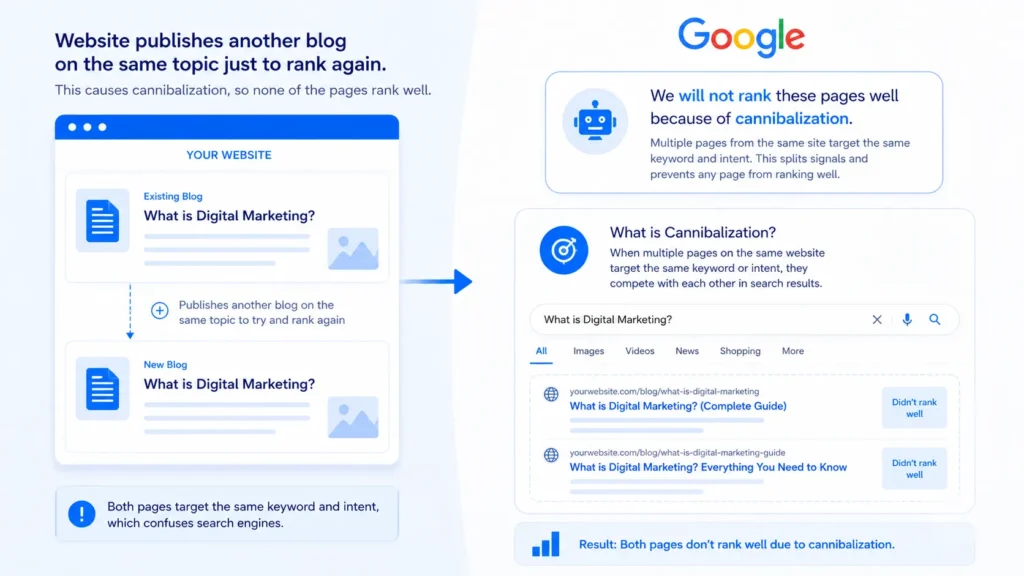
Sometimes website owners create a completely new article to replace an old one.
The problem is that Google now sees two pages on the same website targeting the same topic.
In most cases, Google trusts the older page because it already has authority and history.
Instead of keeping both pages live, it is often better to move the best information from the new article into the old URL and use a 301 redirect if necessary.
This allows you to combine fresh content with the old page’s existing authority.
6. Your Update May Move Away From Search Intent
A common SEO mistake is making content longer instead of making it more helpful. Users may want a quick answer, but the updated page becomes a lengthy guide with unnecessary details.
Google ranks pages that best match user intent. If visitors do not find the answer they expected and return to search results, Google may continue trusting older pages that satisfy the query better.
7. Some Search Results Are Extremely Difficult to Break
Many evergreen keywords have websites that have ranked for years.
These pages have strong backlinks, are trusted by brands, and have a long history of positive user interaction.
A new website trying to rank for the same broad keyword is competing against years of authority.
In these situations, it is often smarter to target more specific searches where large websites have not fully answered the user’s needs.
Finding hidden questions and unanswered problems gives smaller websites a better opportunity to compete.
8. YMYL Topics Require Higher Trust
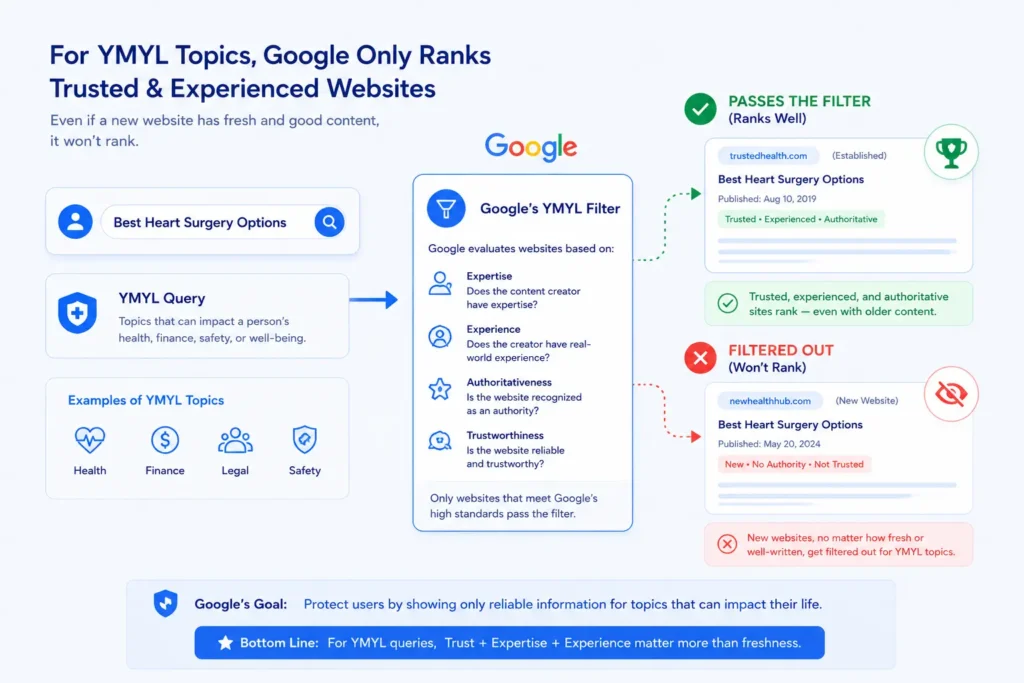
Topics related to health, finance, legal matters, and safety are treated more carefully by Google.
For these searches, trust, expertise, and proven experience are extremely important.
A newly published article from an unknown source will usually struggle against a trusted organisation, even if the information is newer.
For these areas, building authority over time through real expertise and valuable content matters more than simply publishing fresh articles.
9. Google Tests New Content Before Trusting It
When Google finds a new page, it does not immediately know whether it is better than existing results.
It may test the page for different searches and observe how users interact with it.
If people click your page but quickly leave because it does not answer their question well, Google receives a signal that the page may not be the best result, and this creates a situation of page ranking on Day 1 and then dropping later.
Older pages already have years of proven performance, so they naturally have an advantage.
How to Make Google Notice Your Updated Content
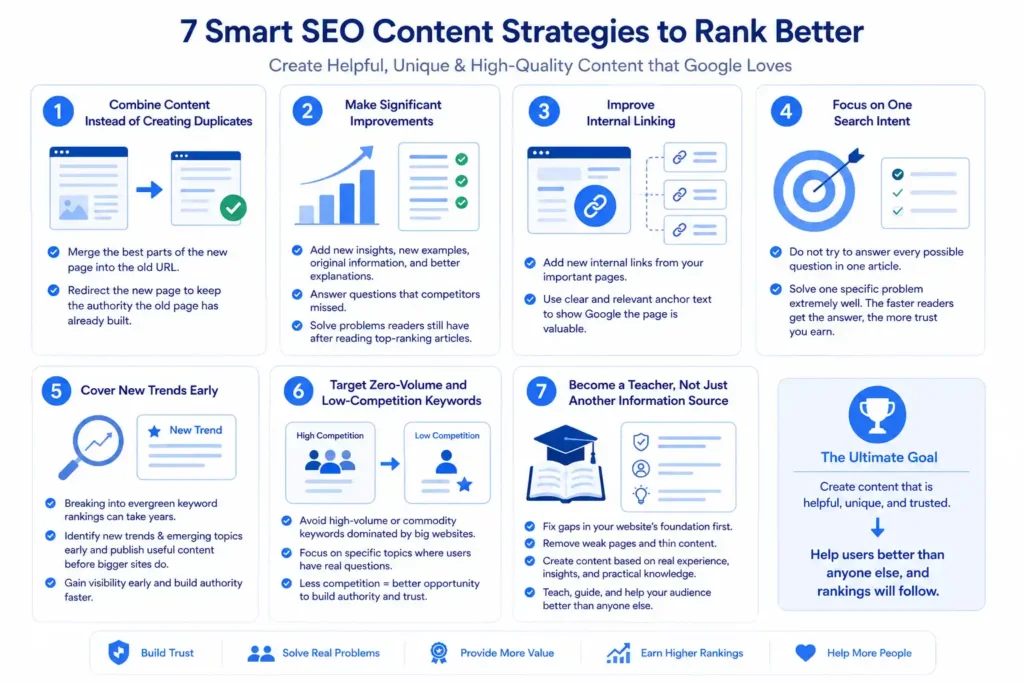
If your fresh content is being ignored, focus on improving its real value.
Combine Content Instead of Creating Duplicates
If you created a new page to replace an old one, merge the best parts into the old URL and redirect the new page. This keeps the authority that the old page has already built.
Make Significant Improvements
Do not only change small details. Add new insights, new examples, original information, better explanations, and answers to questions that competitors missed.
Look for problems readers still have after reading the top-ranking articles, and solve them better.
Improve Internal Linking
Add new internal links from your important pages to the updated article using clear and relevant anchor text. This helps Google understand that the page is valuable and should be reviewed again.
Focus on One Search Intent
Do not try to answer every possible question in one article.
Create content that solves one specific problem extremely well. The faster a reader gets the answer they came for, the better your chances of earning trust.
Cover New Trends Early
For highly competitive evergreen keywords, breaking into the rankings can take years.
A smarter strategy is to identify new trends and emerging topics before larger websites fully cover them. Publishing useful content early can help you gain visibility and build authority.
Target Zero-Volume and Low-Competition Keywords
Avoid competing directly for high-volume keywords or commodity content keywords dominated by established websites. Instead, focus on specific topics where users have real questions but existing content does not fully satisfy their needs.
These zero-volume or low-search keywords often have less competition and give smaller websites a better opportunity to build authority and gain trust before moving toward more competitive topics.
Become a Teacher, Not Just Another Information Source
Before creating more content, fix the gaps in your website’s foundation. Build trust by removing weak pages and creating content based on real experience, insights, and practical knowledge.
The goal is not to repeat what everyone else says but to become a trusted teacher in your niche who helps users understand things better.
The Future of SEO in the AI Overview Era
The rise of AI Overviews and AI search modes has changed how websites should approach content. Earlier, many websites could rank by collecting information from different sources and presenting it in a well-written article. Today, AI can do the same within seconds.
That is why simply creating a better version of existing content is no longer enough. To stand out, your content needs to provide something AI and competitors cannot easily copy.
Share your own experience, original research, case studies, experiments, unique insights, images, videos, templates, or tools. Build your website as a source of knowledge, not just another page repeating information already available online.
The websites that will succeed in the future are the ones that create original value and become trusted sources in their niche.
Case Study: The “What is Digital Marketing” Query
To understand this, I searched the keyword “What is Digital Marketing.” Google mostly ranks established websites like Adobe, Investopedia, Grow with Google, Oracle, Wikipedia, and Coursera. Some of these pages are old, but Google still trusts them because they have years of authority and user satisfaction signals.
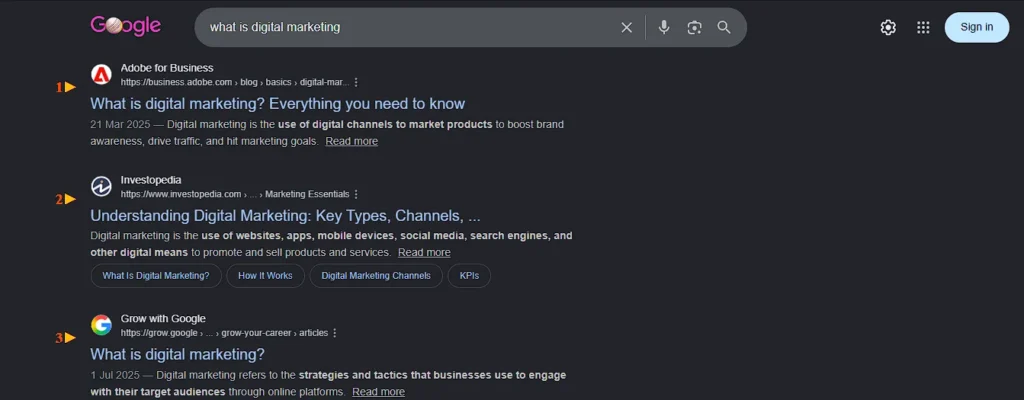
I then filtered the search results by Past 24 Hours and found many new articles targeting the same keyword. However, most of them explain the same digital marketing definition without adding anything new.
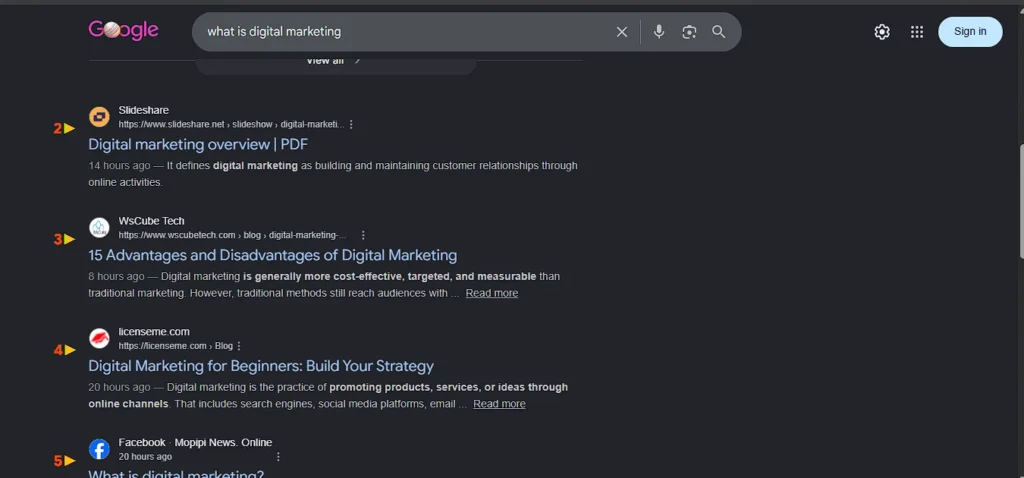
Since the core answer has not changed much, this has become a closed SERP. Google has no strong reason to replace trusted pages with newer websites providing the same information.
Final Thoughts
Google does not reward content simply because it is newer. It rewards pages that have proven they satisfy users.
Older pages have years of backlinks, trust, and user history. To beat them, creating a newer version is not enough.
You need to provide information that does not already exist, match the exact search intent, offer a better experience, and build your website’s trust over time.
The websites that win in modern SEO are not the ones that publish the most content. They are the ones that give users a reason to choose them over the pages that Google already trusts.
 Add Content Decoded as a preferred source