Why You Should Stop Publishing Commodity Content and Start Publishing Non-Commodity Content
You should stop publishing commodity content because Google is no longer rewarding content that repeats what already exists. What it wants now is clear: real experience, original data, and insights that AI or competitors cannot easily recreate. If your content doesn’t add something new, it has very little chance of earning visibility.
Search has changed, but most websites are still writing like it’s 2015. That’s the problem.
Earlier, the process was simple: pick a high search volume keyword, check top pages, write something slightly better, and publish. That worked because search engines needed help filling basic information gaps.
That gap no longer exists.
AI can now generate those same standard articles instantly, in the same structure and style. When everything starts sounding the same, search engines have no reason to surface most of it.
We’ve entered the non-commodity content era.
Commodity Content Is Everywhere: That’s Exactly the Problem
Commodity content is anything that can be recreated easily without real loss of meaning or quality. If you remove the name of the website, the author, or even the brand, the article still reads exactly the same.
Think about common examples like:
- “What is digital marketing?”
- “10 tips for better sleep”
- “How to start a blog”
- “Benefits of exercise”
None of this is useless. People search for it every day. The issue is simpler: nothing inside it belongs to you, and nothing inside it changes even if a hundred other websites publish the same thing.
And when content becomes this replaceable, search engines no longer need to send traffic to every version of it.
The Real Dividing Line: Can This Be Faked?
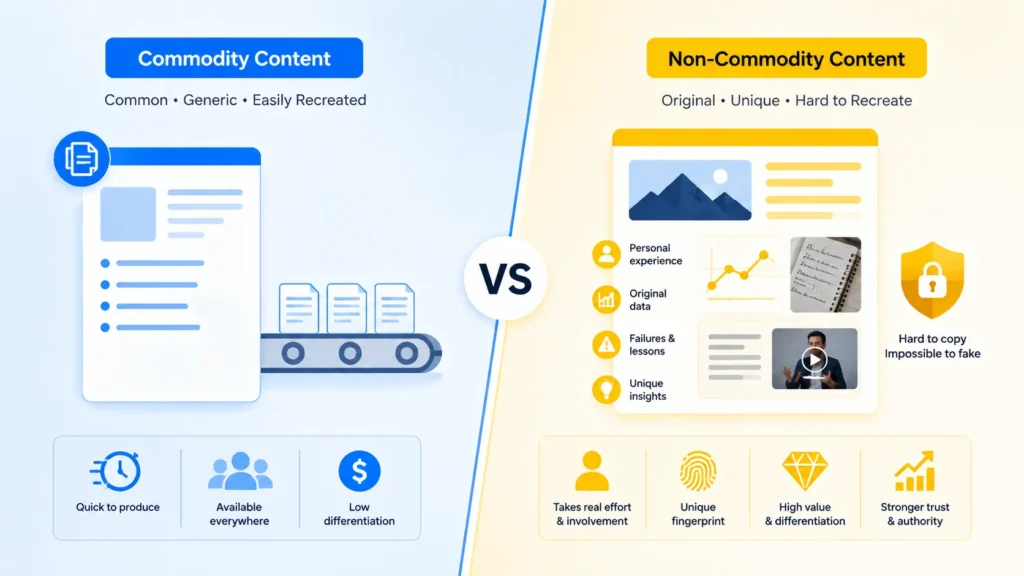
Search systems today are not just checking if content is correct. They are quietly checking if it could have been created without real effort or real involvement.
That’s the real test.
There are two clear types of content:
| Type | What it looks like | Why it matters |
| Commodity content | Generic explanations, simple lists, common advice | Can be generated instantly, so it adds very little new value |
| Non-commodity content | Real experiences, original data, experiments, failures, personal lessons | Cannot be recreated without the actual source behind it |
Here’s the thing: writing quality alone is no longer enough. A well-written summary of existing ideas still sits in the same category as weak content if it doesn’t add anything new.
What matters now is whether your page contains something that did not already exist elsewhere.
Why This Shift Happened Now
This change is not random. It comes from three strong forces that all appeared at the same time.
1. Content became too easy to produce
AI tools changed the cost of writing.
You can now generate hundreds of clean, structured articles in a very short time. They look fine, they read well, and they follow the same patterns as top-ranking pages.
But because everyone can do this, the average quality of generic content has stopped meaning much. When everything is acceptable, nothing stands out anymore.
2. Search engines started looking for real effort
Modern ranking systems don’t rely only on text anymore. They look for signs that something actually happened behind the content.
These signs include things like:
- Original photos or screenshots
- Real numbers from actual work or testing
- Specific examples that don’t appear elsewhere
- Clear experience from doing something, not just reading about it
What this really means is simple: if a page feels like it could exist without a real person involved, it slowly loses strength.
You can also read this guide to determine whether your website shows signs of being spammy.
3. AI search needs real sources, not repeated ideas
AI-powered search systems don’t want ten versions of the same answer. They want strong reference points they can rely on.
So when they generate answers, they look for pages that contain something unique enough to quote or use as grounding.
If your content only repeats common knowledge, it gets ignored because it doesn’t help the system build a stronger answer.
4. AI overview answers are now replacing basic content
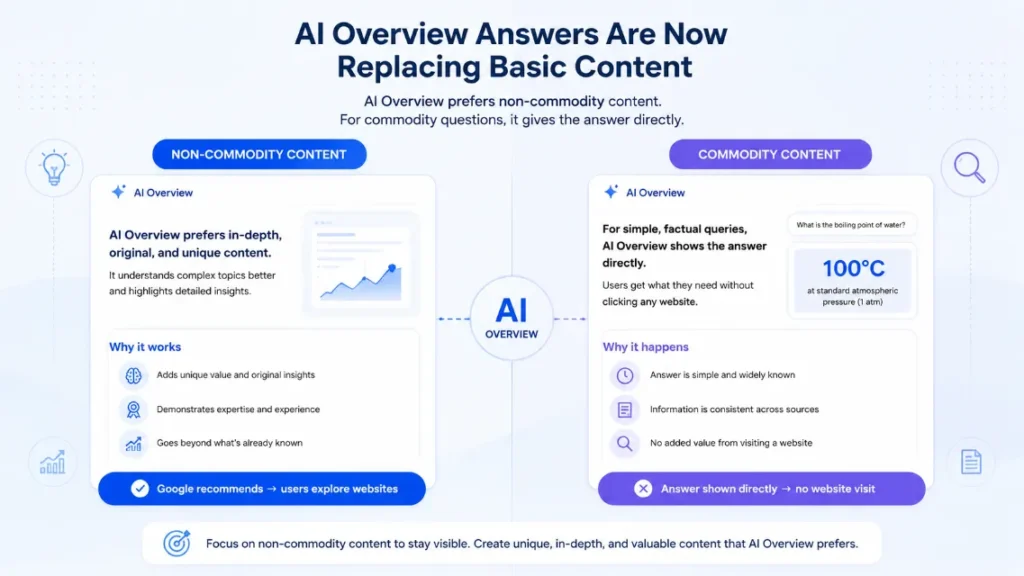
For a lot of simple queries, users never reach websites anymore.
AI overview systems now answer commodity questions directly inside search results. That removes the need for many basic informational pages.
So AI overview only considers content which is non-commodity in nature.
So content that only exists to answer obvious questions is losing its place by default, because the answer is already being given upfront.
5. Big, trusted sites already dominate commodity topics
Older, established websites already have authority, links, and history.
So for generic topics, search engines tend to reuse those sources instead of giving new or smaller pages a chance.
This creates a heavy bias toward existing players, especially for non-differentiated content.
6. Commodity content is no longer considered useful
If a piece of content doesn’t add anything new, it’s basically interchangeable.
And interchangeable content is not valuable anymore. It doesn’t help users, and it doesn’t help ranking systems either. Google now prefers useful content.
If there’s no information gain, the content is already outdated the moment it’s published.
7. Stability is hard to achieve with commodity content
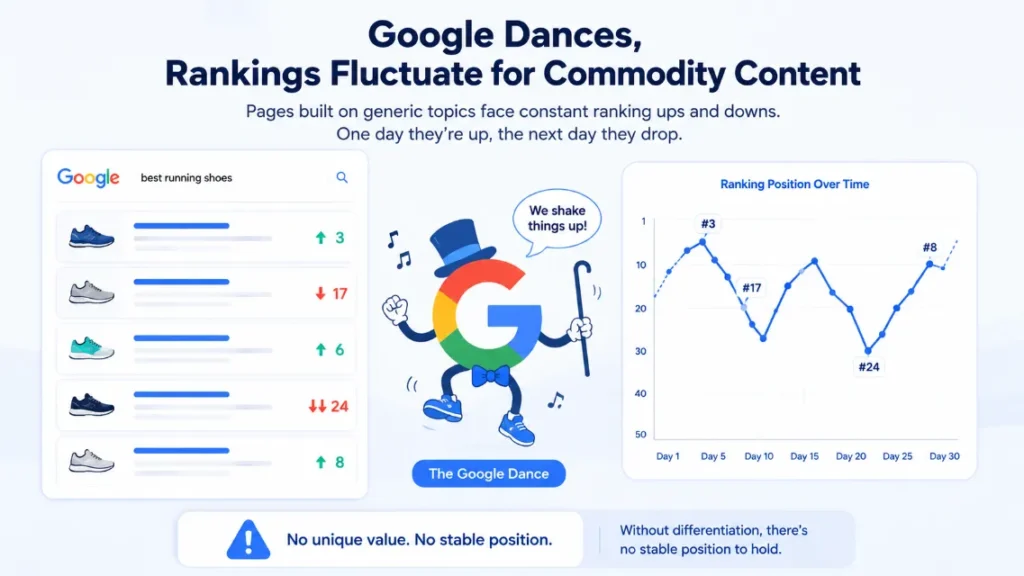
Pages built on generic topics often go through constant ranking fluctuations.
One day they appear, the next day they drop. This “Google dance” effect is common when there’s nothing unique anchoring the page.
Without differentiation, there’s no stable position to hold.
8. Search now prefers lived experience and real data
Search systems increasingly favor content that reflects real use and real situations. That’s why forums like Reddit and Quora often rank well, even when they aren’t perfectly optimised. They carry natural language, first-hand experience and insights that polished SEO content often lacks.
9. Identity matters more than anonymity in content
Commodity content often feels like it was written by no one in particular.
Non-commodity content feels like it comes from someone who actually did the thing, tested it, or experienced it.
That difference is becoming a ranking signal in itself: generic voice versus real perspective.
The Uncomfortable Truth About Commodity SEO
Many websites still follow the same routine, thinking it is safe and scalable.
- Pick a keyword
- Write an article
- Add structure and length
- Publish and repeat
On the surface, this looks like progress. But underneath, it creates a weak foundation.
So even if you rank for a moment, the actual traffic keeps shrinking over time.
You are not competing for visibility anymore. You are competing for leftover attention.
Information Gain Is The New Ranking Currency

There is a simple idea behind modern search quality: does this page add something new compared to everything else?
That idea is often called information gain.
In practical terms, it works like this:
- If your article repeats the same ideas as others, it adds almost no value
- If your article includes a real example or case study, it adds something new
- If your article shares internal results or personal findings, it becomes naturally unique
This is why sometimes a simple forum post can outrank a polished article. The forum post may be messy, but it often contains something that has not been said in the same way before.
The Fatal Mistake: Scaling Commodity Content Alone
Many websites try to grow by publishing more of the same type of content.
At first, this looks like progress. Pages increase, impressions grow, and rankings may even improve briefly.
But over time, a pattern appears:
- Content becomes predictable
- Articles start repeating similar ideas
- The site stops adding anything new to the internet
Once this happens, the entire domain starts to lose strength because it is no longer seen as a source of new value.
Even strong SEO work cannot fully fix that.
The Shift You Actually Need To Make
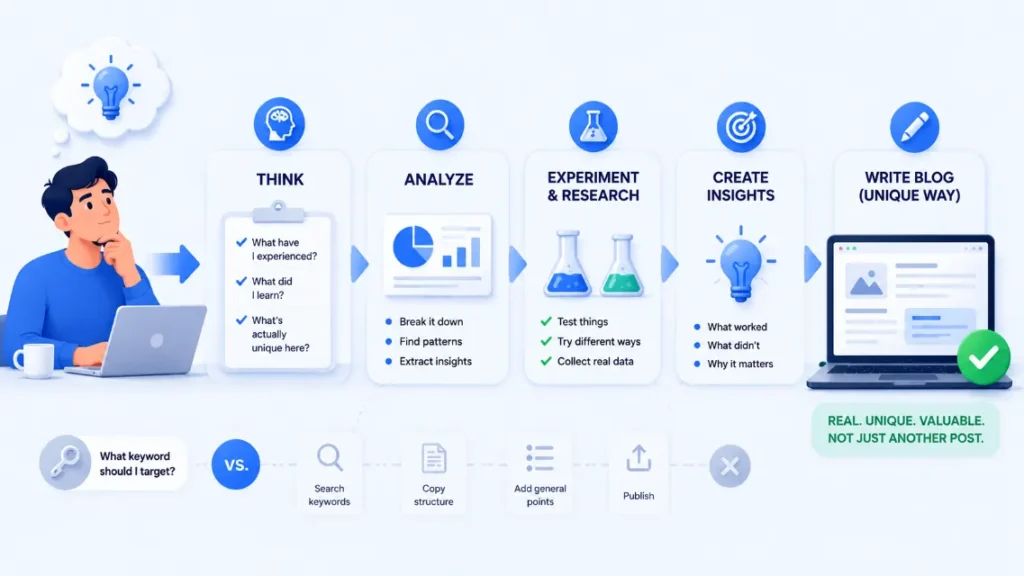
Instead of asking:
What keyword should I target?
The better question is:
What can I share that only I can say because I have actually done it?
That small change completely changes how content is created.
It pushes you toward:
- Real experiences instead of summaries
- Mistakes instead of perfect advice
- Observations instead of definitions
- Actual results instead of general claims
Once you move in this direction, your content stops blending in with everything else.
A Simple Example From My Own Work
I usually don’t start with keyword research. I start with small observations that most people ignore.
For example, once I noticed Google was heavily using location signals in rankings, I tested it, documented what I saw, and wrote about how it actually affects visibility. Another time, I noticed LinkedIn was quietly sending consistent traffic even without active posting strategy, so I broke down what was happening there too.
These aren’t topics you find through search volume tools. They come from watching how things behave in real time, then turning that into content.
Commodity Vs Non-Commodity In Real Terms
Let’s make this more practical and easier to see in action.
| Commodity approach | Non-commodity approach |
| “How to start a Shopify store” | “I launched a Shopify store and here is where customers dropped off during checkout and why it happened” |
| “Benefits of remote work” | “We tracked remote work performance for months and saw where productivity actually fell, not just improved” |
| “What is SEO?” | “We studied real pages that lost traffic and found the exact patterns behind the drop” |
The topic stays the same, but the value changes completely.
One version can be copied endlessly. The other depends on real experience.
The Hub And Spoke Model That Actually Works Now
Commodity content still has a role, but it cannot carry the entire strategy anymore.
A better structure looks like this:
- Commodity pages bring in search traffic for basic questions
- Non-commodity pages contain deeper insight and real experience
- Internal links connect both so users move from basic to valuable content
In simple terms:
Commodity content brings people in, but non-commodity content gives them a reason to stay and trust you.
Without that second layer, everything becomes replaceable.
The Backlink Reality Nobody Likes To Admit
Links are no longer about effort or outreach alone. They are about whether your content is worth referring to.
Ask a simple question:
Why would someone cite your page instead of the many similar ones already online?
If the only answer is “because it ranks well”, that is not strong enough anymore.
But if your page includes something like:
- A real test you conducted
- A dataset no one else has
- A clear failure story with results
Then links start happening naturally because your content becomes a reference point, not just another article.
What This All Really Means
The web is slowly splitting into two kinds of content: pages that explain what’s already known, and pages that add something new to it.
Search engines can already generate the first type on their own. That’s why it keeps losing value. The second type is what they still depend on to stay accurate and useful.
Most websites don’t fail because they lack content. They fail because their content is interchangeable. In a system where anything can be replaced instantly, volume stops mattering.
What survives is tied to real experience, testing, or discovery. If it only exists because you actually did it, it has weight. Everything else fades.
At the system level, this is what search is optimizing for:
Search Trust = Topical Authority + Information Gain + E-E-A-T
- Topical Authority: do you actually own this space
- Information Gain: are you adding something new
- E-E-A-T: why should you be trusted
If any one is missing, rankings don’t hold. The real shift is simple: it’s no longer about producing content, but about producing something that didn’t exist before you wrote it.
 Add Content Decoded as a preferred source